
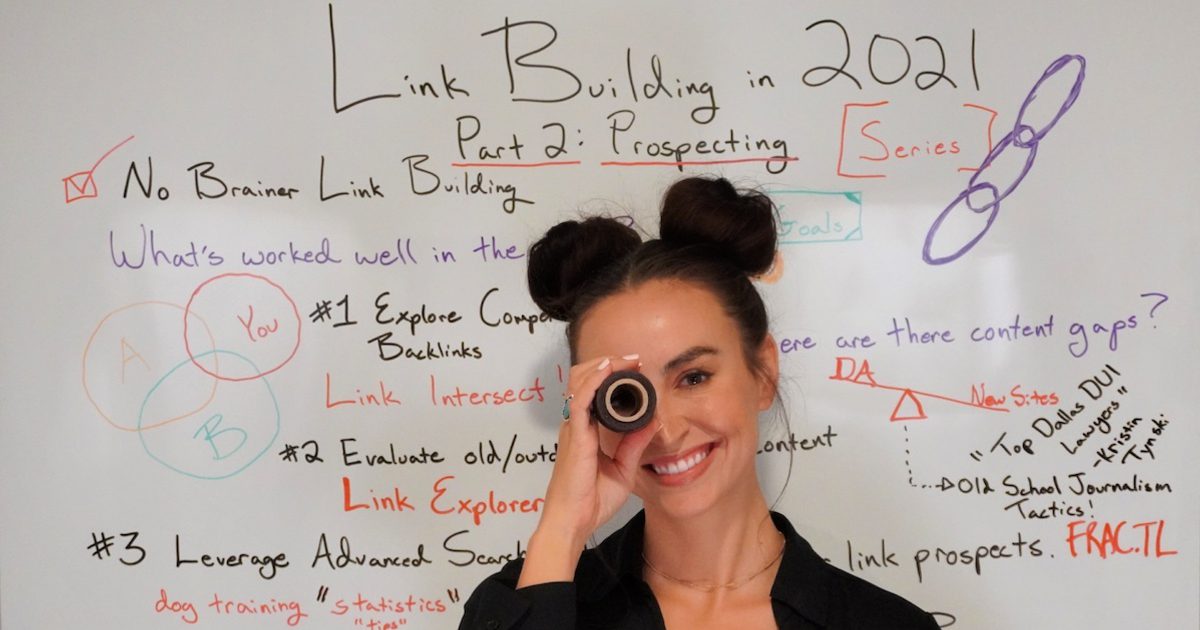
If link building is the road trip, prospecting is choosing the map before you throw snacks in the car and drive into the wilderness. Too many marketers treat backlink prospecting like speed dating with the whole internet: send 400 emails, hope for magic, and act surprised when nobody writes back. In reality, great backlinks usually come from one very unglamorous habit: finding the right sites before you ever pitch them.
That was the real shift in 2021, and honestly it still matters now. Smart SEO teams stopped obsessing over “more outreach” and started focusing on “better prospects.” Instead of chasing every website with a contact page and a pulse, they built smaller, cleaner, more relevant lists of websites, editors, bloggers, resource pages, journalists, and industry publishers that actually made sense for their content. That is backlink prospecting in a nutshell: identifying realistic, relevant link opportunities before outreach begins.
And yes, this part is less glamorous than bragging about “digital PR velocity” on LinkedIn. But it works. Prospecting helps you avoid spammy sites, dead-end outreach, irrelevant placements, and the soul-crushing experience of sending a beautiful pitch to someone who covers luxury travel when your article is about warehouse management software. A little homework saves a lot of heartbreak.
What backlink prospecting actually means
Backlink prospecting is the process of researching websites that could reasonably link to your content, then narrowing them down based on relevance, authority, quality, and fit. It is not just “finding websites with high metrics.” It is finding websites where a link would make editorial sense for real readers.
That distinction matters. A backlink is not valuable just because it exists. A good link usually lives on a relevant page, appears naturally in context, points to a useful destination, and makes the web a little more helpful instead of a little more weird. If the link feels forced, stuffed, hidden, paid-for-in-spirit, or awkwardly jammed into a sentence like a raccoon in a tuxedo, it is probably not the kind of signal you should chase.
Prospecting, then, is part SEO, part research, part common sense, and part “Would a normal person think this link belongs here?” If the answer is no, the spreadsheet may still look impressive, but the campaign is already limping.
Why prospecting matters more than mass outreach
Most weak link-building campaigns do not fail because the emails are terrible. They fail because the target list is terrible. You can write the most charming outreach email in the history of keyboards, but if you send it to irrelevant sites, inactive blogs, spam farms, or editors who would never link to your asset, the campaign will flop harder than a screen door on a submarine.
Good prospecting fixes that. It helps you:
- focus on sites that already publish content related to your topic,
- spot pages where your resource could add value,
- identify realistic targets instead of fantasy placements,
- avoid toxic or manipulative sites,
- personalize outreach faster because you understand each prospect,
- build campaigns around quality instead of volume.
In other words, prospecting improves both efficiency and outcomes. It is the difference between fishing in a stocked pond and throwing breadcrumbs at a parking lot.
Start with the right asset before you build the list
Here is the part many people skip: you should not build a prospect list in a vacuum. Start with the page, article, report, tool, guide, visual, or study you want links to. Your prospecting strategy depends on what kind of asset you have.
If you have a data-driven asset
Think original research, survey findings, industry benchmarks, or statistics pages. These work well for journalists, bloggers, analysts, niche publications, and writers who need evidence to support future articles.
If you have a practical evergreen guide
Think tutorials, how-to posts, checklists, templates, or resource hubs. These often fit resource pages, educational articles, community roundups, and curated reading lists.
If you have a visual or content upgrade
Think infographics, charts, calculators, interactive tools, or polished summaries. These can work for creators who already publish on the same topic but would benefit from a cleaner visual or supporting resource.
If you have a replacement-worthy page
Think updated content that can replace something broken, outdated, or thin. This is where broken link building and content refresh outreach come into play.
In short, the asset tells you who should care. If your content is not link-worthy yet, prospecting will not save it. That is like putting racing stripes on a shopping cart.
The best places to find backlink prospects
Once your asset is clear, start building your pool of prospects from several angles instead of relying on a single tactic.
1. Competitor backlinks
This is the classic move for a reason. Look at sites that link to competing pages, especially those ranking for the keywords you care about. You are not copying your competitors; you are reverse-engineering the editorial neighborhoods where your topic already lives.
Pay special attention to:
- resource pages,
- industry blogs,
- guest contributions,
- list posts,
- tools roundups,
- statistics pages,
- best-of articles,
- pages linking to outdated competitor content.
2. Google search operators
Sometimes the old-school method is still beautiful. Search operators remain great for finding pages that are topically aligned and visibly open to links. Searches like these can work:
intitle:resources "your topic""your topic" "helpful links""your keyword" inurl:links"your topic" "guest post""your topic" "statistics""your topic" "recommended tools"
This works especially well when you are searching for people who already publish on your topic. If someone has written about the subject before, you are not introducing them to Mars. You are showing them something relevant to their existing audience.
3. Topical authors and editors
Do not just prospect websites. Prospect people. Authors who routinely cover your niche are often better targets than generic “contact us” inboxes that have not been checked since the Obama administration. A relevant writer with editorial control, or at least influence, is often your best path to a natural link.
4. Broken pages and outdated resources
If a page links to a dead resource, an outdated study, or a flimsy article from 2017 that still thinks Clubhouse is the future, that is an opening. You can step in with a stronger replacement and frame your outreach as useful rather than needy.
5. Existing relationships and warm connections
This one gets ignored because it is not shiny. But some of the best prospects are already in your orbit: partners, vendors, associations, clients, communities, event hosts, alumni groups, and industry contacts. Warm prospecting often beats cold outreach because the trust gap is smaller from the start.
How to qualify a prospect before you email anyone
Finding prospects is only half the job. The next step is qualification. This is where you decide whether a site is genuinely worth pitching.
Relevance first, metrics second
Relevance should be the first filter. Ask whether the site covers your topic, serves a related audience, or publishes pages where your content would fit naturally. A slightly lower-metric site with excellent topical fit can be far more valuable than a random giant website where your link would look lost, unloved, and mildly confused.
Look for signs of editorial quality
Check whether the site is active, readable, and clearly maintained. Are posts updated? Do they have real authors? Does the writing feel human? Are there obvious contact details or an editorial process? Is the site overloaded with casino links, payday loan anchors, and enough pop-ups to trigger a spiritual event? If yes, walk away briskly.
Review the outbound link profile
See who the site links to. A trustworthy site usually links sensibly and contextually. A sketchy site often sprays commercial links all over the place like confetti at a bad wedding.
Check whether the page can actually link out
Some pages never add external resources. Others clearly do. If a page already includes citations, references, tools, or additional reading, your odds improve. Prospecting is easier when you are aiming at pages that already behave the way you need them to behave.
Find the real decision-maker
Whenever possible, identify the editor, author, content manager, or site owner most likely to care. Generic inboxes are fine as a fallback, but direct relevance beats general access almost every time.
What makes a backlink prospect “good” in 2021-style white-hat SEO
A strong backlink prospect usually checks most of these boxes:
- the site is topically relevant,
- the audience overlap is real,
- the content is actively maintained,
- the site has clear editorial standards,
- the page already links to useful external resources,
- your asset adds obvious value,
- the outreach can be personalized without forcing it,
- the placement would feel natural to a reader.
That last point matters most. Natural links are the goal. Not “links that technically exist,” but links that make sense in context and improve the page. Google has spent years getting better at ignoring or neutralizing manipulative patterns, so prospecting should be aimed at editorial fit, not loophole hunting.
How to organize your prospect list without losing your mind
Once you find prospects, organize them like a functioning adult. A messy list destroys momentum. At minimum, track:
- domain,
- specific page URL,
- contact name,
- email address,
- prospect type,
- why the fit makes sense,
- asset to pitch,
- priority score,
- outreach status,
- notes on personalization.
You do not need a spaceship dashboard. A spreadsheet works. The key is to tag prospects by campaign type: guest post, broken link, resource page, digital PR, statistics inclusion, expert quote, tools roundup, and so on. Once your list is segmented, your outreach gets sharper because the angle is clearer.
Prospecting mistakes that quietly ruin campaigns
Chasing only domain metrics
Metrics are useful, but they are not a substitute for judgment. A shiny metric on a bad-fit site is still a bad fit.
Pitching homepages instead of relevant pages
Many campaigns fail because they target domains, not pages. Links live on pages. Prospect at the page level whenever possible.
Ignoring the audience
If the prospect’s readers would not care about your asset, the editor probably will not either. Prospecting is audience matching, not just site collecting.
Using one-size-fits-all lists
Different assets need different prospects. A study, a calculator, a guest article, and a beginner guide should not all be pitched to the exact same list unless chaos is your preferred management style.
Skipping site quality review
Do not assume a site is good because it looks decent at first glance. Review the content, links, publishing pattern, and credibility signals before spending time on outreach.
How prospecting connects to outreach
Here is the good news: when prospecting is done well, outreach becomes much easier. Why? Because you already know why the link makes sense. You are not inventing a reason in the email; you discovered the reason during research.
A good outreach message is usually short, specific, respectful, and value-driven. It shows that you understand the page, explains why your resource is relevant, and avoids sounding like a robot who took a marketing workshop and never emotionally recovered.
That means prospecting should capture the exact hook you will use later. Maybe the page cites an outdated source. Maybe they publish weekly roundups. Maybe they linked to a broken resource. Maybe your study fills a data gap. Maybe your visual can enhance an existing article. Prospecting finds the angle. Outreach simply delivers it.
A simple backlink prospecting workflow you can actually use
- Choose the page or asset you want links to.
- Define the most likely campaign type.
- Pull competitor links and keyword-adjacent pages.
- Use search operators to find resource pages, roundups, and relevant articles.
- Add authors, editors, and pages to a working list.
- Qualify each prospect for relevance, quality, and link fit.
- Score and segment the prospects by priority.
- Write personalization notes before outreach starts.
- Remove weak prospects aggressively.
- Send thoughtful outreach to the strongest tier first.
That is the whole game. Not glamorous. Very effective. A little nerdy. Beautiful, really.
Final thoughts: backlink prospecting is where good link building begins
If you want better backlinks, do not begin with email templates. Begin with better targets. The best link builders are not just persuasive; they are selective. They know that prospecting is not busywork. It is strategy. It decides whether your campaign is built on relevance and editorial value or on caffeine and wishful thinking.
In the spirit of Moz’s Whiteboard Friday approach, the smartest backlink strategy in 2021 was never “send more emails.” It was “find better prospects.” That idea still holds up. Build a useful asset, research pages that actually deserve the pitch, qualify them with discipline, and then reach out like a human being with something helpful to offer.
Because in link building, as in life, yelling at the whole internet is rarely the answer.
Experience Notes: What backlink prospecting teaches you after enough campaigns
After you spend enough time prospecting for backlinks, a funny thing happens: you stop seeing the web as a pile of domains and start seeing it as a map of editorial habits. Some websites love citing statistics. Some never link externally unless the source is extraordinary. Some blogs look promising until you realize every article contains three oddly cheerful casino anchors and a guest author named “Admin Team.” Prospecting teaches pattern recognition fast.
One of the biggest lessons is that relevance beats ego. Early on, it is tempting to chase huge publications because they look impressive in a report. But many successful campaigns come from smaller, tightly aligned sites whose audiences actually care about the topic. A mid-sized niche publication can outperform a flashy general site simply because the context is stronger and the readers are more likely to click, trust, and share the content. That is not as glamorous in a meeting, but it is much prettier in the results.
Another lesson is that the best prospects are often hiding in plain sight. They are not always the top ten sites everybody already knows. Sometimes they are authors writing thoughtful resource roundups, industry associations maintaining useful links pages, or companies adjacent to your niche that share the same audience. Once you start widening the lens without losing relevance, prospecting becomes more creative and less repetitive. That is when campaigns stop feeling like factory work.
Prospecting also teaches humility. You may love your content, but the prospect does not owe you a link just because you worked hard on it and your designer missed lunch to finish the graphics. The web is full of good content. Your job is to figure out where your asset genuinely improves a page, solves a problem, fills a gap, or replaces something weak. If you cannot explain that in a sentence, the issue is usually not the outreach email. It is the fit.
Then there is the organizational side. Experienced link builders learn quickly that prospecting is won or lost in systems. A clean sheet, clear tags, notes on why a prospect matters, and a simple priority score save hours later. Without that structure, outreach becomes chaotic. With it, you can spot themes, scale personalization, and learn which prospect types consistently convert.
Most of all, prospecting teaches patience. Great backlinks rarely come from random luck. They come from thoughtful research, careful filtering, and a willingness to skip weak opportunities. That last part is underrated. The discipline to not pitch the wrong sites is often what makes the right sites pay off. In that sense, prospecting is less about hunting every possible link and more about building a shortlist of opportunities that make so much sense they almost pitch themselves.














