
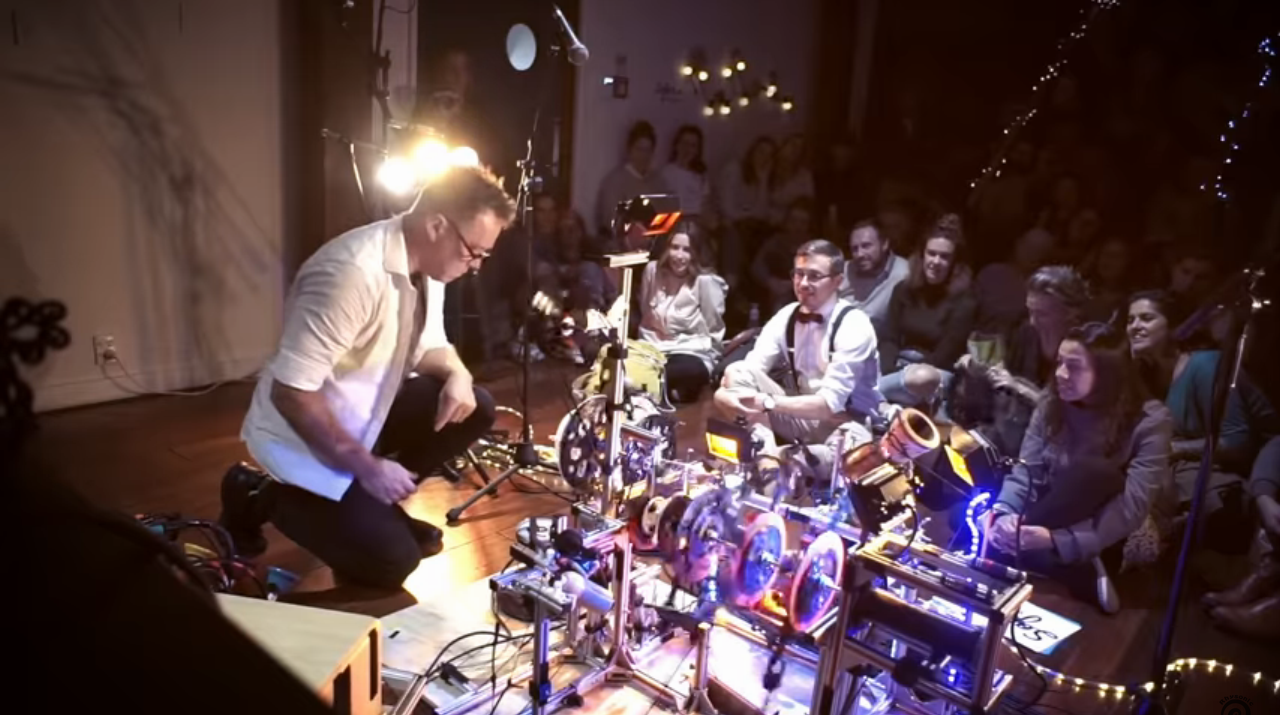
Some musical inventions arrive wearing tuxedos. Others roll in from the garage with a spinning wheel, a power tool, and the kind of confidence usually reserved for drummers who say, “Don’t worry, I can carry this upstairs by myself.” The Rhysonic Wheel belongs proudly to the second group.
Invented by musician Pete O’Connell, the Rhysonic Wheel is a handmade mechanical music instrument that uses rotating wheels, striking materials, and carefully placed acoustic instruments to automate live music in a way that feels both futuristic and oddly prehistoric. It is not simply a gimmick. It is a strange, charming, and surprisingly musical answer to a question many performers have quietly asked: what if a machine could keep the rhythm, strike the strings, trigger percussion, and still leave room for human expression?
At first glance, the Rhysonic Wheel looks like something that escaped from a maker fair and wandered into a concert. But once it starts spinning, the idea becomes clear. Instead of playing back samples or hiding behind a laptop, the device physically hits real objects. Guitar strings vibrate. Drums respond. Bells ring. The sound is acoustic, visible, and satisfyingly honest. You can see the music being made, which gives the performance a kinetic thrill that a normal drum loop can never quite match.
What Is the Rhysonic Wheel?
The Rhysonic Wheel is an automated live music device built around spinning wheels. Different versions have used wheels driven by power tools or a common shaft, with small striking elements attached so they can hit guitar strings, percussion instruments, bells, or other sound-making surfaces at steady rhythmic intervals.
In simpler terms, imagine a bicycle wheel, a mechanical drummer, a guitar pick, and a mischievous shop-class project forming a band. That gets you somewhere close.
The core concept is beautifully direct: rotation becomes rhythm. When a wheel spins at a consistent speed, anything attached to it can strike an instrument repeatedly. Change the wheel speed, the placement of the striking material, the instrument position, or the type of material used, and the musical pattern changes. This makes the Rhysonic Wheel part instrument, part sequencer, part kinetic sculpture, and part one-person backing band.
Why It Feels Different From a Drum Machine
Electronic drum machines are powerful, precise, and easy to carry. They are also invisible in performance. A beat comes out of a speaker, and the audience trusts that something inside the box is doing its job. The Rhysonic Wheel takes the opposite approach. It lets the audience watch the rhythm happen in real time.
That matters. In live music, the eye often believes before the ear does. Seeing a wheel strike a guitar or tap a drum creates suspense. Will it hit cleanly? Will it wobble? Will the performer move the instrument at exactly the right time? The machine may automate the rhythm, but the performance still contains risk. That little spark of danger is part of the fun.
The Origin: From Bicycle Spokes to Mechanical Music
The inspiration behind the Rhysonic Wheel reportedly goes back to a classic childhood sound: a card rattling in bicycle spokes. Many people remember that homemade motorcycle illusion, usually made with a playing card, hockey card, or piece of plastic clipped to a bike fork. Most children hear the rattling and think, “Excellent, my bicycle is now a superbike.” Pete O’Connell heard the seed of an instrument.
That memory led to the idea of using a rotating wheel as a musical trigger. Instead of merely making a rattling noise, the wheel could strike instruments in controlled ways. Over years of experimentation, failed attempts, workshop nights, and performance testing, the concept developed into the Rhysonic Wheel.
This is one of the reasons the project is so appealing. It does not begin with a corporate innovation lab or a million-dollar robotics grant. It begins with curiosity. It begins with the sound of a kid’s bicycle. Great inventions often start that way: someone notices a tiny everyday sound and refuses to let it stay tiny.
How the Rhysonic Wheel Automates Live Music
The Rhysonic Wheel automates music through mechanical repetition. A wheel spins. Attached pieces strike instruments. Because the rotation is steady, the strikes form a beat or pattern. The performer can then sing, play chords, move instruments in and out of the wheel’s path, or layer additional musical parts on top.
In some performances, the device has been used to strike guitar strings, creating rapid, percussive strumming without the player’s picking hand doing the usual work. In later versions, multiple wheels can spin together, allowing different instruments to be triggered in the same performance. Percussion, djembe, bells, and guitar can all become part of the machine’s rotating rhythm system.
The Main Components
The exact design can vary by version, but the Rhysonic Wheel concept generally depends on a few key elements:
- Rotating wheels: These provide the timing engine of the instrument.
- A drive system: A power tool, motor, or shaft can keep the wheels spinning.
- Striking materials: Rubber, metal, sticks, or flexible pieces can hit strings, drums, bells, or other surfaces.
- Acoustic instruments: The machine does not merely trigger electronic samples; it activates real sound-producing objects.
- Human control: The performer still chooses chords, placement, timing changes, instrument combinations, and musical direction.
This combination creates an unusual balance. The machine is responsible for reliable repetition, while the musician provides taste, timing, arrangement, and drama. It is automation, but not replacement. The performer is still very much the captain of the spinning ship.
Why the Sound Works
The Rhysonic Wheel works because it produces rhythm through physical contact. When a wheel strikes a guitar string, the resulting tone is not a sterile loop. It has attack, scrape, vibration, resonance, and tiny imperfections. Those imperfections are exactly what make acoustic music feel alive.
For guitar, the wheel can create a tremolo-like pulse or rapid rhythmic brushing effect. For percussion, it can maintain a steady beat without needing a second musician. For bells or small metallic instruments, it can add bright accents that cut through the arrangement. In a one-person setup, this opens a surprising amount of musical space.
The result can sound like a busker, a robot, a folk band, and a kinetic art installation all arguing politely in the same room. Somehow, the argument becomes music.
The Rhysonic Wheel and the One-Man Band Tradition
Although the Rhysonic Wheel feels modern, it belongs to a long tradition of musicians trying to sound bigger than one body should reasonably allow. The classic one-man band might wear a bass drum on the back, cymbals between the knees, a harmonica near the mouth, and a guitar in the hands. It is impressive, exhausting, and probably terrible for posture.
The Rhysonic Wheel updates that idea for the maker era. Instead of strapping every instrument to the performer, it places instruments around a mechanical rhythm source. This changes the physical relationship between musician and machine. The performer does not have to do every motion manually; instead, they choreograph the interaction between rotating parts and acoustic objects.
That makes the Rhysonic Wheel closer to a collaborator than a tool. It repeats patterns the way a mechanical bandmate might, but it still needs a human to turn repetition into a song.
Mechanical Music Has Deep Roots
Automated music did not begin with laptops, MIDI controllers, or viral garage inventions. Mechanical music has been around for centuries. Music boxes, barrel organs, orchestrions, player pianos, and self-playing instruments all explored the same basic dream: can a machine perform music with timing, texture, and emotion?
Player pianos brought self-playing music into homes. Orchestrions attempted to imitate the sound of entire bands or orchestras through pipes, percussion, and mechanical control. Museums still preserve mechanical instruments that used rolls, cylinders, pins, gears, air pressure, and levers to perform complex arrangements long before digital audio existed.
The Rhysonic Wheel fits into this history, but with a handmade twist. It is not trying to hide the mechanism inside a polished cabinet. It puts the mechanism right in front of the crowd. The machine is not backstage; it is the show.
Robotic Musicianship and Modern Automation
Today, automated live music has expanded far beyond player pianos. Researchers and artists have built robotic drummers, marimba-playing robots, MIDI-controlled percussion machines, solenoid-driven instruments, and systems that can respond to human performers in real time. Some robotic musicians use artificial intelligence to improvise. Others use motors and actuators to strike acoustic instruments with superhuman speed and consistency.
These projects show that automation in music is not just about convenience. It can create sounds and performance possibilities that humans would struggle to produce alone. A robot can repeat a pattern endlessly without fatigue. A motor can strike faster than a wrist. A machine can synchronize multiple instruments with terrifying accuracy. Meanwhile, the human musician can focus on composition, expression, improvisation, and audience connection.
The Rhysonic Wheel stands at the scrappy, handmade end of this spectrum. It is less laboratory robot and more workshop wizardry. But the artistic question is similar: how can a machine extend what a live musician can do?
Why Audiences Love Watching It
The appeal of the Rhysonic Wheel is not only musical. It is visual. A conventional backing track may sound perfect, but it gives the audience very little to look at. A spinning mechanical instrument, on the other hand, turns rhythm into theater.
People like seeing cause and effect. The wheel hits the string; the string makes a sound. The striker taps the drum; the drum answers. This visible chain of action makes the performance easy to understand, even for listeners who know nothing about gear, robotics, or music theory.
There is also humor in it. The whole thing looks slightly impossible. It feels like a cartoon invention that somehow wandered into real life and learned syncopation. That sense of surprise helps people remember the performance. In an era when nearly every musician can access the same software, same plug-ins, and same social media platforms, memorability is gold.
Automation Without Losing the Human Touch
One of the biggest concerns about automated music is that it may feel cold. Machines can be precise, but precision alone does not make a performance meaningful. The Rhysonic Wheel avoids this problem because it does not erase the human performer. It magnifies the performer’s decisions.
The musician still chooses what to play, how to position the instrument, when to introduce a new sound, how to shape the song, and how to react when the machine creates a surprising texture. The wheel may handle repeated motion, but it does not decide the emotional direction of the performance.
That distinction is important. Good musical automation should not feel like replacing a musician with a toaster. It should feel like giving the musician an extra pair of hands, preferably hands that do not complain about rehearsing the same groove for forty minutes.
Specific Examples of What the Rhysonic Wheel Can Do
The Rhysonic Wheel has been shown playing guitar in a way that resembles automated strumming or striking. In one well-known performance, O’Connell used it in a cover of Michael Jackson’s “Don’t Stop ’Til You Get Enough,” showing how the spinning mechanism can create a lively, percussive foundation while the performer manages the musical flow.
Other demonstrations show the device interacting with percussion and different acoustic objects. Later versions expanded the concept from a single wheel striking guitar strings to multiple wheels triggering a wider arrangement. This is where the invention becomes especially interesting. Once several wheels spin together, the performer can build something closer to an automated ensemble.
That does not mean the machine plays the whole show by itself. Instead, it gives the performer a repeatable rhythmic framework. The human can then add melody, dynamics, movement, and personality. Think of it as a mechanical groove engine with a strong taste for adventure.
Creative Lessons From the Rhysonic Wheel
The Rhysonic Wheel offers several lessons for musicians, makers, and anyone who has ever stared at a pile of spare parts and thought, “This could be art, or at least a mild insurance claim.”
1. Constraints Can Create Originality
Many instruments are designed to make playing easier. The Rhysonic Wheel does something different: it creates a new constraint. The wheel spins at a steady rate. The performer must work with that motion. This limitation encourages unusual phrasing, instrument placement, and arrangement choices.
2. Acoustic Sound Still Matters
Digital tools are wonderful, but there is still something powerful about real strings and drums being physically struck. The Rhysonic Wheel proves that automation does not have to mean artificial sound. A machine can make acoustic music feel even more tactile.
3. Performance Is Also Design
The invention is not only about the device. It is about how the device is used in front of people. The best Rhysonic Wheel performances turn setup, motion, timing, and risk into part of the entertainment. The design continues on stage.
Could the Rhysonic Wheel Inspire Future Instruments?
Absolutely. The Rhysonic Wheel points toward a future where musicians build custom mechanical assistants instead of relying only on software presets. Imagine compact rotating systems for buskers, modular wheel-based percussion rigs, acoustic loop machines that physically strike instruments, or hybrid stage setups where guitarists control mechanical rhythm arms through foot pedals.
There is also potential for education. A device like this can teach rhythm, frequency, tempo, mechanics, and acoustics in one unforgettable demonstration. Students can see how speed affects timing, how material affects tone, and how physical design shapes musical output. It is STEM with better groove.
For experimental musicians, the lesson is even broader: the next great instrument may not look like an instrument at all. It may look like a wheel, a drill, a wooden frame, a hacked toy, a recycled fan, or something that makes your neighbor ask whether you are building furniture or summoning a jazz goblin.
Challenges and Limitations
Of course, the Rhysonic Wheel is not a magic solution for every musician. Mechanical instruments come with practical challenges. They can be heavy, noisy, fragile, unpredictable, and difficult to transport. Moving parts require maintenance. Striking surfaces wear out. Motors need power. Safety matters because rapidly spinning objects deserve respect, not casual finger placement.
There is also the musical challenge of control. A laptop can change tempo instantly and silently. A wheel-based instrument may require more physical adjustment. That makes it less convenient but more expressive in a different way. The slight resistance of the machine becomes part of the performance language.
In other words, the Rhysonic Wheel is not trying to beat Ableton Live at being software. It is doing something software cannot do as naturally: making rhythm visible, physical, imperfect, and theatrical.
Experiences Related to the Rhysonic Wheel Automating Live Music
Watching or imagining a Rhysonic Wheel performance changes the way you think about live music. In a typical concert, the audience often separates “the musician” from “the equipment.” The guitar is a tool. The drum kit is a tool. The amplifier is a tool. With the Rhysonic Wheel, the equipment becomes a character. It has motion, timing, personality, and a faintly chaotic stage presence. It is not just sitting politely on a stand; it is actively doing something.
One of the most exciting experiences connected to this kind of automated music is the moment of recognition. At first, a listener may see the spinning wheel and wonder what on earth is happening. Then the rhythm locks in. A guitar begins to pulse. A drum answers. Bells or other percussion add accents. Suddenly the machine makes sense. The audience realizes that the spinning object is not decoration; it is the groove.
For performers, the experience is equally fascinating. Playing with a mechanical device requires a different mindset from playing with a human bandmate or a digital track. A human drummer can listen and adjust. A backing track stays fixed. The Rhysonic Wheel sits somewhere in between. It is physically alive, but not emotionally aware. It will keep spinning unless the performer changes the system. That means the musician must anticipate the machine’s movement and shape the song around it.
This can create a satisfying sense of partnership. The wheel provides momentum, like a train moving down the track. The performer can ride that momentum, lean against it, or create tension by introducing changes at just the right moment. When it works, the music feels larger than one person. It feels engineered and spontaneous at the same time.
There is also a strong DIY pleasure in the Rhysonic Wheel experience. Modern music technology often arrives as sealed products: polished controllers, apps, plug-ins, and devices that work beautifully but reveal very little about their inner lives. The Rhysonic Wheel is the opposite. It celebrates visible mechanics. It reminds people that sound can come from wood, rubber, metal, string, rotation, friction, and experimentation. You do not need to understand every detail to enjoy it. The basic principle is right there in front of you: spin, strike, resonate, repeat.
For audiences used to perfect digital production, that physical honesty can be refreshing. A Rhysonic Wheel performance has the charm of a street act, the curiosity of a science demonstration, and the groove of an acoustic jam. It invites people to listen with their eyes as well as their ears. Every strike is a tiny event. Every rotation promises another one.
The experience also encourages creative courage. Many musicians privately collect strange ideas but never build them because they seem impractical. The Rhysonic Wheel argues in favor of trying anyway. Some of the best artistic tools are born from awkward prototypes, late-night repairs, and the stubborn belief that a weird sound deserves a chance. Even if a project looks ridiculous at first, it may lead to a performance nobody forgets.
That may be the real magic of the Rhysonic Wheel. It does not simply automate live music. It reawakens the playful engineering spirit behind music itself. It says rhythm can be built, not just played. It says a wheel can become a bandmate. And it proves that sometimes the shortest path to originality runs straight through the garage.
Conclusion
The Rhysonic Wheel automates live music by turning rotation into rhythm and mechanics into performance. It is a handmade invention with deep roots in mechanical music and clear connections to modern robotic musicianship, yet its personality remains refreshingly human. Pete O’Connell’s wheel does not hide behind screens or pretend to be flawless. It spins, strikes, rattles, grooves, and invites the audience to watch every beat being born.
In a world full of polished digital tools, the Rhysonic Wheel stands out because it is physical, funny, inventive, and musically useful. It shows that automation does not have to remove emotion from music. When designed creatively, automation can add texture, spectacle, and possibility. The wheel may do some of the work, but the imagination is still unmistakably human.














