
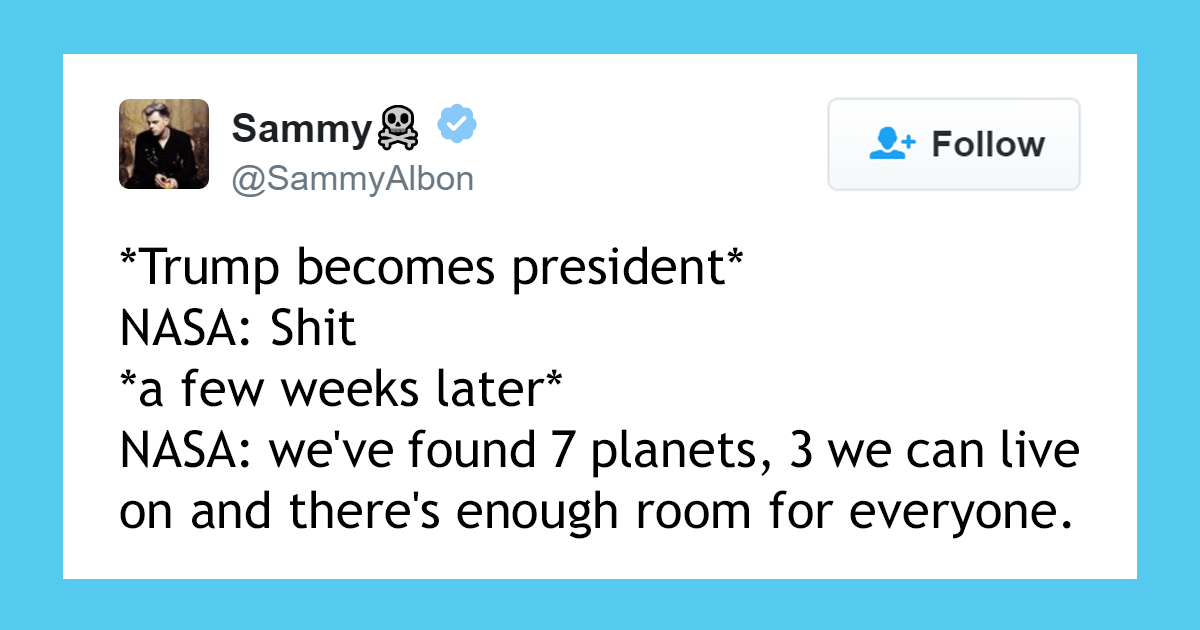
On February 22, 2017, NASA helped deliver the kind of announcement that makes humanity collectively stop scrolling, look toward the sky, and ask the most important question in astronomy: “So, when can we move?”
An international team of astronomers had identified seven roughly Earth-sized planets orbiting a small, ultracool dwarf star called TRAPPIST-1. Three appeared to circle within the star’s habitable zone, where temperatures might permit liquid water under the right atmospheric conditions. The planets were about 40 light-years awaypractically next door by galactic standards and approximately forever away by commercial-airline standards.
The scientific community responded with careful excitement. The internet responded by forming a relocation committee, designing alien vacation packages, naming planets after sitcom characters, and volunteering assorted politicians, former partners, noisy neighbors, and frustrating coworkers for the first outbound mission.
A viral collection of 131 priceless reactions captured that glorious collision between legitimate scientific wonder and the internet’s inability to behave normally for even five minutes. Behind the jokes, however, was a discovery that genuinely changed the study of planets beyond our solar system.
The NASA Announcement That Launched a Thousand Moving Jokes
What astronomers actually discovered
TRAPPIST-1 is a faint red dwarf star in the constellation Aquarius. It has only a small fraction of the Sun’s mass and is not much larger than Jupiter, although it is far denser and massive enough to sustain nuclear fusion. Because the star is so cool and dim, planets can orbit extremely close to it without necessarily becoming cosmic frying pans.
The first planets in the system were identified using the TRAPPIST telescope in Chile. NASA’s Spitzer Space Telescope later observed the star almost continuously for roughly three weeks, recording repeated dips in its brightness. Those dips occurred whenever a planet crossed, or transited, in front of the star.
By measuring the timing and depth of those shadows, researchers determined that seven planetsnamed TRAPPIST-1b through TRAPPIST-1hwere circling the star. All seven were comparable to Earth in size, and the available measurements suggested that they were rocky rather than miniature gas giants.
The system immediately became one of astronomy’s most valuable natural laboratories. Finding one small rocky planet is exciting. Finding seven of them packed around the same nearby star is the celestial equivalent of opening a cereal box and discovering that every piece is a prize.
Why “40 light-years away” sounded deceptively convenient
News reports described TRAPPIST-1 as relatively close to Earth. Astronomically, that is accurate. The Milky Way is about 100,000 light-years across, so a star 40 light-years away belongs to our extended cosmic neighborhood.
Unfortunately, “nearby” has a specialized meaning in astronomy. Traveling there with today’s spacecraft would take far longer than recorded human civilization has existed. Even a message moving at the speed of light would need about 40 years to arrive, followed by another 40 years for a reply.
The internet did not allow these details to interfere with its plans. Within hours, people were mentally packing suitcases, comparing imaginary property values, and discussing which planet offered the best escape from taxes, traffic, politics, and group chats.
Why the 131 Reactions Were So Priceless
The funniest responses generally fell into several recognizable categories. Together, they revealed how ordinary people process a discovery so enormous that it is difficult to comprehend directly: they turn it into jokes, stories, references, and highly questionable travel plans.
1. The Immediate Relocation Committee
One of the largest groups consisted of people who were ready to leave Earth immediately. They did not request atmospheric data, surface-pressure measurements, or evidence of drinkable water. Earth had inconvenienced them that morning, and seven alternatives had just appeared.
Some reactions treated the planets like newly listed apartments. Was parking included? Did the neighborhood have decent internet? Were pets allowed? Could residents avoid people from Earth, or would Earthlings eventually ruin the new place too?
The enthusiasm was impressive, considering the planets might feature permanent day on one side, permanent night on the other, extreme stellar radiation, no breathable atmosphere, and absolutely no pizza delivery.
2. The Volunteers Who Wanted to Send Someone Else
Not everyone planned to board the spaceship personally. Many users generously nominated other people for the honor.
The suggested passenger lists included political leaders, disliked celebrities, terrible bosses, irritating relatives, ex-partners, and anyone who replied to messages with only the letter “K.” In this version of space exploration, the mission was less “boldly go where no one has gone before” and more “please take this person very far away.”
The jokes reflected a timeless principle of human behavior: discovering another world is exciting, but discovering somewhere to send your least favorite person is apparently even better.
3. The Planet-Naming Olympics
Scientific names such as TRAPPIST-1e are useful because they are systematic and precise. They are less useful when someone wants to sell commemorative mugs.
Social media users quickly proposed friendlier alternatives through the hashtag #7NamesFor7NewPlanets. Suggestions drew from Greek mythology, fantasy novels, television shows, music, movies, and the seven dwarfs from Snow White. Other proposals referenced Friends, Harry Potter, Star Wars, and whichever popular franchise happened to occupy the proposer’s entire personality.
NASA joined the lighthearted conversation, although the agency was not actually handing naming authority to whoever produced the most retweets. Official astronomical names follow a more formal process. This was probably wise. Otherwise, future textbooks might contain sentences such as, “The atmosphere of Planet McPlanetface remains under investigation.”
4. The Pop-Culture Prophets
For science-fiction fans, the announcement felt less like breaking news and more like confirmation that the writers had been right all along.
People compared the system to settings from Star Trek, Star Wars, Interstellar, Doctor Who, and countless novels about humanity discovering a second home and immediately creating the same problems there. Some imagined friendly aliens. Others predicted monsters, hostile civilizations, mysterious signals, or a planet populated entirely by beings who had already blocked Earth’s number.
The discovery also encouraged references to famous fictional groups of seven. Whenever nature presents exactly seven objects, the internet is contractually obligated to mention dwarfs, kingdoms, deadly sins, superheroes, or members of a pop group.
5. The Suspicious Realists
A more skeptical group reminded everyone that “Earth-sized” does not mean “Earth 2.0.” Venus is almost the same size as Earth, yet its surface is hot enough to melt lead. Mars sits near our Sun’s habitable zone but is cold, dry, and protected by an atmosphere roughly as substantial as a bad excuse.
These reactions were less glamorous but scientifically important. A planet’s size and orbit provide only the opening chapters of its biography. Habitability also depends on its atmosphere, magnetic environment, geology, chemistry, water supply, stellar radiation, and ability to retain those favorable conditions over immense periods.
6. The People Who Were Simply Amazed
Beneath the memes was genuine wonder. Many people expressed amazement that scientists could detect tiny worlds by measuring minute changes in the light of a star trillions of miles away.
Others reflected on the possibility that life might exist elsewhere or that future generations could learn the composition of an alien atmosphere. For a brief moment, timelines usually dominated by arguments and advertisements were filled with planets.
That may have been the most priceless reaction of all: millions of people looking outward together.
The Real Science Behind the Viral Reactions
A miniature planetary system
The seven TRAPPIST-1 planets orbit much closer to their star than Mercury orbits the Sun. Their years last only a few Earth days. The innermost world completes an orbit in roughly a day and a half, while the outermost known planet takes less than three Earth weeks.
Because the star is much cooler than the Sun, this compact arrangement does not automatically make every planet unbearably hot. Several receive levels of stellar energy comparable to planets in our own solar system.
The planets also participate in an intricate chain of orbital resonances. Their orbital periods are related in regular mathematical ratios, causing them to tug on one another in a predictable gravitational rhythm. Scientists have even translated that orbital pattern into musical notes, turning the system into the universe’s most mathematically disciplined jam session.
The habitable zone is not a guarantee
TRAPPIST-1e, TRAPPIST-1f, and TRAPPIST-1g received particular attention because they were placed within or near the conventional habitable zone. This region is sometimes called the Goldilocks zone because it is neither automatically too hot nor automatically too cold for surface water.
The phrase can be misleading. A planet in the habitable zone is not necessarily habitable. It merely occupies an orbit where liquid water could exist if other conditions cooperate. The atmosphere still has to produce suitable pressure and temperature, the star must not strip that atmosphere away, and the planet needs enough long-term stability to keep water from freezing or evaporating.
Calling such a world “potentially habitable” is like saying an empty lot is “potentially a restaurant.” The location may work, but someone still needs to build the walls, install the kitchen, pass inspections, and stop the star from blasting away the roof.
Red dwarfs create difficult neighborhoods
TRAPPIST-1 is an ultracool red dwarf, part of the most common class of stars in the Milky Way. That makes its planetary system especially important. If rocky planets around red dwarfs can maintain atmospheres and water, potentially habitable environments may be widespread throughout the galaxy.
However, red dwarfs can be active, especially during their early lives. Flares and high-energy radiation may erode planetary atmospheres. The close-in planets are also likely tidally locked, with one side continually facing the star and the other trapped in darkness.
Tidal locking does not automatically prevent habitability. A substantial atmosphere or ocean could redistribute heat between the day and night sides. Without that circulation, however, one hemisphere might roast while the other becomes a planetary freezer aisle.
What Later Observations Have Taught Us
The discovery announcement was not the final answer. It was the beginning of a much longer scientific investigation.
The James Webb Space Telescope has since observed the TRAPPIST-1 system with instruments capable of measuring thermal radiation and searching for atmospheric signatures. Early results have not revealed thick atmospheres around the innermost planets, TRAPPIST-1b and TRAPPIST-1c. The innermost world may be largely bare rock, while any atmosphere on the second planet appears limited.
Results for more temperate planets remain less conclusive. Researchers have ruled out some atmospheric possibilities for TRAPPIST-1d and TRAPPIST-1e, but they have not settled the larger question of whether these worlds possess thinner secondary atmospheres, oceans, clouds, or entirely barren surfaces.
In other words, the dramatic 2017 headline has matured into a slower and more realistic scientific story. That is how science usually works. The announcement identifies the mystery; years of measurements determine whether the mystery contains an ocean, an atmosphere, or merely an unusually photogenic rock.
What the Internet Actually Got Right
The jokes exaggerated the discovery, but they also accomplished something valuable. They made exoplanet science approachable.
Terms such as transit photometry, orbital resonance, stellar irradiation, and atmospheric spectroscopy rarely dominate casual conversations. Yet after the TRAPPIST-1 announcement, people who had never followed astronomy were discussing habitable zones and red dwarf stars over lunch.
Humor became an informal gateway to learning. A joke about moving to another planet might lead someone to ask why the journey would take so long. A silly naming proposal might lead to a discussion of how exoplanets are cataloged. A meme about aliens might introduce the concept of biosignatureschemical combinations that could suggest biological activity.
The reactions also revealed that scientific discoveries do not need immediate practical applications to matter. Nobody was going to commute to TRAPPIST-1. The planets were not about to supply energy, minerals, or luxury vacation packages. They mattered because they expanded the known possibilities of nature.
Experiencing the TRAPPIST-1 Moment: What It Felt Like When Seven Worlds Appeared
Living through the announcement felt different from reading about an old astronomical discovery in a textbook. Textbooks make science appear orderly: a telescope points at a star, scientists collect data, and a neat fact emerges. The public experience was far messier and more memorable.
First came the mysterious advance notice. NASA announced that it would hold a news conference about a discovery beyond our solar system. That phrasing was scientifically ordinary and emotionally dangerous. Within minutes, online speculation upgraded “discovery” to “aliens,” then upgraded “aliens” to “aliens holding a press conference.”
When the actual announcement arrived, it was both less sensational and more profound. No extraterrestrial ambassador walked onto the stage. Instead, astronomers presented measurements, diagrams, orbital periods, and artist illustrations. Seven shadows passing in front of a faint star had revealed an entire planetary family.
The artist concepts played an enormous role in the experience. Data points became worlds with oceans, clouds, ice, glowing horizons, and neighboring planets hanging dramatically in the sky. The illustrations were not photographs, but they gave the public a visual language for imagining the discovery.
Then the reactions began multiplying. One person wanted to move. Another wanted to send Congress. Someone proposed names from a television series. Someone else worried that aliens had discovered Earth first and decided not to make contact after reading the comments section.
Following the conversation felt like attending a global watch party in which half the audience consisted of astronomers and the other half consisted of comedians who had not read past the headline.
The experience also produced a useful lesson in scientific language. News stories often used “Earth-like,” while researchers more cautiously emphasized “Earth-sized.” That single difference mattered. A planet can resemble Earth in diameter while having no oceans, oxygen, forests, or reasonable mortgage rates.
Learning that distinction did not make the discovery less exciting. It made the real achievement clearer. Astronomers had developed instruments sensitive enough to identify seven small planets around a star whose light had traveled for four decades before reaching us. They could estimate the planets’ sizes, periods, masses, temperatures, and gravitational interactions without seeing their surfaces directly.
Another memorable part of the experience was the unusual sense of scale. Forty light-years sounded close until someone calculated the travel time. Then it sounded impossibly distant. Yet the light being analyzed had already completed the journey. The telescope was, in a literal sense, examining the system’s past.
That realization changed the emotional tone. The discovery was not merely about finding replacement planets. It was about recognizing how much of the universe exists beyond immediate human reachand how much can still be learned through patience, mathematics, engineering, and carefully measured starlight.
Years later, the original excitement remains understandable even though observations have complicated the early optimism. Some planets may lack substantial atmospheres. Others remain unresolved. No evidence has confirmed life, oceans, cities, forests, or aliens requesting that humanity keep the noise down.
But the uncertainty is part of the experience rather than a disappointment. TRAPPIST-1 continues to teach scientists how rocky planets form, interact, lose atmospheres, and respond to small red stars. Every inconclusive measurement narrows the possibilities and improves the next observation.
The 131 priceless reactions therefore preserve more than a collection of jokes. They capture the instant an abstract astronomical system became part of popular culture. For a day, seven distant worlds gave humanity a shared excuse to imagine, laugh, debate, and look upward.
Conclusion: Seven Planets, 131 Reactions and One Enormous Question
NASA’s announcement of the TRAPPIST-1 system succeeded because it operated on two levels. Scientifically, it revealed an extraordinary collection of seven Earth-sized planets around one nearby ultracool star. Culturally, it gave the internet enough material for relocation jokes, naming contests, science-fiction fantasies, political commentary, and an impressive number of volunteers for one-way space travel.
The planets have not been confirmed as second Earths. Their atmospheres, climates, surfaces, and prospects for life remain active subjects of investigation. Yet their importance does not depend on discovering little green residents. TRAPPIST-1 provides an unusually rich opportunity to compare multiple rocky worlds formed around the same star.
The priceless reactions remind us that curiosity does not always arrive wearing a lab coat. Sometimes it arrives as a meme about leaving Earth. The joke attracts attention, the attention inspires a question, and the question opens a door into science.
Seven planets were discovered. Hundreds of jokes followed. And behind every reaction was the same enduring thought: perhaps Earth is not the only place where nature learned how to build a world.













