
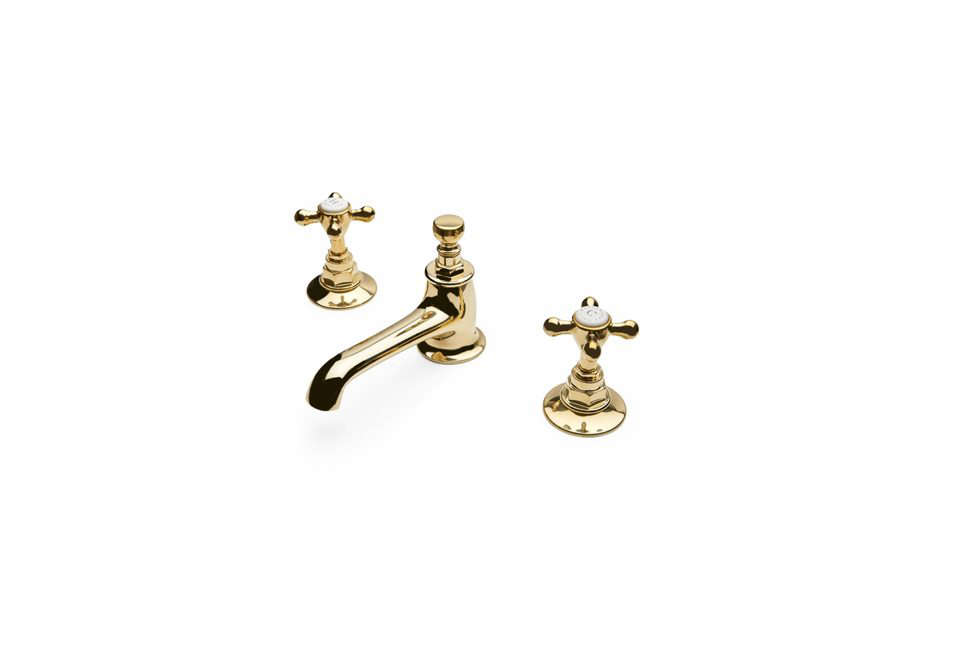
The Highgate Low Profile Three Hole Deck Lavatory Faucet proves that a bathroom fixture does not need to shout to become the most memorable object in the room. With its compact proportions, separate hot and cold controls, solid brass construction, and old-English-inspired details, it brings traditional character to a vanity without turning the space into a plumbing museum.
This is a widespread, deck-mounted bathroom faucet designed for homeowners and designers who appreciate visible craftsmanship. Its stepped bases, hexagonal accents, white porcelain indices, and gently curved spout feel historic, yet the quarter-turn ceramic valves and water-saving flow rate are decidedly modern. In other words, it looks as though it belongs beside a claw-foot tub, but it behaves like a carefully engineered contemporary fitting.
What Is the Highgate Low Profile Faucet?
The Highgate is a three-hole lavatory faucet from Waterworks. Unlike a centerset faucet, where the spout and handles are joined on a single base, this configuration places the spout and two controls in separate countertop openings. The result is a cleaner, more architectural arrangement with visible space between each component.
“Low profile” refers to the fixture’s relatively restrained height. The published height is approximately 4 3/8 inches, while the spout assembly extends roughly 6 11/16 inches in depth. Those proportions help the faucet sit comfortably on compact vanities, shallow counters, and traditional washstands where a tall, dramatic fixture might look like it arrived wearing a top hat indoors.
The collection is inspired by functional old English fittings. That influence appears in the white porcelain hot-and-cold markings, hexagonal transitions, stepped escutcheons, and compact curved spout. The styling is decorative, but not fussy. It works particularly well in bathrooms where the goal is “collected over time” rather than “everything ordered from the same giant box on Tuesday.”
Key Specifications at a Glance
| Feature | Published Specification |
|---|---|
| Installation type | Three-hole, deck-mounted widespread faucet |
| Primary material | Brass |
| Overall height | Approximately 4 3/8 inches |
| Depth or width | Approximately 6 11/16 inches |
| Handle spread | Adjustable from 8 to 12 inches |
| Fitting-hole diameter | Approximately 1 3/8 inches |
| Compatible deck thickness | Approximately 3/8 to 1 7/8 inches |
| Handle operation | Quarter-turn ceramic valves |
| Maximum flow rate | 1.2 gallons per minute |
| Recommended water pressure | Approximately 45 psi |
| Published pressure range | Approximately 20 to 85 psi |
| Inlet connection | 1/2-inch male connection with supply nut |
| Spout | Fixed, non-swiveling |
These measurements matter. A beautiful faucet that does not fit the countertop is simply an expensive metal sculpture with plumbing aspirations. Before ordering, compare the current product drawing with the sink, countertop thickness, backsplash location, cabinet structure, and available space beneath the deck.
Cross Handles or Porcelain Lever Handles?
The Highgate lavatory faucet is commonly offered in two recognizable handle configurations: metal cross handles and white porcelain lever handles. Both share the same compact spout and traditional detailing, but they create noticeably different visual and tactile experiences.
Metal Cross Handles
Cross handles deliver the strongest vintage impression. Their balanced shape feels substantial between the fingers, and the porcelain indices clearly identify hot and cold. They suit English country bathrooms, historic renovations, classic powder rooms, and spaces featuring paneled walls, marble, pedestal sinks, or furniture-style vanities.
The cross-handle version also creates pleasing symmetry. Because each handle resembles a small piece of machinery, the faucet feels purposeful rather than merely decorative. The only practical consideration is that wet or soapy hands may find a smooth cross handle slightly less effortless than a long lever.
White Porcelain Lever Handles
The porcelain lever version feels lighter and somewhat more refined. The longer handles can be operated with fingers, the side of a hand, or a gentle push. This can be helpful when hands are messy or when minimizing grip effort matters.
White porcelain also connects easily with traditional ceramic sinks, white subway tile, and painted cabinetry. It adds contrast to chrome, nickel, or brass finishes without overpowering the room. The effect is classic, but surprisingly fresh when paired with simple modern surfaces.
Why the Low-Profile Design Works
A tall faucet is not automatically a better faucet. Height must be balanced against basin depth, spout reach, backsplash clearance, and the likelihood of splashing. The Highgate’s compact body keeps the visual center of gravity close to the countertop. This is useful in smaller bathrooms and powder rooms, where a towering fixture can make the vanity look crowded.
The lower height also leaves more visual space below a mirror, medicine cabinet, or wall-mounted shelf. On a marble or stone vanity, the restrained silhouette allows the countertop material to remain part of the design rather than disappearing behind plumbing hardware.
Because the spout does not swivel, placement must be deliberate. The water stream should fall near the basin’s drain area without striking the back wall or landing too close to the front rim. A paper template or dry-layout mockup can prevent the unpleasant discovery that the faucet pours water precisely where nobody wanted it.
Finish Options and Design Pairings
Current product information identifies chrome, nickel, and brass among the stocked finish families. Each creates a different personality, even though the faucet shape remains unchanged.
Chrome
Chrome is crisp, reflective, and visually clean. It works well with white porcelain, cool marble, polished stone, and traditional black-and-white tile. It is also a familiar choice for busy bathrooms because its bright surface makes the fixture feel fresh. The trade-off is that fingerprints and dried water spots tend to introduce themselves quickly and without an appointment.
Nickel
Nickel usually has a warmer, softer appearance than chrome. It pairs naturally with creamy stone, warm white paint, walnut cabinetry, antique mirrors, and transitional interiors. Its quieter reflection helps the Highgate’s stepped bases and hexagonal details remain visible without producing excessive sparkle.
Brass
Brass brings warmth and historic character. Depending on the exact finish treatment, it may remain relatively consistent or gradually develop a patina. That change is not necessarily deterioration; many owners choose a living brass finish precisely because it records handling, moisture, and time.
Before buying, confirm the complete finish name and care requirements. “Brass” can describe a color family, a polished treatment, or an unlacquered living surface, and those finishes do not age in exactly the same way.
Water Efficiency Without a Feeble Stream
The Highgate’s published restricted maximum flow rate is 1.2 gallons per minute, or about 4.5 liters per minute. That is lower than the EPA WaterSense maximum of 1.5 gallons per minute for qualifying bathroom sink faucets and well below the longstanding federal reference rate of 2.2 gallons per minute.
A lower flow rate reduces water use during handwashing, toothbrushing, shaving, and routine cleaning. It can also reduce the amount of hot water moving through the faucet. The important distinction is that a 1.2-gallon-per-minute specification does not, by itself, prove that a particular SKU carries the WaterSense label. Buyers seeking formal certification should confirm the current listing rather than assuming that efficiency and labeling are identical.
The faucet is designed around a recommended pressure of approximately 45 psi and a published operating range of about 20 to 85 psi. Homes with unusually low pressure may experience a gentler stream, while excessive pressure should be addressed at the plumbing system rather than celebrated as “enthusiastic water.”
Materials, Valves, and Standards
The faucet’s primary body and escutcheon material is brass, while the valves use ceramic components. Ceramic valves are valued for smooth quarter-turn operation and precise shutoff. They eliminate the endless handle spinning associated with some older compression faucets and reduce the number of wrist rotations required before breakfast.
Waterworks documentation lists compliance references that include NSF/ANSI/CAN 61, NSF/ANSI/CAN 372, and ASME A112.18.1/CSA B125.1, along with California Energy Commission and Massachusetts requirements. These standards address areas such as material health effects, weighted lead content, construction, performance, and plumbing-supply fittings.
NSF/ANSI/CAN 372 uses a weighted-average lead-content limit of 0.25 percent for most wetted plumbing components. Certification details can vary by model and production configuration, so the exact SKU and current technical sheet should be checked when compliance documentation is required for a project.
Planning the Installation
This is a widespread faucet, meaning the two valves and central spout are independent above the countertop and connected beneath it. The handle spread can be adjusted between approximately 8 and 12 inches, giving designers more freedom than a fixed four-inch centerset configuration.
Confirm the Sink and Countertop
The installation requires three openings of the correct diameter. Check whether the sink already has widespread faucet holes or whether the countertop fabricator must drill them. The deck should fall within the specified thickness range, and there must be enough clearance below for mounting hardware, supply hoses, the inlet tee, drain components, and future service access.
Coordinate the Drain
Current product information states that a universal lift-and-turn drain is included and is designed for common drain-hole openings. However, package contents and drain designs can evolve. Confirm the current drain model, sink overflow configuration, and compatibility before installation.
Stone requires special care. Traditional plumber’s putty can contain oils that discolor marble, granite, and other porous materials. The installer should use the sealant recommended for the specific countertop or sink material.
Use a Professional Installer
Waterworks installation guidance is written for professional contractors, and this is sensible advice. The faucet has separate valve bodies, supply hoses, an inlet tee, retaining collars, a restrictor, and drain hardware. Precise alignment is also essential because three independent pieces can look noticeably crooked even when each is only slightly off.
After installation, the supply lines should be flushed, strainers checked for debris, connections inspected for leaks, and the drain tested with a filled basin. Skipping the flush can allow construction particles to lodge in the restrictor or cartridge, turning the first handwashing experience into a disappointing trickle.
Cleaning and Long-Term Care
Luxury finishes reward gentle habits. Waterworks recommends routine cleaning with a soft damp cloth, neutral liquid soap, thorough rinsing, and careful drying. Abrasive pads, stiff brushes, harsh disinfectants, strong acids, and aggressive scouring powders can permanently alter the surface.
Products such as toothpaste, shaving cream, nail-polish remover, air freshener, cologne, vinegar, and wine may also affect certain finishes if left in prolonged contact. A faucet apparently has more bathroom enemies than most homeowners realize.
Drying the fixture after use is especially helpful in hard-water areas. It limits mineral spotting around the spout, handles, and escutcheon edges. Living finishes should be expected to change. Polishing may restore brightness, but it can also remove an intentionally developed patina. Follow the instructions for the exact selected finish rather than treating every metal surface as interchangeable.
Advantages and Possible Drawbacks
Reasons to Choose It
- Distinctive old-English styling without excessive ornament
- Solid brass primary construction
- Quarter-turn ceramic valves
- Flexible 8-to-12-inch widespread installation
- Water-efficient 1.2-gallon-per-minute flow rate
- Choice of cross or porcelain lever handles
- Compact proportions suitable for modest vanities
- Coordinating accessories available within the Highgate collection
Points to Consider
- Three-hole installation is more involved than a single-hole faucet
- The fixed spout requires careful positioning over the basin
- Polished and living finishes require attentive cleaning
- Separate components need sufficient room beneath the countertop
- Premium construction may cost considerably more than mass-market alternatives
- Current specifications should be verified before drilling stone or ordering a custom vanity
Where the Highgate Faucet Looks Best
The Highgate is a natural partner for traditional and transitional bathrooms, but it is more versatile than its historical details suggest. In a classic room, it can reinforce painted cabinetry, paneled walls, marble mosaics, pedestal basins, and antique-style lighting. In a modern room, it can serve as the single decorative counterpoint to flat-front cabinetry and minimalist tile.
It is particularly effective in powder rooms, where a small number of memorable elements can carry the entire design. Pair a brass Highgate faucet with a veined stone sink and a simple plaster wall, and the room needs little additional decoration. Pair the nickel version with a dark wood vanity and framed mirror, and the result feels polished without becoming flashy.
The faucet can also support a historically sensitive renovation. Its visual language feels appropriate in older homes, while its modern valves, flow restriction, and certification references provide practical benefits that genuine antique plumbing cannot always offer.
Everyday Ownership Experience: What Living With It Is Really Like
A realistic experience with the Highgate Low Profile Three Hole Deck Lavatory Faucet begins before anyone turns on the water. The first impression comes from proportion. Because the spout and handles sit relatively low, the vanity feels open rather than crowded. A mirror can begin closer to the countertop, and decorative tile remains visible behind the fitting. In a small powder room, that breathing room can make the entire sink area feel more intentional.
During daily use, the quarter-turn action becomes one of the most noticeable practical advantages. There is no repeated twisting or guessing whether the valve has fully closed. A short movement opens the water, and another short movement stops it. Cross handles feel reassuringly mechanical, while porcelain levers are easier to nudge with a wrist or fingertip. Households with children may appreciate the clearly marked hot-and-cold indices, although adults who have spent decades operating faucets can probably survive without the reminder.
The 1.2-gallon-per-minute flow feels appropriate for handwashing and brushing teeth. It is not intended to fill a stockpot, hydrate a horse, or recreate a hotel waterfall. For normal lavatory tasks, the stream should feel focused and controlled when household pressure is within the recommended range. The lower flow also produces less chaotic splashing than some high-volume faucets, especially when paired with a moderately deep basin.
Sink selection strongly influences the experience. In a shallow basin, even a well-designed stream can splash if it hits the drain cover at the wrong angle. In a deeper undermount sink, the same faucet may feel exceptionally composed. This is why spout placement deserves attention during installation. Moving the fixture half an inch on a custom countertop can make the difference between elegant performance and a daily collection of droplets on your shirt.
Cleaning becomes a small but regular ritual. Chrome shows water spots quickly but returns to a brilliant finish after a soft-cloth wipe. Nickel is visually forgiving, though soap residue still collects around the stepped handle bases. Brass has the most personality. Depending on the finish, areas touched frequently may darken or brighten differently from protected surfaces. Some owners love this gradual record of use; others discover that they actually wanted brass-colored perfection frozen in time. Knowing which camp you occupy before ordering is highly recommended.
The separate widespread components make wiping the countertop easy because there is no large shared base trapping a long crescent of grime. However, there are more circular edges to clean around. A soft cloth wrapped around one finger usually handles the task without requiring specialized equipment or a degree in faucet archaeology.
Over time, the design’s greatest strength is that it does not depend on a temporary trend. The faucet may look equally appropriate with floral wallpaper, white subway tile, dramatic stone, or restrained modern cabinetry. It feels like a permanent architectural fitting rather than an accessory selected to match this year’s towel color. That durability of style is a major part of the ownership experience and one reason a premium traditional faucet can remain satisfying long after the renovation dust has disappeared.
Final Verdict
The Highgate Low Profile Three Hole Deck Lavatory Faucet is an appealing choice for a bathroom that needs classic character, compact proportions, and modern operating performance. Its brass construction, ceramic valves, flexible widespread layout, and 1.2-gallon-per-minute flow rate give it practical substance beneath the decorative details.
It is best suited to buyers who value craftsmanship, understand the maintenance needs of premium finishes, and are willing to plan the installation carefully. It is less appropriate for a quick budget refresh or a countertop that cannot accommodate three widespread openings.
Choose the cross handles for a stronger historic statement, or select the porcelain levers for easier operation and a lighter visual touch. Whichever configuration is used, verify the latest technical sheet, finish designation, drain package, and countertop requirements before ordering. Measuring twice remains cheaper than asking a stone fabricator to develop a sense of humor.
Note: Product dimensions, finish availability, drain components, pricing, and technical documents may change. Confirm the current SKU and installation requirements with Waterworks or an authorized dealer before purchasing, drilling a countertop, or fabricating a custom vanity.














