
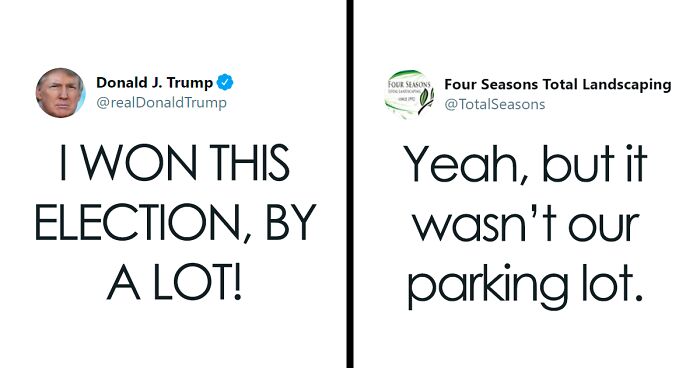
If 2020 had been a television writers’ room, the Four Seasons Total Landscaping episode would have been rejected for being too on the nose. A Trump campaign legal press conference, promoted with the glamorous-sounding phrase “Four Seasons,” did not unfold beneath chandeliers at a luxury hotel. Instead, it took place in the parking lot of a Northeast Philadelphia landscaping business, framed by garage doors, campaign signs, an adult bookstore nearby, and a crematorium across the street. Subtle? Absolutely not. Memorable? Unfortunately for everyone involved, yes.
That strange Saturday morning quickly became one of the internet’s most durable political memes. While Rudy Giuliani stood at a lectern discussing legal challenges to the 2020 election results, news outlets were projecting Joe Biden’s victory. The contrast was almost cinematic: democracy turning a page while the outgoing president’s legal team stood beside mulch, asphalt, and a brand name that sounded like a booking error with landscaping shears.
Then came the jokes. Memes bloomed faster than weeds after rain. Satirists, quote-tweeters, comedy writers, bored office workers, and chronically online political observers all discovered the same punchline at once: Four Seasons Total Landscaping sounded like both a real small business and a fake location invented by a sitcom about failing upward. Naturally, a parody account appeared, pretending to be the landscaping company with a delightfully deadpan personality. Its mock-business voice roasted the confusion, the venue, the campaign optics, and the internet’s obsession in a run of posts that felt like 27 tiny topiary sculptures shaped like sarcasm.
The Real Story Behind Four Seasons Total Landscaping
First, a quick factual cleanup: although many viral headlines loosely described the event as a rally, it was actually a Trump campaign legal press conference held on November 7, 2020. Donald Trump’s team had been challenging vote-counting processes in Pennsylvania and other states. Giuliani, then acting as Trump’s personal attorney, addressed reporters outside Four Seasons Total Landscaping on State Road in Philadelphia.
What made the location instantly famous was the name. “Four Seasons” usually suggests luxury towels, concierge desks, and rooms where the minibar charges more than your weekly grocery budget. “Four Seasons Total Landscaping” suggests snow removal, lawn maintenance, and someone named Mike reminding you not to park in front of the bay door. The internet did not need a second invitation.
The company itself was a real local business, not a prop. It had been operating in Philadelphia for years before suddenly becoming a global punchline. The business later leaned into the attention with merchandise, jokes, social posts, and an unexpectedly charming willingness to laugh along. What could have been a reputation disaster became a masterclass in accidental branding. Most companies spend years trying to go viral. Four Seasons Total Landscaping did it with a parking lot, a podium, and the world’s most confusing press announcement.
Why the Parody Account Worked So Well
The parody account succeeded because it understood the golden rule of internet comedy: do not explain the joke when the sign already says “Total Landscaping.” Instead of screaming, it used a calm, faux-corporate voice. It acted like a business that had been dragged into history and was now politely asking everyone to stop confusing it with a hotel. That restraint made the humor even sharper.
One of the account’s funniest angles was its pretend concern with practical landscaping issues. While the political world argued over ballots, lawsuits, and projections, the parody voice acted as if the real emergency was whether anyone needed shrub trimming. That contrast created the magic. It treated the entire national spectacle like an inconvenient interruption between leaf cleanup appointments.
The account also played with business language: invoices, booking fees, yard maintenance, seasonal services, lectern rentals, mulch, and landscaping puns. The best jokes did not need to mention every political detail. They simply placed the grandiosity of presidential politics next to the everyday reality of a small landscaping company. That is where the comedy lived: between constitutional crisis and crabgrass.
The 27-Tweet Roast: A Comedy Garden in Full Bloom
The widely shared collection of 27 tweets worked like a miniature sketch show. Each post found a new angle on the same absurd setup. Some joked that the company was not a hotel. Others leaned into the idea that Four Seasons Total Landscaping had suddenly become the most important venue in American politics. A few imagined the company sending invoices, offering services, or reminding customers that it handled lawns, not election litigation.
That variety mattered. Viral jokes often wilt quickly because everyone repeats the same punchline until it becomes compost. This parody account kept rotating the soil. One tweet might sound like an earnest customer-service update. Another might mock the idea of high-level strategy happening beside a garage door. Another might use a lawn-care pun so shameless it deserved its own fertilizer spreader.
The result was not just “Trump got the wrong Four Seasons.” It was a whole comedic universe. In that universe, a landscaping business had better media instincts than a national campaign. A parking lot became a press room. A garage door became a historical backdrop. A company that probably preferred quiet weekdays and reliable snow-removal contracts became a symbol of political stagecraft gone sideways.
Why People Could Not Stop Laughing
Part of the laughter came from the clean structure of the joke. Comedy loves contrast, and Four Seasons Total Landscaping delivered contrast with a forklift. There was the expectation: a polished hotel press conference. Then there was the reality: a landscaping company lot near industrial neighbors. There was the intended message: serious legal challenge. Then there was the image: a lectern in front of garage doors and campaign signs.
Another reason the moment stuck is that it arrived at an emotionally overloaded time. Americans had spent days watching vote counts, refreshing maps, arguing about mail ballots, and living through a pandemic election. People were exhausted. Then, out of nowhere, reality handed them an absurd image that required almost no processing. It was instantly legible. Even people barely following politics could understand the joke in one sentence: the Trump team held a major press conference at Four Seasons Total Landscaping, not the Four Seasons hotel.
That simplicity made it perfect meme material. It could be turned into fake reviews, T-shirts, parody accounts, reaction videos, late-night monologues, and neighborhood tourism. It was a political story, a branding story, a social media story, and a comedy story all at once. It had layers, but none of them were hard to peel back. Like an onion, except with more asphalt.
From Viral Gaffe to Small-Business Opportunity
The real Four Seasons Total Landscaping did something smart after the internet discovered it: it joined the joke without becoming mean-spirited. The company sold merchandise, embraced slogans, and let people enjoy the absurdity. Instead of hiding behind the shrubbery, it stepped into the spotlight with a grin.
That response transformed the business from accidental backdrop into cultural participant. People bought shirts not because they suddenly needed landscaping in Philadelphia, but because they wanted a souvenir from one of the strangest political-media moments of the decade. The company became a kind of folk landmark. Visitors took photos. Journalists returned for follow-ups. Musicians even turned the lot into a concert venue later on. Somehow, a place associated with mulch and snow removal became a pilgrimage site for meme historians.
There is a useful marketing lesson here: when attention arrives unexpectedly, the tone of the response matters. Four Seasons Total Landscaping could have complained, denied, or disappeared. Instead, it showed personality. It demonstrated that a small business can survive a weird viral storm by being human, quick, and self-aware. Not every company gets a Super Bowl-adjacent level of attention from a press conference mix-up, but every brand can learn from the way the business handled sudden fame.
The Parody Account and the Line Between Satire and Confusion
Parody accounts can be hilarious, but they also come with a responsibility problem. When a joke account is too convincing, some users may mistake it for the real thing. That is especially true on fast-moving platforms where screenshots travel farther than context. Later fact-checks had to clarify that certain posts attributed to Four Seasons Total Landscaping were satire from a parody account, not official statements from the actual company.
This is why clear labeling matters. A good parody account can roast public figures, mimic brand voice, and exaggerate absurdity while still making it obvious that it is joking. The Four Seasons parody account’s humor depended on the audience understanding the premise: this was not the real business issuing official political commentary. It was a comedic character built around the ridiculousness of the moment.
For readers, the lesson is simple: laugh, but verify. A post can be funny and fake at the same time. In fact, that is often the whole point. Before sharing a screenshot as proof of something, check whether the account identifies itself as parody, whether the handle matches the official business, and whether reputable sources have covered it. The internet is a garden, yes, but misinformation is the crabgrass.
Why This Moment Still Feels So Unbelievable
Years later, Four Seasons Total Landscaping still feels unreal because it captured a massive historical transition in one bizarre image. It was not merely a funny venue choice. It became a symbol of chaotic political communication, failed optics, and the strange way online culture turns minor details into monuments.
Political history usually remembers speeches, scandals, policies, crises, and elections. Internet history remembers the sign in the background. That is why this episode lasted. The visual was stronger than the message. People may not recall the exact legal claims made that day, but they remember the parking lot. They remember the name. They remember the collective double-take.
That is the danger of bad staging. If the setting contradicts the message, the setting wins. If the backdrop is funnier than the speaker, the backdrop becomes the headline. Four Seasons Total Landscaping did not ask to become a metaphor, but once the cameras arrived, it became one anyway.
Specific Examples of the Humor
The funniest jokes around the parody account tended to fall into a few buckets. First were the hotel-confusion jokes, where the account acted offended that anyone could confuse a hard-working landscaping company with a luxury hospitality brand. Second were the lawn-care puns: “rake,” “mulch,” “sod,” “seasonal cleanup,” and every possible variation of “lawn and order.” Third were fake administrative jokes, such as imaginary invoices for lecterns, yard fees, or event setup. Fourth were mock customer-service posts, as though the company’s biggest concern was managing appointment requests after accidentally becoming a political landmark.
Those examples show why the parody account had legs. It did not simply insult Trump or Giuliani. It created a character: a practical, mildly exasperated landscaping business trying to maintain professionalism while history dripped coffee on its welcome mat. That character gave the account a reusable comic engine. Every new post could ask, “How would a landscaping company politely respond to being dragged into a national political meltdown?” The answer, apparently, was: with pruning shears and perfect timing.
What Brands and Writers Can Learn From the Four Seasons Meme
For content creators, the Four Seasons Total Landscaping saga is a case study in timing, specificity, and voice. The name was specific. The visuals were specific. The neighborhood details were specific. That is why the story felt funnier than a generic “campaign event went badly” headline. Specificity makes comedy memorable.
The parody account also shows the power of a consistent voice. It did not need to shout. It did not need to explain every joke. It simply stayed in character. For writers, that is a valuable reminder: a strong comic premise can carry a long sequence if each line explores a slightly different angle. The 27-tweet format worked because the account kept returning to the same absurd reality from new directions.
For brands, the lesson is equally useful. When your company enters a viral conversation, do not panic-post. Understand why people are paying attention. Then respond in a way that fits your identity. Four Seasons Total Landscaping was funny because the company was ordinary. The parody was funny because it respected that ordinariness. A landscaping business talking like a landscaping business is funnier than a landscaping business suddenly trying to sound like a cable-news panel.
Extra Experience: What This Topic Teaches About Internet Culture
Watching the Four Seasons Total Landscaping story unfold felt like seeing the internet discover a new national holiday in real time. One moment, people were doom-scrolling election results. The next, everyone was suddenly an expert in Philadelphia landscaping companies. That whiplash is part of the modern online experience. We move from serious news to absurd comedy at terrifying speed, often within the same browser tab.
The experience also shows how people use humor to process tension. The 2020 election was not a lighthearted event. It unfolded amid a pandemic, intense polarization, and widespread anxiety. The Four Seasons moment gave people a pressure valve. It was not that the underlying political conflict was funny; it was that the staging error was so visually ridiculous that laughter became almost automatic. In stressful times, a perfectly strange detail can become a shared emotional release.
For anyone who creates content online, this episode is a reminder that audiences love stories with a clear hook. “A press conference happened” is not a hook. “A major political press conference happened at a landscaping company apparently confused with a luxury hotel” is a hook wearing a neon vest and holding a leaf blower. The story was easy to summarize, easy to meme, and easy to pass along. That is why it traveled so far.
It also reveals the strange afterlife of viral fame. Most memes disappear quickly, but some become cultural shorthand. Four Seasons Total Landscaping became a phrase people use to describe chaotic logistics, accidental symbolism, and public events that feel like deleted scenes from a political satire. The business itself became more than a business for a while. It became a location people wanted to visit, photograph, and wear on a T-shirt.
The best personal takeaway is this: the internet rewards quick wit, but it remembers strong images. The parody account was funny because the original image was unforgettable. A lectern. A parking lot. A name that promised luxury and delivered lawn care. Add a political meltdown, a national election call, and a deadpan parody voice, and you get a meme sturdy enough to survive multiple news cycles. That is not just comedy. That is accidental mythmaking with a snow-removal contract.
Conclusion
The parody account for Four Seasons Total Landscaping turned an already surreal political moment into a full comedy harvest. By speaking in the voice of a practical landscaping business caught in the headlights of national attention, it roasted the Trump campaign’s infamous Philadelphia press conference without needing to overreach. The jokes worked because reality had already done most of the heavy lifting.
The episode remains memorable because it combined political drama, visual absurdity, small-business charm, and internet timing. It was a reminder that public image is fragile, context matters, and sometimes the most powerful symbol in American politics is not a flag, a podium, or a campaign slogan. Sometimes it is a garage door behind Rudy Giuliani, a few Trump signs, and a landscaping company that just wanted to get through the weekend.













