
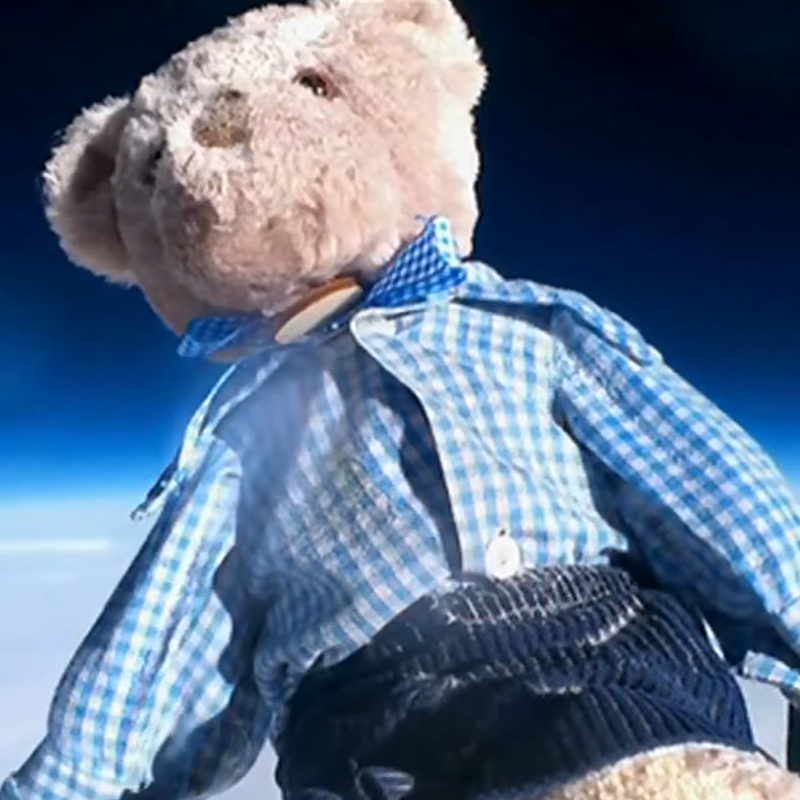
Some school mascots sit on shelves. Some appear in newsletters. Some, if they are especially lucky, get hugged by sticky-fingered students after lunch. Bradfield the Bear, however, aimed highermuch higher. In November 2025, this uniform-wearing teddy bear became the star passenger of a high-altitude balloon launch organized by Walhampton School pupils working with the Southampton University Spaceflight Society. His destination was not technically outer space, but the dazzling, thin-aired world of near space: the stratosphere, where the sky darkens, Earth curves gently below, and a teddy bear can suddenly become a science ambassador.
The story of Bradfield Bear is charming because it combines three things humans never seem to outgrow: curiosity, adventure, and the slightly absurd joy of sending a stuffed animal somewhere it has absolutely no business going. But behind the humor is a serious lesson in STEM education. A near-space balloon launch teaches students about physics, meteorology, engineering, risk management, GPS tracking, aviation rules, teamwork, and the humbling fact that weather has no respect for lesson plans.
Bradfield’s adventure did not unfold like a perfectly scripted cartoon. The balloon system was expected to climb toward the stratosphere, with tracking equipment and a parachute recovery plan. Another plush passenger, Bill the Badger, reportedly completed the journey and returned with the payload. Bradfield, meanwhile, separated at high altitudereported at around 17 miles upcreating the kind of cliffhanger usually reserved for action movies, except the hero was soft, furry, and dressed better than many adults at airport security.
What Does “Near Space” Actually Mean?
Near space is the region above normal aircraft cruising altitude but below true outer space. It is commonly associated with the upper atmosphere, especially the stratosphere, where high-altitude balloons often fly. The stratosphere begins roughly around 33,000 feet at mid-latitudes and extends to about 31 miles above Earth. That means Bradfield Bear was not orbiting the planet, waving at satellites, or asking the International Space Station for snacks. Still, he reached an environment most humans will never personally visit.
At those altitudes, the atmosphere becomes thin, cold, and visually dramatic. Weather balloon systems often climb for more than two hours and may exceed 100,000 feet before the balloon bursts. The balloon expands as outside air pressure drops, eventually growing far beyond its launch size. Then it pops, the parachute deploys, and the payload descends back to Earth. In theory, that is the calm textbook version. In practice, wind, turbulence, attachment points, batteries, radio signals, and recovery logistics all join the party wearing mischievous little hats.
How Bradfield Bear’s Balloon Adventure Worked
Walhampton’s project began as a hands-on STEAM activity. Students helped prepare for the launch, and the school obtained permission from aviation authorities to conduct the flight safely. That detail matters. High-altitude ballooning is not just “tie helium to a box and hope.” Responsible launches require planning: predicting the flight path, checking winds, avoiding busy or risky airspace, tracking the payload, and making sure the descent does not create hazards on the ground.
The balloon carried Bradfield Bear and Bill the Badger, along with tracking equipment. The plan was simple in concept: launch the helium-filled balloon, let it climb into the stratosphere, record the journey, allow the balloon to burst at peak altitude, and retrieve the payload after parachute descent. For students watching from below, the launch transformed abstract science into a real event. Suddenly, altitude was not just a number on a worksheet. It was a bear sailing into the sky.
The flight reportedly touched down near High Wycombe later that afternoon. But Bradfield’s part of the mission became famous because he separated from the payload during the journey. Footage showed him at extraordinary altitude, looking impressively calm for someone experiencing a surprise career change from school mascot to airborne explorer. His descent turned the project into a mystery as well as a mission: Where did Bradfield land, and would he be found?
Why Send a Teddy Bear to Near Space?
Because children remember a teddy bear. That is the simple answer. Students may forget a formula if it arrives alone on a whiteboard, but attach that formula to a furry passenger in a tiny uniform and suddenly it has emotional gravity. Bradfield Bear made the invisible visible. Lift, gas expansion, temperature changes, atmospheric pressure, GPS tracking, and parachute recovery became part of a story rather than a lecture.
Educators know that memorable learning often begins with a hook. Bradfield was the hook with paws. A mascot makes science feel less intimidating, especially for younger students. Instead of asking, “What is the stratosphere?” students can ask, “How high did Bradfield go?” Instead of learning about payload design in the abstract, they can ask, “How do we keep the bear attached?” That last question, as history suggests, deserved more attention.
The Real Science Behind the Cute Story
Helium, Lift, and a Balloon That Grows
A high-altitude balloon rises because helium is lighter than the surrounding air. At launch, the balloon may look large but manageable. As it climbs, air pressure decreases, allowing the helium inside to expand. This expansion continues until the balloon material can stretch no more. Then the balloon bursts, usually at a very high altitude, and the payload returns under parachute.
This process demonstrates core physics concepts in a way students can see. Gas laws stop being dry equations and become a live performance. The balloon is not merely floating; it is responding to the changing environment. It becomes a moving laboratory, and in Bradfield’s case, a moving laboratory with plush cargo.
Temperature and Pressure in the Stratosphere
The stratosphere behaves differently from the lower atmosphere where we live. In the troposphere, temperature usually drops as altitude increases. In the stratosphere, temperature can rise with altitude because ozone absorbs ultraviolet radiation from the Sun. Air is also much thinner, meaning electronics, batteries, cameras, and attachment systems face conditions very unlike a school playing field.
For a near-space mission, this environment creates real engineering challenges. Batteries may struggle in extreme cold. Cameras need insulation and stable mounting. GPS and radio systems must keep transmitting. The payload must survive ascent, balloon burst, descent, landing, and retrieval. A teddy bear can smile through all of this, but the equipment cannot simply rely on charm.
GPS Tracking and Recovery
Tracking is one of the most important parts of high-altitude ballooning. A payload can drift many miles from the launch site, depending on wind at different altitudes. Weather balloon systems may travel long horizontal distances while climbing and descending. Without GPS or radio tracking, recovery becomes a countryside treasure hunt, except the treasure may be in a tree, a field, a hedge, or somebody’s startled vegetable patch.
Bradfield’s story demonstrates why redundancy matters. Serious balloon missions often use multiple tracking systems, carefully planned attachment points, and predictions based on wind models. A launch team wants to know not only where the payload is, but where it is likely to go next. The sky is big. A missing teddy bear is small. This is not an ideal search ratio.
Near-Space Balloons and Weather Science
Bradfield’s adventure belongs to a much larger tradition. Weather services use balloons carrying radiosondes to measure the upper atmosphere. These small instrument packages collect pressure, temperature, humidity, wind, and location data as they rise. Such observations help improve weather forecasting, aviation planning, storm prediction, climate research, and satellite data validation.
A typical radiosonde flight can climb above 100,000 feet and last more than two hours. During that time, it sends data back to ground stations. The balloon eventually bursts, and a parachute slows the instrument package on descent. The system may sound simple, but it provides some of the most valuable direct measurements of the atmosphere. Satellites are powerful, but balloons physically travel through the air column, sampling conditions along the way.
This is one reason Bradfield Bear’s mission was more than a novelty. It gave students a miniature window into real atmospheric science. The same broad principles used in classroom balloon launches also support professional weather observations and scientific balloon campaigns.
What NASA-Style Ballooning Adds to the Picture
NASA’s scientific balloon program shows how powerful balloon platforms can be. Large research balloons can carry scientific instruments to around 120,000 feet, far above most of the atmosphere. From there, payloads can study cosmic rays, astrophysics, Earth science, atmospheric chemistry, and new technologies. These flights cost far less than satellite missions and can sometimes carry large, heavy instruments that would be difficult to launch on a rocket.
Of course, Bradfield Bear was not measuring dark matter or mapping gamma rays. He was, by all available evidence, mainly being adorable at altitude. But the connection is still meaningful. A school balloon launch introduces students to the same family of ideas: payload design, mission planning, high-altitude conditions, data collection, flight tracking, and recovery. Today it is a bear. Tomorrow it may be a sensor package designed by a student who remembers watching that bear disappear into the blue.
Safety: The Part That Keeps the Fun from Becoming a Problem
High-altitude ballooning must be handled responsibly. In the United States, unmanned free balloons fall under aviation regulations that address operating limitations, equipment, markings, notice requirements, and position reports. Operators must consider clouds, visibility, airspace, payload weight, flight termination, radar visibility, lighting when required, and hazards to people or property.
The same safety mindset applies anywhere. Before launch, teams should check local aviation rules, obtain permissions when required, predict the path, monitor weather, avoid populated landing zones when possible, and use a recovery plan. The goal is to produce wonder, not a headline beginning with, “Authorities are investigating why a teddy bear entered controlled airspace.”
Walhampton’s project included official permission and weather monitoring. That is exactly the kind of detail that separates educational exploration from irresponsible improvisation. Good science is curious, but it is also careful.
Lessons From Bradfield Bear’s Unexpected Separation
Every mission teaches something, especially the ones that do not go perfectly. Bradfield’s separation is a practical reminder that payload attachment is not a decorative detail. At high altitude, the payload may swing, rotate, freeze, vibrate, and experience changing forces as winds shift. Any mascot, camera, or instrument must be secured for the full flight, not just for the first cheerful launch photo.
For future school launches, Bradfield’s adventure suggests a useful checklist. Use redundant attachment points. Test the harness under pull, vibration, and cold conditions. Keep the mascot inside or firmly integrated into the payload frame. Avoid dangling parts that can tangle or snap. Label recovered components clearly. Make sure the parachute can deploy without interference. And if the passenger is a beloved bear, perhaps consider a tiny seatbelt. Fashionable? Maybe not. Sensible? Absolutely.
Why This Story Captured People’s Attention
Bradfield Bear’s story went viral because it made science feel human. Or bear-like, which is close enough. People respond to narratives, and this one had all the ingredients: a school project, young scientists, a brave mascot, near-space footage, a sudden mishap, and an unresolved recovery question. It was educational, funny, suspenseful, and oddly emotional.
There is also something poetic about a teddy bear floating at the edge of the sky. Plush toys are symbols of comfort, childhood, and home. Seeing one in the stratosphere creates a delightful contrast. Bradfield looked both wildly out of place and strangely perfect, as if every bear secretly dreams of becoming an astronaut but has been too polite to mention it.
How Bradfield Bear Can Inspire Future STEM Projects
Teachers and parents can use Bradfield’s adventure as a launchpad for dozens of activities. Students can calculate ascent rates, estimate balloon expansion, map wind layers, design safer payload harnesses, compare the troposphere and stratosphere, build model parachutes, write mission logs, analyze video footage, or create a search-and-rescue plan using coordinates and maps.
The project also supports communication skills. Students can write press releases, record mission updates, make infographics, or present findings to younger classes. A successful STEM project does not end when the payload lands. It continues when students explain what happened, what failed, what worked, and what they would improve next time.
Project Ideas Inspired by Bradfield
One classroom could build a “Bear Flight Readiness Review,” where students inspect a plush passenger and payload frame before a simulated launch. Another could compare different parachute shapes by dropping small payloads from a safe height. A math class could track predicted versus actual landing points. A writing class could produce Bradfield’s fictional diary from the stratosphere, including entries such as, “12:45 p.m.: Still climbing. Regret not packing biscuits.”
These activities work because they blend imagination with evidence. Students are not just pretending; they are solving real problems that engineers, meteorologists, and mission planners face. The bear makes the door inviting. Science is what waits inside.
Experiences Related to The Near Space Adventures Of Bradfield The Bear
Anyone who has ever participated in a balloon launch knows the experience begins long before liftoff. The first stage is anticipation. Students gather around tables covered with batteries, tape, foam, cameras, checklists, and the mascot of honor. Someone asks whether the payload is too heavy. Someone else asks whether the bear can breathe, which is sweet but scientifically unnecessary. A teacher checks the wind forecast for the twelfth time. The room buzzes with nervous excitement.
Then comes the outdoor launch moment. The balloon is filled, the payload is attached, and everyone suddenly becomes aware of the sky. It is no longer just background scenery. It is the mission environment. The balloon tugs upward, eager to escape. Students count down. A few phones appear. The release happens, and the balloon rises faster than expected, shrinking into the blue while the crowd cheers as though they have just launched a Mars rover instead of a helium balloon with a teddy bear underneath.
The next experience is tracking. This part feels like science mixed with detective work. Coordinates update. The predicted landing zone shifts. Students learn that wind is not one thing but many layers moving in different directions at different altitudes. A balloon may drift one way near the ground, another way higher up, and another way during descent. The map becomes a living puzzle. Every update matters. Every pause in the signal makes the room collectively hold its breath.
Watching flight footage later is often the most magical part. The ground drops away. Roads become threads. Clouds become a landscape. The sky deepens. The curve of Earth may appear subtle but unforgettable. For students, this view changes scale. Their school, town, and daily worries suddenly look tiny, while the planet feels both enormous and fragile. If a bear is in frame, calmly facing the abyss, the emotional impact doubles. Apparently, perspective is easier to absorb when delivered by a plush ambassador.
Recovery adds another layer of adventure. A payload might land in a field, forest, roadside, or tree. The search team may have to knock on doors, walk muddy paths, follow GPS points, and explain to strangers why they are looking for a parachute, a camera, and possibly a missing bear in school uniform. These moments are funny, but they also teach perseverance. Real science includes uncertainty, inconvenience, and occasional mud on your shoes.
Bradfield Bear’s story is especially valuable because it includes imperfection. A flawless mission is inspiring, but a mission with a surprise teaches more. Students can study why separation happened, how attachment could improve, what recovery methods might help, and how communication changes when the public becomes interested. Failure, in this context, is not embarrassment. It is data wearing a dramatic cape.
The lasting experience is pride. Students remember that they helped send something into near space. They remember the countdown, the tracking map, the footage, the laughter, and the mystery. Some may become engineers. Some may become scientists. Some may simply become adults who look at the sky with more curiosity. That is still a success. Bradfield Bear’s greatest achievement may not be how high he went, but how many minds he lifted along the way.
Conclusion
The Near Space Adventures Of Bradfield The Bear is more than a charming school story about a teddy bear with an unusually ambitious travel itinerary. It is a reminder that great learning often begins with wonder. A high-altitude balloon can turn the stratosphere into a classroom, a mascot into a mission specialist, and a group of students into engineers, meteorologists, storytellers, and problem-solvers.
Bradfield’s journey shows why hands-on STEM education matters. It makes science visible, memorable, and delightfully unpredictable. The mission involved real planning, real atmospheric science, real aviation safety considerations, and real engineering lessons. It also involved a bear falling from near space, which is not something most textbooks are brave enough to include.
Whether Bradfield is remembered as a mascot, explorer, accidental skydiver, or the fluffiest warning ever issued about payload attachment, his adventure has earned a place in the growing tradition of near-space education. He may not have reached orbit, but he did something just as important: he helped bring the universe a little closer to the classroom.










