
Every year, the Emmy Awards arrive wearing a tuxedo, carrying a golden statue, and acting like television history has been carefully measured by wise cultural elders. Then the nominations come out, and half the internet screams into a throw pillow. Welcome to the strange, sparkly circus of Emmy snubs: a place where masterpiece dramas can leave empty-handed, legendary actors can spend years smiling politely from the audience, and a show about terrible bar owners in Philadelphia can run for decades while the Academy looks at it like it just tried to sell them a bag of questionable deli meat.
To be fair, awards are not completely useless. They can introduce audiences to great work, boost careers, and give actors a very expensive-looking object to place behind them during Zoom interviews. But Emmy history also proves something less glamorous: awards are imperfect, political, trend-driven, category-confused, and sometimes hilariously late to the party. The best TV shows do not always win. Sometimes they are barely invited.
This article looks at some of the biggest Emmy snubs in television history, not to cancel the Emmysrelax, little statue, you are safebut to remind viewers that quality and trophies are not the same thing. A masterpiece does not become less brilliant because a voting body missed it. In fact, some of the most beloved series ever made have become more powerful because fans had to defend them against the silence of awards season.
Why Emmy Snubs Still Make People So Dramatic
An Emmy snub hurts because television is personal. We do not watch a great series the way we inspect a refrigerator manual. We live with these characters. We quote them. We recommend them with the emotional intensity of someone handing over a family heirloom. When a show changes how we think, laugh, or cry, it feels absurd when awards voters respond with, “Interesting. Anyway, here is another trophy for the usual favorite.”
The Emmys also carry cultural authority. Winning can turn a good show into a “prestige” show overnight. Losing, or worse, being ignored, can make casual viewers assume a series was less important than it really was. That is where the problem begins. Awards are snapshots of industry opinion at a specific moment. They are not final judgments carved into stone by the gods of television. If they were, several gods would owe “The Wire” an apology muffin basket.
The Wire: The Snub That Became a Punchline Against the Emmys
If there is a Mount Rushmore of Emmy snubs, “The Wire” is not merely on itit is staring down from the biggest rock with a disappointed Baltimore accent. David Simon’s HBO drama is now widely discussed as one of the greatest television series ever made. It explored policing, schools, journalism, politics, labor, race, capitalism, and institutional failure with the patience of a novelist and the punch of a street sermon.
And yet, in Emmy terms, “The Wire” was treated like a suspicious package left outside the ceremony. It received only two Primetime Emmy nominations, both for writing, and won nothing. No Outstanding Drama Series trophy. No acting nominations for its deep bench of performers. No victory lap for a show that practically rewired what serious television could do.
The snub is almost useful now because it proves the central argument: awards can miss the obvious. “The Wire” did not need a golden statue to become essential. Its reputation grew through critics, viewers, scholars, and creators who recognized that the show was not just entertainment but a full civic autopsy with better dialogue than most political speeches.
Better Call Saul: Fifty-Plus Reasons to Stop Worshiping Trophies
“Better Call Saul” may be the cleanest modern example of Emmy voters repeatedly looking at greatness and saying, “Maybe later,” until there was no later left. The “Breaking Bad” prequel entered television with a dangerous assignment: turn a comic-relief lawyer into the tragic center of a slow-burn moral collapse. Somehow, it succeeded so elegantly that viewers forgot they were watching a prequel and started treating Jimmy McGill’s printer paper problems like Shakespeare with a burner phone.
The series earned more than fifty Emmy nominations across its run and still ended with zero competitive wins for the show itself. Bob Odenkirk’s layered performance, Rhea Seehorn’s devastating work as Kim Wexler, the writing, the direction, the editingyear after year, the show showed up, bowed gracefully, and went home empty-handed.
What makes this Emmy snub especially wild is that “Better Call Saul” was not some obscure cult oddity hiding in a basement. It was critically adored, connected to one of the most awarded dramas of the modern era, and executed with almost surgical precision. If awards were a pure measurement of craft, “Better Call Saul” would have needed a separate garage for trophies. Instead, it became the patron saint of “nominated but not rewarded.”
Steve Carell Never Winning for The Office Is Comedy Treason
Steve Carell’s Michael Scott is one of the most recognizable comedy performances in American television. He was cringe, chaos, loneliness, ego, insecurity, and weirdly tender humanity stuffed into a regional manager’s suit. Carell made viewers laugh at Michael, then feel terrible for laughing, then laugh again because Michael had somehow made a corporate seminar sound like a hostage situation.
Carell received multiple Emmy nominations for “The Office,” but he never won for playing Michael Scott. That sentence still looks wrong. The Emmys recognized the show, and “The Office” did win Outstanding Comedy Series, but the central performance that turned Michael from a cartoon boss into a tragicomic legend never got its individual Emmy moment.
The deeper issue is how award bodies often undervalue comedy. Drama can announce itself with tears, monologues, and dramatic rain. Comedy has to look effortless while performing emotional gymnastics in a clown car. Carell’s work was precise, vulnerable, and physically fearless. The fact that he never won is not just an Emmy snub; it is a reminder that making people laugh is sometimes treated like a magic trick instead of serious craft.
Parks and Recreation: Leslie Knope Deserved a Binder Full of Emmys
“Parks and Recreation” began as a modest workplace comedy and grew into one of the warmest, sharpest sitcoms of its era. It gave viewers Leslie Knope, Ron Swanson, April Ludgate, Tom Haverford, Donna Meagle, Ben Wyatt, Chris Traeger, and a fictional town that somehow felt both ridiculous and emotionally necessary.
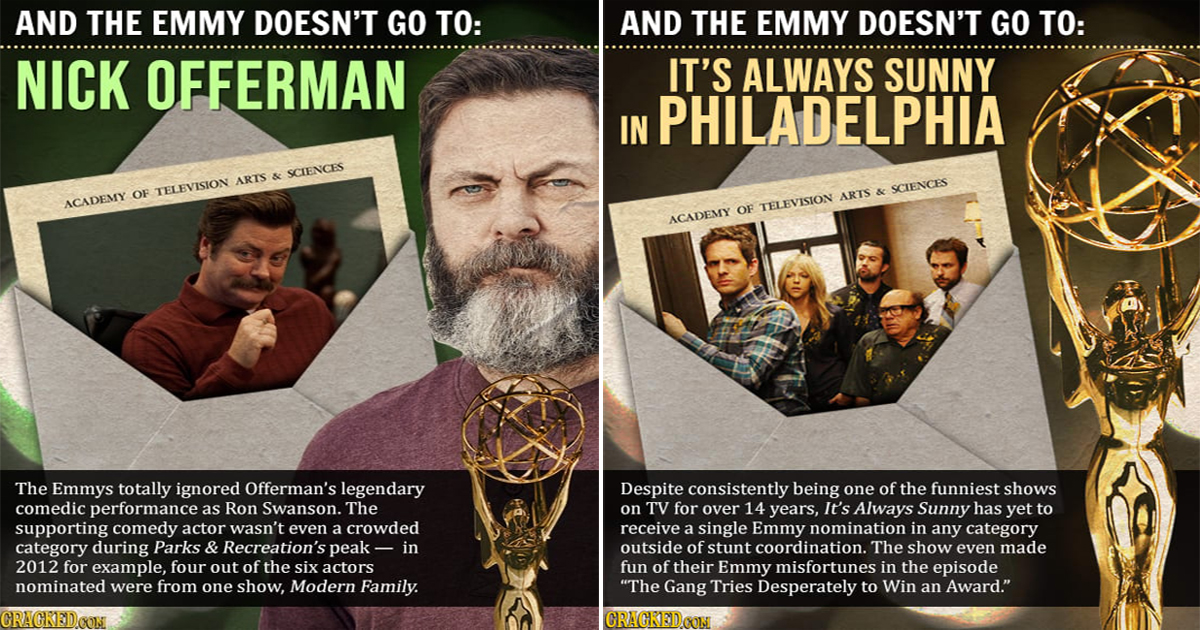
Amy Poehler’s Leslie Knope was a tornado of waffles, public service, color-coded ambition, and friendship. Poehler was repeatedly nominated, and the series earned recognition in comedy categories, writing, and technical fields. Still, “Parks and Recreation” never became the Emmy powerhouse its reputation now suggests it should have been.
Part of the problem may have been timing. The show competed during a crowded era of acclaimed comedies. But that explanation only goes so far. “Parks and Recreation” built a complete comic universe, developed one of TV’s best ensembles, and made optimism feel rebellious. If the Emmys could not fully reward that, maybe Pawnee should have formed its own awards ceremony, sponsored by Sweetums and judged exclusively by Li’l Sebastian.
It’s Always Sunny in Philadelphia: Too Weird, Too Mean, Too Good
“It’s Always Sunny in Philadelphia” has been on television so long that it has outlasted trends, networks, streaming panic, and probably several species of office printer. The FX/FXX comedy turned five morally bankrupt friends into a long-running experiment in bad decisions. It is rude, inventive, dark, fast, and often smarter than it pretends to bewhich is exactly how it steals your wallet and then explains capitalism to you.
Despite its longevity and cultural footprint, “It’s Always Sunny in Philadelphia” has received only a tiny handful of Emmy nominations, mostly in stunt coordination, and has never been embraced in major comedy categories. That feels both absurd and strangely appropriate. The Gang would absolutely ruin an awards ceremony, probably by starting a fake charity, misusing the red carpet, and trying to trap voters in a scheme involving denim.
The show’s Emmy snub reveals another awards problem: tone bias. Some shows are easier to reward because they look respectable. “Sunny” has never been interested in respectability. It hides sharp social satire inside chaos, yelling, and people making the worst possible choice with full confidence. Awards voters may not know what to do with a comedy that behaves like a raccoon wearing a blazer, but fans know: it belongs in the conversation.
Buffy the Vampire Slayer: Genre Television Gets the Wooden Stake
For years, genre television had to fight the idea that vampires, spaceships, witches, and monsters were somehow less serious than lawyers talking in rooms. “Buffy the Vampire Slayer” suffered from that bias. The series mixed horror, comedy, teen drama, mythology, romance, grief, and coming-of-age storytelling with a level of invention that influenced a generation of TV writers.
The episode “Hush” earned a writing nomination, and the show received some technical recognition, but “Buffy” was mostly ignored in the major categories. Sarah Michelle Gellar’s performance as Buffy Summers, in particular, remains one of those omissions that makes fans stare into the distance like they have just remembered a betrayal from high school.
Genre snubs matter because they show how awards can confuse surface with substance. “Buffy” had monsters, yes, but the monsters were often metaphors for fear, trauma, adulthood, desire, and loss. The fact that it wore leather pants while doing philosophy does not make it less worthy.
BoJack Horseman: Animation Is Not a Kids’ Table
“BoJack Horseman” was an animated series about a washed-up horse actor, which sounds like a joke someone makes before being asked to leave a pitch meeting. But beneath the absurd premise was one of television’s most painfully honest examinations of depression, addiction, fame, regret, and self-destruction. It could make a pun about animal people one minute and quietly devastate you the next.
The series received Emmy nominations, including Outstanding Animated Program recognition, but it never won the major Emmy respect many critics and fans believed it deserved. The snub reflects another long-running awards blind spot: animation is often treated as a format rather than a storytelling language. “BoJack Horseman” was not great “for a cartoon.” It was great, period.
Its best episodes used animation to do what live action could not: bend time, visualize memory, distort celebrity culture, and turn emotional collapse into surreal imagery. Ignoring that level of ambition is like refusing to eat a gourmet meal because it arrived on a colorful plate.
Angela Lansbury: Eighteen Nominations, Zero Wins, Infinite Class
Angela Lansbury’s Emmy history is both impressive and baffling. She earned eighteen Emmy nominations during her career and never won a competitive Emmy. For “Murder, She Wrote,” she became a television institution as Jessica Fletcher, the mystery writer who visited charming places where, statistically speaking, everyone should have been very concerned about the murder rate.
Lansbury’s case proves that Emmy snubs are not limited to edgy dramas or cult comedies. Sometimes the Academy can repeatedly nominate a beloved legend and still somehow never hand her the trophy. That is not a snub; that is an annual tradition of poor manners.
Her legacy, however, was never dependent on Emmy validation. Audiences loved her. The industry respected her. Jessica Fletcher remains iconic. Awards may measure a voting outcome, but they cannot measure the comfort of a familiar theme song or the joy of watching Lansbury politely solve a crime while everyone else behaves suspiciously.
Michael K. Williams: A Great Actor the Emmys Never Fully Honored
Michael K. Williams gave television some of its most unforgettable characters, especially Omar Little on “The Wire.” Omar was feared, principled, funny, wounded, and mythica character who could enter a scene and change the temperature of the entire episode. Williams brought him to life with such originality that Omar became larger than the show without ever feeling false.
Williams later received Emmy nominations for other performances, including acclaimed work in projects such as “Bessie,” “When They See Us,” and “Lovecraft Country.” But he never won a competitive Emmy. The lack of recognition for Omar, in particular, remains one of the great acting snubs in television history.
Some performances become part of the language of TV. Omar walking down the street became an image viewers never forgot. That kind of impact cannot be reduced to a ballot result. Williams did not need the Emmy to prove the performance mattered; the performance proved the Emmy missed something.
The Leftovers: Too Strange, Too Spiritual, Too Much for the Room
“The Leftovers” was never an easy show to summarize. It began after a mysterious global disappearance and became a meditation on grief, faith, family, denial, and the human need to make meaning when the universe refuses to explain itself. In other words, perfect light viewing if your hobby is staring at the ceiling at 2 a.m.
The HBO drama earned passionate critical support, especially for its later seasons, but it received only limited Emmy recognition. Carrie Coon, Justin Theroux, Regina King, Ann Dowd, Christopher Eccleston, and the rest of the cast delivered work that deserved a much larger awards conversation.
The snub makes sense in an unfortunate way. “The Leftovers” was emotionally intense, spiritually ambiguous, and allergic to easy answers. Awards campaigns often reward shows that can be neatly packaged. “The Leftovers” was not a package. It was a storm cloud with a hymnal, a cigarette, and a question mark.
What Emmy Snubs Reveal About Awards Culture
Popularity and prestige are not the same thing
Some shows become awards favorites because they arrive with the right network, campaign, timing, or industry momentum. Others become audience favorites because they are original, rewatchable, emotionally honest, or just wonderfully strange. The overlap is not guaranteed.
Genre still fights for respect
Fantasy, horror, science fiction, animation, and dark comedy have historically faced extra hurdles. Even when the writing and acting are exceptional, the packaging can make voters underestimate the work.
Comedy is harder to reward than drama
A dramatic breakdown announces itself. A perfect joke disappears into rhythm, timing, editing, chemistry, and delivery. That invisibility can hurt comic performers when awards season arrives.
Timing can ruin everything
A show can peak during a crowded year, air on a smaller platform, or finish just as another series becomes the industry obsession. Awards often reward the moment, not the full legacy.
Experiences That Make Emmy Snubs Feel Personal
Anyone who has loved a snubbed show knows the ritual. First, you watch something brilliant. Then you tell people about it with missionary intensity. Then awards season arrives, and you think, “Surely this is the year.” Then the nominations are announced, and your show is absent while something perfectly fine receives twelve nominations for being expensive in a tasteful font.
That experience teaches viewers to separate personal taste from official approval. Many fans discovered this with “The Wire.” They watched a series that felt bigger, smarter, and more lasting than almost anything else on TV, then learned the Emmys had barely touched it. At first, that feels like injustice. Later, it becomes liberating. If the Emmys can miss “The Wire,” then maybe viewers do not need permission to trust their own judgment.
The same thing happens with comedy. People who grew up quoting Michael Scott or Leslie Knope did not need a trophy to confirm those characters mattered. The jokes became social currency. The performances became comfort food. The shows became shared language. Awards can honor that, but they cannot create it. A trophy is nice. A line that millions of people repeat for fifteen years is cultural immortality wearing sweatpants.
Emmy snubs also make fandom more passionate. When a show is overlooked, fans often become its unofficial publicists. They write essays, make lists, create clips, argue online, and force friends to watch “just one episode,” which is the most dangerous lie in television. The lack of awards can actually strengthen a show’s identity. It becomes the thing smart viewers found for themselves, not the thing advertised to them by a ceremony.
There is also something deeply human about rooting for the overlooked. Many people understand what it feels like to do good work without applause. Maybe you did the group project and someone else presented it. Maybe you made the perfect playlist and nobody appreciated the transition. Maybe you brought emotional intelligence to a situation and were rewarded with more emails. Emmy snubs tap into that familiar frustration: excellence does not always get recognized on schedule.
But the healthiest way to think about awards is not to reject them completely. Awards can be fun. They create conversation, introduce people to art, and sometimes get it beautifully right. The problem begins when we treat them as the final word. They are not. They are one room’s opinion, shaped by taste, access, campaigning, category rules, and the mood of the year. Sometimes that room is wise. Sometimes that room forgets Angela Lansbury eighteen times.
In the end, the best experience a viewer can have is watching widely and judging generously. Let awards point you toward shows, but do not let them build the whole map. Watch the acclaimed winner, sure. Then watch the strange little series everyone ignored. Watch the old drama that never got its due. Watch the animated comedy that makes you laugh until it quietly punches your soul. The real reward is not predicting the Emmys correctly. The real reward is finding television that stays with you.
Conclusion: Awards Are Fun, But Legacy Wins the Long Game
Emmy snubs do not prove that talent is invisible. They prove that awards are limited. “The Wire,” “Better Call Saul,” “Parks and Recreation,” “It’s Always Sunny in Philadelphia,” “Buffy the Vampire Slayer,” “BoJack Horseman,” and many other overlooked shows continue to matter because audiences keep watching, discussing, quoting, and defending them.
Award shows can create unforgettable moments, but they cannot control legacy. The Emmys can hand out trophies, but they cannot decide what people will still care about twenty years from now. That decision belongs to viewers, critics, creators, and timethe toughest voting body of all.
So yes, Emmy snubs can make awards feel meaningless. But maybe the better lesson is this: awards are meaningful only when we remember their limits. A statue is nice. A masterpiece is better. And if a great show never wins, do not panic. History has a way of correcting the guest list.
Note: This article is based on publicly available Emmy records and widely reported television history. It includes analysis and original commentary written for web publication.










