
Note: This article is written for web publication and synthesizes factual art-history information from reputable museum, academic, and reference sources, including The Met, MoMA, Getty, Smithsonian, National Gallery of Art, Britannica, MFA Boston, and Khan Academy.
Art history is often taught as a parade of masterpieces: pyramids, frescoes, oil paintings, sculptures, soup cans, and the occasional urinal that walks into a gallery and changes civilization. But behind the famous names and gold-framed icons are details that make the story of art far more human, surprising, and occasionally hilarious. Artists borrowed from science, fooled the eye, repainted over old canvases, turned insults into movements, and sometimes became famous because somebody stole their work.
These “now-you-know” facts from art history are not just trivia. They reveal how art responds to technology, politics, materials, money, religion, illness, travel, and plain old creative stubbornness. Whether you are a museum lover, a student, a casual browser, or someone who only clicked because you like strange facts, this guide gives you 14 memorable stories that make art history feel less like a dusty textbook and more like a very dramatic group chat across centuries.
14 Now-You-Know Facts From Art History
1. Ancient statues were not plain whitethey were often colorful
For a long time, many people imagined ancient Greek and Roman sculpture as pure white marble: elegant, quiet, and about as colorful as a bowl of rice. In reality, many ancient sculptures were painted in bright pigments. Scientific analysis has identified traces of reds, blues, yellows, and patterned decoration on surviving works. The clean white look is partly the result of time, weathering, and old museum habits. Once you know ancient sculpture was often painted, the classical world suddenly feels less like a minimalist showroom and more like a festival with very good cheekbones.
2. Egyptian blue may be the world’s first synthetic pigment
Ancient artists were not just decorators; they were chemists with better sandals. Egyptian blue, a calcium copper silicate pigment, is widely described as the first synthetic, or man-made, pigment in human history. It was produced by heating materials such as copper compounds, limestone, quartz, and plant ash. This brilliant blue appeared in Egypt and spread through the Mediterranean world. In other words, long before modern paint tubes, ancient makers were already engineering color through controlled heat and materials. The next time someone says “it is just paint,” remind them that paint helped invent applied chemistry.
3. Ultramarine blue was once more precious than many artists could afford
That deep, heavenly blue in Renaissance and medieval art was not always just a design choice. Natural ultramarine was made from lapis lazuli, a prized stone historically imported from faraway regions, making it extremely expensive. Patrons often reserved it for sacred figures, especially the Virgin Mary’s robe, because the color itself signaled value, devotion, and prestige. So when you see a glowing blue cloak in an old painting, you may be looking at a spiritual symbol and a financial flex at the same time. Renaissance art: where holiness and budget approval meet on one canvas.
4. The Mona Lisa became even more famous after it was stolen
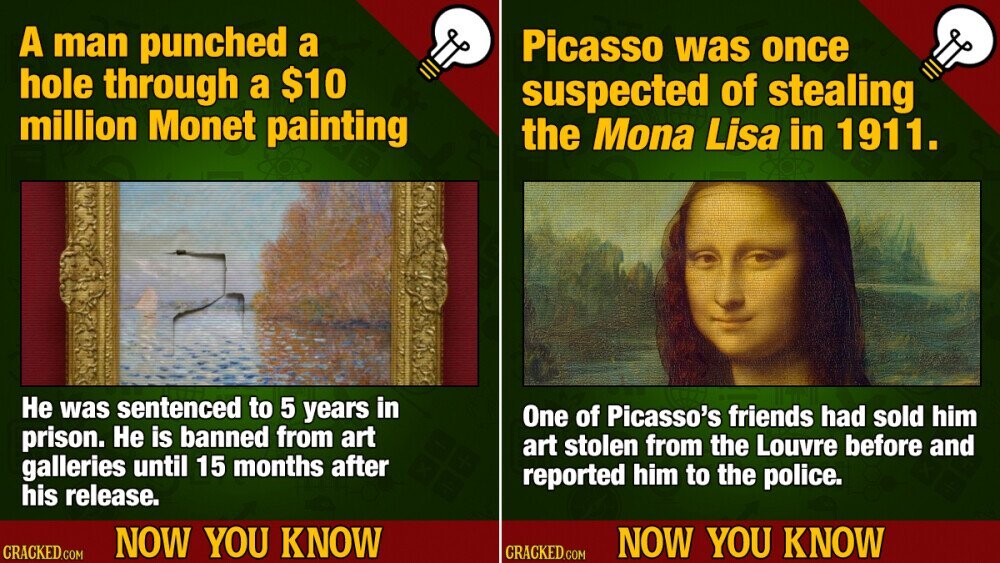
The Mona Lisa was admired before 1911, but its theft from the Louvre helped transform it into a global celebrity. Vincenzo Peruggia, who had worked at the museum, removed the painting and kept it hidden for more than two years. The media frenzy made people obsess over the empty space where Leonardo’s portrait had hung. When the painting was recovered, it returned not just as a masterpiece but as a superstar. Basically, the Mona Lisa got the kind of publicity campaign no museum could ethically plan, and her mysterious smile has been booked solid ever since.
5. The word “Impressionism” began as an insult
Today, Impressionism is beloved for its shimmering light, quick brushwork, and dreamy scenes of modern life. But the name came from criticism. In 1874, Claude Monet exhibited Impression, Sunrise, and critic Louis Leroy mocked the loose, sketch-like quality of the work. The term “Impressionist” stuck, and the artists eventually wore it like a badge. This is one of art history’s best examples of turning a bad review into branding gold. Imagine being roasted in print and accidentally founding one of the most popular art movements in the world. Monet did not just paint sunlight; he weaponized criticism.
6. Linear perspective changed painting like a visual magic trick
Before the Renaissance, artists had many ways to suggest space, but linear perspective gave them a more mathematical system for creating convincing depth. Using a horizon line, orthogonals, and a vanishing point, painters could make flat surfaces look like believable three-dimensional worlds. Filippo Brunelleschi’s experiments and later written explanations by Leon Battista Alberti helped popularize this visual technology. Once artists mastered perspective, walls could become streets, chapels could open into illusionistic architecture, and viewers could feel pulled into painted space. It was basically the Renaissance version of discovering 3D mode.
7. Michelangelo did not paint the Sistine Chapel lying flat on his back
The popular image of Michelangelo reclining comfortably under the Sistine Chapel ceiling is dramatic, but not quite right. Historical accounts and modern summaries indicate that he worked standing on scaffolding, craning his neck and reaching upward while painting frescoes between 1508 and 1512. That sounds less like a cozy artist nap and more like the world’s most exhausting shoulder workout. The myth persists because it is visually memorable, but the truth is even more impressive. Michelangelo created one of Western art’s greatest achievements while fighting gravity, wet plaster, and probably a very angry spine.
8. Caravaggio made sacred scenes look startlingly real
Caravaggio’s paintings shocked viewers because they brought religious drama down to earth. His figures often look like real people pulled from the street, placed under theatrical lighting, and frozen at the most intense second of the story. His use of chiaroscurostrong contrasts of light and darkgave scenes emotional force and influenced generations of artists. The result was not polite holiness wrapped in gold leaf. It was blood, shadow, sweat, and revelation. Caravaggio made viewers feel as if the sacred had stepped into a dim room and slammed the door behind it.
9. Trompe l’oeil art is designed to fool your eyes
Trompe l’oeil means “deceive the eye,” and that is exactly the point. Artists use extreme realism, life-size details, shadows, and clever perspective to make painted objects appear real. A painted letter may seem pinned to a board; a fake window may seem to open into another room; a flat surface may pretend to be carved stone. The National Gallery of Art has described illusionistic works as art that momentarily fools the eye with the appearance of reality. So yes, art history had visual clickbait centuries before the internet. The difference is that old-school clickbait was painted with patience.
10. Van Gogh painted The Starry Night from memory, observation, and imagination
Vincent van Gogh painted The Starry Night in Saint-Rémy in June 1889 while staying at the Saint-Paul-de-Mausole asylum. MoMA notes that the painting was inspired by the view from his window, but it is not a simple copy of what he saw. The village was based on other views, and the cypress and sky were transformed through imagination, mood, and expressive color. That is why the painting feels both real and impossible. Van Gogh did not merely report the night sky; he turned it into emotion with stars, swirls, and blue paint that seems to breathe.
11. Seurat built a famous painting from tiny marks of color
Georges Seurat’s A Sunday on La Grande Jatte1884 looks calm from a distance: people in a park, parasols, water, trees, and a general air of everyone pretending not to be uncomfortable in formal clothing. Up close, however, the image dissolves into dots and dashes of color. Seurat’s technique, often associated with Pointillism, placed small marks of complementary colors side by side so the eye could blend them visually. It was art, optics, and patience in one package. If Impressionism was quick sunlight, Seurat was sunlight organized by a very disciplined spreadsheet.
12. Hokusai’s Great Wave is also about Mount Fuji
Many viewers remember Hokusai’s Great Wave as a giant wave threatening boats, but the print belongs to the series Thirty-six Views of Mount Fuji. Mount Fuji appears in the distance, small and calm beneath the enormous curling wave. Hokusai’s clever perspective makes Japan’s famous mountain seem tiny, while the wave dominates the scene like nature’s dramatic hand gesture. The Met has also highlighted the importance of Prussian blue in the print’s impact. This image became one of the most recognizable works in world art because it balances terror, elegance, design, and a mountain playing hard to get.
13. Duchamp changed art by presenting ordinary objects as art
Marcel Duchamp’s readymades asked a dangerous question: what if the artist’s choice could turn an ordinary manufactured object into art? His most notorious example, Fountain, was a urinal signed “R. Mutt” and submitted in 1917. It challenged the idea that art had to be handmade, beautiful, or traditional. MoMA describes Duchamp’s readymades as a major expansion of what art could be and how authorship could work. Whether people loved it or hated it, Fountain made art history argue with itselfand honestly, art history has not fully stopped arguing since.
14. Modern technology lets conservators see beneath the surface
Art history is not only about looking at paintings; it is also about looking through them. Conservators use tools such as infrared reflectography, X-radiography, ultraviolet light, microscopy, and pigment analysis to study underdrawings, changes, restorations, and hidden layers. These methods can reveal where artists changed their minds, reused materials, or adjusted compositions. The National Gallery of Art and The Met both describe technical examination as a way to understand process and condition. In other words, museums have turned paintings into detective stories. The canvas may look quiet, but under the surface it is often whispering, “You should see my first draft.”
Why These Art History Facts Still Matter
The best art history facts are not random decorations. They change how we see. Knowing that ancient sculpture was painted helps us question modern assumptions about “classical” taste. Learning that ultramarine was expensive reveals how economics shaped beauty. Discovering that Impressionism began as an insult reminds us that innovation often looks unfinished before it looks influential. Understanding Duchamp explains why contemporary art can involve ideas as much as objects. Seeing Van Gogh’s Starry Night as a blend of observation and invention helps us appreciate art as more than visual accuracy.
Art history also teaches that every masterpiece is part of a larger network: materials, patrons, politics, technology, criticism, trade, travel, religion, and public reaction. A painting is never only paint. A sculpture is never only stone. A print is never only paper. Each artwork carries decisions, accidents, costs, arguments, and cultural values. That is why a museum visit becomes more rewarding when you know a few hidden stories. Suddenly, the quiet gallery is not quiet at all. It is full of pigment recipes, stolen portraits, optical tricks, rejected exhibitions, and artists having very strong opinions about everything.
of Personal Experience and Reflection: Seeing Art History With Fresh Eyes
One of the most useful experiences related to art history is visiting a museum with one simple rule: do not try to see everything. Many people enter a major museum like they are on a competitive sport schedule. They race from masterpiece to masterpiece, photograph the label, nod solemnly, and move on before their feet file a formal complaint. But art history becomes far more enjoyable when you slow down and choose a few works to study deeply.
Start with one painting or sculpture and ask practical questions. What is the first thing your eye notices? Is the artist guiding you with light, color, gesture, or perspective? Does the work feel calm, tense, funny, wealthy, sacred, political, or strange? Then look for evidence. Maybe the brightest color sits on the most important figure. Maybe the background tells a second story. Maybe the artist uses scale to make a patron look powerful or a saint look supernatural. This habit turns viewing into investigation, and investigation is where art history becomes fun.
Another helpful experience is comparing the artwork with its material reality. A painting is not just an image; it is oil, tempera, canvas, wood panel, pigment, varnish, and time. A sculpture is not just a body; it is marble, bronze, clay, plaster, carving marks, casting seams, and surface wear. When you think about how something was physically made, the artist stops being a distant genius and becomes a skilled worker solving problems. Michelangelo had scaffolding and wet plaster. Hokusai relied on a woodblock print process involving designers, carvers, printers, and publishers. Seurat needed methodical dots. Duchamp needed a concept sharp enough to make an ordinary object explode into debate.
For writers, teachers, and content creators, art history is also a rich storytelling toolbox. The strongest art-history content usually combines fact with surprise. Instead of only saying “Van Gogh was a Post-Impressionist,” explain that The Starry Night was inspired by a view from an asylum window but transformed through memory and imagination. Instead of saying “Impressionism began in France,” explain that its name came from a critic’s insult. Instead of saying “ancient sculpture was beautiful,” explain that much of it was once painted and may have looked dramatically different from the white marble we imagine today.
The final experience is emotional: art history makes the past feel crowded with living minds. Artists were not simply producing objects for future textbooks. They were experimenting, competing, grieving, joking, worshiping, protesting, selling, failing, and trying again. Some wanted beauty. Some wanted truth. Some wanted money. Some wanted to annoy the establishment, and a few succeeded spectacularly. When you look at art with that awareness, every gallery becomes a room full of human decisions. That is the real “now-you-know” reward: art stops being distant and starts feeling wonderfully, stubbornly alive.
Conclusion
These 14 facts from art history show that masterpieces are rarely simple. They are made from minerals, myths, scandals, experiments, market forces, stolen moments, and bold ideas. Ancient artists engineered pigments. Renaissance painters used math to bend space. Critics accidentally named movements. Modern artists asked whether an idea could matter as much as a handmade object. Conservators now use technology to uncover hidden drafts beneath famous surfaces.
That is why art history remains endlessly fascinating. It is not only a record of beautiful things; it is a record of human curiosity. Every time we learn a new detail, an artwork becomes less like a frozen image and more like a conversation. And once you start hearing that conversation, museum walls never feel silent again.













