
When American Pie arrived in 1999, it looked like a simple teen comedy with one unforgettable baked-goods incident and a cast of painfully awkward high school seniors trying to survive adolescence. It was loud, embarrassing, sentimental, and proudly inappropriate. In other words, it was exactly the kind of movie that could only have escaped from the late 1990s wearing cargo shorts and smelling faintly of hair gel.
But what began as a surprisingly sweet coming-of-age comedy eventually became one of the strangest long-running franchises in modern teen comedy. The American Pie series did not merely continue. It multiplied. It jumped from theaters to direct-to-video sequels, replaced its original cast with cousins, brothers, distant relatives, and spiritual knockoffs, then circled back years later for a nostalgia-heavy reunion. Somewhere along the way, the franchise became less like a slice of pie and more like a dessert buffet assembled during a power outage.
This is the story of how the American Pie movies descended into madness: from relatable teenage panic to franchise logic, from heartwarming embarrassment to increasingly wild spin-offs, and from one iconic R-rated comedy to a pop-culture time capsule that refuses to stay in the yearbook.
Why the First American Pie Worked So Well
The original American Pie was not subtle, and honestly, subtlety would have looked terrified in the corner. The movie followed Jim, Oz, Finch, and Kevin, four high school friends who make a pact to lose their virginity before graduation. That setup sounds like a recipe for cheap jokes, and yes, the movie absolutely serves cheap jokes by the tray. Yet the reason it worked was that underneath the outrageous humor, the characters felt nervous, confused, and weirdly sincere.
Jim Levenstein, played by Jason Biggs, became the face of teenage humiliation. He was not a cool rebel or a smooth-talking romantic lead. He was a walking emergency siren in human form. Every attempt he made to become more confident somehow turned into a public safety warning. The famous pie scene may have made the movie infamous, but the real hook was Jim’s complete inability to be normal for more than 45 seconds.
The supporting cast gave the movie its balance. Chris Klein’s Oz was a jock learning emotional honesty. Thomas Ian Nicholas’s Kevin was the boyfriend trying to understand intimacy beyond bragging rights. Eddie Kaye Thomas’s Finch transformed social awkwardness into a strange form of mythmaking. Alyson Hannigan’s Michelle turned one repeated band camp line into a cultural grenade. Eugene Levy, as Jim’s dad Noah Levenstein, gave the series its most reliable source of warmth: a parent who could make any conversation both mortifying and supportive.
What made the first movie more than a gross-out comedy was its soft center. It understood that teenage sexuality is often less about conquest than insecurity. Everyone is pretending to know what they are doing. Nobody does. That was the emotional truth hiding under the whipped cream, awkward pauses, and panic-sweating.
The Sequel Problem: Bigger, Louder, Stickier
After the first film became a major hit, a sequel was inevitable. American Pie 2, released in 2001, brought the group back after their first year of college. This time, the boys rent a beach house, reunite with old friends, and attempt to recreate the chaotic magic of their high school days. In classic sequel fashion, everything is bigger: the parties, the misunderstandings, the sexual disasters, and the pressure to repeat the jokes audiences remembered.
To its credit, American Pie 2 still has charm. Jim and Michelle’s relationship grows in a way that feels earned, and the movie understands the bittersweet weirdness of returning home after college changes everyone just enough to make friendships feel slightly out of tune. The problem is that the film also starts leaning harder into franchise machinery. It knows which characters people laughed at, so it pushes them forward. It knows which jokes became famous, so it reheats them. It knows Stifler is popular, so Stifler becomes less of a chaotic side dish and more of a main course with a foghorn.
This is where the descent begins. The original movie used raunch as a delivery system for embarrassment and growing up. The sequel sometimes uses embarrassment as an excuse to deliver more raunch. That may sound like splitting hairs, but in comedy, that difference matters. One feels like a story. The other feels like a checklist taped to a beer cooler.
American Wedding and the Stifler Takeover
By the time American Wedding arrived in 2003, the series had narrowed its focus. The movie centers on Jim and Michelle’s wedding, which should have been the perfect emotional endpoint for the original arc. Jim, the most awkward teenager in East Great Falls history, is getting married. Michelle, once introduced as the ultimate surprise punchline, becomes the romantic center of the story. Jim’s dad is still there, gently turning every sincere conversation into an accidental health-class demonstration.
But American Wedding also reveals the franchise’s growing addiction to Stifler. Seann William Scott’s Steve Stifler was hilarious in the original because he was a disruption. He barged into scenes like a human air horn. He was offensive, loud, selfish, and strangely magnetic. Used sparingly, he was comic gasoline. Used too much, he became the entire fire department report.
In the third film, Stifler dominates the plot. He ruins plans, causes disasters, competes for attention, and becomes both villain and hero depending on what the scene needs. The movie still has funny moments, especially when it lets Jim and Michelle be sweetly bizarre together, but the balance has shifted. The ensemble comedy has become a Stifler containment exercise.
That shift matters because American Pie originally worked as a group portrait of awkward youth. American Wedding turns the franchise into a louder, narrower machine. The madness is no longer accidental. It has a name, a spiked haircut, and probably a terrible idea involving a dance floor.
The Direct-to-Video Era: Welcome to the Stifler Family Tree
Then came the era that truly pushed the franchise into beautiful, baffling chaos: American Pie Presents. These spin-offs moved away from the theatrical core cast and into direct-to-video territory, beginning with Band Camp in 2005. The idea was simple: keep the brand, keep the raunchy teen comedy formula, keep Eugene Levy whenever possible, and replace the main characters with new teenagers connected loosely to the Stifler bloodline.
This is where the series stops descending a staircase and starts using a laundry chute. Band Camp follows Matt Stifler, Steve’s younger brother, as he gets sent to band camp after a prank goes wrong. The title alone shows how the franchise had begun mining its own jokes. A throwaway line from the first movie had become the foundation for an entire spin-off. That is not world-building. That is rummaging through the couch cushions of nostalgia and finding a DVD budget.
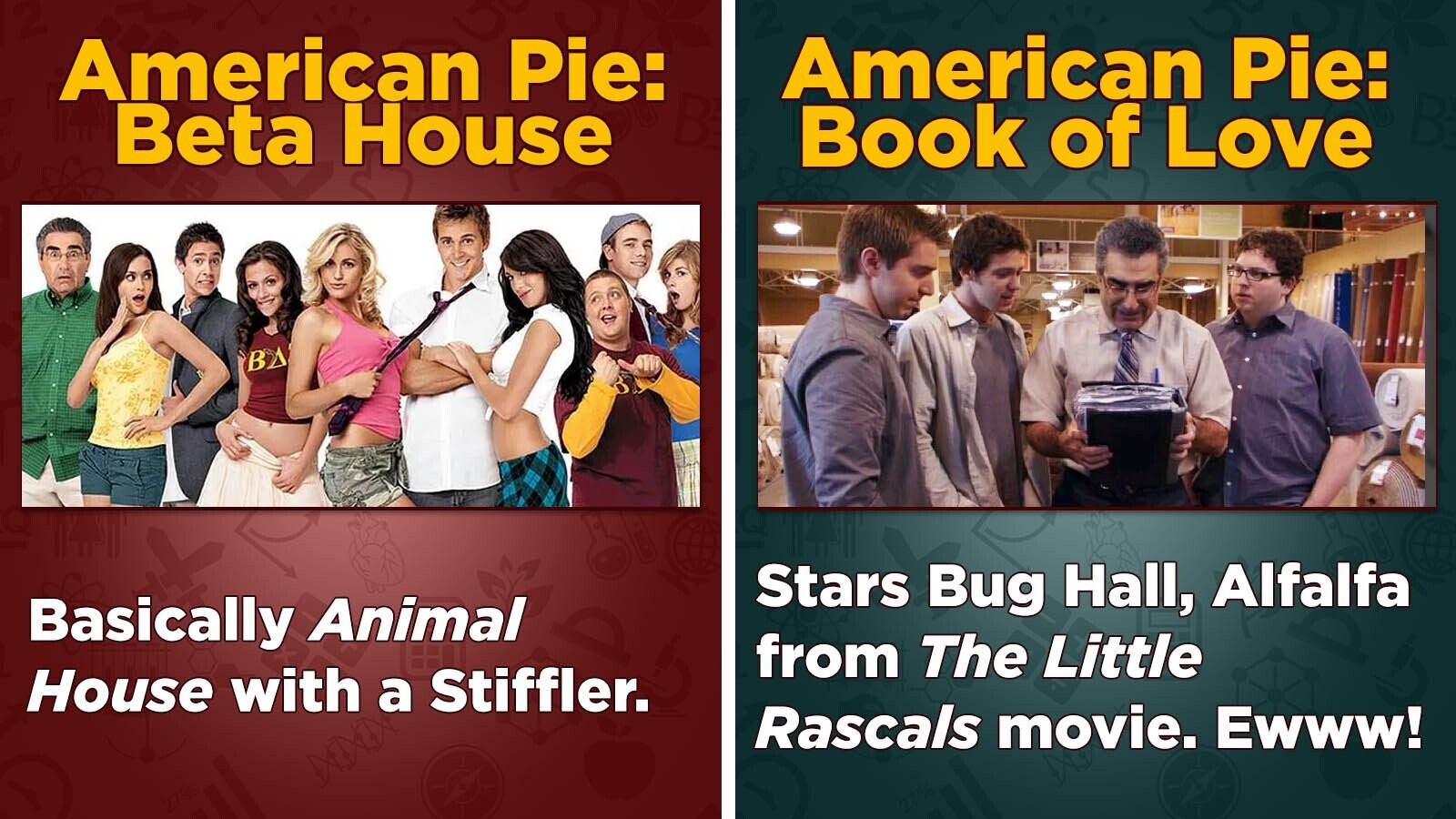
The Naked Mile followed in 2006, shifting attention to Erik Stifler, another relative trying to live up to the family’s legendary bad behavior. Beta House arrived in 2007 and moved the action into fraternity territory, where the franchise could indulge in college-party chaos without pretending too hard to be about emotional growth. By The Book of Love in 2009, the series had returned to East Great Falls High and introduced a legendary sex manual as if the franchise had discovered its own sacred scripture.
These movies are fascinating because they feel less like sequels and more like experiments in brand survival. How little of the original recipe can remain before the dessert is no longer pie? The answer, apparently, is: a Stifler relative, a few outrageous set pieces, a connection to East Great Falls, and Eugene Levy appearing as the franchise’s patient guardian angel.
American Reunion: Nostalgia Comes Home Wearing a Name Tag
In 2012, American Reunion brought the original cast back for a high school reunion. On paper, this was the smartest possible move. The direct-to-video spin-offs had stretched the brand thin, and the theatrical series needed the people who made audiences care in the first place. Jim, Michelle, Oz, Kevin, Finch, Stifler, Vicky, Heather, Nadia, and Jim’s dad all return, older but not necessarily wiser.
The movie’s central joke is that adulthood does not magically solve awkwardness. Jim is now a husband and father, but he can still stumble into humiliation with Olympic consistency. Stifler is trapped in an office job that cannot contain his party-goblin spirit. Oz is famous but emotionally unfulfilled. Kevin has settled into domestic life. Finch is still performing a version of himself. Everyone is asking the same question in different outfits: what happened to the person I thought I would become?
That idea gives American Reunion more emotional weight than it sometimes gets credit for. The movie is drenched in nostalgia, but it also recognizes the melancholy of revisiting your youth and realizing the building is smaller than you remembered. Still, the film cannot resist dragging every old joke out for one more victory lap. Some land. Some wheeze. Some arrive wearing a reunion badge and asking where the punch bowl is.
Yet compared with the spin-offs, American Reunion feels grounded. That may sound ridiculous for a movie full of raunchy callbacks, but the original cast brings history. Their chemistry reminds viewers why the franchise mattered before it became a Stifler genealogy project.
Girls’ Rules and the Attempt to Flip the Formula
In 2020, American Pie Presents: Girls’ Rules tried to update the spin-off formula by shifting the focus to four female high school seniors. The concept made sense. The original franchise was heavily built around male anxiety, male bragging, and male embarrassment. A version told from the girls’ perspective could have been a smart modernization, especially after years of teen comedies becoming more self-aware, inclusive, and emotionally honest.
The challenge was that the American Pie brand came with baggage. Audiences expected outrageous humor, but comedy culture had changed. What felt rebellious in 1999 could feel stale or uncomfortable decades later. Girls’ Rules had to be connected enough to the franchise to justify the title, but different enough to avoid feeling like a museum exhibit labeled “Please Do Not Touch the Problematic Joke.”
The result was another strange chapter in the franchise’s ongoing identity crisis. Was American Pie a coming-of-age series? A gross-out comedy brand? A nostalgia machine? A direct-to-video label that could be attached to almost any teen misadventure? By this point, the answer was yes, no, maybe, and please check the DVD aisle.
How the Series Reflects Changing Teen Comedy
The madness of the American Pie series is not just about sequels. It is also about timing. The first movie arrived when R-rated teen comedies could still feel like dangerous mainstream events. The internet existed, but social media had not yet turned every embarrassing teenage moment into a permanent public archive. The characters in American Pie could humiliate themselves, recover, and still graduate without a viral clip following them into job interviews.
Later teen comedies had to evolve. Movies like Superbad, Easy A, Booksmart, and other coming-of-age stories became more aware of gender, consent, identity, and emotional nuance. The comedy did not disappear, but the targets changed. The best modern teen movies often laugh at insecurity rather than exploiting it.
That shift makes revisiting American Pie complicated. The original remains influential, but parts of it are unmistakably locked in their era. Some jokes still work because embarrassment is timeless. Others feel like artifacts from a time when teen comedy often confused shock value with honesty. The series’ descent into madness mirrors the genre’s struggle to grow up. Ironically, a franchise obsessed with coming of age had trouble maturing.
Why Stifler Became Both the Secret Weapon and the Warning Sign
No discussion of the American Pie series is complete without Stifler, the human embodiment of a red plastic cup. He is one of the most memorable characters in the franchise and one of the clearest examples of how a breakout supporting role can distort an entire series.
In the original film, Stifler works because he is not the emotional center. He is the guy everyone knows, tolerates, fears, laughs at, and occasionally uses for access to a party. His selfishness is funny because the movie understands he is ridiculous. But as the sequels progress, Stifler becomes more central, and the spin-offs turn his family name into franchise glue.
This is how a successful comic ingredient becomes a warning sign. The more the series depends on Stifler energy, the less room it has for the awkward sincerity that made the original connect. Stifler is funny as spice. The direct-to-video era tries to make an entire meal out of spice. That is how you end up with a cinematic stomachache.
The Real Madness: A Franchise That Could Not Let Go
The American Pie series descends into madness because it keeps trying to solve the same problem: how do you repeat a movie that was successful because it felt like a specific moment in youth? The first film captured the terror of being young, inexperienced, and desperate to seem less clueless than you are. That is universal. But the exact style, slang, shock humor, and gender politics were deeply tied to 1999.
Instead of reinventing itself, the franchise mostly repeated itself. Another pact. Another awkward virgin. Another party. Another Stifler. Another connection to East Great Falls. Another attempt to turn humiliation into legend. The results range from funny to exhausting, but the pattern is fascinating. The movies become increasingly aware that they are chasing their own shadow.
And yet, the franchise survives in memory because the best parts are genuinely memorable. Jim’s dad remains one of comedy’s great awkward parents. Michelle is more than a punchline. Stifler, for better and worse, is impossible to forget. The first movie’s soundtrack, late-1990s fashion, and emotional sincerity make it a comfort watch for many viewers who grew up with it. Even the weaker entries have a strange archaeological value. They show what happens when Hollywood keeps baking from the same recipe long after the kitchen has caught fire.
Viewing Experience: Watching the American Pie Series Lose Its Mind
Watching the American Pie series from beginning to end feels like opening an old yearbook and slowly realizing someone has glued extra pages into it from three different schools. The first movie has the grainy, chaotic energy of a late-1990s sleepover rental. It is awkward, loud, and frequently ridiculous, but it has a pulse. You can feel the nervousness of the characters. You can also feel the filmmakers trying to make something that is both shocking and oddly affectionate.
The second movie feels like returning to a summer house with friends who are pretending college made them cooler. Everyone is still recognizable, but the jokes are bigger and the movie is more aware of its own reputation. It is fun in the way reunions with old friends can be fun: familiar, slightly repetitive, and full of stories everyone insists on retelling even though you were there the first time.
Then American Wedding arrives, and the experience changes. Suddenly, the franchise is not about adolescence so much as managing the chaos it created. Jim and Michelle’s relationship gives the movie heart, but Stifler’s antics keep grabbing the steering wheel. Watching it is like attending a wedding where the best man has mistaken the reception for a demolition derby.
The direct-to-video spin-offs are where the viewing experience becomes surreal. At first, Band Camp seems like a harmless attempt to squeeze more comedy from a famous line. Then the series keeps going, and you realize the franchise has built an entire underground tunnel system beneath its original jokes. Every new Stifler relative feels like someone found another cousin in a filing cabinet. The movies are not always good, but they are oddly fascinating because they show the mechanics of franchise extension with zero shame. They ask, “Can we keep this going?” and answer, “Only if another Stifler owns a hoodie.”
By the time American Reunion brings the original cast back, the experience becomes unexpectedly reflective. You are no longer just watching characters revisit high school; you are watching a franchise confront its own age. The actors have grown older, the audience has grown older, and the jokes have grown creakier. Still, there is something warm about seeing the core group together again. The movie understands that nostalgia is embarrassing, but it also understands that embarrassment was always the franchise’s native language.
The strangest part of watching the whole series is realizing that its madness is also its identity. American Pie was never built to be elegant. It was built to be messy, hormone-driven, sentimental, and occasionally out of control. The sequels simply pushed that messiness to its limit. Some franchises descend into darkness. This one descended into awkward family trees, reunion speeches, DVD sequels, and jokes that should probably be wrapped in caution tape. Somehow, that feels perfectly on brand.
Conclusion: The Pie That Would Not Cool Down
The American Pie series descends into madness because it begins with a relatable emotional premise and gradually turns into a franchise built around callbacks, relatives, and escalating shock humor. The original film worked because it mixed raunch with vulnerability. The sequels worked best when they remembered the vulnerability. They struggled when they treated outrageousness as the whole point.
Still, the franchise remains important in the history of American teen comedy. It helped revive mainstream interest in R-rated coming-of-age humor, launched several recognizable stars, and created pop-culture moments that remain instantly identifiable decades later. It is dated, uneven, and frequently absurd, but it is also strangely durable. Like the most chaotic high school memory, it survives because nobody involved can believe it happened in the first place.














