
Editor’s note: Box office rankings can shift whenever a hit movie is still playing, a classic gets re-released, or a studio updates international totals. The figures below reflect worldwide lifetime grosses in nominal U.S. dollars, not adjusted for inflation, as of early July 2026.
Movie history has many ways to measure greatness. Critics have awards. Fans have favorite lines they repeat until their friends politely leave the room. Studios, however, have the box office: the giant scoreboard where popcorn, nostalgia, superheroes, blue aliens, dinosaurs, animated feelings, and one very determined doll in pink all compete for global supremacy.
The highest-grossing movies ever are not simply the films that made people buy tickets. They are cultural events. They inspire midnight screenings, theme park rides, Halloween costumes, questionable sequel pitches, and family debates over whether “just one more trailer” means five minutes or half an hour. Looking at the top 100 highest-grossing movies worldwide reveals what audiences keep choosing on the biggest possible scale: spectacle, familiar characters, emotional payoffs, and stories that travel well across languages and borders.
What Counts As A Highest-Grossing Movie?
For this list, “highest-grossing” means worldwide theatrical box office revenue: domestic sales in the United States and Canada plus international ticket sales. It does not include streaming deals, TV licensing, toys, video games, lunchboxes, theme park churros, or the emotional value of seeing a theater erupt when Captain America finally says, “Avengers, assemble.”
It is also important to remember that these rankings are not inflation-adjusted. That means a modern blockbuster with premium formats, IMAX, 3D surcharges, global rollouts, and higher average ticket prices has an obvious advantage over older films. In inflation-adjusted discussions, classics such as Gone with the Wind, Star Wars, The Sound of Music, and E.T. the Extra-Terrestrial rise dramatically. But in raw worldwide grosses, recent franchise films dominate the leaderboard like superheroes at a buffet.
The 100 Highest-Grossing Movies Ever Worldwide
| Rank | Movie | Year | Worldwide Gross |
|---|---|---|---|
| 1 | Avatar | 2009 | $2,923,710,708 |
| 2 | Avengers: Endgame | 2019 | $2,799,439,100 |
| 3 | Avatar: The Way of Water | 2022 | $2,334,484,620 |
| 4 | Ne Zha 2 | 2025 | $2,267,446,370 |
| 5 | Titanic | 1997 | $2,264,812,968 |
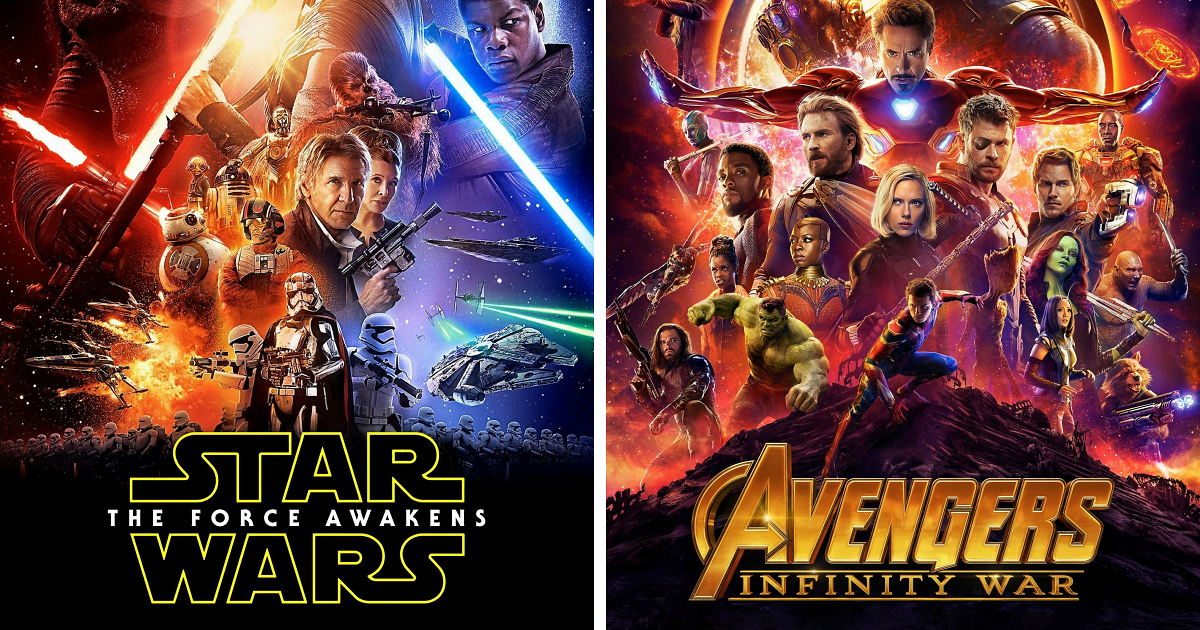
| 6 | Star Wars: Episode VII – The Force Awakens | 2015 | $2,071,310,218 |
| 7 | Avengers: Infinity War | 2018 | $2,052,415,039 |
| 8 | Spider-Man: No Way Home | 2021 | $1,921,426,073 |
| 9 | Zootopia 2 | 2025 | $1,866,647,950 |
| 10 | Inside Out 2 | 2024 | $1,698,863,816 |
| 11 | Jurassic World | 2015 | $1,671,537,444 |
| 12 | The Lion King | 2019 | $1,662,020,819 |
| 13 | The Avengers | 2012 | $1,520,538,536 |
| 14 | Furious 7 | 2015 | $1,515,342,457 |
| 15 | Top Gun: Maverick | 2022 | $1,503,260,455 |
| 16 | Avatar: Fire and Ash | 2025 | $1,485,999,890 |
| 17 | Frozen II | 2019 | $1,453,683,476 |
| 18 | Barbie | 2023 | $1,447,138,421 |
| 19 | Avengers: Age of Ultron | 2015 | $1,405,018,048 |
| 20 | The Super Mario Bros. Movie | 2023 | $1,360,783,214 |
| 21 | Black Panther | 2018 | $1,349,926,083 |
| 22 | Harry Potter and the Deathly Hallows: Part 2 | 2011 | $1,342,942,050 |
| 23 | Deadpool & Wolverine | 2024 | $1,338,073,645 |
| 24 | Star Wars: Episode VIII – The Last Jedi | 2017 | $1,334,407,706 |
| 25 | Jurassic World: Fallen Kingdom | 2018 | $1,308,566,455 |
| 26 | Frozen | 2013 | $1,284,879,663 |
| 27 | Beauty and the Beast | 2017 | $1,266,115,964 |
| 28 | Incredibles 2 | 2018 | $1,243,225,667 |
| 29 | The Fate of the Furious | 2017 | $1,236,009,236 |
| 30 | Iron Man 3 | 2013 | $1,215,577,205 |
| 31 | Minions | 2015 | $1,159,457,503 |
| 32 | Captain America: Civil War | 2016 | $1,155,046,416 |
| 33 | Aquaman | 2018 | $1,152,028,393 |
| 34 | The Lord of the Rings: The Return of the King | 2003 | $1,149,453,674 |
| 35 | Spider-Man: Far from Home | 2019 | $1,132,723,226 |
| 36 | Captain Marvel | 2019 | $1,131,416,446 |
| 37 | Transformers: Dark of the Moon | 2011 | $1,123,794,079 |
| 38 | Skyfall | 2012 | $1,108,594,137 |
| 39 | Transformers: Age of Extinction | 2014 | $1,105,261,713 |
| 40 | Jurassic Park | 1993 | $1,103,110,411 |
| 41 | The Dark Knight Rises | 2012 | $1,085,429,532 |
| 42 | Joker | 2019 | $1,078,958,629 |
| 43 | Star Wars: Episode IX – The Rise of Skywalker | 2019 | $1,077,022,372 |
| 44 | Toy Story 4 | 2019 | $1,073,841,394 |
| 45 | Toy Story 3 | 2010 | $1,067,316,101 |
| 46 | Pirates of the Caribbean: Dead Man’s Chest | 2006 | $1,066,179,747 |
| 47 | Moana 2 | 2024 | $1,059,242,164 |
| 48 | Rogue One: A Star Wars Story | 2016 | $1,058,684,742 |
| 49 | Aladdin | 2019 | $1,054,304,000 |
| 50 | Pirates of the Caribbean: On Stranger Tides | 2011 | $1,046,721,266 |
| 51 | Star Wars: Episode I – The Phantom Menace | 1999 | $1,046,515,409 |
| 52 | Lilo & Stitch | 2025 | $1,038,027,526 |
| 53 | Despicable Me 3 | 2017 | $1,034,800,131 |
| 54 | Harry Potter and the Sorcerer’s Stone | 2001 | $1,029,374,615 |
| 55 | Finding Dory | 2016 | $1,029,266,989 |
| 56 | Zootopia | 2016 | $1,025,521,689 |
| 57 | Alice in Wonderland | 2010 | $1,025,468,216 |
| 58 | The Hobbit: An Unexpected Journey | 2012 | $1,017,453,991 |
| 59 | The Super Mario Galaxy Movie | 2026 | $1,008,721,015 |
| 60 | The Dark Knight | 2008 | $1,008,480,203 |
| 61 | Jurassic World: Dominion | 2022 | $1,001,978,080 |
| 62 | The Lion King | 1994 | $979,161,632 |
| 63 | Michael | 2026 | $977,864,221 |
| 64 | Oppenheimer | 2023 | $975,811,333 |
| 65 | Despicable Me 4 | 2024 | $972,021,410 |
| 66 | Despicable Me 2 | 2013 | $970,766,005 |
| 67 | The Jungle Book | 2016 | $967,724,775 |
| 68 | The Hobbit: The Battle of the Five Armies | 2014 | $962,749,443 |
| 69 | Jumanji: Welcome to the Jungle | 2017 | $962,544,585 |
| 70 | Pirates of the Caribbean: At World’s End | 2007 | $961,691,209 |
| 71 | Harry Potter and the Deathly Hallows: Part 1 | 2010 | $960,858,478 |
| 72 | A Minecraft Movie | 2025 | $960,387,780 |
| 73 | The Hobbit: The Desolation of Smaug | 2013 | $959,079,095 |
| 74 | Doctor Strange in the Multiverse of Madness | 2022 | $955,775,804 |
| 75 | The Lord of the Rings: The Two Towers | 2002 | $945,226,412 |
| 76 | Harry Potter and the Order of the Phoenix | 2007 | $942,872,838 |
| 77 | Finding Nemo | 2003 | $941,637,960 |
| 78 | Harry Potter and the Half-Blood Prince | 2009 | $941,056,063 |
| 79 | Minions: The Rise of Gru | 2022 | $940,482,695 |
| 80 | Shrek 2 | 2004 | $932,542,741 |
| 81 | Bohemian Rhapsody | 2018 | $911,027,169 |
| 82 | Star Wars: Episode III – Revenge of the Sith | 2005 | $905,595,947 |
| 83 | The Battle at Lake Changjin | 2021 | $902,548,476 |
| 84 | Harry Potter and the Goblet of Fire | 2005 | $900,435,886 |
| 85 | The Lord of the Rings: The Fellowship of the Ring | 2001 | $897,519,866 |
| 86 | Spider-Man 3 | 2007 | $887,415,130 |
| 87 | Ice Age: Dawn of the Dinosaurs | 2009 | $886,686,817 |
| 88 | Harry Potter and the Chamber of Secrets | 2002 | $883,386,103 |
| 89 | Spider-Man: Homecoming | 2017 | $880,978,185 |
| 90 | Spectre | 2015 | $880,707,597 |
| 91 | Ice Age: Continental Drift | 2012 | $877,244,782 |
| 92 | The Secret Life of Pets | 2016 | $875,698,161 |
| 93 | Batman v Superman: Dawn of Justice | 2016 | $874,362,803 |
| 94 | Wolf Warrior 2 | 2017 | $870,325,439 |
| 95 | Jurassic World: Rebirth | 2025 | $869,146,189 |
| 96 | The Twilight Saga: Breaking Dawn – Part 2 | 2012 | $868,599,758 |
| 97 | The Hunger Games: Catching Fire | 2013 | $865,216,075 |
| 98 | Inception | 2010 | $864,535,015 |
| 99 | Guardians of the Galaxy Vol. 2 | 2017 | $863,764,214 |
| 100 | Black Panther: Wakanda Forever | 2022 | $859,208,836 |
Why These Movies Made So Much Money
1. The franchise effect is almost unfair
Look at the list and you will notice a pattern faster than a Marvel post-credit scene can make people sit back down. Sequels, prequels, spin-offs, reboots, remakes, and shared-universe entries are everywhere. Avengers: Endgame was not just one movie; it was the payoff to more than a decade of storytelling. Star Wars: The Force Awakens was not merely a space adventure; it was a global reunion with lightsabers, nostalgia, and a very marketable round droid.
Franchises lower the risk for audiences. People know the world, understand the characters, and arrive with built-in emotional investment. That does not guarantee quality, but it does guarantee curiosity. When a beloved property returns, millions of viewers show up partly to enjoy it and partly to avoid being the one person at work who says, “Wait, Darth Vader was whose father?”
2. International markets now shape the leaderboard
The modern box office is global. A movie can become enormous because it plays well in North America, Europe, Latin America, China, Southeast Asia, and beyond. The success of Ne Zha 2, The Battle at Lake Changjin, and Wolf Warrior 2 proves that the all-time list is no longer only a Hollywood scoreboard. Local-market power can now push films into global history.
This matters because studios increasingly design blockbusters for worldwide audiences. Visual storytelling, action, comedy, fantasy, animation, and recognizable emotional themes travel more easily than dialogue-heavy stories filled with regional references. Exploding dinosaurs, heroic underdogs, family reunions, and giant blue oceans need very little translation.
3. Premium formats turn excitement into bigger grosses
Movies like Avatar, Avatar: The Way of Water, Top Gun: Maverick, and Oppenheimer benefited from the idea that the theater itself was part of the experience. These were films people wanted to see big, loud, sharp, and preferably with a screen large enough to make their living room feel like a postage stamp.
Premium large formats, IMAX, 3D, and other higher-priced experiences can boost total grosses significantly. When a movie becomes a “you have to see this in theaters” event, it separates itself from the endless streaming queue where every title is competing with laundry, snacks, and the dangerous temptation to check your phone.
4. Animation is a box office superpower
Animated movies dominate this list because they attract multiple generations at once. Frozen, Inside Out 2, Zootopia, Finding Dory, The Super Mario Bros. Movie, and Minions are not just children’s films. They are family outings, nostalgia machines, soundtrack factories, and sometimes emotional sneak attacks. Pixar, Disney Animation, Illumination, DreamWorks, and global animation studios have turned colorful characters into billion-dollar ambassadors.
The smartest animated hits balance simple concepts with universal feelings. Inside Out 2 turned anxiety into a character. Frozen made sisterhood and self-acceptance sing. Minions proved that nonsense syllables can be more profitable than many carefully polished speeches.
The Biggest Lessons From The Top 100
Originality can still win, but it needs an event hook
Many of the highest-grossing movies ever are connected to existing intellectual property, but original or relatively fresh ideas can still explode. Avatar built a new world from scratch and became the biggest movie ever. Titanic combined history, romance, spectacle, and tragedy so effectively that audiences returned again and again. Inception turned dream architecture into a summer blockbuster, which sounds impossible until Christopher Nolan shows up with folding cities and a spinning top.
The catch is that original blockbusters need a strong reason to leave the house. They need scale, mystery, a famous filmmaker, breakthrough technology, emotional urgency, or word-of-mouth strong enough to make people feel left out if they stay home.
Re-releases and long legs matter
Box office glory is not always about opening weekend. Avatar and Titanic both benefited from re-releases and long theatrical lives. Older hits often returned to theaters before home video, streaming, and instant digital rentals changed viewing habits. A movie that keeps selling tickets month after month can defeat a movie that opens huge and vanishes quickly.
In box office language, “legs” means staying power. In everyday language, it means a movie refuses to leave the party even after the lights come on. Family films, holiday releases, crowd-pleasers, and movies with strong repeat viewing often have the best legs.
Emotion is still the secret weapon
Yes, giant franchises dominate. Yes, visual effects matter. But the highest-grossing films usually give audiences something to feel. Black Panther became a cultural milestone. Furious 7 carried a real-world farewell to Paul Walker. Top Gun: Maverick offered nostalgia, old-school movie-star charisma, and aerial sequences that made viewers grip their armrests. Barbie turned a toy brand into a colorful conversation about identity, growing up, and the weird burden of being perfect in plastic heels.
People pay for spectacle, but they remember emotion. The films that reach the top of the worldwide box office usually deliver both.
Franchises That Dominate The List
The Marvel Cinematic Universe appears repeatedly, with Avengers: Endgame, Infinity War, The Avengers, Age of Ultron, Black Panther, Captain America: Civil War, Captain Marvel, Doctor Strange in the Multiverse of Madness, and other superhero titles crowding the chart. This is the cinematic equivalent of a group project where everyone actually did the work.
Star Wars remains a heavyweight, with sequel trilogy entries, prequels, and Rogue One showing the power of mythology. Harry Potter is another remarkable case: nearly every main entry became a global event, proving that wizard school was apparently one of the most profitable educational institutions in history.
Jurassic Park and Jurassic World show that audiences will always make room for dinosaurs, especially if those dinosaurs are larger, louder, and somehow still placed inside parks with questionable safety policies. Meanwhile, Fast & Furious, Despicable Me, Minions, Pirates of the Caribbean, The Lord of the Rings, and The Hobbit all prove that strong brands can keep global audiences coming back.
Why “Highest-Grossing” Does Not Always Mean “Best”
A massive box office total does not automatically make a movie the greatest film ever made. It means the film reached a huge audience at the right time, with the right marketing, distribution, release date, and cultural momentum. Some masterpieces never had access to thousands of screens. Some beloved classics were slow burns. Some international films are huge in one market but less visible elsewhere. And some box office giants are best described as “fun, loud, and extremely expensive,” which is not an insult. Sometimes that is exactly what movie night requires.
Still, box office lists are useful because they reveal what audiences collectively choose when a film becomes too big to ignore. They show the power of global fandom, family entertainment, theatrical spectacle, and shared cultural moments. The best box office hits make going to the movies feel like joining a worldwide conversation.
Experience Notes: What Watching The Biggest Box Office Movies Teaches You
One of the best things about following the 100 highest-grossing movies ever is that the list doubles as a memory map. You do not just remember the films; you remember where you were when everyone was talking about them. Maybe you saw Avatar in 3D and spent the next week wondering why real plants were not glowing. Maybe you watched Avengers: Endgame in a packed theater where people cheered so loudly the floor practically filed a noise complaint. Maybe Barbie turned your local cinema into a pink parade, and suddenly the lobby looked like a fashion doll convention with better snacks.
These movies prove that theatrical experiences are social events. Streaming is convenient, but it rarely recreates the electricity of a full auditorium. A great crowd can improve a movie. Laughter becomes contagious. Gasps arrive in waves. Silence can feel powerful when everyone is holding their breath at once. When Top Gun: Maverick sent jets screaming across the screen, the theater made the action feel physical. When Oppenheimer played in premium formats, even quiet scenes felt enormous because the room gave them weight. That kind of shared attention is rare now, and big movies know how to use it.
Another lesson from the all-time box office list is that different audiences go to the movies for different reasons. Families want something everyone can enjoy without a two-hour argument in the parking lot. Teenagers want a film that feels current and meme-ready. Longtime fans want payoff. Casual viewers want spectacle. Parents want air conditioning and 100 minutes where the children are entertained. The most successful films manage to serve several of these groups at once.
Watching the biggest hits also makes you appreciate marketing. A movie does not become a global giant by quietly existing. It becomes an event through trailers, posters, interviews, social media, release timing, merchandise, memes, and word-of-mouth. The campaign around Barbie was practically impossible to escape, and that was the point. The Marvel films turned spoiler avoidance into an Olympic sport. Animated hits often invade households through songs, toys, and repeat viewings until parents can recite dialogue against their will.
The most enjoyable way to explore this list is not to treat it like homework. Treat it like a world tour of popular taste. Watch a superhero movie, then an animated sequel, then a fantasy epic, then a musical biopic, then a science-fiction spectacle. Notice what each one promises. Notice what audiences rewarded. Some will feel timeless. Some will feel like perfect snapshots of their release year. Some may make you wonder how the villain’s plan passed basic common sense. That is part of the fun.
Ultimately, the highest-grossing movies ever remind us that cinema is both art and carnival. It can be emotional, ridiculous, beautiful, loud, moving, commercial, and wonderfully over-the-top. The box office may count dollars, but behind every dollar is a person choosing a seat, buying a ticket, and hoping the lights go down on something worth remembering.
Conclusion
The list of the highest-grossing movies ever is more than a ranking of billion-dollar winners. It is a snapshot of what global audiences love at scale: immersive worlds, familiar heroes, emotional endings, family-friendly animation, franchise payoffs, and theatrical experiences big enough to justify leaving the couch. From Avatar to Black Panther: Wakanda Forever, these 100 films show how movies become cultural landmarks as well as commercial machines.
Some titles rose through nostalgia. Some through technology. Some through international dominance. Some through pure crowd-pleasing charm. The common thread is simple: each movie gave audiences a reason to show up. And in an era crowded with streaming options, short videos, and endless entertainment choices, that is still the ultimate box office magic trick.













