
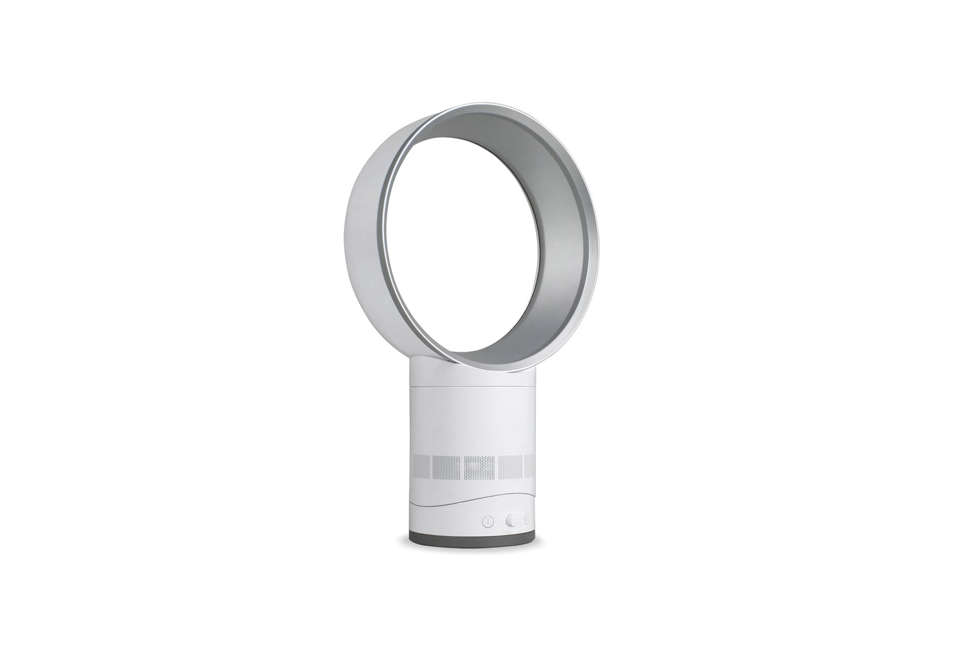
A desk fan is supposed to do one job: keep you from slowly becoming a human puddle while you answer emails, sleep, cook, or pretend your apartment has “cross-breeze potential.” The Dyson Air Multiplier table fan approaches that simple mission with the confidence of a tiny spaceship.
Instead of exposed spinning blades, it uses a smooth loop-shaped amplifier to project a steady stream of air. The result is a fan that looks cleaner, feels more refined, and attracts the kind of attention usually reserved for expensive coffee machines. But is a Dyson Air Multiplier table fan actually worth the premium price, or is it simply a very stylish way to move air around your desk?
This guide breaks down how Dyson Air Multiplier technology works, what to expect from popular desk-style models such as the Dyson Cool AM06, how the newer Dyson Cool table-fan format compares, and who will get the most value from a bladeless desk fan.
What Is a Dyson Air Multiplier Table Fan?
A Dyson Air Multiplier table fan is a compact personal cooling fan that creates airflow through a bladeless-looking loop rather than visible propeller blades. The motor and impeller are housed in the base, where air is pulled in and pushed through a narrow channel around the fan’s circular amplifier.
The air exits through a slim opening around the loop and follows the curved surface of the amplifier. This movement helps draw in additional surrounding air, creating a smoother and more continuous stream of airflow in front of the fan.
It is worth clearing up one common misunderstanding: Dyson fans are not truly “bladeless” on the inside. There is still a motor and an internal impeller doing the hard work. The difference is that the fast-moving parts are hidden in the base instead of sitting behind a grille where your curious cat, toddler, or overly ambitious houseplant can investigate them.
How Dyson Air Multiplier Technology Works
Traditional table fans use exposed blades to chop through the air and push it forward. They can work extremely well, but the airflow may feel gusty or uneven, especially at lower speeds. Dyson’s Air Multiplier design aims to create a smoother stream by channeling air through the loop-shaped amplifier.
Air Is Drawn Into the Base
The fan’s motor sits inside the base. It pulls room air through intake vents and directs it upward into the amplifier. This is why the loop itself looks empty: the mechanical parts are mostly hidden below it.
Air Moves Through a Narrow Ring
Once inside the amplifier, the air is forced through a thin slot around the loop. This creates a focused sheet of air that travels over the curved surface. The movement encourages nearby air to join the flow, helping the fan project a larger stream than the air moved by the internal impeller alone.
The Result Is a Smooth Breeze
In practical terms, the Dyson Air Multiplier table fan produces a breeze that often feels less choppy than a conventional blade fan. It can be especially pleasant for desk work, bedside use, makeup application, or any situation where you want air movement without feeling like you are standing behind a helicopter.
Key Features of Dyson Air Multiplier Desk Fans
Dyson’s desk-format fans have changed over the years, but the core experience remains fairly consistent: compact size, refined controls, adjustable airflow, and a premium build.
Bladeless-Looking Design
The biggest visual feature is the open loop. Because there are no exposed blades or safety grille to clean, the fan looks more minimal than a traditional desk fan. It also fits easily into modern offices, bedrooms, nurseries, dorm rooms, and countertops without looking like it escaped from a 1997 cubicle.
Multiple Airflow Settings
Many Dyson desk fans offer precise speed settings rather than a basic low-medium-high switch. The Dyson Cool AM06, for example, includes 10 airflow levels. This gives you more control when you need a whisper-soft breeze for sleeping or stronger airflow when your home office starts feeling like a laptop-powered sauna.
Oscillation and Tilt Adjustment
A major strength of a Dyson Air Multiplier table fan is its directional control. Depending on the model, users can adjust the tilt angle manually and activate smooth oscillation to spread airflow across a wider space.
Older AM06 models use a remote control for oscillation and timer functions, so treat that little remote like a family heirloom. Losing it behind the bed can turn your premium fan into a very expensive stationary breeze machine.
Sleep Timer
A timer is useful for bedrooms, dorm rooms, and anyone who falls asleep with a fan running but does not want it operating until breakfast. Instead of waking up at 4 a.m. feeling like you have been stored in a refrigerated warehouse, you can set the fan to shut off automatically.
Magnetic Remote Storage
Dyson remotes are often curved and magnetized so they can sit neatly on top of the machine. It is a small design detail, but it solves one of humanity’s oldest household mysteries: where did the remote go?
Dyson Cool AM06: The Classic Air Multiplier Table Fan
The Dyson Cool AM06 is one of the best-known Dyson desk fans. It was designed as a quieter and more energy-efficient update to earlier Air Multiplier models, while keeping the familiar circular amplifier design.
Depending on the version, the AM06 was offered in desk-friendly sizes, including 10-inch and 12-inch formats. The 12-inch version is tall enough to project airflow across a desk, bed, or small sitting area while still remaining compact enough for a nightstand or counter.
Its main strengths include smooth airflow, 10 speed settings, remote control, oscillation, a sleep timer, and no exposed fast-spinning blades. Many owners also appreciate that it is easier to wipe down than a conventional fan with a dusty grille and blades that require the patience of a watchmaker to clean.
However, shoppers should know that the AM06 is an older model. It may be found through used, refurbished, or remaining-stock retailers rather than as a widely available current product. Before buying one, check the model number, condition, warranty coverage, included remote, and availability of replacement parts.
Is a Dyson Air Multiplier Table Fan Actually Quiet?
Compared with many traditional high-speed desk fans, a Dyson Air Multiplier table fan is generally designed to reduce turbulence and create smoother airflow. That can make it feel less harsh and less mechanically noisy during normal use.
Still, “quiet” is not the same as “silent.” At lower settings, the fan can be gentle enough for reading, working, or sleeping. At higher settings, you will hear airflow and motor noise, because physics remains stubbornly undefeated. A fan moving a lot of air cannot completely disappear into another dimension.
The important difference is the character of the sound. Many users prefer the consistent whoosh of a Dyson desk fan over the clicking, rattling, or blade-chopping sound sometimes produced by inexpensive fans. If you are sensitive to noise, use the lower or mid-range settings and position the fan a few feet away instead of directly beside your head.
Does a Dyson Table Fan Cool the Room?
A Dyson Air Multiplier table fan improves comfort by moving air across your skin. That airflow can help sweat evaporate and create a wind-chill effect, making you feel cooler even though the fan is not lowering the actual room temperature.
That distinction matters. A fan is not an air conditioner, and it does not remove heat from the room. It cools people, not empty furniture. Turn it off when you leave the room unless you are trying to provide emotional support to your sofa.
For the best results, place the fan where it can direct airflow toward you. On a desk, aim it toward your upper body rather than your knees. In a bedroom, position it a few feet from the bed and angle it across your sleeping area instead of blasting directly into your face all night.
Dyson Air Multiplier Table Fan vs. Traditional Desk Fan
| Feature | Dyson Air Multiplier Table Fan | Traditional Desk Fan |
|---|---|---|
| Design | Modern loop-style, hidden internal impeller | Visible blades behind a grille |
| Airflow Feel | Smooth and focused | Often stronger but more gusty |
| Cleaning | Easy exterior wipe-down | May require grille removal |
| Safety | No exposed fast-spinning blades | Usually protected by a grille |
| Controls | Often includes remote, timer, and oscillation | Ranges from simple knobs to smart controls |
| Price | Premium | Usually far more affordable |
A conventional fan may provide more airflow per dollar, especially if raw power is your top priority. A Dyson desk fan is more about the complete experience: smoother airflow, easy cleaning, compact design, safety, quiet operation, and controls that make daily use less annoying.
Who Should Buy a Dyson Air Multiplier Table Fan?
A Dyson Air Multiplier table fan makes the most sense for people who care about design, quiet comfort, and ease of use as much as pure airflow power.
It Is a Good Choice For:
- Home office workers who need focused airflow at a desk.
- Light sleepers who prefer steady white noise over rattling fan blades.
- Parents and pet owners who want no exposed fast-spinning blades.
- Apartment dwellers with limited floor space.
- People who want a fan that is easy to wipe clean.
- Buyers who value a polished, modern appearance.
It May Not Be the Best Choice For:
- Shoppers on a tight budget.
- People trying to cool a large living room with one small desk fan.
- Anyone who wants an air purifier but is considering a fan-only model.
- Garage, workshop, patio, or high-heat users who need industrial-strength airflow.
- Buyers who want app controls, smart-home integration, or extensive automation in a basic fan.
Important Buying Tips Before You Choose One
Choose the Right Fan Category
Dyson sells several types of air-treatment products, including fan-only models, tower fans, purifier fans, heater fans, and humidifier-purifier combinations. A Dyson Air Multiplier table fan is best for personal cooling. It should not be confused with a Dyson purifier fan that contains filters and is designed to address airborne particles.
Check the Size Carefully
A table fan can look compact online and still take up prime desk real estate once it arrives. Measure your nightstand, desk, kitchen counter, or shelf before ordering. Leave room behind the fan for air intake and avoid squeezing it into a crowded corner.
Consider Your Cooling Distance
Desk fans are best for a person or a small zone. They are not intended to replace a large tower fan or a powerful air circulator in a spacious room. If your goal is to move air throughout a living room, compare tower fans, pedestal fans, or whole-room circulators instead.
Confirm Included Accessories
If you are shopping for an older Dyson Cool AM06, confirm that the remote control, power adapter, base, and manual are included. A missing remote may limit access to certain functions, especially timer and oscillation controls on older units.
Do Not Assume It Purifies the Air
A fan-only Dyson model moves air but does not automatically filter smoke, pollen, dust, or odors. For air-cleaning needs, look for a purifier with a suitable filter system and room-size rating. Moving dusty air around more elegantly is still moving dusty air around.
How to Get Better Results From Your Dyson Desk Fan
Placement makes a surprising difference. Set the fan on a stable, level surface and position it where the airflow has a clear path to you. Avoid blocking the intake vents with books, curtains, laptop bags, or the mysterious pile of cables you have been planning to organize since 2021.
For sleep, start with a low to medium speed, use oscillation only if you share the bed or want wider coverage, and set the timer. For desk work, angle the fan toward your chest and shoulders rather than your face to avoid dry eyes. In a warm kitchen, position it several feet away from the stove so it supports comfort without blowing directly across cooking flames or loose paper towels.
Clean the exterior regularly with a soft dry cloth. Because the fan does not have exposed blades and a grille, routine cleaning is much simpler than with many conventional desk fans. Always unplug it before wiping and avoid spraying cleaners directly into the air outlets or base.
Real-World Experiences With a Dyson Air Multiplier Table Fan
The most memorable thing about using a Dyson Air Multiplier table fan is that it changes the emotional status of a fan from “necessary appliance” to “small household luxury.” It does not magically turn July into October, but it can make a hot desk, warm bedroom, or stuffy apartment feel noticeably more manageable.
On a work desk, the experience is often about control. A traditional fan may be powerful but can feel like it has two moods: “barely alive” and “airport runway.” A Dyson desk fan gives you more gradual airflow choices. At low settings, it can provide enough movement to prevent that sticky, still-air feeling while you work. At medium settings, it becomes useful during long video calls, especially when your laptop is radiating heat like it is trying to bake a potato under the keyboard.
In a bedroom, the smooth airflow is one of the strongest selling points. Instead of a sharp burst of air every time a blade passes, the Air Multiplier design creates a more even breeze. That can be more comfortable for people who dislike sleeping with a fan aimed directly at them. A gentle setting with a timer can make a warm room easier to fall asleep in without leaving you shivering under a blanket at sunrise.
The oscillation feature also feels more polished than it sounds on paper. In a small bedroom, it helps share airflow across the bed instead of treating one sleeper like the favorite and the other like a forgotten houseplant. In a home office, oscillation can keep air moving between the desk and chair without forcing you to reposition the fan every time you stand up.
Another common experience is appreciating the design during cleaning day. A regular fan can become a dusty archaeology project: remove the grille, find the screws, discover a gray fur coat around the blades, question every life decision. With a Dyson Air Multiplier table fan, the exterior is much easier to wipe down. It is not maintenance-free, but it is far less intimidating.
That said, the premium price remains impossible to ignore. Someone who only wants the strongest possible airflow for the lowest price can find excellent conventional fans and air circulators for much less money. A Dyson is not the budget champion, and it does not need to pretend otherwise.
The value comes from the combination of personal cooling, quiet operation, safer visible design, compact footprint, remote controls, timer functions, and visual appeal. It is the kind of appliance that earns its place in a carefully designed bedroom or office because it works without looking like a piece of temporary summer equipment.
For many owners, that is the real appeal. The Dyson Air Multiplier table fan is not just about moving air. It is about making a hot, uncomfortable moment feel a little calmer, a little quieter, and considerably less sweaty.
Final Thoughts
A Dyson Air Multiplier table fan is a premium personal cooling appliance for people who want more than a basic desk fan. Its smooth airflow, bladeless-looking design, adjustable settings, remote control, oscillation, and easy-clean exterior make it a practical choice for bedrooms, desks, apartments, and stylish small spaces.
It will not replace an air conditioner, cool an entire large room on its own, or purify the air unless you choose a Dyson model specifically built with filtration. But for focused, quiet, comfortable airflow, it remains one of the most distinctive desk fan designs available.
Note: Features, pricing, warranty terms, and availability vary by Dyson model and retailer. Confirm the exact model specifications before purchasing, especially when considering older or refurbished AM06 units.














