
Finding a wild bird sitting helplessly on the ground can turn an ordinary afternoon into a miniature; the next, you are staring at a robin with a drooping wing and wondering whether it needs a veterinarian, a snack, or a motivational speech.
The most important thing to understand is that caring for an injured wild bird does not mean treating it at home. Wild birds have specialized diets, delicate respiratory systems, hollow bones, and an impressive talent for hiding serious injuries. Your job is to recognize a genuine emergency, protect the bird from further harm, and get it to a licensed wildlife rehabilitator as quickly as possible.
Across the United States, wildlife agencies, veterinary clinics, and bird-rescue organizations consistently recommend the same basic response: observe before intervening, place an injured bird in a secure and quiet container when safe to do so, and arrange professional care without feeding or giving water.
Emergency reminder: Do not attempt to capture an eagle, hawk, owl, heron, crane, large waterfowl, or any bird with a long stabbing bill or powerful talons unless a wildlife professional gives you specific instructions. Contact animal control, a state wildlife agency, or a permitted wildlife rehabilitator instead.
First, Determine Whether the Bird Really Needs Help
A bird that cannot fly is not automatically injured. Young birds often spend time on the ground while learning to use their wings, and healthy adults may temporarily remain still after being startled. Rushing in without assessing the situation can separate a youngster from attentive parents or cause a frightened adult to injure itself further.
Look for clear signs of injury
A wild bird probably needs professional assistance when you notice one or more of the following:
- Active bleeding, an open wound, or visible puncture marks
- A wing hanging lower than the other wing
- An obviously twisted leg or inability to stand
- Labored breathing, repeated gasping, or a constantly open beak
- Severe weakness, trembling, circling, or loss of balance
- Closed, swollen, cloudy, or injured eyes
- Feathers covered with oil, glue, paint, or another substance
- Known contact with a cat or dog
- A recent collision with a vehicle, building, or window
- Failure to move away when approached, despite being in immediate danger
Any bird caught by a cat should be treated as an emergency, even when no wound is visible. Tiny punctures can close quickly while trapping bacteria beneath the skin, and internal injuries may not be obvious. A bird that escapes from a pet’s mouth and looks “mostly fine” still needs prompt evaluation by a wildlife rehabilitator. w the difference between a nestling and a fledgling
A nestling is very young, usually has bare skin or fluffy down, and cannot hop or perch well. An uninjured nestling found below its nest may be gently returned to the nest when it can be reached safely. Parent birds generally do not abandon babies because a person briefly touched them.
A fledgling is mostly or completely feathered, may have a short tail, and can usually hop, grip, flutter, or hide. Fledglings commonly spend several days on the ground while their parents continue feeding them. In that situation, the best help may be keeping children and pets indoors and watching from a distance.
If a healthy fledgling is sitting in the middle of a road, exposed sidewalk, or busy driveway, it may be moved a short distance to nearby shrubs or low cover. Do not carry it to another neighborhood or place it in a cage. Its parents need to be able to find it. Wildlife specialists emphasize that many fully feathered young birds found on the ground are experiencing a normal stage of development rather than abandonment. 1: Observe Safely and Contact a Wildlife Professional
Before touching the bird, step back and spend a few minutes observing it. Note its size, color, exact location, behavior, and any visible injury. A photo taken from a safe distance can help a rehabilitator identify the species and decide whether capture is necessary.
Call before beginning a rescue
Search for a licensed wildlife rehabilitator through your state wildlife agency, a local wildlife hospital, the National Wildlife Rehabilitators Association, or Animal Help Now. Animal Help Now can identify nearby wildlife emergency resources based on your location. Rehabilitators may specialize in particular animals, so the closest facility may not accept every type of bird. you call, be prepared to provide:
- Your location and phone number
- The bird’s approximate size and species, if known
- Whether the bird is an adult, nestling, or fledgling
- Visible injuries or unusual behavior
- Any known window strike, vehicle collision, or pet contact
- How long the bird has been in the area
- Whether you can safely contain and transport it
Leave a detailed voicemail when nobody answers. Many wildlife rehabilitators are volunteers caring for animals rather than operating a full-time reception desk. While waiting for instructions, keep people and pets away from the bird and avoid repeatedly approaching it.
Watch for possible disease situations
Do not personally collect birds when several are sick or dead in the same location, especially waterfowl, shorebirds, seabirds, or raptors. Unusual signs such as circling, severe loss of coordination, jerking head movements, or multiple unexplained deaths should be reported to a state wildlife agency.
Current federal health guidance recommends avoiding unprotected contact with sick or dead wild birds because of possible exposure to avian influenza and other pathogens. When handling is specifically recommended by a professional, use appropriate protective equipment, avoid touching your face, and wash your hands thoroughly afterward. 2: Safely Contain and Temporarily Stabilize the Bird
Once a rehabilitator confirms that the bird should be contained, prepare everything before approaching it. Chasing an injured bird around the yard like an overly determined cartoon character increases stress and may worsen fractures or breathing problems.
Prepare a secure transport box
Choose a cardboard box only slightly larger than the bird. A huge container gives the bird room to flap, jump, and collide with the walls. Make several small ventilation holes before placing the bird inside, then line the bottom with paper towels, newspaper, or a smooth non-looping cloth.
Avoid terry-cloth towels with loose loops because claws and toes can become tangled. Do not add a perch, food bowl, water dish, toys, leaves, or decorative accommodations. This is emergency transport, not a woodland-themed hotel suite.
Close the top securely with tape, but do not block the ventilation holes. A cardboard box is generally safer than a wire cage because it limits visual stimulation and prevents feathers from becoming damaged against bars.
Use a towel and protective gloves
For a small songbird, wear disposable or washable gloves and gently place a lightweight towel over the bird. Darkness often reduces struggling. Carefully gather the bird through the towel while keeping its wings folded naturally against its body, then lower it into the prepared box.
Never squeeze the bird’s chest. Birds need movement of the breastbone and chest area to breathe, so excessive pressure can cause suffocation. Handle the bird only as much as necessary to complete the transfer.
Do not attempt this method with a large bird, a bird of prey, or a species with a spear-like bill. Even a weak hawk can drive its talons into a hand, and a frightened heron may strike toward the face. Covering the bird with a laundry basket or ventilated container from a safe distance may sometimes prevent escape, but only do so under professional direction.
Keep the container warm, dark, and quiet
Place the closed box in a calm indoor location away from children, pets, televisions, music, cigarette smoke, cooking fumes, fans, and air-conditioning vents. Normal room temperature is appropriate for many adult birds. A chilled or very young bird may need gentle supplemental warmth, but ask the rehabilitator for instructions first.
If warmth is recommended, place a heating pad on its lowest setting beneath only half of the box. That arrangement allows the bird to move away from the heat. Never place the container directly beneath a heat lamp or in strong sunlight, where overheating can occur quickly.
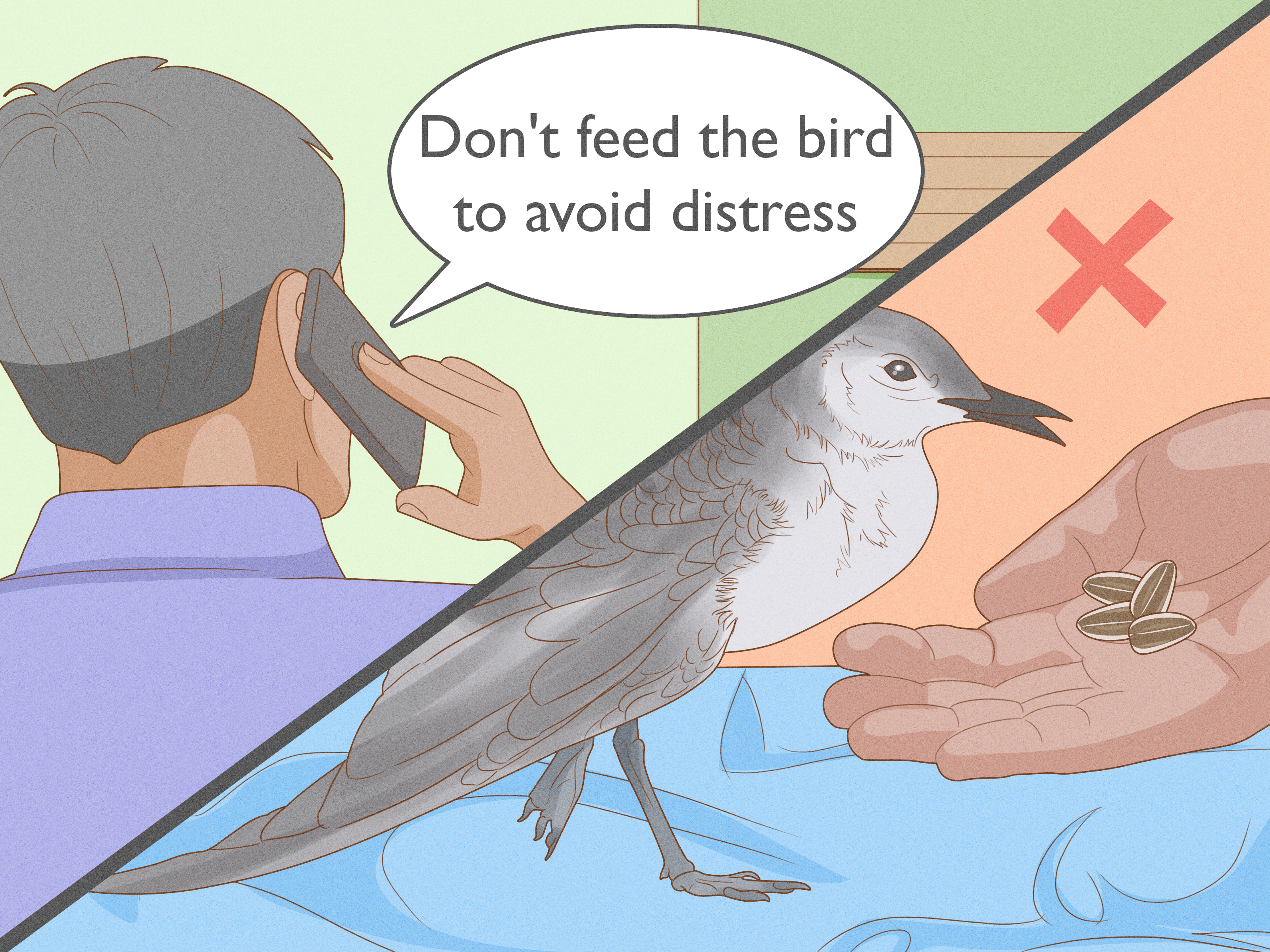
Do not give food or water
This rule feels counterintuitive, but it is one of the most important parts of injured bird care. Do not place water in the bird’s beak, drip liquid from a syringe, or leave an open water dish in the box. A weak bird may inhale liquid into its lungs, become chilled after spilling it, or injure itself while struggling around the dish.
Do not offer bread, milk, rice, worms, seeds, pet food, sugar water, or anything else unless a licensed wildlife rehabilitator specifically instructs you to do so. Different species require dramatically different diets, and an injured bird may need medical stabilization before digestion is safe. Wildlife clinics consistently warn that incorrect feeding or forced hydration can lead to choking, aspiration, digestive injury, hypothermia, or death. 3: Transport the Bird to a Licensed Wildlife Rehabilitator
Temporary containment is only a bridge to professional treatment. A bird that cannot fly may have a fracture, head trauma, internal bleeding, infection, neurological disease, eye damage, poisoning, or severe exhaustion. These conditions cannot be diagnosed by watching a few online videos or gently poking the wing to “see what happens.”
Transport the bird promptly
Confirm that the rehabilitation facility is open and has agreed to accept the bird. Some centers have limited hours, restricted service areas, or species-specific permits. Do not leave a boxed bird outside a closed facility.
During transportation:
- Keep the bird inside the closed box.
- Place the box securely on the vehicle floor or fasten it with a seat belt.
- Keep the vehicle quiet and comfortably ventilated.
- Do not play music or repeatedly open the box.
- Avoid sudden braking, excessive heat, and direct sunlight.
- Bring notes about where and when the bird was found.
The original location is important because rehabilitators often try to release recovered birds near their established territory or reunite young birds with their families.
Understand the legal limits of home care
Many native wild birds in the United States are protected by federal and state laws. The U.S. Fish and Wildlife Service issues permits for migratory bird rehabilitation, and state rules may impose additional requirements. Briefly containing an injured bird for immediate transport may be allowed, but keeping, treating, raising, or attempting to domesticate it without proper authorization is generally not permitted. essional wildlife rehabilitation involves more than placing a splint on a wing. Rehabilitators evaluate nutrition, pain, hydration, infection, feather condition, flight strength, predator avoidance, and the bird’s ability to survive independently. The goal is not merely to keep the bird alive; it is to return a healthy, behaviorally wild animal to suitable habitat.
Common Mistakes That Can Make an Injured Bird Worse
Trying to straighten or splint a wing
A homemade splint can restrict breathing, damage circulation, shift broken bones, or permanently impair flight. Wing injuries require professional examination and, in many cases, imaging.
Keeping the bird in a decorative cage
Wire cages can damage feathers and allow a frightened bird to repeatedly strike the bars. A ventilated cardboard box is usually the safer temporary container.
Checking the bird every few minutes
Wild birds do not interpret human staring, talking, or petting as emotional support. To them, you are a very large predator with suspiciously enthusiastic bedside manners. Repeated handling consumes energy and increases stress.
Testing whether the bird can fly
Do not toss the bird into the air or repeatedly release and recapture it. A bird with a fracture or neurological injury may fall, escape into danger, or worsen its condition. Let a rehabilitator decide when a flight assessment is appropriate.
Waiting several days to seek help
Birds can deteriorate rapidly, particularly after cat attacks, collisions, poisoning, or blood loss. Call for professional advice as soon as you recognize a genuine injury.
Practical Rescue Experiences: Lessons From Common Situations
The following experience-based scenarios are composites of common wildlife-rescue situations. They are not substitutes for professional instructions, but they illustrate how small decisions can significantly affect an injured bird’s chances.
Experience 1: The “abandoned” fledgling that was not abandoned
A family finds a fully feathered young mockingbird beneath a hedge. It hops away when approached but cannot gain more than a few inches of height. Believing the bird has a broken wing, they prepare to place it in a pet carrier.
Before capturing it, they call a rehabilitator and send a photo. The bird is identified as a normal fledgling. The family moves its curious dog indoors and watches from a window. Within an hour, an adult mockingbird arrives with food. By the next morning, the fledgling has moved deeper into the shrubs.
The lesson is simple: inability to fly well does not always equal injury. Fledglings often look awkward because they are awkward. Their flight muscles and coordination are still developing. A short period of quiet observation can prevent an unnecessary rescue and keep a young bird with the parents best equipped to raise it.
Experience 2: The window-strike bird that looked better too quickly
A small thrush strikes a large window and lands on a patio. After several minutes, it stands upright and opens its eyes. Because it looks more alert, the homeowner considers releasing it immediately.
Instead, the homeowner contacts a wildlife center, places the bird in a ventilated shoebox, and keeps it in a quiet room while arranging transport. At the clinic, the bird receives an examination for head trauma and eye injury. This matters because a bird can become active while still suffering from concussion, internal bleeding, or impaired vision.
The experience also prompts the homeowner to install exterior window markers with close spacing across the glass. Preventing the next collision becomes part of helping the first victim. A rescue is valuable, but removing the hazard is even better.
Experience 3: The tiny cat puncture nobody could see
A cat brings a sparrow into the house. The bird escapes, flutters behind a chair, and appears to have no visible injury. A well-meaning person might simply carry it outside, especially when the bird remains lively.
However, cat contact is treated as an emergency. The bird is contained with a towel, placed in a small box, and delivered to a licensed rehabilitator. During examination, staff find a nearly invisible puncture beneath the feathers.
The practical lesson is that feathers conceal injuries extremely well. What looks like a harmless encounter may involve crushing trauma, damaged air sacs, or bacterial contamination. Waiting for the bird to “act sick” can cost valuable treatment time.
Experience 4: Kindness that became too much attention
After rescuing an injured dove, a household places the box in the living room so everyone can check on it. Children whisper to the bird, the dog sniffs the box, and someone opens the lid every ten minutes to confirm that it is breathing.
The family believes it is providing comfort, but the dove experiences an unending parade of predators. Moving the box to a dark, quiet bathroom or spare room immediately reduces stimulation. The bird no longer struggles against the container and conserves its limited energy for survival.
This scenario demonstrates that effective wildlife first aid is often wonderfully boring. Darkness, silence, stable temperature, and minimal handling usually help more than affection, entertainment, or constant observation.
Experience 5: Knowing when not to attempt capture
A large heron is found beside a pond with fishing line wrapped around one wing. The bird appears weak, so a bystander assumes it will be easy to pick up. Fortunately, someone recognizes that a heron’s long bill can strike with remarkable speed and cause a serious eye injury.
Instead of approaching, they keep people and dogs away, note the exact location, and contact a wildlife rescue team. Trained rescuers arrive with protective equipment and an appropriate transport enclosure.
The most useful action in this case is restraintnot restraint of the bird, but restraint of the human urge to become an action hero. A safe rescue protects the bird, the rescuer, and the professionals who would otherwise have two patients to worry about.
Experience 6: Preparing before touching the bird
Another common problem occurs when someone captures a bird first and searches for a container second. The rescuer ends up holding a frightened animal while another person hunts through the garage for a box, tape, towels, and scissors.
A better approach is to assemble the ventilated box, lining, gloves, towel, and contact information before capture. The actual handling then lasts only a few seconds. Planning reduces stress, prevents escape, and lowers the chance of squeezing or dropping the bird.
These experiences point to one central principle: successful emergency care is measured by how little additional harm occurs before professional treatment begins. The calmest, quietest, and least dramatic rescue is often the best rescue.
Conclusion
When you encounter an injured wild bird that cannot fly, resist the urge to become its long-term nurse. Begin by determining whether it is genuinely injured or simply a healthy fledgling learning to navigate the world. When intervention is necessary and safe, place the bird in a small ventilated box, keep it warm, dark, and quiet, and avoid giving food or water. Then transfer it promptly to a permitted wildlife rehabilitator.
Your role may last only an hour or two, but those careful decisions can give the bird its best opportunity to recover and return to the wild. Sometimes helping wildlife means taking decisive action. Sometimes it means backing away from a fledgling and bringing the cat indoors. Wisdom is knowing which kind of help the bird actually needs.
Note: This article provides general emergency guidance for temporary assistance and transportation. It does not replace instructions from a licensed wildlife rehabilitator, veterinarian, animal-control officer, public-health agency, or state wildlife authority. Local laws and disease-response recommendations may vary.










