
The North American Free Trade Agreement, better known as NAFTA, was one of those policy ideas that sounded simple on paper and became wonderfully complicated in real life. Signed by the United States, Canada, and Mexico, NAFTA created a massive free trade zone across North America. Its main job was to reduce or eliminate tariffs, open markets, encourage investment, and make it easier for goods and services to move across borders. In other words, it tried to turn three neighboring economies into a more connected commercial neighborhoodless “keep off my lawn,” more “borrow my lawnmower, but please return it with gas.”
NAFTA officially entered into force on January 1, 1994, after years of negotiation and political debate. It built on the earlier U.S.-Canada Free Trade Agreement and added Mexico to form a trilateral trade bloc. For more than 25 years, NAFTA shaped the way cars, food, electronics, energy products, machinery, and countless other goods moved around North America. It also became a lightning rod in debates about globalization, manufacturing jobs, wages, consumer prices, corporate strategy, and national sovereignty.
So, what was NAFTA really? Was it a brilliant engine of regional growth, a job-killing villain in a business suit, or something more boring and accurate: a powerful trade agreement with benefits, costs, winners, losers, and a very large stack of paperwork? Let’s unpack it.
What Was NAFTA?
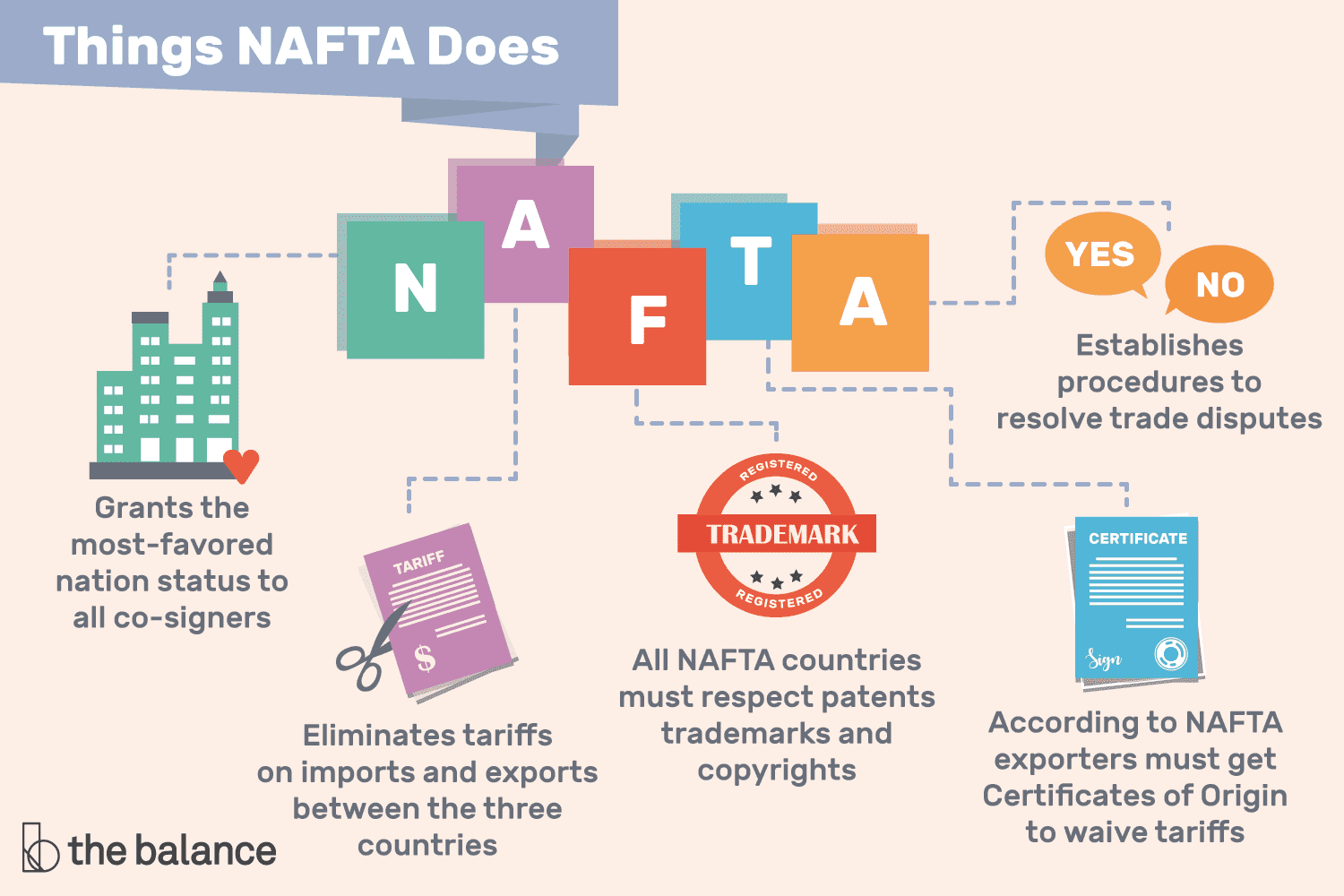
NAFTA was a trade agreement between the United States, Canada, and Mexico designed to remove barriers to trade and investment. Its core purpose was to make it easier and cheaper for businesses in the three countries to buy, sell, produce, and invest across borders. The agreement reduced tariffs on many goods, addressed non-tariff barriers, created rules for investment, protected intellectual property, and established systems for settling trade disputes.
Before NAFTA, North American trade was already important, especially between the United States and Canada. The U.S. and Canada had a free trade agreement that took effect in 1989. Mexico’s inclusion changed the scale and character of the project. The result was a huge regional market connecting a high-income U.S. economy, a resource-rich Canadian economy, and a fast-developing Mexican economy with a growing manufacturing base.
NAFTA did not create totally borderless trade. Trucks still stopped. Customs officers still existed. Paperwork did not disappear into a puff of economic fairy dust. But the agreement significantly reduced taxes on cross-border commerce and gave companies clearer rules for operating in North America.
When Did NAFTA Start and Who Signed It?
NAFTA was signed in 1992, approved by the U.S. Congress in 1993, and implemented on January 1, 1994. The agreement was negotiated during the administration of President George H. W. Bush and enacted under President Bill Clinton. Canada and Mexico also completed their own approval processes.
The political story was intense. Supporters argued that NAFTA would increase exports, strengthen North American competitiveness, lower consumer prices, and help the three countries compete with Europe and Asia. Critics warned that it could encourage companies to move production to Mexico, weaken labor standards, pressure wages, and harm small farmers and certain manufacturing communities.
Both sides were partly right, which is why NAFTA remains such a useful case study. Trade policy rarely behaves like a superhero movie. There is no single cape-wearing winner and no mustache-twirling villain. Instead, trade agreements create incentives, and people, companies, industries, and governments react to those incentives in different ways.
What Were the Main Goals of NAFTA?
1. Eliminate Tariffs
One of NAFTA’s biggest goals was to phase out tariffs on goods traded among the United States, Canada, and Mexico. Tariffs are taxes on imports, and they can make foreign goods more expensive. By reducing or eliminating many tariffs, NAFTA made cross-border trade cheaper and more attractive.
2. Increase Trade Among the Three Countries
NAFTA encouraged companies to sell more products across North America. U.S. farmers could reach Mexican and Canadian markets more easily. Mexican manufacturers could sell more goods to the United States and Canada. Canadian energy, lumber, machinery, and agricultural products also moved through a more integrated regional system.
3. Encourage Foreign Investment
The agreement gave investors more confidence by setting rules for how foreign investment would be treated. This mattered because factories, supply chains, logistics hubs, and energy projects often require long-term commitments. Businesses like predictability almost as much as accountants like spreadsheets.
4. Protect Intellectual Property
NAFTA included rules covering patents, trademarks, copyrights, and other intellectual property rights. These provisions were important for industries such as technology, pharmaceuticals, entertainment, software, and branded consumer goods.
5. Create Dispute Settlement Procedures
Trade agreements need referees. NAFTA created procedures for resolving disagreements among governments and, in some cases, investors and states. These systems were designed to reduce the chance that every trade dispute would turn into a political food fight with tariffs as the mashed potatoes.
How Did NAFTA Work?
NAFTA worked by creating a shared legal framework for trade among the three member countries. It did not merge the economies into one country, create a shared currency, or eliminate all national regulations. Each country kept its own laws, tax systems, labor policies, environmental rules, and border controls.
Instead, NAFTA focused on market access. It gradually eliminated many tariffs, set rules of origin, opened certain service sectors, improved investment protections, and created procedures for dealing with trade conflicts.
Rules of origin were especially important. They determined whether a product qualified for NAFTA benefits. For example, a car could not simply be assembled in one NAFTA country using mostly parts from outside North America and automatically receive preferential treatment. It had to meet regional content requirements. This encouraged companies to build supply chains within North America.
Which Industries Were Most Affected by NAFTA?
Automotive Manufacturing
The auto industry became one of the clearest examples of NAFTA’s influence. Cars and auto parts began crossing borders multiple times during production. A vehicle might include parts from the United States, assembly work in Mexico, and components from Canada before being sold to consumers. This created a deeply integrated North American automotive supply chain.
Agriculture
NAFTA changed agricultural trade significantly. U.S. corn, meat, dairy-related products, and processed foods gained broader access to Mexico and Canada. Mexican fruits and vegetables became more common in U.S. grocery stores. Consumers enjoyed more year-round options, though some farmers faced tougher competition.
Energy
Energy trade between the United States and Canada was already large, and NAFTA helped reinforce regional energy flows. Oil, natural gas, electricity, and related equipment became part of broader North American commercial networks.
Textiles and Apparel
Textile and apparel companies adjusted production patterns under NAFTA. Some production shifted to Mexico, where labor costs were lower than in the United States or Canada. Supporters saw this as a way to keep production within North America rather than losing it entirely to Asia. Critics saw it as another source of pressure on U.S. manufacturing workers.
Technology and Services
NAFTA also affected services, finance, telecommunications, and technology-related sectors. While goods trade got most of the attention, cross-border business services and investment flows became increasingly important over time.
What Were the Benefits of NAFTA?
Trade Grew Dramatically
One of NAFTA’s most visible results was the growth of trade among the United States, Canada, and Mexico. Cross-border commerce expanded substantially after 1994. U.S. exports to Canada and Mexico grew, while imports from both countries also increased. North America became a more tightly connected production and consumption region.
Consumers Got More Choices
Lower trade barriers helped increase product variety. American consumers found more Mexican produce, Canadian energy products, imported vehicles, electronics, household goods, and industrial components in the marketplace. More competition often helped keep prices lower than they might otherwise have been.
Supply Chains Became More Efficient
NAFTA allowed companies to organize production across borders. A business could design a product in one country, source components in another, assemble it in a third, and sell it across the region. This kind of specialization helped many firms reduce costs and compete globally.
Mexico Became a Major Manufacturing Partner
Mexico benefited from increased foreign investment and growth in export-oriented manufacturing. Factories near the U.S.-Mexico border and in Mexico’s industrial regions became important parts of the North American production system. Automotive, electronics, aerospace, and appliance manufacturing all expanded.
Canada Deepened Its Trade Relationship with the United States
Canada was already closely connected to the U.S. economy before NAFTA, but the agreement reinforced that relationship. Trade in energy, vehicles, machinery, agricultural goods, and industrial inputs remained central to Canada’s economic ties with the United States.
What Were the Criticisms of NAFTA?
Manufacturing Job Losses
The most famous criticism of NAFTA was that it contributed to U.S. manufacturing job losses. Some companies moved production to Mexico to take advantage of lower labor costs. Communities dependent on factories often felt the pain directly. A closed plant is not an abstract economic adjustment; it is a very real problem for families, schools, local restaurants, and Friday night high school football budgets.
However, economists generally debate how much job loss should be blamed specifically on NAFTA. Automation, China’s entry into the global trading system, changes in technology, corporate decisions, recessions, and consumer demand all played major roles in reshaping manufacturing. NAFTA was one factor in a much larger economic transformation.
Wage Pressure
Critics argued that NAFTA placed downward pressure on wages in some industries by increasing competition with lower-wage labor markets. Workers in sectors exposed to import competition often had less bargaining power, especially when companies could threaten to relocate production.
Environmental Concerns
Some environmental groups worried that increased industrial activity, especially near the U.S.-Mexico border, would increase pollution and strain infrastructure. NAFTA included environmental side agreements, but critics argued that enforcement was not strong enough.
Pressure on Small Farmers
In Mexico, small farmers faced serious challenges from increased competition, especially in crops such as corn. Larger, more mechanized producers could compete more effectively, while many rural families struggled to adapt.
Uneven Distribution of Gains
Perhaps the biggest lesson from NAFTA is that trade gains are rarely distributed evenly. Consumers may benefit from lower prices, exporters may gain new markets, and multinational companies may become more efficient. At the same time, some workers and communities can be hit hard. The national economy may show growth while certain towns feel like the economy packed a suitcase and left without saying goodbye.
Did NAFTA Help or Hurt the United States?
The honest answer is: both, depending on where you look. NAFTA helped many U.S. exporters, farmers, manufacturers, logistics companies, retailers, and consumers. It supported cross-border supply chains that made North American companies more competitive. It also strengthened trade relationships with two neighboring countries that remain among America’s most important economic partners.
At the same time, NAFTA intensified competition in some sectors. Certain manufacturing workers and communities experienced job displacement. The agreement became a symbol of globalization’s downside, especially in regions where factory closures were visible and painful.
Economically, NAFTA was not large enough by itself to explain every major change in the U.S. labor market after 1994. Politically, however, it became a powerful shorthand for the anxiety many Americans felt about trade, outsourcing, wage stagnation, and the changing nature of work.
Did NAFTA Help Mexico?
Mexico gained greater access to U.S. and Canadian markets, attracted foreign investment, and expanded its manufacturing sector. Cities and industrial corridors connected to export production often benefited. Mexican auto manufacturing, electronics, and advanced manufacturing became more closely linked to U.S. supply chains.
But Mexico’s gains were uneven. Rural areas, small farmers, and workers outside export-focused regions did not always benefit. Wages in Mexico did not rise as much as many supporters had hoped. NAFTA helped modernize parts of the Mexican economy, but it did not magically solve poverty, inequality, corruption, infrastructure gaps, or regional development challenges.
Did NAFTA Help Canada?
Canada continued to benefit from deep access to the U.S. market, its most important trading partner. NAFTA reinforced cross-border trade in autos, energy, agriculture, machinery, and services. Canadian businesses gained more certainty in North American commerce.
Still, Canada also faced concerns about dependence on the U.S. economy, disputes over lumber, dairy, energy, and cultural industries, and the challenge of maintaining policy independence while operating inside a highly integrated trade zone.
Why Was NAFTA Replaced by USMCA?
NAFTA was replaced by the United States-Mexico-Canada Agreement, or USMCA, which entered into force on July 1, 2020. The replacement happened because NAFTA had become politically controversial and economically outdated in several areas. When NAFTA began, the internet was young, smartphones did not exist, digital trade was barely a concept, and nobody was ordering tacos through an app while complaining about supply chain inflation.
USMCA kept much of NAFTA’s basic structure but updated rules in several areas. It included new provisions for digital trade, stronger labor rules, updated intellectual property protections, revised automotive rules of origin, and changes to dispute settlement and investor protections. It also included review mechanisms to revisit the agreement over time.
In simple terms, USMCA was not a total demolition of NAFTA. It was more like remodeling an old house: keep the foundation, replace the questionable wiring, update the kitchen, and argue loudly about the garage.
NAFTA vs. USMCA: What Changed?
The USMCA preserved tariff-free trade for many goods but made several important updates. Automotive rules became stricter, requiring higher regional content and certain labor-value standards. Labor provisions became more enforceable, especially concerning workers’ rights in Mexico. Digital trade rules were added to reflect the modern internet economy. Intellectual property protections were revised. Some investor-state dispute settlement rules were reduced, and the agreement included a review process.
These changes reflected lessons from NAFTA’s first 25 years. Policymakers wanted to keep the benefits of regional integration while addressing concerns about labor standards, modern technology, and political accountability.
Why NAFTA Still Matters Today
Even though NAFTA no longer exists as the active agreement, its influence remains everywhere. The supply chains built under NAFTA did not disappear when USMCA arrived. Cars, food, energy, electronics, machinery, medical devices, and consumer goods still move through North American networks shaped by decades of integration.
NAFTA also matters because it changed how Americans talk about trade. Before NAFTA, trade policy was often treated as a technical issue for economists, diplomats, and people who enjoy reading tariff schedules voluntarily. After NAFTA, trade became a kitchen-table political issue. Workers, farmers, business owners, consumers, unions, environmental groups, and politicians all had strong opinions.
That debate continues today. When people discuss reshoring, nearshoring, supply chain resilience, U.S.-Mexico trade, manufacturing jobs, or North American competitiveness, they are still living in the world NAFTA helped create.
Practical Experiences and Lessons from NAFTA
One useful way to understand NAFTA is to imagine the experience of a small U.S. manufacturer in the late 1990s. Before NAFTA, selling parts into Mexico might have involved higher tariffs, more uncertainty, and extra costs. After NAFTA, that same company could find new buyers across the border, partner with Mexican assemblers, and become part of a larger supply chain. For that business, NAFTA may have felt like someone opened a locked door and replaced it with a loading dock.
Now imagine a factory worker in a U.S. town where the main employer moved some production to Mexico. For that worker, NAFTA did not feel like economic theory. It felt like a layoff notice. Even if economists explained that automation, global competition, and corporate strategy also mattered, the personal experience was immediate and painful. Trade benefits can be widespread and subtle, while trade losses can be concentrated and brutally obvious.
A farmer’s experience could also vary. A large U.S. corn or meat producer might have benefited from expanded access to Mexican markets. A small Mexican corn farmer, however, may have faced intense competition from cheaper imported grain. The same agreement that created opportunity for one group created pressure for another. That is the uncomfortable truth of trade policy: one person’s export boom can be another person’s survival challenge.
Retailers and consumers experienced NAFTA differently. Many shoppers benefited from lower prices and wider choices. Fresh produce from Mexico became more available in U.S. stores, especially during colder months. Auto parts and assembled vehicles moved through regional supply chains, helping companies manage costs. Consumers may not have walked into a store saying, “Ah yes, I can taste the tariff reduction in this avocado,” but the effects were often built into prices and availability.
For logistics companies, NAFTA created new demand. More trade meant more trucks, warehouses, customs brokers, rail shipments, freight planning, and cross-border coordination. Border cities and transportation hubs became important links in the North American economy. The agreement did not eliminate friction, but it increased the value of knowing how to move goods efficiently across borders.
The biggest practical lesson from NAFTA is that trade agreements need adjustment policies. If a country benefits overall from trade but leaves displaced workers to figure things out alone, resentment grows. Retraining, education, wage support, infrastructure investment, and regional development are not decorative extras. They are the seatbelts in the trade-policy vehicle. Without them, the ride may still be fast, but it gets a lot more dangerous for the people sitting in the wrong seats.
Another lesson is that supply chains are strategic, not just economic. NAFTA helped create a North American production platform that became especially important as companies reconsidered dependence on distant suppliers. Today, nearshoring and regional manufacturing are major business trends. In that sense, NAFTA’s legacy is not just about the 1990s. It is part of the modern conversation about how close countries should be to the goods they depend on.
Conclusion: What Was NAFTA in the Big Picture?
NAFTA was a landmark trade agreement that connected the United States, Canada, and Mexico more deeply than ever before. It lowered tariffs, expanded trade, encouraged investment, strengthened supply chains, and helped create one of the world’s most important regional markets. It also created controversy because its benefits and costs were not shared evenly.
For businesses, NAFTA often meant opportunity. For consumers, it often meant more choices and competitive prices. For some workers and communities, it meant disruption, uncertainty, and painful adjustment. For policymakers, it became a lesson in the power and limits of free trade.
NAFTA was replaced by USMCA in 2020, but its legacy remains alive in North American factories, farms, highways, ports, grocery stores, and political debates. To understand modern trade in North America, you have to understand NAFTA. It was not perfect, not simple, and definitely not boringunless you read the full legal text without coffee, in which case, good luck and may your highlighter be strong.
Note: This article is written for educational and editorial publication purposes. It summarizes NAFTA using historically accurate trade information, policy analysis, and practical examples in standard American English.













