
Note: This article is based on widely reported public information about Jon Stewart’s July 21, 2025 episode of The Daily Show, the cancellation of The Late Show with Stephen Colbert, CBS and Paramount’s public statements, and the larger media reaction around political satire, corporate pressure, and late-night television.
There are nights in television when a host tells jokes, lands a few good punchlines, smiles at the camera, and politely hands America its bedtime snack. Then there are nights when someone appears to remember, live on air, that satire is supposed to have teeth. Not decorative teeth. Not “bought on Etsy for a Halloween party” teeth. Real teeth. The kind that bite through the polished plastic of corporate talking points.
That is why the question feels so alive: Was last night the moment Jon Stewart became Jon Stewart again?
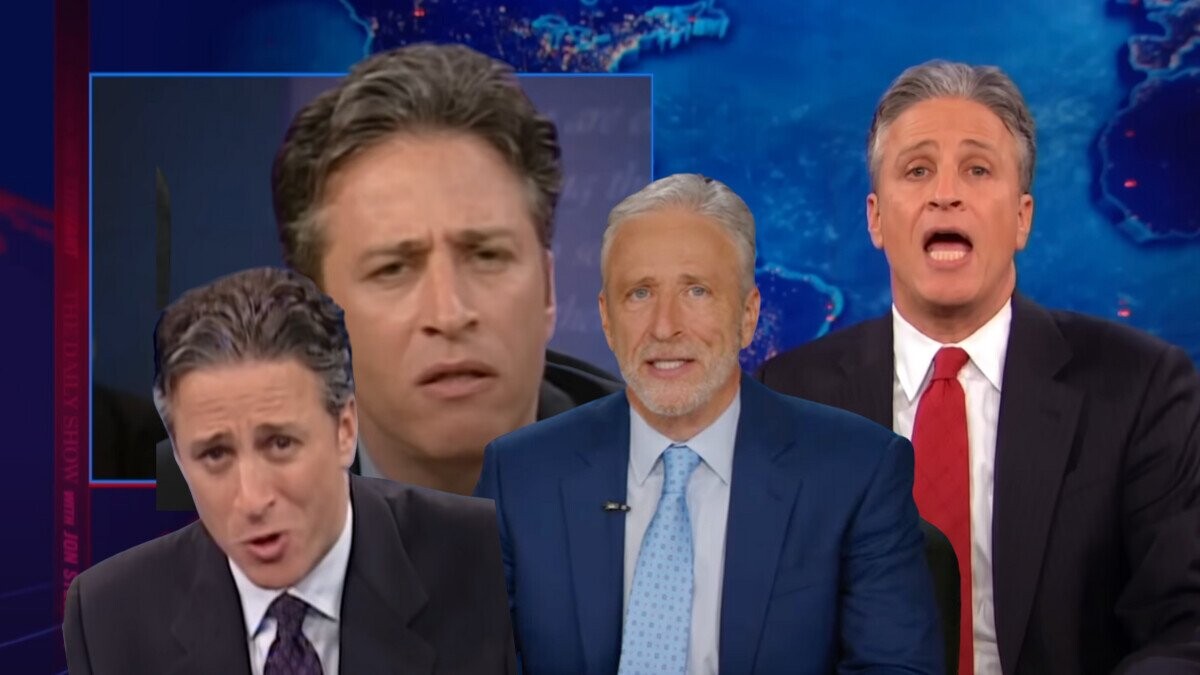
The “last night” in question was the July 21, 2025 episode of The Daily Show, when Stewart returned to the desk and delivered a blistering response to CBS canceling The Late Show with Stephen Colbert. The official explanation from CBS was financial. The timing, however, made many viewers raise an eyebrow so high it nearly needed its own zip code. The cancellation came shortly after Colbert criticized Paramount, CBS’s parent company, over its $16 million settlement with Donald Trump related to a 60 Minutes dispute. Then Stewart, who shares a corporate roof with CBS under the Paramount umbrella, sat down on Comedy Central and essentially asked: Are we really pretending this is just about spreadsheets?
For longtime fans, the segment felt less like a normal late-night monologue and more like a flare shot into the sky. It had anger, yes, but not the kind of cable-news anger that arrives prepackaged with a lower-third graphic and a discount code for tactical coffee. Stewart’s anger had structure. It had targets. It had jokes that did not merely decorate the point; they carried it into the living room and set it on the couch.
Jon Stewart’s Return Had Always Been a Complicated Nostalgia Trip
When Jon Stewart returned to The Daily Show in February 2024, the reaction was a mixture of excitement, relief, suspicion, and “Wait, are we doing reboots of news satire now?” Stewart had hosted the show from 1999 to 2015, shaping it into one of the most influential comedy institutions in American media. His version of The Daily Show was not simply a joke factory. It was a media literacy class with better timing and fewer fluorescent lights.
Still, the world he came back to was not the world he left. In 2015, Twitter was annoying but not yet a full-time national weather system. TikTok had not turned every teenager into a video editor and every adult into a confused anthropologist. Cable television still had more cultural muscle. Donald Trump had not yet completed his transformation from reality-TV chaos machine into the central gravitational force of American politics.
So Stewart’s return carried a fair question: Could the old magic work in a new media environment? Or would it feel like seeing your favorite band reunite at a county fair, playing the hits while someone eats nachos under a banner advertising discount gutters?
At first, the answer was mixed. Stewart was still funny. He was still sharp. He could still stare into a camera with the weary disbelief of a man who has read too many press releases and too few honest sentences. But some viewers wondered whether his return was more comfort food than necessary medicine. America had changed. The audience had changed. Late-night television had changed. Even outrage had changed; it now arrives every seven minutes with push notifications.
Then came the Colbert cancellation, and suddenly Stewart was not just commenting on the news. He was inside the story. That changed everything.
Why the Colbert Cancellation Became Bigger Than Late-Night TV
CBS announced in July 2025 that The Late Show with Stephen Colbert would end in May 2026, retiring the franchise that began with David Letterman in 1993. The network said the decision was purely financial and not related to Colbert’s performance, content, or events at Paramount. That may be the official explanation, and late-night television is certainly under economic pressure. Audiences are fragmented. Advertising is harder. The old model of people tuning in every night at 11:35 p.m. has been mugged by streaming, social clips, podcasts, and the human need to go to bed before midnight.
But the timing was the gasoline. Colbert had recently criticized Paramount’s settlement with Trump, calling it, in his own sharp style, a “big fat bribe.” Days later, CBS announced his show would end. Even if the decision had been developing behind closed doors for months, the public optics were brutal. It looked, to many critics, like a corporation trimming away a loud political satirist while trying to protect a major business deal and reduce conflict with a powerful political figure.
That is why Stewart’s monologue mattered. He did not merely defend a friend, though he clearly did that too. Stewart and Colbert’s professional history runs deep, from Colbert’s years as a correspondent on The Daily Show to The Colbert Report, which Stewart helped produce. This was personal, but it was not only personal. Stewart framed the cancellation as part of a broader pattern: institutions preemptively softening themselves, sanding down their edges, and hoping that if they become bland enough, power will stop noticing them.
His argument was simple and uncomfortable: if networks cancel or control the shows that made them culturally valuable in the first place, they are not protecting their brands. They are draining them like someone trying to preserve a houseplant by removing all the soil.
The Moment Stewart Sounded Like His Old Self
The old Jon Stewart was never just the guy who made funny faces at politicians. The funny faces helped, obviously. A well-timed Stewart grimace could summarize an entire congressional hearing. But his deeper skill was pattern recognition. He watched politicians, pundits, journalists, and corporate leaders speak in fog, then cut through the fog with a flashlight and a weed whacker.
In the July 2025 monologue, that skill came roaring back. Stewart acknowledged the business challenges facing late-night TV, which made his argument stronger. He did not pretend that network television was a magical money fountain. Instead, he asked why CBS would walk away from a major late-night franchise without fighting harder to preserve it. He connected the decision to Paramount’s political and corporate pressures. He pushed back against the idea that safety can be achieved through blandness.
That last point was the heart of the segment. Stewart’s best satire has always understood that neutrality can become a costume. Sometimes “just business” is genuinely just business. Other times, it is a very expensive trench coat worn by fear. Stewart did not claim to have a secret memo proving political retaliation. He did something more interesting: he explained why the public had reason to doubt the clean corporate version of events.
That is classic Stewart. He does not need to say, “Here is the villain, here is the mustache, here is the dramatic thunder.” He builds the case through contradiction. If the show was valuable, why discard it? If the timing was innocent, why does it look so convenient? If corporations believe they can appease political power by becoming flavorless, why would anyone watch them in the first place?
Why Profanity Was Not the Point, Even Though Everyone Noticed It
Much of the coverage focused on the intensity of Stewart’s language and the comic spectacle of the segment, including the choir-style bit that turned frustration into a televised musical middle finger. That part was memorable, of course. Late-night television does not usually resemble a church service for people who have lost faith in media executives.
But the profanity was not the real point. The real point was permission. Stewart gave viewers permission to stop pretending the situation felt normal. He said, in effect, that there are moments when polite phrasing becomes part of the problem. Sometimes the room is on fire, and the correct response is not, “The room is experiencing a temperature event.”
That is where Stewart felt newly relevant. In an era when public language is often scrubbed by lawyers, brand teams, crisis consultants, and invisible committees named things like “Stakeholder Harmony Task Force,” blunt speech can feel almost radical. Not because bluntness is always good. It is not. Plenty of people are blunt because they are lazy, cruel, or allergic to thinking. Stewart’s bluntness worked because it was attached to an argument.
He was not just yelling. He was diagnosing.
Jon Stewart and the Fragile Future of Political Satire
The bigger question is not whether one monologue was funny. It was. The bigger question is whether political satire still has a meaningful role in American culture. That question sounds dramatic, but late-night television has been shrinking for years. Younger audiences often discover segments through YouTube, TikTok, Instagram, or whatever platform currently makes everyone feel elderly by Thursday. The old ritual of watching a host react to the day’s news before bed is no longer the dominant cultural habit.
Yet the Stewart segment showed that late-night can still matter when it stops chasing relevance and starts earning it. The reason people talked about the monologue was not merely that Jon Stewart said spicy words on television. It was that he used his platform to challenge the company airing him. That creates stakes. Stakes are oxygen for satire.
Satire without risk becomes decoration. It may still sparkle, but it does not cut. Stewart’s monologue cut because it moved toward the uncomfortable center of the issue: corporate media companies want the cultural value of fearless comedy while also wanting the political safety of harmless entertainment. That is a difficult balance. Actually, “balance” may be too generous. It is more like trying to ride a bicycle while removing the wheels for legal reasons.
Colbert’s cancellation became a symbol because it raised a fear many viewers already had: that big media companies may decide political comedy is too inconvenient, too risky, too expensive, or too annoying to powerful people. Stewart’s response mattered because it refused to accept that fear as normal.
Was This Really Jon Stewart “Becoming Jon Stewart Again”?
The phrase is tempting, but it needs a little unpacking. Jon Stewart never stopped being Jon Stewart. He did not vanish into a shed and emerge years later as a cryptocurrency consultant named Brad. After leaving The Daily Show, he remained active in public life, advocated for 9/11 first responders and veterans, made films, hosted The Problem with Jon Stewart, and returned to commentary when he felt he had something to say.
But television identity is not only about who someone is. It is about the role the audience needs that person to play. The Jon Stewart people remember from his first Daily Show run was not simply a comedian. He was a pressure valve, a translator, and occasionally a very tired substitute teacher trying to explain why the media had once again eaten glue.
For a while after his return, it was fair to wonder whether that role still existed. The media ecosystem had become so chaotic that even Stewart’s sharpest critiques sometimes felt like one more smart voice in a hurricane of smart voices. But the Colbert episode gave him a target that matched his strengths: hypocrisy, institutional cowardice, media self-protection, and the absurd performance of corporate innocence.
That is why the monologue felt like a reawakening. It was not nostalgia. It was function. Stewart was once again doing the thing that made him indispensable: taking a complicated media-political mess and making its core absurdity visible.
The Specific Examples That Made the Segment Land
One reason the monologue worked was that Stewart did not float above the details. He grounded the comedy in specific context: CBS canceling Colbert’s show, the stated financial rationale, Paramount’s settlement with Trump, the merger pressure surrounding the company, and the broader pattern of institutions appearing to soften criticism in advance of political consequences.
He also made the stakes concrete by pointing to the value of shows that “say something.” That idea matters. A late-night program is not valuable only because it fills a time slot. It is valuable because it builds trust with an audience. That trust comes from a voice. Remove the voice, flatten the risk, and the show becomes another shiny box in the infinite warehouse of content. Congratulations, you have invented television wallpaper.
Stewart’s defense of Colbert was especially powerful because he did not pretend late-night comedy is heroic in some grand, marble-statue sense. He has often resisted the idea that comedians are saviors. In the monologue, the force came from a more modest claim: people on these shows are not saving democracy single-handedly, but they are trying to speak honestly into cameras. That humility made the argument more credible. He was not asking for sainthood. He was asking for backbone.
Why Viewers Responded So Strongly
Audiences are good at detecting when something has real charge. They may not always agree on politics, comedy, or whether a joke crossed the line, but they can feel when a performer is leaning forward rather than coasting. Stewart leaned forward.
The segment also arrived at a time when many Americans feel exhausted by institutional language. Everything controversial is framed as a “process.” Every ugly decision is “strategic.” Every retreat is “a realignment.” People are tired of being handed oatmeal and told it is fireworks. Stewart’s monologue broke through because it rejected the oatmeal.
There is also the simple fact that Stewart was criticizing his own corporate environment. That gave the segment a spark that ordinary political jokes often lack. Mocking a politician is expected. Mocking the people who sign the checks is different. It does not automatically make someone brave beyond measure, but it does create a sense that the host is not merely playing inside the safest lines available.
For fans who missed the old Stewart, this was the closest thing to a “he’s back” moment. Not because the jokes sounded exactly like 2004, but because the moral posture felt familiar: impatient with nonsense, allergic to cowardice, and deeply suspicious of powerful people explaining themselves too neatly.
The Experience of Watching Stewart Find the Gear Again
Watching the monologue felt like seeing an old engine turn over after a long winter. At first, you listen carefully. Is it still working? Is that a rattle? Did someone leave a squirrel in the carburetor? Then suddenly the engine catches, and you remember why people loved the machine in the first place.
That experience is rare in modern television because so much content is built to be consumed and forgotten. Clips are designed to travel fast, not last long. A joke gets posted, reacted to, stitched, clipped, summarized, argued over, and buried under the next scandal before lunch. Stewart’s segment had more weight because it felt like a complete argument rather than a content pellet.
It also reminded viewers of the strange comfort that sharp comedy can provide. Not comfort as in “everything is fine.” More like comfort as in “at least someone is saying the weird part out loud.” In confusing political moments, that matters. People do not always need a comedian to solve the problem. Sometimes they need one to point at the problem and say, with precision, “That is not a lampshade. That is a raccoon wearing a lampshade.”
For anyone who grew up watching Stewart during the Iraq War era, the financial crisis, cable-news absurdities, and the endless theater of Washington, the July 2025 monologue triggered a specific memory: Stewart as the person who could make institutional failure legible. He did not remove the frustration. He organized it. That is a valuable service, especially when the headlines arrive like furniture thrown down a staircase.
Additional Experience: Why This Moment Felt Personal for Viewers
To understand why this episode resonated, imagine the experience of a viewer who has followed Stewart casually for years. Maybe they watched him in college when The Daily Show clips were passed around like contraband common sense. Maybe they discovered him through YouTube compilations. Maybe they were too young for his original run but heard older viewers talk about him like he was a news anchor, comedian, and exasperated uncle rolled into one.
For that viewer, Stewart’s return in 2024 may have felt pleasant but not essential. It was nice to see him back at the desk. Nice to see the eyebrow. Nice to hear the rhythm. Nice to be reminded that some people can still construct a joke with a beginning, middle, end, and actual thought inside it. But nice is not the same as necessary. A nostalgia act can be enjoyable without becoming urgent.
The Colbert monologue changed the feeling because it put Stewart in a situation where his old tools were suddenly useful again. The topic was not merely “politician says ridiculous thing.” That is standard late-night material, and frankly, there is so much of it that even professional comedians must occasionally feel like they are trying to drink from a fire hose while filing taxes. This was about the machinery around political speech: networks, owners, advertisers, mergers, legal settlements, public explanations, and the quiet pressure that can shape what gets said on mainstream platforms.
That is exactly the kind of machinery Stewart has always been good at exposing. He is not at his best when simply listing bad news. He is at his best when showing how the official story bends around power. Viewers could feel that difference. The monologue did not ask them to admire Stewart for being angry. It invited them to notice what the anger was aimed at.
There was also an emotional layer. Colbert is not just another late-night host in Stewart’s orbit. He is part of the same comedic family tree. To many viewers, seeing Stewart defend Colbert felt like watching one member of an old band step forward when another member’s microphone was cut. It carried loyalty, but it also carried warning. If a top-rated, culturally significant late-night voice can be pushed offstage under a cloud of suspicion, what does that say about everyone else?
That is why the segment traveled beyond normal entertainment chatter. It gave people a way to talk about something they already sensed: that media institutions are increasingly cautious, reactive, and terrified of offending the wrong powerful person. Whether every suspicion about the Colbert cancellation is provable is not the whole point. The point is that the trust reservoir was already low. Stewart’s monologue landed because he spoke from inside that distrust and gave it language.
From a viewer’s perspective, the experience was almost cathartic. Not because it fixed anything. Colbert’s show was still ending. Corporate media was still corporate media. Late-night television was still fighting the math of a fractured audience. But for half an hour, the polished surface cracked. A host looked at the situation and refused to behave as though the official explanation had settled the matter. That refusal was the show.
And that may be the answer to the title. Last night was not the moment Jon Stewart became Jon Stewart again because he had somehow lost himself completely. It was the moment the job once again met the man. The moment gave him the right target, the right pressure, and the right reason to stop sounding like a respected veteran visiting his old office and start sounding like the host who once made viewers feel that satire could still punch upward.
In that sense, yes. Last night may have been the moment Jon Stewart became Jon Stewart again. Or maybe it was the moment we remembered what we needed him for.
Conclusion
Jon Stewart’s July 2025 monologue was more than a viral late-night clip. It was a reminder of what political comedy can do when it refuses to become harmless. By taking on CBS, Paramount, the Colbert cancellation, and the broader fear shaping American institutions, Stewart found the sharp, specific, morally irritated voice that made him a defining figure in modern satire.
The segment worked because it was not only loud; it was focused. It did not rely on nostalgia, though nostalgia certainly helped viewers feel the impact. It relied on Stewart’s old gift for identifying the absurd center of a serious issue. Late-night television may be smaller than it once was, but moments like this prove it can still matter when the host is willing to risk discomfort for clarity.
So, was last night the moment Jon Stewart became Jon Stewart again? Maybe the better answer is this: it was the moment Jon Stewart reminded everyone that the desk still has power when the person behind it is willing to use it.










