
Some survival tips spread online because they sound dramatic, simple, and perfect for a 12-second video. Unfortunately, nature does not care about your algorithm. A bear does not pause for your comment section. A thunderstorm does not respect confidence. And a snakebite is not improved by someone yelling, “I saw this on the internet!”
The viral phrase “run away as fast as you can” is a perfect example. Is running sometimes the right move? Yes. If a building is on fire, leave. If a flash flood warning says evacuate, go. If lightning is close and a hard-topped vehicle is nearby, move quickly. But as a universal survival rule, “run away” can be dangerously fake. Around bears, mountain lions, snakes, unstable slopes, fast water, smoke, and earthquakes, panic-speed movement may turn a bad situation into a starring role in a safety training video.
This guide breaks down 50 viral survival myths, explains why they are wrong, and replaces them with practical advice based on widely accepted U.S. safety guidance from emergency management, public health, outdoor recreation, weather, poison control, and geological safety organizations.
Why Fake Survival Tips Go Viral
Fake survival tips succeed because they are easy to remember. “Suck out snake venom.” “Punch a shark.” “Hide under a bridge in a tornado.” “Drink cactus water.” These lines are punchy, cinematic, and usually wrong. Real survival advice is less glamorous: stay calm, reduce exposure, carry basic supplies, call for help, avoid risky shortcuts, and make decisions before panic turns your brain into oatmeal.
Good survival advice also depends on context. The right response to a black bear is not always the same as the right response to a mountain lion. Heat exhaustion is not treated the same way as hypothermia. A generator that saves your refrigerator during a power outage can also poison a family if used indoors or too close to a window. Survival is not about looking brave. It is about staying alive long enough to tell the story badly at dinner.
50 Fake Survival Tips That Keep Circulating Online
1. “Run Away As Fast As You Can”
Why it is fake: Running can trigger chase behavior in some animals, cause falls on rough terrain, and make you lose orientation. Better move: Stop, assess, back away slowly when dealing with wildlife, and move quickly only when the specific hazard requires evacuation.
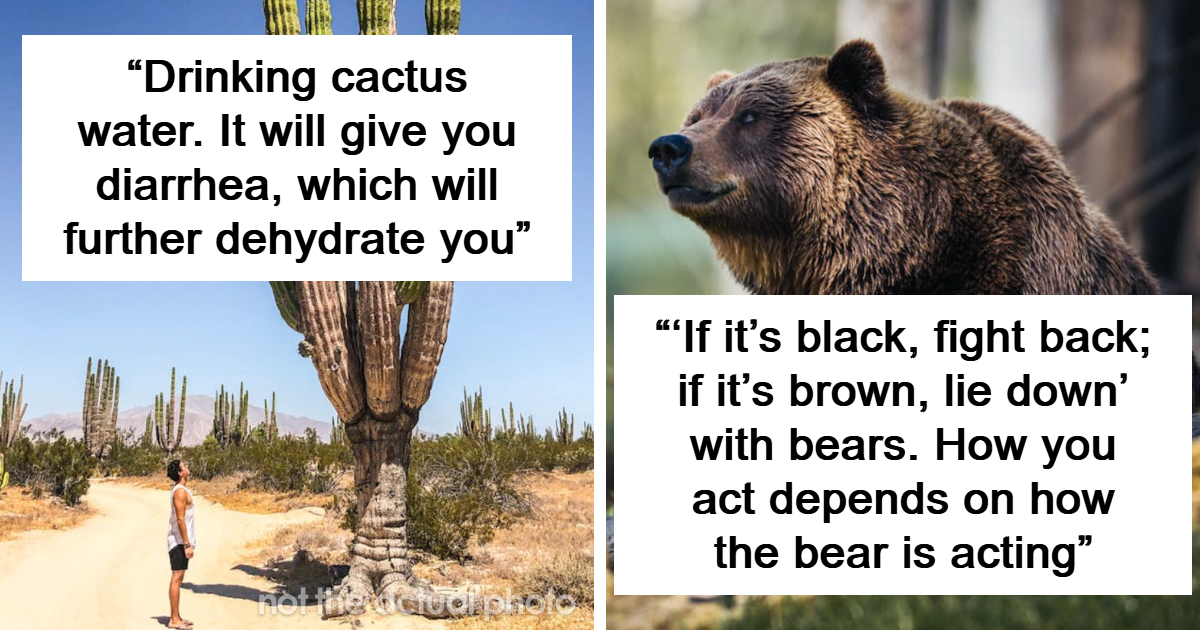
2. “If You See a Bear, Play Dead Immediately”
Playing dead is not a universal bear strategy. With some encounters, especially if a bear is curious or predatory, the advice changes. The better approach is prevention: make noise, travel in groups, carry bear spray where appropriate, store food properly, and never approach a bear.
3. “Spray Bear Spray on Your Clothes Like Bug Repellent”
Bear spray is not bear perfume. It is an emergency deterrent designed to be sprayed toward a charging bear, not on your jacket, tent, dog, backpack, or ego.
4. “Climb a Tree to Escape a Bear”
Many bears climb extremely well, and even bears that do not feel like climbing can wait below while you reconsider your life choices. Create distance calmly and use proper bear-country practices instead.
5. “Throw Food to Distract Wildlife”
Feeding wildlife teaches animals to associate people with snacks, which can make future encounters more dangerous for both humans and animals. Secure food; do not bribe the forest.
6. “A Baby Animal Alone Needs Your Help”
Many young wild animals are left alone while parents forage nearby. Touching them can create stress, injury, or legal trouble. Observe from a distance and contact wildlife professionals if the animal is clearly injured.
7. “If a Snake Bites You, Suck Out the Venom”
This is one of the stickiest myths online. Cutting the wound, sucking venom, applying ice, or using a tourniquet can worsen injury. Stay calm, remove tight items, keep the bitten area still, and get medical care.
8. “Kill the Snake So Doctors Can Identify It”
Trying to kill or capture a snake risks a second bite. A safe photo from a distance may help, but treatment should not depend on a dramatic snake duel.
9. “Pee on a Jellyfish Sting”
This myth refuses to die, possibly because it is gross enough to be memorable. Urine is not reliable treatment and may worsen some stings. Use region-appropriate first aid and seek help for severe reactions.
10. “Punch a Shark in the Nose Every Time”
The ocean is not an action movie audition. If contact occurs, defend yourself with whatever you have and aim for sensitive areas if necessary, but prevention matters more: avoid swimming at dawn or dusk, near fishing activity, or with shiny jewelry.
11. “Moss Always Grows on the North Side of Trees”
Moss grows where conditions are damp and shaded, which can be north, south, sideways, or wherever the forest feels like being mysterious. Use a map, compass, GPS, and landmarks.
12. “Follow Birds to Water”
Birds may fly toward water, food, nesting sites, or a meeting about bird business. Do not gamble your hydration plan on pigeons with unclear motives.
13. “Drink Cactus Water in the Desert”
Many cacti contain bitter, irritating, or unsafe fluids. In desert survival, prevention is king: carry water, know your route, avoid peak heat, and tell someone your plan.
14. “Drink Your Urine If You Are Thirsty”
Urine contains waste your body already tried to remove. Drinking it can worsen dehydration. Prioritize shade, reduced sweating, water collection, and signaling for rescue.
15. “Snow Is Basically Water, So Eat It”
Eating snow can lower body temperature and increase hypothermia risk. Melt it first if possible, and treat it when contamination is a concern.
16. “Clear Running Water Is Always Safe”
Beautiful mountain streams can still carry pathogens. Filter, boil, or disinfect water when safety is uncertain. Sparkly water is not the same as safe water.
17. “Boiling Water for a Few Seconds Fixes Everything”
Boiling can kill many biological hazards, but it does not remove chemical contamination, heavy metals, or fuel runoff. Know the water source and use proper treatment methods.
18. “Alcohol Warms You Up in the Cold”
Alcohol may make you feel warmer by changing blood flow, but it can increase heat loss and impair judgment. Dry layers, shelter, calories, and controlled rewarming are better.
19. “Rub Frostbitten Skin With Snow”
Rubbing frostbitten skin can damage tissue. Protect the area, avoid refreezing, and seek medical care. Snow is not a magic eraser for cold injury.
20. “Warm a Hypothermic Person Fast With a Hot Shower”
Rapid or rough rewarming can be dangerous. Move the person to warmth, remove wet clothing, dry them, use blankets, and get emergency help for serious symptoms.
21. “If You Are Hot, Stop Drinking Until You Feel Thirsty”
Thirst is not always an early warning system. In heat, drink water regularly, replace salts when needed, rest in shade, and watch for dizziness, nausea, headache, confusion, and heavy sweating.
22. “Heat Stroke Can Wait”
Heat stroke is a medical emergency. Confusion, fainting, very high body temperature, or altered mental status require immediate cooling and emergency medical care.
23. “During Lightning, Crouch Down and You Are Safe”
Crouching outdoors is not real safety. The best move is to get to a substantial building or hard-topped vehicle. Do not shelter under isolated trees.
24. “Metal Attracts Lightning, So Drop Your Keys and Relax”
Metal does not determine where lightning strikes in the simple way viral posts claim. Location, height, isolation, and exposure matter. Seek proper shelter quickly.
25. “A Lightning Victim Is Electrified, So Do Not Touch Them”
Lightning victims do not carry an ongoing charge. Call emergency services and provide first aid if trained. Waiting because of this myth can cost lives.
26. “Hide Under an Overpass During a Tornado”
Overpasses can create dangerous wind tunnels and flying debris hazards. The safer option is a sturdy building, basement, storm shelter, or an interior room away from windows.
27. “Open Windows Before a Tornado to Equalize Pressure”
This wastes time and exposes you to broken glass. Get to shelter. Your windows are not waiting for a physics seminar.
28. “Stand in a Doorway During an Earthquake”
Modern doorways are not necessarily stronger than other parts of a building. The safer standard is to drop, cover, and hold on under sturdy furniture when possible.
29. “Run Outside During an Earthquake”
Running outside can expose you to falling glass, bricks, signs, and power lines. If indoors, stay inside, move away from windows, and take cover.
30. “Use Elevators During a Fire or Earthquake”
Elevators can stop, lose power, or open onto dangerous conditions. Use stairs unless emergency personnel instruct otherwise.
31. “If You Are Lost, Keep Walking Until You Find Something”
Wandering can move you farther from your route and make rescue harder. Stop, stay calm, think, observe, plan, signal, and conserve energy.
32. “Your Phone GPS Means You Do Not Need a Map”
Batteries die. Signals disappear. Screens crack. Carry a paper map, compass, extra power, and the knowledge to use them.
33. “A Big Fire Is Easy to Outrun”
Wildfire speed depends on wind, slope, fuel, and weather. Evacuate early when warned, know routes, and do not wait for flames to look cinematic.
34. “Smoke Is Annoying but Not a Big Deal”
Smoke can reduce visibility, irritate lungs, and contain dangerous particles. Get out of smoky areas, use clean indoor air strategies, and follow official alerts.
35. “Use a Generator in the Garage With the Door Open”
Carbon monoxide can build up even with doors open. Generators must be used outdoors, far from windows, doors, and vents, with working carbon monoxide detectors inside.
36. “Heat the House With a Gas Oven”
Using ovens, grills, or camp stoves indoors for heat can cause carbon monoxide poisoning and fire. Use safe heating methods only.
37. “Candles Are the Best Emergency Light”
Candles can start fires, especially after disasters when people are tired and surroundings are damaged. Flashlights, lanterns, and battery-powered lights are safer.
38. “Floodwater Is Just Dirty Rainwater”
Floodwater may contain sewage, chemicals, sharp debris, downed power hazards, and hidden currents. Avoid walking or driving through it.
39. “Drive Through Water If Your Vehicle Is Heavy”
Vehicles can be swept away by surprisingly shallow moving water. Turn around instead of gambling your car against physics.
40. “If You Fall Into Fast Water, Stand Up”
Trying to stand can trap your foot and push you under. In swift water, float on your back with feet downstream and work toward safety when possible.
41. “Jump Into Any Waterfall Pool Because It Looks Deep”
Waterfall pools may hide rocks, logs, and powerful currents. Enjoy waterfalls from safe areas and obey warning signs.
42. “Ice Is Safe If It Looks Thick”
Ice strength varies by thickness, temperature, currents, snow cover, and hidden weak spots. Check local guidance and avoid unknown ice.
43. “Tourniquets Are Always Bad”
This myth is outdated. Tourniquets can save lives in severe bleeding when used correctly. The fake part is using them for everything, including snakebites or minor wounds.
44. “Put Butter on a Burn”
Butter belongs on toast, not injuries. Cool minor burns with cool running water and seek care for serious burns.
45. “Remove an Embedded Object From a Wound”
Pulling out an embedded object can worsen bleeding. Stabilize it and get medical help.
46. “Sleep Off a Head Injury”
Confusion, vomiting, worsening headache, loss of consciousness, seizure, or unusual behavior after a head injury needs urgent medical evaluation.
47. “If Someone Is Choking, Slap Them While They Are Coughing”
If a person is coughing forcefully, encourage coughing. If they cannot breathe, speak, or cough effectively, use proper choking first aid and call emergency services.
48. “Remove a Fishhook by Yanking It Backward”
That may tear tissue. Fishhook removal depends on location, depth, and risk. Hooks near eyes, faces, joints, or deeply embedded areas require medical care.
49. “For Food Poisoning, Just Wait It Out No Matter What”
Mild cases may pass, but severe dehydration, blood in stool, high fever, persistent vomiting, pregnancy, older age, or immune compromise should prompt medical attention.
50. “Survival Is About One Genius Trick”
The biggest fake tip is believing one trick saves everyone. Survival is a system: planning, supplies, training, calm decisions, communication, and respect for local conditions.
What Real Survival Advice Usually Has in Common
Real survival guidance is boring in the most beautiful way. It tells you to carry water. It tells you to check the forecast. It tells you to wear layers, bring a flashlight, pack medications, share your route, and keep a basic emergency kit. It tells you to learn first aid before you need it, because the worst time to Google “how to stop bleeding” is while actively bleeding.
Reliable advice also tells you what not to do. Do not use a generator indoors. Do not shelter under a tree during lightning. Do not run blindly from wildlife. Do not drive through floodwater. Do not use old snakebite remedies. Do not assume your phone replaces navigation skills. Do not confuse confidence with competence.
How to Spot Fake Survival Tips Online
It Sounds Too Simple
If a tip claims to solve every emergency with one move, be suspicious. Real emergencies are specific. “Always run” and “never move” are both too broad.
It Feels Like a Movie Scene
Hollywood survival is built for drama. Real survival is built for probability. If the advice involves punching, jumping, sucking venom, drinking strange fluids, or yelling at weather, slow down.
It Ignores Professional Help
Any tip that says medical care is unnecessary for serious bites, burns, heat stroke, hypothermia, head injuries, or severe bleeding deserves a long stare and a short funeral march.
It Has No Location Context
Outdoor safety changes by region. Desert heat, Appalachian storms, Rocky Mountain wildlife, Gulf Coast hurricanes, and California earthquakes require different planning.
Experience-Based Lessons: What People Actually Learn the Hard Way
The first hard lesson is that panic is louder than intelligence. People who get lost often describe the same moment: they realize the trail looks unfamiliar, their phone battery is lower than expected, and every tree suddenly appears to be wearing the same outfit. The fake instinct says, “Move faster.” The better instinct says, “Stop before you make the search area bigger.” Sitting down, drinking water, checking the map, marking your location, and making a calm plan may feel less heroic, but it is much smarter than sprinting into deeper confusion.
The second lesson is that small preparation beats big bravery. A whistle weighs almost nothing. A headlamp can turn a miserable night into a manageable one. A paper map looks old-fashioned until your phone becomes a shiny black rectangle of regret. Extra socks sound silly until your feet are wet, cold, and forming blisters with the enthusiasm of a startup company. Survival often depends on humble items packed before the trip, not dramatic decisions made after things go wrong.
The third lesson is that weather changes the rules quickly. A sunny hike can become a lightning hazard. A warm afternoon can turn cold after sunset. A dry creek bed can become a dangerous channel during heavy rain. People get into trouble when they treat the outdoors like a theme park with trees. The outdoors is wonderful, but it is not supervised by a teenager in a polo shirt. Check forecasts, understand local hazards, and turn back before conditions trap you.
The fourth lesson is that “I will be fine” is not a plan. During power outages, people sometimes bring grills or generators too close to the house because they are tired, cold, and trying to solve one problem fast. That shortcut can create carbon monoxide danger. During floods, drivers sometimes assume their vehicle is heavy enough to cross moving water. That confidence can disappear the moment tires lose contact with the road. Real survival thinking asks, “What is the hidden risk here?” before acting.
The fifth lesson is that embarrassment causes bad choices. People keep walking when lost because they do not want to admit they are lost. They ignore early heat illness because they do not want to slow the group down. They approach wildlife because everyone wants a photo. They hesitate to call for help because it feels dramatic. The wilderness, weather, and disasters do not reward pride. The safest people are often the ones willing to say, “This is getting sketchy. We should stop, turn around, cool down, shelter, or call someone.”
The final lesson is that survival is not about being fearless. Fear is useful when it tells you to pay attention. The goal is not to become a fearless internet warrior who can fight coyotes with a shoelace and a protein bar. The goal is to become the person who recognizes nonsense advice, prepares early, stays calm, and chooses the boring safe option before danger becomes dramatic.
Conclusion
Fake survival tips are viral because they are simple, dramatic, and easy to share. Real survival advice is more careful, but it is also more useful. “Run away as fast as you can” might sound decisive, yet survival depends on knowing when to move, when to stay, when to shelter, when to call for help, and when to stop listening to internet cowboys with ring lights.
The best survival strategy is not a secret trick. It is preparation, awareness, humility, and reliable information. Carry the basics. Learn first aid. Respect weather. Give wildlife space. Treat water. Avoid flood currents. Use generators safely. Question viral advice before your life depends on it. In other words, survive first, post later.
Note: This article synthesizes practical safety guidance from reputable U.S. public safety, outdoor, weather, poison control, geological, and public health organizations. It is for general educational content and does not replace emergency services, professional medical care, local alerts, or official instructions during a real emergency.













