
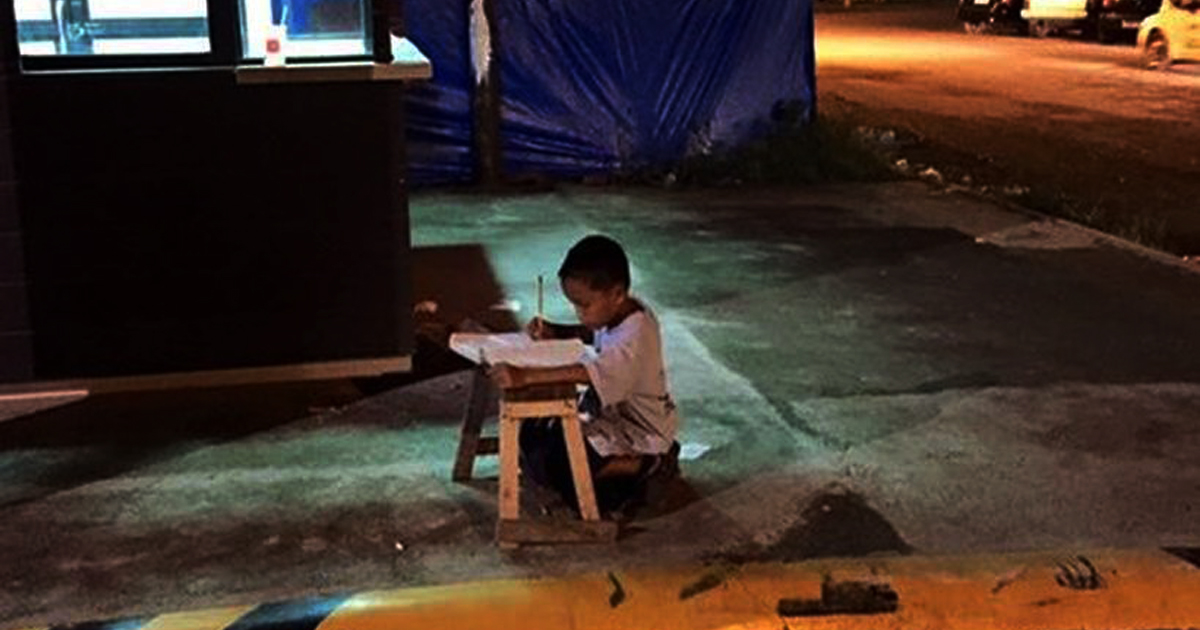
Editor’s note: This article is based on publicly reported information about Daniel Cabrera, the young student photographed studying outside a McDonald’s in the Philippines, along with broader research on student homelessness, housing instability, education access, and the homework gap.
A Small Boy, a Wooden Stool, and a Light That Traveled Around the World
Every once in a while, the internet pauses its usual diet of celebrity drama, mysterious kitchen hacks, and people arguing with strangers in comment sections to notice something that actually matters. One such moment came when a photograph showed a young boy doing his homework on the pavement outside a McDonald’s, using the restaurant’s light because he had nowhere brighter to study.
The boy was widely identified in news reports as Daniel Cabrera, a 9-year-old student from Mandaue City in Cebu, Philippines. In the now-famous image, Daniel sat near a small makeshift table, focused on his schoolwork while the glow from the fast-food restaurant spilled onto the sidewalk. It was not a polished “study aesthetic” scene with a laptop, iced coffee, and color-coded highlighters. It was a child making do with what he had: a pencil, a notebook, a patch of light, and a level of determination that made adults everywhere suddenly feel very dramatic about complaining that their desk chair squeaks.
The photo was taken by college student Joyce Torrefranca, who reportedly saw Daniel studying and shared the picture online with a simple message about being inspired. The image spread quickly. People saw not just poverty, but perseverance. Not just hardship, but hunger for education. Not just a boy under a restaurant light, but a reminder that opportunity is not distributed equally, even when talent and effort are present in abundance.
Who Was the Boy in the Viral McDonald’s Homework Photo?
Reports at the time described Daniel as a Grade 3 student whose family had endured devastating hardship. His father had died, the family home had reportedly burned down, and Daniel, his mother, and his siblings were living in unstable conditions. His mother, Christina Espinosa, worked difficult low-wage jobs to keep the family going. In other words, Daniel’s school day did not end when the bell rang. It continued into the evening, wrapped in uncertainty, noise, hunger, and the awkward problem of not having a proper place to study.
What made the photograph so powerful was its quietness. Daniel was not posing. He was not performing motivation for social media. He was simply doing what millions of children are told to do every day: finish your homework. The difference was that he had to borrow light from a restaurant window to do it.
That detail matters. Light is such a basic thing that many of us do not even notice it until the power goes out and everyone suddenly becomes a pioneer with a smartphone flashlight. But for a child trying to read, write, calculate, or memorize lessons, light is not decoration. It is infrastructure. It is the difference between “I can finish this” and “I have to stop.”
Why This Photo Hit So Many People So Hard
The image traveled because it had emotional gravity. It condensed a massive social problem into one unforgettable scene. You did not need a policy paper to understand it. You could look at Daniel’s small body leaning over his notebook and instantly grasp the unfairness: a child should not need a fast-food sign to function as his study lamp.
At the same time, the photo also triggered admiration. Daniel was not waiting for perfect conditions. He was not saying, “I’ll study once life gets easier.” He was showing up for his future with the materials available to him. That is why people described him as inspiring. His concentration felt like a tiny rebellion against circumstance.
But here is where the story needs a careful, honest reading. It is easy to turn Daniel into a motivational poster: “No excuses! Work harder!” That interpretation is neat, catchy, and about as useful as a chocolate teapot. The deeper lesson is not that poor children should simply try harder. The deeper lesson is that no child should have to prove their worthiness by studying on a sidewalk.
Daniel’s determination deserves respect. His situation demands action. Both can be true at the same time.
The Community Response: When One Photo Became a Lifeline
After the photo went viral, help began to arrive. Reports said Daniel and his family received school supplies, money, a reading lamp, uniforms, and even scholarship support. People from different places wanted to help him continue his education. For a family under intense pressure, that support was not merely symbolic. It meant fewer barriers, fewer impossible choices, and perhaps a little more breathing room.
Daniel’s mother reportedly expressed deep gratitude, saying the family felt overwhelmed by the blessings that followed. The attention also highlighted Daniel’s dream of becoming a police officer. Suddenly, a boy who had been studying in public because he lacked private resources was being seen by people around the world.
There is something beautiful about that response. A stranger noticed. A photo spread. Donations came in. A child received help. It is the kind of sequence that makes the internet look less like a giant washing machine full of opinions and more like a human network capable of kindness.
Still, charity after a viral moment is not the same as justice before a crisis. Viral generosity can change a life, but it cannot be the only safety net. For every Daniel whose photo is seen, there are countless children studying in dim rooms, crowded shelters, motel hallways, cars, temporary homes, and noisy corners where no camera ever arrives.
Student Homelessness Is Often Less Visible Than People Think
When people hear the word “homeless,” they often imagine someone sleeping outside. But child and student homelessness can look very different. A student may be staying with relatives because the family lost housing. Another may be living in a motel, shelter, car, campground, or temporary arrangement. Some children have a roof overhead but no stability, no quiet, no desk, no reliable transportation, and no guarantee that they will still be in the same school next month.
In the United States, public schools identify large numbers of students experiencing homelessness under the McKinney-Vento framework, which recognizes that unstable housing can seriously disrupt education. Recent national education data has shown well over a million students experiencing homelessness in American public schools in a single school year. That number is not just a statistic; it is a crowded classroom’s worth of anxiety multiplied across the country.
Housing instability affects more than where a child sleeps. It affects attendance, concentration, nutrition, emotional well-being, friendships, transportation, access to technology, and the ability to keep track of assignments. Homework becomes harder when your backpack is also your closet, your desk, and your filing cabinet.
The Homework Gap: When “Just Go Online” Is Not a Plan
Daniel’s story centered on light, but modern students often face another version of the same problem: access. In many classrooms, homework assumes that students have electricity, internet, a device, a quiet space, and an adult available to help. That is a lot of assumptions packed into one innocent-looking worksheet.
The “homework gap” refers to the divide between students who have reliable home internet and technology and students who do not. For low-income families, the gap can turn a simple assignment into a logistical obstacle course. A student may need to sit outside a library for Wi-Fi, borrow a phone, wait for a parent’s device, or complete an online assignment on a cracked screen while autocorrect behaves like a tiny villain.
Even when students are motivated, the lack of tools can slow them down. Imagine trying to write an essay without a stable place to sit, research without internet, or read assigned chapters while siblings, traffic, shelter rules, or stress keep interrupting. Motivation helps, but it does not magically transform a sidewalk into a study room.
Why Education Still Matters So Much in Stories Like Daniel’s
Education is often described as a pathway out of poverty. That phrase can sound shiny and simple, but the reality is more complicated. School can open doors, but students still need shoes to walk through them, transportation to reach them, meals to stay awake, and a stable enough life to keep going.
Daniel’s commitment to homework matters because education can provide structure, identity, and possibility. For children facing homelessness or poverty, school may be one of the few predictable places in life. A teacher who notices. A meal program that helps. A library corner. A counselor. A friend. A routine. These supports can become anchors.
But the responsibility cannot rest on the child alone. A student should not have to be extraordinary just to receive ordinary support. We should admire Daniel without using his story to excuse systems that leave children studying under commercial lighting.
What Schools and Communities Can Learn From the McDonald’s Light
The light from that McDonald’s became a symbol, but it also raises a practical question: what kinds of light should communities provide before children are forced to search for it?
1. Safe Study Spaces Matter
Libraries, schools, churches, community centers, youth clubs, and after-school programs can offer safe places for students to read and complete homework. A clean table, bright lighting, Wi-Fi, and a caring adult may not sound revolutionary, but for a child without stability, they can be life-changing.
2. Teachers Need Support to Identify Housing Instability
Many students hide homelessness because they feel embarrassed or fear being separated from family. Schools need trained staff who can notice warning signs without shaming students. Frequent moves, chronic absenteeism, tiredness, lost supplies, incomplete forms, or sudden behavior changes may signal that a child needs help, not punishment.
3. Supplies Are Small Items With Big Impact
A pencil, notebook, backpack, charger, lamp, calculator, or clean uniform can make a student feel prepared instead of exposed. Adults sometimes underestimate the emotional weight of basic school supplies. For a child, not having them can feel like walking into class wearing a sign that says, “Please notice what I lack.”
4. Internet Access Is an Education Issue
Homework has moved online, but not every household has followed at the same speed. Schools and local governments can support students through device lending, Wi-Fi hotspots, extended library hours, and offline assignment options. “Go online” should never be the educational equivalent of “good luck, tiny scholar.”
5. Kindness Should Be Organized, Not Accidental
The response to Daniel’s photo was generous, but children should not need virality to receive help. Communities can create regular systems: school supply drives, emergency housing referrals, transportation support, meal programs, tutoring, and partnerships between businesses and nonprofits.
The Danger of Turning Poverty Into Inspiration Porn
There is a delicate line between being inspired by resilience and romanticizing hardship. Daniel’s photo is moving because his effort is real. But it should not make poverty look noble, cute, or character-building. Poverty is not a personality workshop. Homelessness is not a motivational boot camp. Children do not need suffering to become strong; they need safety to become themselves.
When we share stories like this, we should avoid captions that imply, “If he can do it, anyone can.” That sounds encouraging until you realize it places the burden on children instead of on the conditions around them. A better message is: “Look how hard he is trying. Now look at what he should never have had to overcome.”
Daniel’s story should expand our compassion, not shrink our expectations for society. It should make us ask why children lack light, housing, food, transportation, and study space in the first place.
Why the McDonald’s Detail Became So Memorable
McDonald’s is familiar almost everywhere. Its bright windows, glowing signs, and late-night presence are part of the modern landscape. That familiarity made the image more powerful. The contrast was sharp: a global brand with electric brightness, and a child borrowing a little of that brightness to finish homework.
For some viewers, the restaurant represented access. For others, it represented inequality. Either way, the light became a character in the story. It was not just illumination; it was a reminder that public and private spaces often become informal safety nets. Fast-food restaurants, libraries, bus stations, laundromats, and convenience stores sometimes become places where people charge phones, warm up, cool down, connect to Wi-Fi, or simply exist for a while.
That reality should make us think carefully about how cities are designed. A humane community includes places where vulnerable people can access basic needs without being treated as a nuisance.
How Parents, Teachers, and Readers Can Help Students Like Daniel
Not everyone can fund a scholarship, but many people can reduce barriers for children in practical ways. Donate school supplies to local districts. Support food banks and family shelters. Volunteer with tutoring programs. Ask schools whether they have funds for emergency clothing, transportation, or technology. Support libraries. Vote for housing policies that treat stability as a foundation for education, not a luxury item.
Teachers can help by creating flexible homework policies, offering printed alternatives when online access is uncertain, and quietly connecting families to resources. Parents can encourage children to treat classmates with dignity instead of teasing someone for worn shoes, missing supplies, or repeated absences. Businesses can partner with community groups to provide safe study hours, charging stations, or sponsorship for students in need.
Small help is not small to the person receiving it. A lamp is just a lamp until a child can finally read at night. A backpack is just a backpack until it lets a student carry their world with a little more dignity.
Experiences and Reflections: What This Story Teaches Us About Effort, Dignity, and Opportunity
Stories like “Homeless Boy Does His Homework Using the Light From a Local McDonald’s” stay with people because they touch a familiar memory: the feeling of trying to finish something important when conditions are not ideal. Most people have had a night when they were tired, distracted, hungry, stressed, or stuck working in a place that was not exactly built for success. But Daniel’s story takes that ordinary frustration and places it inside a much harder reality.
One of the strongest lessons from the story is that children often understand responsibility more deeply than adults assume. Daniel did not need a perfect desk to know his homework mattered. He did not need applause to open his notebook. He did not wait for the world to become fair before doing his part. That kind of discipline is humbling. It reminds us that ambition is not limited to comfortable homes, private tutors, or quiet bedrooms with inspirational wall art that says “Dream Big” in cursive.
At the same time, the story teaches that effort needs an environment where it can survive. A seed may be strong, but it still needs soil, water, and light. Children are the same. Daniel had determination, but determination alone did not give him a safe home, a reliable lamp, or all the supplies he needed. When help arrived, it did not replace his effort; it supported it. That is the point communities sometimes miss. Assistance is not the enemy of hard work. Often, it is what allows hard work to finally produce results.
Many students facing poverty develop habits that outsiders never see. They memorize bus schedules because one missed ride means one missed class. They protect a single pencil like treasure because replacing it is not guaranteed. They learn which public places have outlets, which adults are kind, which offices might have extra paper, and which classmates will not laugh if they ask to borrow something. These are survival skills, but children should not have to become experts in survival just to complete fourth-grade math.
Daniel’s photo also reminds adults to notice without judging. A child doing homework late in a public place may not be “wandering.” A student who falls asleep in class may not be “lazy.” A missing assignment may not mean a child does not care. Sometimes the real story is hidden behind the behavior. Good teachers, neighbors, and community members learn to ask better questions: Do you have a quiet place to work? Do you have internet? Do you need supplies? Is there someone helping you at home? Those questions can open doors without embarrassing the student.
Another experience connected to this topic is the strange dignity of borrowed spaces. Many people have studied in libraries, restaurants, buses, hallways, or waiting rooms because life did not pause politely for schoolwork. Those spaces can be noisy and imperfect, but they can also become places of hope. The corner table, the public bench, the library outlet, the restaurant glowthese can become temporary classrooms when official ones are closed.
Still, the goal should not be to celebrate children for enduring hardship forever. The goal should be to build communities where a child’s best chance does not depend on a stranger taking a viral photo. Daniel’s story should move us from sympathy to responsibility. Admire the boy, yes. Share the story, yes. But then ask what can be done locally so the next child has a lamp, a desk, a meal, a stable address, and the simple privacy to make mistakes on homework without the whole world watching.
In the end, Daniel’s story is not only about poverty. It is about dignity. It is about the quiet power of a child who believed his future was worth studying for, even when the present gave him very little room. The light from McDonald’s helped him see the page. The world’s response, at its best, helped others see the child.
Conclusion: More Than a Viral Photo
The image of a homeless boy doing homework by the light from a local McDonald’s remains powerful because it is both heartbreaking and hopeful. It shows a child refusing to let hardship erase his dream, but it also exposes the uncomfortable truth that too many students are forced to fight for the basics before they can even begin to learn.
Daniel Cabrera’s story should not be remembered only as a feel-good viral moment. It should be remembered as a challenge. Children need more than admiration. They need housing stability, school support, technology access, safe study spaces, and communities that notice them before crisis becomes content.
The glow in that photo came from a restaurant window. The bigger light came from what people chose to do after seeing it. And if there is one lesson worth carrying forward, it is this: a child’s determination can be extraordinary, but our compassion should be practical.













