
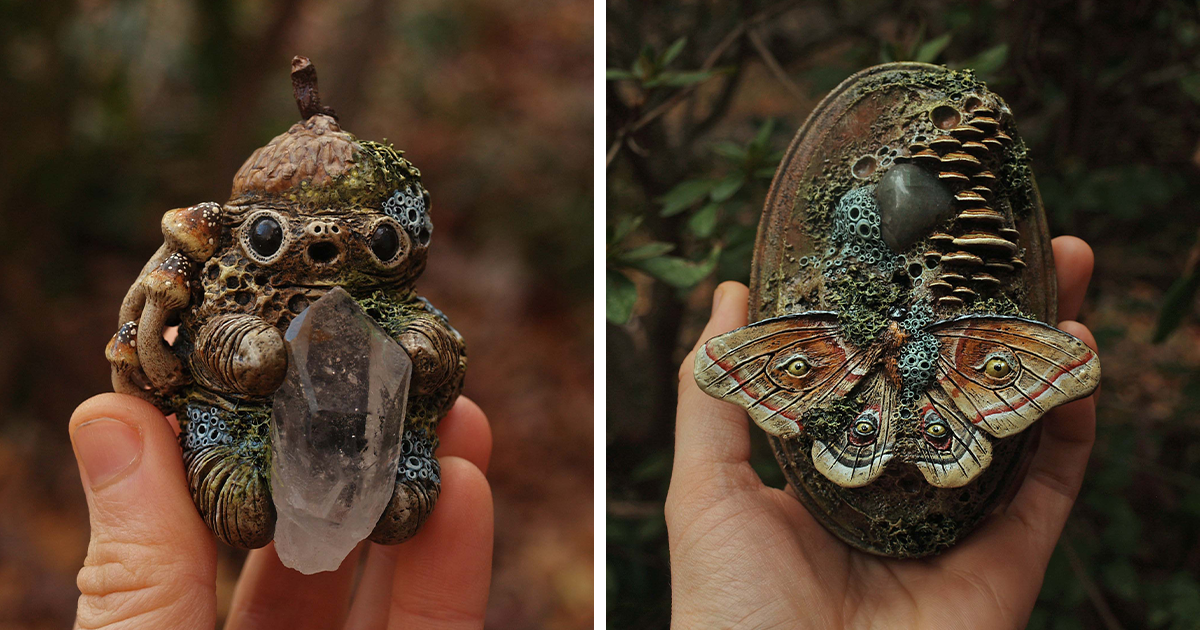
Some artists paint landscapes. Others photograph forests. Michelle Petersen appears to have discovered a third option: quietly populate the woods with mushroom-headed spirits, miniature mandrakes, mossy cats, and other creatures that look suspiciously capable of rearranging your houseplants after midnight.
The “I” in this wonderfully curious title belongs to artist Michelle Petersen, whose polymer clay sculptures combine fantasy storytelling with the colors, textures, and tiny treasures of the natural world. Her collection of 45 pictures introduces an enchanted population of figurines that seem to have wandered out of an old fairy tale, stopped for snacks beneath a mushroom, and decided they were comfortable enough to stay.
Petersen creates whimsical fantasy sculptures, seasonal ornaments, and figurines using polymer clay and acrylic paint. Nature provides the common thread. Stones, pinecones, acorns, wood, moss, crystals, shells, and other organic elements become parts of imaginary beings rather than simple decorative accessories.
From Watercolor Artist to Polymer Clay Creature Maker
Petersen did not begin with a grand plan to build an army of forest spirits. According to her artist profile, she once worked almost entirely in watercolor and had little interest in sculpture. Around 2013, she bought a block of polymer clay simply to experiment with it. The material apparently had other plans. She fell in love with sculpting, and the experiment developed into a full-time creative obsession that included jewelry, masks, figurines, and freestanding artwork.
That origin story feels appropriate for an artist fascinated by transformation. A plain block of clay becomes a sleepy woodland creature. A stone becomes an eye, heart, belly, or magical object. A pinecone might suggest armor, scales, a tail, or the roof of a house occupied by someone who definitely pays rent in berries.
Her watercolor background is still visible in the sculptures. The painted surfaces often rely on layered earthy shades rather than flat color. Greens drift into blues, browns break into rusty oranges, and pale highlights make eyes, mushrooms, fur, leaves, and lichen appear more dimensional. The figures are sculpted objects, but their surfaces are treated with a painter’s sensitivity.
Why Polymer Clay Is Ideal for Fantasy Sculpture
Polymer clay is a synthetic, pliable modeling material that remains workable until it is cured with heat. Unlike traditional ceramic clay, it does not require a professional kiln. Many varieties can be cured in a household oven when the manufacturer’s temperature and timing instructions are followed. It also retains small details well and is available in a wide range of colors.
For a fantasy sculptor, those qualities are practically an invitation to misbehave creatively.
An artist can form tiny claws, ears, horns, mushroom gills, wrinkles, leaves, and expressive faces without racing against air-drying clay. If a creature looks too cheerful, its eyebrows can be adjusted. If its ears need to become three times largerand fantasy creatures often have union rules about impressive earsthe clay will patiently cooperate.
It Supports Small Details
Fantasy art depends on details that make an invented subject feel believable. The viewer may know that a blue forest cat covered in moss does not technically exist, but carefully modeled paws, alert ears, textured fur, and thoughtfully painted eyes persuade the imagination to accept it.
Firmer sculpting clays can hold fine marks and defined edges, while softer varieties are easier to blend and shape. Polymer clay can also be carved, impressed, painted, sanded, glazed, or combined with other materials after curing. Museums and professional craft organizations now feature polymer clay in decorative art, sculpture, and contemporary jewelry, showing how far the medium has traveled beyond its old reputation as a children’s craft supply.
It Welcomes Mixed Media
Petersen’s work becomes especially distinctive when sculpted forms meet real natural objects. Her artist statement describes a deep respect for nature and an ongoing effort to incorporate stone, moss, dirt, shell, and other found materials into her creations.
This mixture creates a satisfying visual puzzle. Viewers can see where reality ends and fantasy begins, but the boundary is blurry. A gemstone may be both an actual mineral and a magical organ. A terracotta pot may be an ordinary gardening object and the home of a grumpy mandrake. Moss can look like fur, clothing, camouflage, or evidence that a creature has been standing still for approximately 400 years.
The Enchanted World Inside the 45 Pictures
The gallery is not simply a collection of unrelated cute objects. The sculptures share enough colors, materials, and recurring motifs to suggest a connected world. It feels less like browsing a craft table and more like examining field notes from a forest that does not appear on conventional maps.
Nature Spirits With Big Personalities
Many of Petersen’s creatures resemble small nature spiritspart plant, part animal, and part mysterious potato. Sprouting leaves, root-like limbs, rounded bodies, mushroom caps, and jewel details give them recognizable silhouettes without making them predictable.
Their expressions are equally important. Some look shy. Others appear curious, sleepy, mildly offended, or deeply concerned about the current condition of your compost pile. Their personalities are communicated through posture, eye placement, tilted heads, and tiny gestures rather than exaggerated action.
Mushrooms, Mandrakes, and Forest Folklore
Mushrooms are perfect fantasy ingredients because they already look imaginary. Their unusual shapes, sudden appearance after rain, and long association with folklore make them natural hats, umbrellas, houses, and companions for woodland beings.
Petersen’s broader body of work includes mushroom creatures, potted mandrakes, sprouting nature spirits, faerie cats, horned figures, and sculptures incorporating quartz, moonstone, aventurine, amethyst, and black onyx. These repeated subjects create a recognizable artistic vocabulary: earthy, magical, slightly witchy, and charming without becoming sugary.
Creatures That Are Cute but Not Too Polished
A major strength of these whimsical polymer clay sculptures is their imperfect texture. The surfaces often resemble bark, soil, stone, weathered skin, moss, or rough fur. This prevents the figures from looking mass-produced.
They remain adorable, certainly, but it is the kind of adorable that may know ancient woodland secrets. A perfectly smooth figure might look like a toy. A figure with cracked-earth textures, uneven horns, lichen-colored patches, and a tiny crystal tucked into its body looks like it has a history.
How a Fantasy Sculpture Comes Together
Every artist develops a personal process, but successful polymer clay sculpture usually moves through several practical stages. The magic may look spontaneous. The studio table, however, knows the truth.
1. Beginning With a Silhouette
A strong creature normally begins with a readable overall shape. Before adding eyelashes, freckles, buttons, or seventeen tiny mushrooms, the artist needs a convincing body, head, limbs, and pose.
Silhouette matters because viewers understand form before they notice surface detail. Oversized ears may communicate alertness. A rounded body may feel gentle. Long limbs can create elegance or awkward comedy. A hunched posture might suggest age, caution, secrecy, or a creature attempting to hide the fact that it ate an entire pie.
2. Building a Lightweight Interior
Larger sculptures may use an internal armature or a tightly formed aluminum-foil core. This reduces weight, saves clay, and supports projecting parts. Polymer artists and sculptors commonly build clay over aluminum or another stable inner structure, particularly when creating figures with limbs, tails, wings, or oversized heads.
The armature is the invisible skeleton of the artwork. It is not glamorous, but neither is the wooden framework inside a castle. Both are useful when the towers refuse to remain upright.
3. Conditioning and Shaping the Clay
Before sculpting, polymer clay is conditioned by kneading, rolling, folding, or passing it through a clay-conditioning machine. Proper conditioning makes the material smooth and flexible and helps reduce cracking while it is shaped.
The main masses are generally added before small details. An artist may create a torso, attach limbs, shape the head, establish facial proportions, and then work toward progressively finer elements. Needles, loop tools, silicone shapers, blades, brushes, and homemade texture stamps can all contribute to the finished surface.
4. Curing Without Roasting the Resident Goblin
Polymer clay hardens through heat curing. Exact temperatures and times vary by product, so package directions matter more than studio folklore. An oven thermometer is useful because household ovens may fluctuate, and increasing the heat to finish faster can discolor or damage the clay rather than improve it.
Thick pieces may be built and cured in stages. Correct curing is important because under-cured clay can remain weak, while excessive heat may darken pale colors. Covering a piece during baking can also help shield it from direct heat. In other words, the oven is not a dragon. It should not be encouraged to breathe harder.
5. Painting the Personality
Once the sculpture is cured, acrylic paint can deepen shadows, add highlights, define facial features, and unify mixed materials. Thin washes settle into texture and make wrinkles, scales, bark, fur, and mushroom gills easier to see. Dry-brushed highlights catch raised areas and create contrast.
This is often the stage when a technically competent form becomes a character. A tiny reflective dot in an eye can make a creature appear suddenly awake. Blushed cheeks create warmth. Dark paint around the mouth may suggest age or mischief. One poorly placed eyebrow can turn a gentle forest guardian into an accountant who has discovered several unauthorized expenses.
Why These Sculptures Feel So Appealing
They Encourage Small Stories
People connect with figurative art when it leaves room for imagination. Petersen’s sculptures do not require a long explanation. Their poses and expressions offer just enough information for viewers to invent one.
Where does the mushroom creature live? Why is the faerie cat carrying a gemstone? Does the little mandrake sing, scream, or simply complain about being watered before noon? Each viewer supplies different answers, turning a small handmade object into the beginning of a larger narrative.
They Make Nature Feel Magical Again
Adults become efficient at ignoring tiny things. We walk past seedpods, lichen, unusual stones, twisted roots, and fallen bark because none of them are sending email notifications.
Nature-inspired sculpture reverses that habit. It encourages viewers to examine texture, color, and shape closely. An acorn is no longer lawn debris; it is a helmet. A branch is a staff. A quartz point is a glowing heart. The landscape becomes less like background scenery and more like an overflowing supply cabinet.
They Preserve the Human Hand
Handmade fantasy figurines carry evidence of their creation. Tool marks, painted transitions, asymmetry, and subtle variations reveal that a person shaped each part. That visible human presence is a feature, not a flaw.
Polymer clay has increasingly been recognized as a serious artistic medium because it can imitate other materials while also producing effects that belong entirely to itself. Artists use it in sculpture, jewelry, mixed-media assemblage, narrative objects, and museum-quality decorative art.
What Beginning Polymer Clay Artists Can Learn From This Work
The most useful lesson is not “make the same creature.” It is “build a personal visual world.” Petersen repeatedly returns to nature, folklore, earthy colors, gemstones, mushrooms, roots, cats, plants, and expressive faces. Repetition does not make the work repetitive; it makes it recognizable.
Beginners can develop a similar sense of identity by choosing a few elements they genuinely enjoy. Someone fascinated by the ocean might combine shells, translucent clay, fish, coral textures, and sea-glass colors. A desert-inspired artist could work with cactus forms, sun-bleached bones, warm stone shades, and miniature lizards. Another artist may build an entire civilization of haunted kitchen utensils. There are no laws against this, although the spoons may eventually demand representation.
It also helps to start small. A single expressive head, mushroom, animal, or seated character provides practice in proportion and texture without requiring an elaborate armature. Safe materials should be used according to their labels, and tools used for clay should generally remain dedicated to art rather than returning to food preparation. Products carrying the ACMI AP Seal have undergone toxicological evaluation for their intended use, but artists must still follow the manufacturer’s handling and curing directions.
Studio Experience: What Creating Whimsical Clay Creatures Teaches You
Working on a fantasy sculpture is an unusual conversation between planning and improvisation. You may begin with a tidy sketch of an elegant forest guardian. Twenty minutes later, the guardian has developed enormous ears, a mushroom hat, and the emotional expression of someone who has misplaced a very important sandwich. The sculpture frequently becomes more interesting when the original plan loosens its grip.
The first practical lesson is patience. Small forms exaggerate every decision. Moving an eye by a fraction of an inch can change a face from gentle to suspicious. Tilting the head can produce curiosity, sadness, pride, or the unmistakable look of a cat preparing to push a glass from a table. Details that seem insignificant in your hand become powerful in a close-up photograph.
The second lesson is that mistakes are often design opportunities wearing poor disguises. A cracked surface can become bark. An uneven patch can grow into moss. A fingerprint may be blended away, textured intentionally, or covered with a leaf. A body that feels too wide may become a round, cheerful creature instead of the slender elf originally imagined.
Material experiments are equally educational. Natural objects bring authentic texture, but they also impose constraints. A stone may be beautiful and inconveniently heavy. A pinecone might have the perfect pattern but a rebellious shape. Moss adds atmosphere but must be attached and preserved appropriately. Mixed-media work requires the artist to respond to the object that exists rather than the perfectly obedient object pictured in the mind.
Painting brings another round of discoveries. Freshly cured neutral clay may look plain, but a few translucent washes can reveal every crease and tool mark. Dark color settles into recessed areas. Pale dry brushing emphasizes raised texture. Several restrained layers usually create more depth than one heroic application of paint that leaves the creature looking as though it fell into a bucket.
Photography also changes how an artist evaluates the sculpture. The camera notices dust, fingerprints, seams, and awkward angles with the enthusiasm of a detective in a crime drama. Yet it also reveals successful expressions and textures that may be less obvious under ordinary studio lighting. Photographing the work from several angles becomes part of the creative process, not merely documentation.
Perhaps the greatest experience is watching a character acquire an identity. At first it is only clay arranged around a shape. Then the face appears. A posture develops. Colors create a mood. A stone, twig, leaf, or mushroom provides context. Eventually, the object no longer feels like a technical exercise. It feels like a particular creature with habits, preferences, and probably several firm opinions about humans.
That moment explains why handmade fantasy sculpture can become so absorbing. The artist is not merely reproducing something already visible. Sculpting becomes a method of discovery. Each figure answers a question that did not exist before the clay was opened: What sort of being might live under this pinecone, guard this crystal, sleep beside this mushroom, or hide inside this flowerpot?
Conclusion: A Tiny Forest With a Very Large Imagination
Michelle Petersen’s whimsical polymer clay sculptures show what happens when close observation of nature meets playful fantasy. The materials may be modestclay, paint, stones, moss, wood, shells, and found objectsbut the resulting world feels surprisingly expansive.
The 45 pictures are enjoyable because they offer more than technical skill. They contain personality. Each creature looks discovered rather than manufactured, as though it existed long before the camera arrived and will return to its secret routine after the final photograph.
These sculptures also provide a useful reminder for artists: an original style does not always arrive through a dramatic revelation. Sometimes it begins with one inexpensive block of clay purchased for fun. You make a shape, add a face, place a mushroom on its head, and accidentally open a portal to an entire imaginary forest.













