
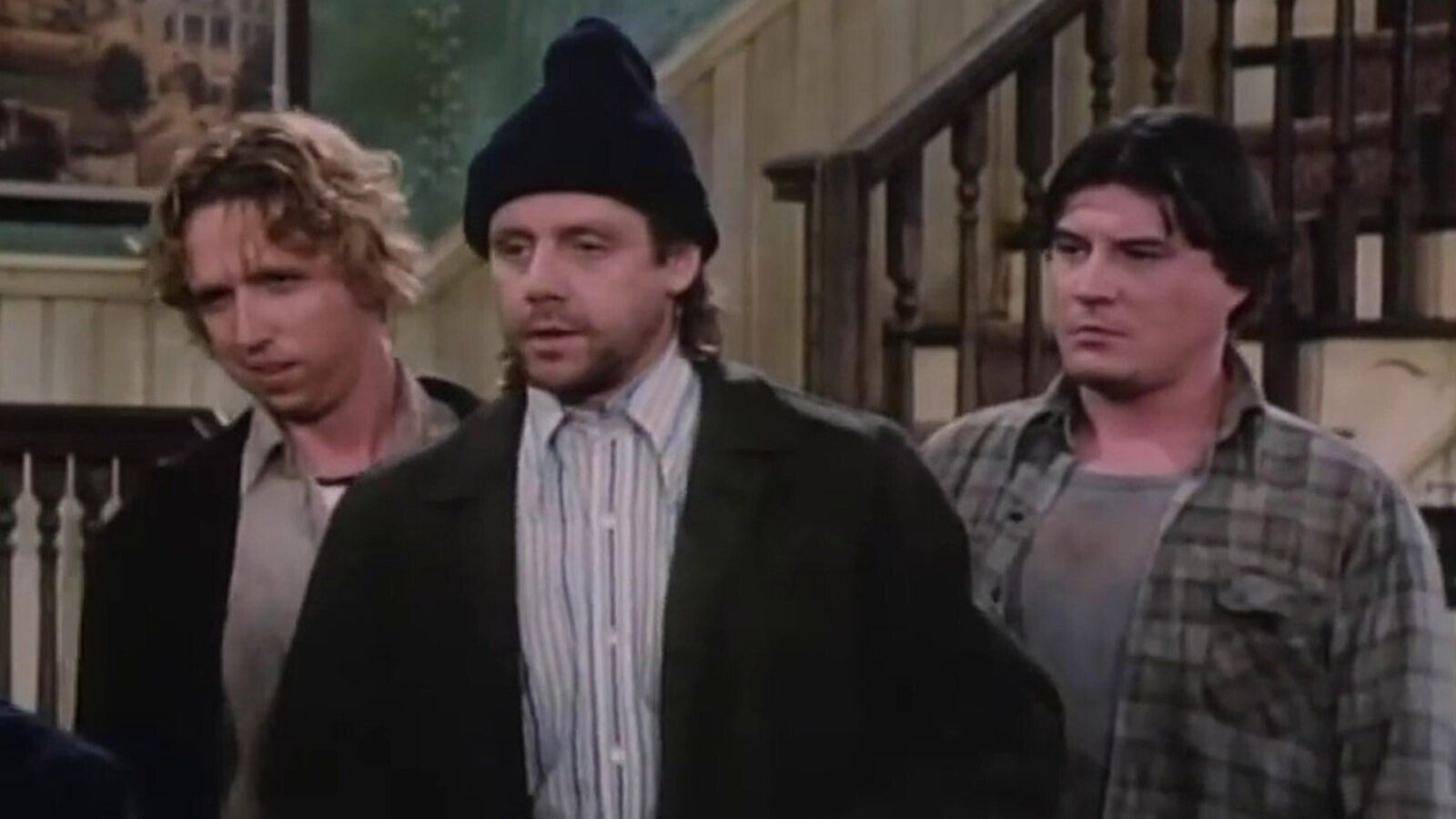
Some television reunions arrive with red carpets, swelling music, and enough promotional buildup to make viewers wonder whether tha cure for aging. The reunion of Newhart favorites Larry, Darryl and Darryl needed none of that. William Sanderson, Tony Papenfuss, and John Voldstad simply appeared together in a 2024 video interview and began remembering the strange little comedy miracle that turned three supposed one-shot characters into sitcom legends.
The conversation was especially meaningful because it took place during a year when audiences were reflecting on Bob Newhart’s remarkable career following his death on July 18, 2024. Yet the reunion was not gloomy. It felt like three brothers opening an old family albumassuming the family album contained buried bodies, pet pigs, porcupine-related injuries, and two men who declined to speak for nearly eight seasons.
More than four decades after Larry delivered his unforgettable introduction, the actors’ affection for one another remained obvious. Their memories revealed how live audiences helped save the characters, how two performers built complete personalities without dialogue, and how Bob Newhart quietly created an environment in which supporting players were encouraged to steal scenes.
ll>
The Reunion Was Small, but Its Television History Was Huge
This was not a fictional Newhart episode or a heavily scripted network reunion special. It was a remote interview published in December 2024, bringing Sanderson, Papenfuss, and Voldstad together to discuss their auditions, favorite episodes, silent performances, and years of friendship.
That modest format suited them. Larry, Darryl and Darryl were never glamorous characters. They looked as though they had walked out of the Vermont woods because somebody had mentioned free food. A polished reunion staged inside a glittering theater might have felt wrong. Seeing the three actors talk from their own screens made the exchange warmer and more personallike accidentally joining the world’s most unusual family video call.
The actors remembered specific jokes, but the heart of the conversation was their bond. Voldstad recalled feeling an immediate kinship when he first met Sanderson and Papenfuss. Papenfuss described the emotional emptiness he experienced when Newhart ended. Sanderson spoke appreciatively of what he learned from his two television brothers. The roles may have begun as a bizarre gag, but the relationship behind them became very real.
How Larry, Darryl and Darryl Entered the Newhart Universe
Newhart premiered on CBS in October 1982. Bob Newhart played Dick Loudon, a practical writer who moved with his wife, Joanna, from New York City to rural Vermont and purchased the historic Stratford Inn. Dick expected peaceful country living. Instead, he discovered a community apparently governed by people who considered common sense an optional hobby.
Larry and the two Darryls appeared in the show’s second episode, “Mrs. Newton’s Body Lies A-Mould’ring in the Grave,” which aired on November 1, 1982. Dick and Joanna discovered that a woman accused of witchcraft had been buried in the inn’s basement. The brothers were hired to remove the body, an assignment they approached with considerably more enthusiasm than most licensed contractors would display.
The trio’s entrance established the formula immediately. Sanderson’s Larry introduced himself and his brothers with the now-famous line: “Hi, I’m Larry. This is my brother Darryl, and this is my other brother Darryl.” Larry spoke for the group while the Darryls watched, reacted, nodded, frowned, and somehow communicated entire arguments without making a sound.
The characters were intended for a single appearance. There were no elaborate plans, spinoff proposals, or Larry-and-the-Darryls cinematic universe waiting in a filing cabinet. They were simply three odd workers needed for one odd story. However, the studio audience reacted so strongly that the producers brought them back. Their return appearances generated even greater excitement, transforming an eccentric guest spot into one of the show’s defining attractions.
ll>
Three Very Different Auditions Built One Perfectly Strange Family
William Sanderson Found Larry by Looking a Little Unpredictable
William Sanderson arrived at his audition in clothing he had previously used while playing eccentric characters in New York. He also placed a quarter in his ear, because apparently every successful audition strategy book had overlooked that technique.
The role reportedly had been conceived with respected character actor Tracey Walter in mind, although Walter still auditioned. Sanderson believed he won the part partly because his interpretation was unusual without becoming uncontrollable. His Larry was unsettling, but also intelligent, articulate, and strangely gracious. He might offer to remove a corpse, cook a woodland animal, or run for public office, yet he would usually explain the plan with the courtesy of a hotel concierge.
Sanderson’s range extended far beyond Newhart. Movie audiences knew him as J.F. Sebastian in Blade Runner, while later television viewers saw him as E.B. Farnum in Deadwood and Sheriff Bud Dearborne in True Blood. Larry nevertheless remained one of his most recognizable creations because Sanderson never treated the character as a disposable hillbilly joke. Larry possessed his own logic, confidence, and peculiar dignity.
Tony Papenfuss and John Voldstad Auditioned Without Dialogue
Tony Papenfuss and John Voldstad had both worked at Los Angeles’ Mark Taper Forum. Casting personnel knew they were trained actors who could take direction, which mattered because neither Darryl had audition lines. There was no stirring monologue, no emotional confession, and no convenient speech about childhood dreams. Their assignment was essentially to stand there and look as though something complicated was happening behind their eyes.
Papenfuss later joked that the casting team needed actors who appeared capable of crawling out of the woods to excavate an old body. Voldstad approached the audition by behaving disheveled and unpredictable. Once Sanderson had been selected as Larry, the production chose two performers who visually complemented him and could create convincing reactions.
That decision was crucial. Silent characters can easily become furniture with eyebrows. Papenfuss and Voldstad instead developed internal monologues for their scenes. They imagined what each Darryl was thinking, how he felt about Larry’s statements, and whether the brothers agreed with one another. Their invented subtext gave purpose to every glance and shrug.
The Darryls Turned Silence Into a Comic Superpower
Television comedy usually rewards the performer with the sharpest line. The Darryls demonstrated that the funniest person in a scene may be the one staring quietly at somebody who has just said something ridiculous.
Papenfuss described the challenge as keeping the characters “alive.” The brothers could not merely wait for Larry to finish speaking. Their posture, timing, eye movements, and expressions had to suggest an ongoing private conversation. Sometimes they supported Larry. Sometimes one Darryl appeared skeptical. Sometimes both looked as though they knew Larry was heading toward disaster but had decided that watching would be educational.
The restriction extended beyond the series. During the height of the characters’ popularity, Papenfuss and Voldstad generally avoided speaking during promotional interviews because producers wanted to protect the illusion. Commercial appearances also had to preserve their silence. On one television interview, they maintained character while Regis Philbin attempted to provoke them into talking. Papenfuss’s refusal to break became part performance, part endurance sport.
By withholding dialogue, Newhart made viewers pay closer attention. Every reaction mattered because a Darryl response was rare and economical. Modern comedies sometimes explain a joke, repeat it, and then place a flashing arrow above it. The Darryls simply raised an eyebrow and trusted the audience to catch up.
Bob Newhart Wanted Supporting Actors to Succeed
The reunion also offered a revealing portrait of Bob Newhart away from the camera. His screen persona was controlled, hesitant, and quietly bewildered. According to his costars, he was warmer and more animated backstage, particularly when a scene produced a tremendous audience response.
Before one of the trio’s early return appearances, the actors worried that viewers might not welcome them back. Newhart reassured them that the audience would love them. When the brothers walked onto the set, the crowd erupted. Papenfuss remembered Newhart celebrating backstage with almost childlike excitement because his prediction had been correct.
That reaction illustrated Newhart’s generosity as a star. He did not resent another performer receiving a large laugh. He understood that the series improved whenever the entire ensemble succeeded. His deadpan style also depended on strong comic partners. Dick Loudon was funniest when surrounded by people whose behavior forced him to question every decision that had brought him to Vermont.
The show’s live audience was equally important. Sanderson credited Newhart’s insistence on performing before an audience with helping the brothers survive beyond their first episode. The laughter gave producers immediate evidence that the characters worked. In an era before online engagement statistics, the sound of hundreds of people losing their minds over three scruffy handymen was a fairly effective analytics dashboard.
Characters Who Could Go Anywhere and Do Almost Anything
Once the writers recognized the trio’s flexibility, Larry, Darryl and Darryl became usable in nearly any plot. They could operate the Minuteman Café, live in a remarkably primitive cabin, write a winning advertising jingle, become involved in politics, adopt a teenager, host television, raise animals, or display a surprising skill that contradicted everything viewers thought they knew about them.
Papenfuss remembered realizing the characters had a future when the audience saw their home in the woods. Their world no longer ended when they exited a scene at the inn. They had a lifestyle, a household, and a brotherly system that somehow functioned despite appearing to violate several health regulations.
Among their most memorable showcases was “The Prodigal Darryl,” first broadcast in May 1985. After the brothers won money in a jingle contest, one Darryl left for the supposed temptations of Stowe, Vermont. Larry and the remaining Darryl went searching for him. The story allowed one silent brother to become the emotional center of an episode without suddenly transforming him into a conventional speaking character.
Other plots placed the trio in absurdly elevated situations. They could seem barely acquainted with indoor plumbing in one episode and capable of navigating government or broadcasting in another. That inconsistency was not a flaw. It was the joke. Larry and the Darryls operated under fairy-tale logic: whatever skill the story required, they had somehow learned it in the woods.
ll>
The Moment Darryl and Darryl Finally Spoke
Keeping two popular characters silent for years created a magnificent comic promise. Eventually, viewers had to wonder whether the Darryls would ever speakand what event could possibly force them to do it.
The answer arrived in the 1990 series finale. Both Darryls had married highly talkative women from Long Island. After enduring an unstoppable wave of conversation, the brothers finally shouted, “Quiet!” It was their only spoken word on the series.
The joke succeeded because the show had practiced restraint for eight seasons. Had the Darryls spoken during an ordinary episode, the moment would have been amusing. Saving their voices for the finale transformed one word into a major event. The audience was not merely hearing dialogue; it was witnessing a television law being broken.
That surprise was soon eclipsed by an even more famous one. After Dick Loudon was struck by a golf ball, Bob Newhart’s character awakened in the bedroom from The Bob Newhart Show beside Suzanne Pleshette’s Emily Hartley. The entire Vermont series was presented as a dream experienced by Newhart’s earlier television character.
Pleshette’s appearance had been guarded with extraordinary secrecy. Several cast and crew members reportedly did not know she was on the set. When she was moved into position, efforts were made to conceal her identity so the studio audience would experience the reveal without warning. Their explosive response became part of one of television’s most celebrated endings.
The finale aired on May 21, 1990, and ranked as the most-watched program of its broadcast week, reaching approximately 17.2 million television households. Larry and the Darryls may not have appeared in the bedroom reveal, but their long-awaited dialogue contributed another perfect payoff to a finale built around rewarding patient viewers.
ll>
A Television Brotherhood That Continued Off-Screen
The most touching part of the 2024 reunion was not a specific production anecdote. It was the ease with which the three actors still interacted. Their roles had required them to create a believable family, and years of working together turned that assignment into a genuine connection.
Papenfuss and Voldstad became especially close while solving the unusual challenge of playing silent brothers. They invented thoughts for their characters, discussed reactions, and learned how to communicate inside scenes without competing for dialogue. After Newhart, members of the trio appeared together at events and continued to be associated with the characters.
For actors, such recognition can be complicated. A beloved role may open doors while also overshadowing decades of other work. Yet the reunion suggested gratitude rather than frustration. A minor assignment with no guarantee of returning had given them eight seasons, lifelong friendships, and a place in American television history.
Why Larry, Darryl and Darryl Still Work
The Introduction Was Repetition With a Purpose
Larry’s introduction became a catchphrase because viewers knew exactly what was coming and still enjoyed hearing it. Repetition created anticipation. The words signaled that ordinary logic was about to leave the room, possibly through a window.
The Characters Were Strange but Never Empty
The brothers’ poverty, woodland lifestyle, and peculiar habits supplied jokes, but the actors gave them confidence and emotional loyalty. They did not consider themselves ridiculous. From their perspective, the people at the Stratford Inn were the confusing ones.
They Balanced Bob Newhart’s Comic Style
Newhart specialized in controlled reactions. Larry specialized in describing insanity as though presenting a sensible business proposal. The silent Darryls amplified the contrast. Together, they created a clean comic structure: calm disbelief met cheerful absurdity while two witnesses silently confirmed that, yes, this was apparently happening.
The Experience of Revisiting the Brothers Today
Watching Them Feels Like Rediscovering How Patient Comedy Can Be
Returning to Larry, Darryl and Darryl after years of faster, louder television can feel strangely refreshing. Their scenes do not rush to provide constant dialogue. The camera allows a reaction to develop. Larry may complete a long explanation, Dick may stare at him in disbelief, and the Darryls may exchange a nearly invisible glance. The laugh grows from timing rather than volume.
That viewing experience encourages attention. A distracted viewer may hear Larry’s joke but miss the second joke occurring silently beside him. Watching closely reveals how Papenfuss and Voldstad adjusted their faces and bodies in response to every conversational turn. Their work is a reminder that listeningor convincingly pretending to listenis a major part of acting.
The Reunion Feels Like Meeting Old Neighbors
For longtime fans, seeing Sanderson, Papenfuss, and Voldstad together again does more than revive a running gag. It reconnects them with a period when network sitcoms arrived at the same time every week and millions of households watched the same characters together.
The actors have aged, as audiences have, but their rhythm remains familiar. That recognition creates the peculiar warmth of a successful cast reunion. Viewers are not pretending that no time has passed. They are appreciating the fact that the relationship survived it.
The reunion also changes how earlier episodes feel. Knowing that the performers formed lasting friendships makes the fictional brotherhood more convincing. A silent glance between the Darryls no longer seems like a clever technical choice alone; it becomes evidence of two actors who trusted each other enough to share a joke without words.
Their Story Offers a Useful Lesson About Small Opportunities
Papenfuss emphasized that some actors might have rejected a one-time role with no dialogue. On paper, playing an unnamed silent brother in a single early episode hardly resembled a career-changing opportunity. There was no reason to assume the character would return, much less become culturally recognizable.
Yet that tiny opening led to years of steady work. The lesson reaches beyond acting. Creative careers often change through assignments that initially appear too small, too strange, or too uncertain to matter. The important question is not always whether an opportunity looks impressive. It is whether someone can make it memorable.
Sanderson made Larry memorable with a peculiar costume, a quarter in his ear, and a courteous delivery. Papenfuss and Voldstad made silence memorable by filling it with thought. Bob Newhart and the producers noticed the audience reaction rather than stubbornly following the original plan. Success arrived because several people treated a temporary idea as though it deserved permanent effort.
The Brothers Also Demonstrate the Value of Creative Restraint
Modern entertainment frequently responds to popularity by supplying more: more dialogue, more backstory, more explanations, more spinoffs, and perhaps an origin movie revealing where Larry purchased his first hat. Newhart largely resisted that temptation.
The Darryls remained silent. Their past stayed mysterious. Their abilities changed whenever the joke required it. The show provided enough information to make them recognizable but not enough to make them ordinary. That restraint allowed audiences to participate by imagining what the brothers thought and how their household worked.
The 2024 reunion preserved that spirit. It answered important questions about the actors and production without dismantling the comic mystery of the characters. We learned how the performances were constructed, but Larry and the Darryls remained delightfully unexplained.
Conclusion: The Brothers Are Still Together
The reunion of William Sanderson, Tony Papenfuss, and John Voldstad celebrated more than an old catchphrase. It honored the unpredictable way television history is made. Three actors hired for a single episode created such a strong response that they became recurring players, café owners, silent reaction specialists, and essential residents of Newhart’s wonderfully illogical Vermont.
Their success came from precise casting, live-audience energy, generous ensemble work, and a willingness to treat absurd characters seriously. Most importantly, the actors built a brotherhood that endured long after the Stratford Inn closed its doors.
Larry, Darryl and Darryl were funny because they never seemed aware that they were unusual. Their reunion was moving for a similar reason. There was no need to manufacture emotion or declare the occasion historic. Three old friends simply talked, laughed, remembered Bob Newhart, and demonstrated that some television families remain families even after the cameras stop.













