
Every family bookshelf has its celebrities. Goodnight Moon has a reserved parking space. The Very Hungry Caterpillar has eaten through several generations. And somewhere nearby, a Dr. Seuss character is balancing seventeen household objects on one paw.
Classics deserve their fame, but children’s literature is much bigger than the usual bestseller parade. Plenty of funny, imaginative, and emotionally intelligent picture books are waiting just beyond the spotlight. This refreshed Tipsaholic reading list introduces ten awesome kids books that can make bedtime funnier, conversations deeper, and cardboard boxes considerably less likely to reach the recycling bin.
These lesser-known children’s books cover creativity, emotions, confidence, bedtime resistance, conservation, gratitude, and the dangerous consequences of allowing dangerous consequences of allowing a duck to develop a personal style. They are especially useful as family read-aloud books because children can predict, interrupt, imitate noises, study illustrations, and argue with the characters. Shared reading is not only a literacy activity; the American Academy of Pediatrics also recognizes it as an opportunity to support relationships, rn266807search0turn266807search19
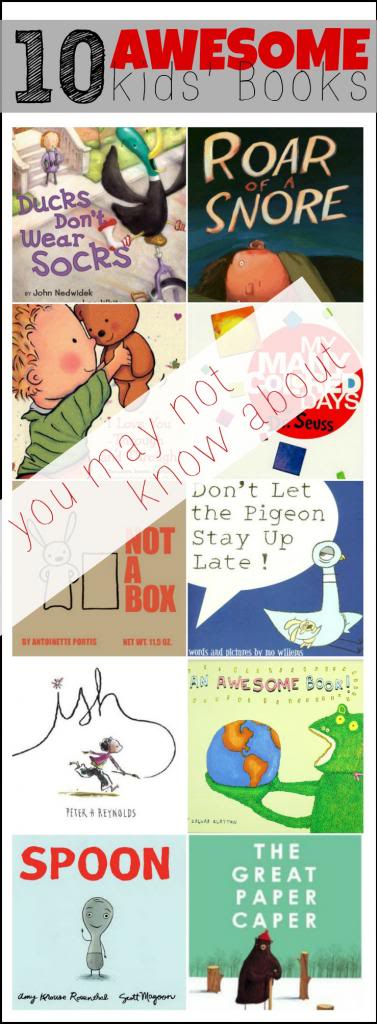
10 Awesome Kids Books Worth Discovering
1. Ducks Don’t Wear Socks by John Nedwidek
Emily is a serious child. Duck is not a serious duck. He appears in ridiculous outfits, behaves in gloriously undignified ways, and keeps trying to pull Emily out of her solemn little shell. Their repeated encounters gradually reveal that silliness is not the enemy of maturity. Sometimes laughter is exactly what a person needs.
This picture book works particularly well for children who are cautious, shy, or determined to do everything “properly.” Duck’s clothing choices create an easy prediction game: What impossible thing might he wear next? After reading, invite children to design an outfit that an animal supposedly should never wear. A giraffe in roller skates? A penguin in pajamas? There are no bad answers, although the penguin may argue thateasonable. citeturn763586search0
2. Roar of a Snore by Marsha Diane Arnold
A tremendous snore shakes the Huffle household, sending young Jack on a nighttime investigation. One by one, family members and animals join the search. Each new suspect is eliminated, the group grows larger, and the noisy mystery becomes increasingly ridiculous.
The cumulative structure makes this an excellent interactive read-aloud book. Children can repeat the snoring sound, guess who is responsible, and listen for the rhythm of the language. Pierre Pratt’s shadowy illustrations add just enough nighttime suspense without making the story frightening. Publishers Weekly highlighted the book’s escalating search and its dramatic treatment of the mysterious snore. It is a bedtime story about sleep that may temporarily make e to sleep. citeturn966636search6
3. I Love You Through and Through by Bernadette Rossetti-Shustak
Some books deliver a complicated plot. This one delivers something younger children may need even more: steady reassurance. The narrator expresses love for every side of a child, including the happy, grumpy, silly, active, and quiet parts.
Caroline Jayne Church’s warm illustrations and the book’s simple rhythm make it especially comfortable for toddlers and preschoolers. Parents can use the pictures to practice naming body parts, facial expressions, and emotions. More importantly, the story communicates that affection does not disappear when a child has a difficult feeling or a spectacularly dramatic Tuesday.
The book is short enough for repeated reading, and repetition is part of its appeal. Familiar words can become a soothing ritual at bedtime, before preschool, or after a rough moment. The author identifies it as a story centered on enduring love, and the book has remained a wirn194636search21turn194636search2
4. My Many Colored Days by Dr. Seuss
This is not the striped-hat, invented-word version of Dr. Seuss many readers expect. Instead, it is a visual exploration of moods using colors, movement, and animals. Different kinds of days are represented through energetic paintings by Steve Johnson and Lou Fancher.
The book gives children a flexible way to discuss emotions without demanding a perfect definition. A child may not know how to explain restlessness, loneliness, or excitement, but they may be able to say, “Today feels red,” or “I’m having a slow blue day.” That metaphor can open a conversation without turning it into an interrogation conducted by a worried adult with a clipboard.
After reading, let children create a “color of my day” drawing. There is no official emotional color chart, so green can mean peaceful, wiggly, jealous, dinosarn194636search10turn266807search2
5. Not a Box by Antoinette Portis
An adult voice keeps identifying a cardboard box as a cardboard box. A small rabbit keeps correcting that painfully limited interpretation. The object becomes a race car, a mountain, a robot costume, a rocket, and anything else imagination permits.
The visual design is wonderfully economical. Ordinary scenes show the physical box, while contrasting illustrations reveal what the rabbit imagines. Children understand the joke immediately because they already know that adults frequently misidentify spaceships as laundry baskets.
Not a Box received a Theodor Seuss Geisel Honor, and HarperCollins describes it as a celebration of imaginative play. Pair the reading with an actual box and a few washable markers. Resist giving detailed instructions. The whole point is to let the child decide whether the box is a castle, submarine, bakery, dragon hospital, or an unusually cramped apartmern831021search1turn831021search28
6. Don’t Let the Pigeon Stay Up Late! by Mo Willems
The Pigeon has been given a bedtime. The Pigeon rejects this bedtime. What follows is an impressive campaign involving excuses, negotiations, emotional appeals, denial, and the sort of legal reasoning normally heard from a preschooler who has recently discovered the phrase “five more minutes.”
Mo Willems places the reader in charge, allowing children to respond directly to the character. That participation transforms a simple bedtime conflict into a miniature comedy performance. Ask children which of the Pigeon’s arguments is most convincing and which is obviously nonsense. Older children can invent additional excuses and then sort them from “possibly reasonable” to “nice try, bird.”
The story also offers a playful way to talk about bedtime routines. Children may recognize the Pigeon’s stalling strategies before realizing they used trn763586search0turn966636search34
7. Ish by Peter H. Reynolds
Ramon loves drawing until a careless criticism makes him doubt everything he creates. He begins chasing perfection, and the pleasure disappears from his art. His sister eventually helps him see that a drawing does not need to look exactly right to be meaningful. It can be tree-ish, vase-ish, or wonderfully Ramon-ish.
This gentle story is ideal for children who become frustrated when their work does not match the picture in their head. It also gives adults a useful reminder: one thoughtless comment can shrink a child’s confidence, while one encouraging response can reopen an entire creative world.
Candlewick presents Ish as a story about discovering that creative freedom matters more than getting everything right. After reading, try an “ish art” challenge in which nobody is allowed to erase. The results may be crooked. That is nourn354187search4turn354187search7
8. An Awesome Book! by Dallas Clayton
Dallas Clayton’s exuberant picture book urges children to dream beyond ordinary possessions and predictable ambitions. Its pages are packed with energetic colors, unusual creatures, enormous ideas, and enough visual activity to keep a child inspecting the illustrations long after the words have been read.
The message is optimistic without requiring children to identify a future career before they have mastered tying their shoes. Dreams can be imaginative, generous, strange, artistic, adventurous, or delightfully impossible. The book was originally self-published before receiving a broader HarperCollins release, an unusual publishing journey turn966636news37turn966636news38
Use it as a conversation starter by asking, “What would you create if nobody told you it was impossible?” Do not be surprised when the answer involves a flying library operated by talking waffles.
9. Spoon by Amy Krouse Rosenthal
Spoon believes the other utensils have more exciting lives. Knife gets to cut and spread. Fork seems useful at every meal. Chopsticks appear sophisticated and interesting. Spoon, meanwhile, feels painfully ordinary.
What Spoon does not realize is that the other utensils are looking at him with exactly the same envy. This clever perspective makes the story a gentle lesson in comparison, gratitude, and recognizing personal strengths. Scott Magoon’s expressive utensil characters prove that a spoon can experience a full emotional crisis without possessing eyebrows.
Publishers Weekly notes Spoon’s jealousy of Knife and Chopsticks as the central comic problem. After reading, ask children to name something they appreciate about themselves and something they admire in another person. The goal is not to stop admiration but to show that someone else’surn831021search5turn831021search9
10. The Great Paper Caper by Oliver Jeffers
Trees are disappearing from the forest, and the animals want answers. The investigation includes clues, accusations, police involvement, and a trial. Eventually, the mystery leads to a bear whose secret project requires a suspicious amount of paper.
Oliver Jeffers combines an environmental theme with the structure of a detective story. Children can search the illustrations, study the evidence, and decide who looks suspicious. The conservation message emerges through the plot rather than arriving as a lecture wearing hiking boots.
HarperCollins describes the title as a character-filled picture book from Jeffers, whose visual humor rewards close observation. Follow the story with a recycled-paper challenge: build a paper airplane, create a collage from scraps, or make a tiny notebook from pages that would otherwise be discarded. Just establish one ruleno seurn354187search2turn763586search0
How to Choose the Right Book for Your Child
Age recommendations are helpful, but they are not commandments carved into library stone. A preschooler may become fascinated by the visual mystery in The Great Paper Caper, while an older elementary student may still connect deeply with the perfectionism in Ish. Picture books can remain valuable long after children begin reading chapter books independently.
- For energetic participation: Try Roar of a Snore or Don’t Let the Pigeon Stay Up Late!
- For imaginative play: Choose Not a Box, Ducks Don’t Wear Socks, or An Awesome Book!
- For emotional conversations: Read My Many Colored Days, I Love You Through and Through, or Spoon.
- For creative confidence: Start with Ish.
- For mystery and environmental themes: Pick The Great Paper Caper.
Before opening a new book, examine the cover and make predictions together. During the story, pause occasionally to notice illustrations, ask what might happen next, or wonder aloud about a character’s feelings. Scholastic recommends these kinds of predictions, questions, expressive voices, and close attention to illustrations as ways to mn266807search15turn266807search32
Read-Aloud Experiences: What These Books Can Add to Family Life
The First Reading Is Rarely the Best Reading
A realistic family reading experience is not always a peaceful child sitting perfectly still while an adult performs literature beneath a tasteful reading lamp. Sometimes the listener is upside down. Sometimes someone leaves to locate a stuffed dinosaur. Occasionally the book is interrupted by an urgent explanation about why worms probably have birthdays.
That does not mean the reading has failed. Children often engage physically, verbally, and unpredictably. On the first reading of Roar of a Snore, they may focus entirely on making the loudest possible noise. On the fourth reading, they may notice the sequence of suspects. Later, they may begin anticipating rhymes or retelling the entire plot to a bewildered grandparent.
Interactive Stories Give Children a Job
Books such as Don’t Let the Pigeon Stay Up Late! become especially memorable because the child has a role. The reader is not merely receiving a story; the reader is resisting the Pigeon’s persuasion. This small responsibility creates immediate investment. Even children who usually wander during storytime may return to deliver a firm “No!” when the character attempts another excuse.
The same principle works with other titles. Children can roar during Roar of a Snore, identify colors in My Many Colored Days, and search for clues in The Great Paper Caper. Participation turns reading into a shared event rather than a performance delivered to a silent audience.
The Best Conversations Often Happen Sideways
Direct questions such as “How are you feeling?” sometimes receive the classic response: “Fine.” A story can approach the same subject more gently. While reading Spoon, a parent might ask whether the character is being fair to himself. A child who does not want to discuss personal jealousy may still explain Spoon’s problem in remarkable detail.
My Many Colored Days can produce similar moments. Instead of demanding an emotional report, an adult can casually wonder what color the afternoon feels like. NAEYC notes that discussing characters’ feelings during read-alouds can help children practice emotional awareness. Books create a little distance, and that disrn266807search2turn266807search33
A Simple Activity Can Extend the Story
The strongest follow-up activities do not require a twelve-page supply list. After Not a Box, provide a box. After Ish, draw without erasing. After Ducks Don’t Wear Socks, invent absurd animal clothing. After The Great Paper Caper, reuse paper scraps.
These activities work because they continue the central idea of the book. The goal is not to transform every bedtime story into a formal lesson plan. Nobody needs a quiz on Spoon’s emotional development. Instead, offer a low-pressure invitation to play, create, or talk.
Let Children Dislike a Book Occasionally
Adults do not love every novel they open, and children are not required to admire every award-winning rabbit. A child may dislike the artwork, lose interest in the plot, or request the same pigeon book for the eighty-seventh time instead.
Ask what did not work for them. Their answer may reveal a developing sense of humor, visual preference, or storytelling taste. Then try another title. Building a reading life is not about forcing enthusiasm for specific books; it is about helping children discover that somewhere on the shelf is a story that feels as though it was waiting specifically for them.
Conclusion: Make Room for an Unexpected Favorite
The best children’s book recommendations do more than fill space on a shelf. They create running jokes, bedtime rituals, art projects, emotional vocabulary, and conversations that appear days after the final page. These ten awesome kids books offer humor and heart without feeling like identical variations of the same familiar story.
Begin with the title that matches your child’s current interests. Choose Pigeon for a professional bedtime negotiator, Ish for a frustrated young artist, Spoon for a child caught in the comparison trap, or Not a Box for anyone who considers cardboard a premium construction material.
Then read it again. Use ridiculous voices. Pause for predictions. Let the child interrupt. A successful read-aloud does not need to be quiet, polished, or educational in an obvious way. Sometimes it simply needs a serious girl, an improperly dressed duck, and enough shared laughter to make everyone request one more book.













