
The solar system is not just a neat classroom poster with eight planets smiling around the Sun like they are waiting for school picture day. It is a wild, noisy, icy, dusty, stormy, lava-spitting neighborhood where planets roll sideways, moons shoot geysers into space, and one world has a day longer than its year. Honestly, if the solar system had a group chat, it would be chaotic.
For most of us, the basics are familiar: the Sun sits in the middle, Earth is our home, Mars is red, Saturn has rings, and Pluto still has a passionate fan club. But once you look closer, the solar system becomes much stranger than a simple model can show. It contains scorching worlds, frozen shadows, giant storms, underground oceans, methane lakes, and leftovers from the birth of the Sun itself.
Below are ten crazy things you should know about our solar system, written in plain English, with enough scientific depth to satisfy your inner space nerd and enough humor to keep your brain from drifting into orbit.
1. The Sun Basically Owns the Solar System
When we talk about the solar system, we usually focus on planets. That makes sense because planets are photogenic. Jupiter has stripes, Saturn has rings, Earth has oceans, and Mars has that rusty “I left my bike outside all winter” look. But the real heavyweight champion is the Sun.
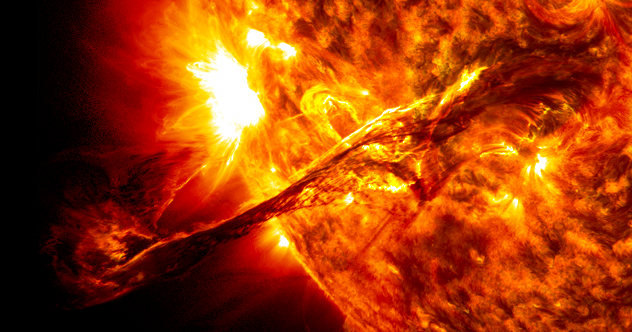
The Sun contains about 99.8% of the mass in the entire solar system. Everything elsethe eight planets, dwarf planets, moons, asteroids, comets, dust, and every suspicious little space pebbleshares the tiny remaining fraction. In cosmic terms, the Sun is not just the main character. It is the producer, director, lighting department, and snack budget.
This enormous mass gives the Sun the gravity needed to hold the solar system together. Earth does not orbit the Sun because it politely agreed to do so. It orbits because the Sun’s gravity keeps pulling while Earth’s motion keeps it from falling straight in. That beautiful balance is why our planet travels around the Sun once every year instead of taking an extremely bad shortcut.
Why this matters
Without the Sun, there is no solar system as we know it. Its energy drives weather, climate, photosynthesis, ocean currents, and life on Earth. Even faraway objects in the Kuiper Belt and the distant Oort Cloud are part of the Sun’s extended gravitational kingdom.
2. Venus Has a Day Longer Than Its Year
Venus sounds romantic. It is named after the Roman goddess of love, glows beautifully in the sky, and is often called Earth’s sister planet. Then you check the details and discover that Venus is less “sister” and more “unhinged cousin with a flamethrower.”
A single rotation on Venus takes about 243 Earth days. But Venus completes one orbit around the Sun in about 225 Earth days. That means a Venusian day is longer than a Venusian year. Imagine celebrating New Year’s before finishing Monday. That is Venus.
Venus also rotates in the opposite direction from most planets. If you could somehow stand on its surfaceand survive the crushing pressure, toxic atmosphere, and oven-like heatthe Sun would appear to rise in the west and set in the east. Of course, “stand on Venus” is doing a lot of work here. The surface temperature is hot enough to melt lead, so your vacation photos would be brief.
Why this matters
Venus shows how dramatically planets can evolve. It is similar to Earth in size and structure, but its runaway greenhouse effect turned it into a furnace. Studying Venus helps scientists understand climate, atmosphere, and why Earth’s balance is so precious.
3. Mercury Has Ice Even Though It Is Closest to the Sun
Mercury is the closest planet to the Sun, so naturally you might picture it as a roasted space potato. During the day, parts of Mercury become extremely hot. But here comes the plot twist: Mercury may have water ice at its poles.
How can the closest planet to the Sun keep ice? The answer is shadows. Mercury has deep polar craters where sunlight never reaches the floor. These permanently shadowed regions can stay cold enough for ice to survive. It is one of the solar system’s best examples of “location, location, location.” A few meters can mean the difference between sizzling heat and ancient frozen deposits.
Mercury also has almost no atmosphere to spread heat around. On Earth, air and weather help move warmth from place to place. Mercury lacks that cozy blanket, so temperature differences can be extreme. Sunlit areas bake, while shadowed craters can remain icy and dark.
Why this matters
Mercury’s polar ice reminds us that planets are not simple. Even the hottest-looking worlds can hide cold traps. These frozen deposits may also help scientists understand how water and volatile materials moved around the early solar system.
4. Mars Has a Canyon System That Makes the Grand Canyon Look Like a Scratch
The Grand Canyon is one of Earth’s most spectacular landscapes. It is huge, dramatic, and absolutely capable of making tourists whisper, “Wow,” while taking 347 nearly identical photos. But Mars has Valles Marineris, a canyon system so large it makes Earth’s Grand Canyon look like someone dragged a fork through mashed potatoes.
Valles Marineris stretches more than 4,000 kilometers across Mars. If placed on Earth, it would span a huge portion of the United States. In places, the canyon system reaches several kilometers deep. It is not just a crack in the ground; it is a planet-scale scar.
Mars also has Olympus Mons, one of the most famous volcanoes in the solar system. This giant shield volcano rises far higher than Mount Everest and spreads across a vast area. Mars could grow such enormous volcanic features partly because it lacks Earth-style plate tectonics. On Earth, moving plates shift over hot spots, spreading volcanic activity around. On Mars, volcanic activity could remain focused in one region for a very long time, building monsters.
Why this matters
Mars is a frozen desert today, but its geology tells a dramatic story. Huge volcanoes, ancient riverbeds, dry lake basins, and massive canyons suggest a planet that was once more active and possibly wetter than it is now.
5. Jupiter’s Great Red Spot Is a Storm That Has Outlived Generations
Earth has hurricanes, tornadoes, and thunderstorms that can ruin your picnic plans. Jupiter looked at all that and said, “Cute.” The Great Red Spot is a gigantic storm in Jupiter’s atmosphere that has been observed for centuries. It is a swirling oval of clouds powerful enough to make Earth’s worst weather seem like a dramatic sneeze.
The Great Red Spot is famous not only because it is huge, but because it has lasted so long. Scientists have observed this storm for hundreds of years, though its size has changed over time. Recent spacecraft observations show that Jupiter’s storms can extend far below the visible cloud tops, making them deeper and more complex than they appear from pretty telescope images.
Jupiter itself is the largest planet in the solar system. It is more massive than all the other planets combined, and its gravity has shaped the architecture of the solar system. It tugs on asteroids, influences comets, and protects or threatens Earth depending on the cosmic traffic situation.
Why this matters
Jupiter is like a laboratory for extreme weather, magnetic fields, and planetary formation. By studying Jupiter, scientists learn how giant planets work, how they affect smaller worlds, and how similar gas giants may behave around other stars.
6. Saturn’s Rings Are Spectacular, But They Are Not Permanent
Saturn is the solar system’s drama queen, and honestly, it has earned the title. Those rings are magnificent. They are made mostly of countless particles of ice and rock, ranging from tiny grains to larger chunks. From a distance, the rings look smooth and elegant. Up close, they are more like a cosmic demolition yard arranged by a perfectionist.
Saturn is not the only planet with rings. Jupiter, Uranus, and Neptune have ring systems too. Saturn simply has the most famous and visually stunning set. Its rings stretch wide around the planet but are surprisingly thin compared with their diameter.
Even crazier, Saturn’s rings may not last forever. Ring particles can slowly fall into the planet’s atmosphere in a process sometimes called “ring rain.” That does not mean the rings are disappearing tomorrow, so no need to panic-buy a telescope. But on astronomical timescales, Saturn’s current look may be temporary.
Why this matters
Saturn teaches us that the solar system is dynamic. Features that seem timeless can change. Rings form, evolve, darken, spread, and disappear. The solar system is not a museum; it is an active construction site with no hard hats provided.
7. Uranus Spins Sideways Like It Lost a Bet
Most planets spin with their poles roughly “up” and “down” compared with the plane of their orbit. Uranus did not get that memo. It rotates at an angle of nearly 90 degrees, making it appear to roll around the Sun on its side.
This bizarre tilt gives Uranus extreme seasons. Each pole can experience decades of sunlight followed by decades of darkness. Earth has winter and summer; Uranus has the cosmic version of leaving one side of your body under a lamp for 42 years.
Scientists are still studying why Uranus is tilted so dramatically. One leading idea is that a massive collision early in the solar system’s history knocked the planet sideways. Another possibility involves a more complicated gravitational interaction with other objects. Either way, Uranus is proof that planetary formation was not a calm, tidy process. It was more like billiards, but with baby planets.
Why this matters
Uranus helps scientists investigate how impacts and orbital dynamics shape planets. Its unusual tilt, faint rings, cold atmosphere, and complex magnetic field make it one of the most underrated worlds in the solar system.
8. Neptune Has Supersonic Winds in the Deep Freeze
Neptune is far from the Sun, cold, dark, and not visible to the naked eye. You might expect it to be sleepy. Instead, Neptune has some of the fastest winds in the solar system, with storms and atmospheric jets that can race at more than 1,200 miles per hour.
That is especially strange because Neptune receives very little sunlight compared with Earth. Less sunlight usually means less energy to drive weather. Yet Neptune’s atmosphere is wildly active. Scientists think internal heat may help power its intense winds and storms.
Neptune was also the first planet discovered through mathematics before it was directly observed. Astronomers noticed that Uranus was not moving exactly as expected, and calculations pointed to another planet tugging on it. Neptune was found near the predicted location. That is one of the greatest “I told you so” moments in astronomy.
Why this matters
Neptune proves that distance from the Sun does not mean boredom. Its weather, winds, dark storms, and mysterious internal energy make it a key world for understanding ice giants, a type of planet commonly found around other stars.
9. Some Moons May Have Better Places to Search for Life Than Some Planets
When people imagine alien life, they often picture planets. But some of the most exciting places in the search for life are moons. In particular, icy moons around Jupiter and Saturn have become major targets for astrobiology.
Europa, one of Jupiter’s moons, likely has a salty ocean beneath its icy shell. Scientists think that ocean may contain more water than all of Earth’s oceans combined. That does not mean fish are waving from below the ice, but it does mean Europa has one of the most important ingredients for habitability: liquid water.
Saturn’s moon Enceladus is another superstar. It shoots geysers of water vapor and icy particles into space from fractures near its south pole. These plumes suggest a subsurface saltwater ocean. Best of all, spacecraft can sample material from the plumes without drilling through miles of ice. Enceladus is basically sending science samples by express delivery.
Titan, Saturn’s largest moon, is weird in a different way. It has rivers, lakes, and seas, but they are filled with liquid methane and ethane instead of water. Titan has weather, clouds, rain, shorelines, and a thick atmosphere. It is like Earth in structure but alien in chemistry.
Why this matters
These moons expand our idea of where life could exist. A world does not need to look like Earth on the surface to be scientifically fascinating. Sometimes the most promising places are hidden beneath ice or wrapped in orange haze.
10. The Solar System Has a Frozen Outer Frontier Full of Leftovers
Beyond Neptune lies the Kuiper Belt, a doughnut-shaped region filled with icy bodies, dwarf planets, and comets. Pluto lives there, along with other fascinating objects such as Haumea, Makemake, and many smaller worlds. The Kuiper Belt is like the solar system’s attic: cold, distant, cluttered, and full of old stuff that tells family history.
Even farther out, scientists think the Oort Cloud forms a giant spherical shell around the solar system. It has never been directly imaged as a whole, but it is believed to be the source of many long-period comets. These icy objects may preserve materials from the early days of the solar system, making them valuable clues to how everything formed.
Comets from these distant regions can take extremely long journeys toward the inner solar system. When they approach the Sun, their ices vaporize and create glowing comas and tails. In other words, ancient frozen leftovers become some of the most beautiful objects in the night sky. That is a strong glow-up.
Why this matters
The outer solar system is a time capsule. Studying distant icy bodies helps scientists reconstruct the solar system’s origin, migration of planets, and distribution of water-rich material across space.
Why These Crazy Solar System Facts Matter
The solar system is more than a collection of objects orbiting the Sun. It is a record of violent beginnings, delicate balances, strange chemistry, and constant change. The Sun formed from a collapsing cloud of gas and dust. Planets grew from leftover material. Moons were captured, shattered, heated, frozen, and transformed. Asteroids and comets preserved ancient ingredients. Everything we see today is the result of billions of years of motion, collision, gravity, heat, and time.
These crazy solar system facts also help us understand Earth. Venus warns us about atmospheric change. Mars shows what can happen when a planet loses much of its atmosphere and surface water. Jupiter and Saturn reveal how giant planets shape planetary systems. Icy moons teach us that liquid water can exist far from the warmth of the Sun. The Kuiper Belt and Oort Cloud remind us that the solar system extends far beyond the familiar planets.
In short, the solar system is not just “space stuff.” It is our cosmic neighborhood, our origin story, and our best nearby laboratory for understanding planets everywhere.
Personal Experience: How Learning These Solar System Facts Changes the Way You Look Up
There is a funny thing that happens when you start learning real solar system facts: the night sky stops looking flat. At first, stars and planets appear like tiny dots scattered across a dark ceiling. They are pretty, sure, but distant in a way that feels almost decorative. Then you learn that one of those bright “stars” might be Venus, where a day lasts longer than a year. Another could be Jupiter, carrying a storm that has been spinning longer than many nations have existed. Suddenly, the sky feels less like wallpaper and more like a live map of impossible places.
One of the best experiences related to this topic is simply stepping outside and identifying a planet with your own eyes. You do not need a professional observatory, a lab coat, or a dramatic documentary voice. With a basic stargazing app or a simple sky chart, you can find Venus shining after sunset, Jupiter glowing steadily, or Saturn appearing as a pale point of light. Through a small telescope, Saturn’s rings can become visible, and that moment is unforgettable. Your brain knows Saturn has rings. Your eyes seeing them directly is different. It feels like the universe just handed you a secret.
Another powerful experience is watching a meteor shower. Those streaks of light are usually tiny bits of comet or asteroid debris burning up in Earth’s atmosphere. They are small, but they connect you to the larger story of the solar system. A meteor is not just a “shooting star.” It is a reminder that space is full of ancient material still crossing paths with our planet. You are watching leftovers from cosmic construction flash above your head.
Visiting a planetarium or science museum can deepen that feeling even more. Scale models reveal something that textbooks struggle to communicate: space is ridiculously empty. If the Sun were a large ball in one part of a city, the planets would be tiny objects placed blocks or miles apart. Most solar system diagrams cheat because they have to. If they used real distances, the page would be mostly blank, which is scientifically accurate but terrible for printing.
Even reading about ocean moons can change your imagination. Europa and Enceladus make the search for life feel less like science fiction and more like a careful investigation. The idea that a moon covered in ice could hide a global ocean is astonishing. It encourages a humbler view of habitability. Life, if it exists elsewhere, may not need blue skies and green hills. It may need chemistry, energy, time, and a protected environment.
The biggest lesson is that curiosity makes the solar system larger. The more you learn, the more every fact opens another question. Why is Uranus tilted? How long will Saturn’s rings last? What shaped Mars so dramatically? Could ocean moons host biology? What secrets are frozen in the Kuiper Belt? Looking up becomes an act of exploration, even from your backyard. You may be standing in a driveway, but mentally, you are traveling from Mercury’s icy shadows to Neptune’s screaming winds. That is the magic of learning about our solar system: it turns ordinary nights into invitations.
Conclusion
Our solar system is strange, beautiful, extreme, and constantly surprising. It has a star that dominates nearly everything, a planet where the day is longer than the year, ice hiding near the Sun, a canyon system big enough to humble Earth, storms that last for centuries, rings that may one day fade, a sideways ice giant, supersonic winds, ocean moons, methane lakes, and frozen frontiers full of ancient debris.
The more we study it, the less ordinary it becomes. Every planet, moon, asteroid, and comet adds another clue to the story of how our cosmic home formed and evolved. These ten crazy things about our solar system are not just fun facts; they are reminders that reality is often more imaginative than fiction. Space does not need special effects. It already has them.













