
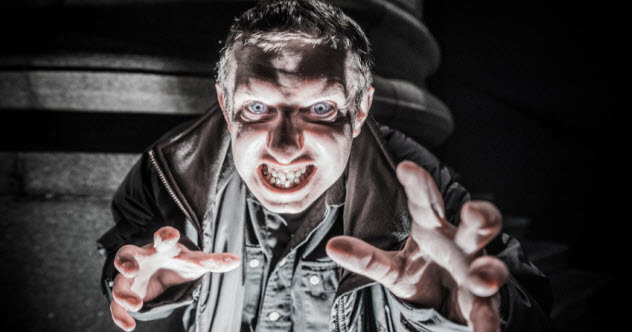
Home is supposed to be the place where the monsters remain outside. You lock the door, close the curtains, check the hallway once for absolutely no reason, and settle in with the comforting belief that four walls equal safety. Home invasion creepypastas take that belief, quietly remove one screw, and wait for the whole thing to collapse.
Some of these scary stories about intruders began as traditional urban legends before migrating to email chains, forums, horror wikis, and online storytelling communities. Others were born directly on the internet, where anonymous narrators, grainy images, and suspiciously specific details made fiction feel like a warning forwarded by someone who knew someone who barely escaped. Scholars and folklorists describe creepypasta as participatory digital folklore: stories are copied, changed, expanded, and retold around countless virtual campfires.
Why Home Invasion Creepypastas Feel So Personal
A haunted castle is frightening, but most of us do not own a haunted castle. A bedroom door, a dark staircase, or a living-room window is another matter. Home-invasion horror uses familiar spaces, then makes them unreliable. The coat rack resembles a person. The furnace clicks at the wrong moment. Your cat stares into an empty hallway as though waiting for its manager.
This subgenre also replaces the distant monster with a nearby uncertainty. Has someone entered the house, or were they already inside? Is the strange sound ordinary plumbing, or is the plumbing wearing shoes? Research into scary storytelling suggests that effective horror carefully times fear, uncertainty, and threatening humanlike figures, while psychological studies of real burglary victims show why violation of the home can produce lasting fear and distress.
1. The Babysitter and the Man Upstairs
The original “inside the house” nightmare
A teenage babysitter receives repeated calls from a stranger asking about the children upstairs. She contacts the police, expecting them to trace the caller to a nearby pay phone or suspicious van. Instead, the warning comes back: the calls are originating from inside the house.
The legend circulated decades before modern creepypasta had a name, but it contains nearly every ingredient internet horror later adopted. There is an isolated narrator, limited communication, vulnerable people sleeping nearby, and a final revelation that transforms the entire setting. The house was never a refuge. It was a trap with carpeting.
Online versions often update the technology. The landline becomes a messaging app, the police trace becomes location sharing, and the intruder may use a child’s tablet. The equipment changes, but the terrible geography remains the same: help is outside, while danger is upstairs.
2. The Clown Statue
When the decoration blinks
In this famous babysitting legend, a sitter becomes increasingly uncomfortable around a life-size clown statue in the room. She eventually calls the parents and asks whether she can cover it. The response is immediate: the family does not own a clown statue.
The story works because it turns observation into danger. The babysitter has already looked directly at the intruder, perhaps several times, but her brain has labeled him as furniture. That delay is more disturbing than a sudden attack. It suggests that seeing is not the same as understanding, which is excellent news for horror writers and terrible news for anyone whose relatives collect porcelain dolls.
Modern variants replace the clown with a mannequin, an antique suit of armor, a mascot costume, or a motionless person visible through a security camera. The disguise changes according to whatever object a generation finds least welcome in a dark room. Clowns remain strong contenders.
3. The Licked Hand
A comforting habit with a horrible explanation
A person sleeping alone reaches down beside the bed and feels the family dog lick their hand. The familiar gesture provides enough reassurance to let them drift back to sleep. In the morning, however, the dog is discovered elsewhereor worseand a message reveals that humans can lick hands too.
This urban legend attacks a tiny domestic ritual. The darkness is frightening, but the real horror comes from misplaced trust. The narrator does not merely fail to detect the intruder; they actively interpret the intruder’s touch as comfort.
The story has circulated in many forms and has roots older than the internet. Creepypasta retellings have added smart pet doors, bedroom cameras, voice assistants, and dogs that refuse to enter a particular room. Yet the strongest version still requires almost nothing: a bed, a hand, and one wet noise from below. Suddenly letting your dog sleep on the mattress seems like a flawless security strategy.
4. Aren’t You Glad You Didn’t Turn on the Light?
The roommate who stayed quiet
In this campus legend, one roommate returns late and enters the dark room without switching on the light, usually to avoid disturbing the other person. The next morning reveals a murder scene and a message implying that the returning roommate survived only because they remained in darkness.
Although commonly associated with dorm rooms, the story belongs comfortably among home invasion creepypastas because it uses shared living space as camouflage. The victim and survivor occupy the same room, yet darkness separates their realities. One believes the other is sleeping. The intruder knows otherwise.
Internet adaptations move the setting into apartments, vacation rentals, and shared houses. Some versions add unread texts from the victim or a silhouette mistaken for laundry. The final message is effective because it converts an ordinary courtesykeeping the light offinto accidental self-preservation. Manners save the day, though the thank-you note is admittedly upsetting.
5. The Killer’s Reflection
The figure was never outside
A young person is alone at home when they notice a disturbing face beyond a glass door or window. Believing someone is watching from the yard, they hide, call for help, or cover themselves with a blanket. Later, the horrifying explanation arrives: the face was not visible through the glass. It was reflected in it.
The supposed stranger outside was standing behind the observer.
This legend weaponizes a basic visual mistake. At night, windows become mirrors, especially when the room is brighter than the space outdoors. The victim’s mind places the threat at a safe distance because that interpretation is easier to accept. The creepypasta twist simply corrects the depth perception.
Newer versions use black television screens, laptop displays, framed photographs, or turned-off phones. Any reflective surface can deliver the realization that the background contains one person too many. After reading it, polishing mirrors becomes a daytime-only activity.
6. The Choking Doberman
The guard dog brings home evidence
A homeowner returns to find the family dog choking. At the veterinary clinic, the cause turns out to be severed human fingers. Police search the residence and discover an injured intruder hiding inside.
Unlike many creepy house stories, this one gives the pet a heroic role. The dog has already confronted the danger before the owner realizes anything is wrong. Unfortunately, the owner must still process the sentence, “Those do not appear to be dog fingers,” which is a difficult addition to anyone’s afternoon.
The legend plays on two fears at once: an unseen person has entered the home, and evidence of the encounter is physically present. Creepypasta versions often extend the suspense by having the dog stare at a closet, scratch at a wall, or return from the basement with an unfamiliar object. The animal knows. The human, busy checking email, remains several terrifying chapters behind.
7. The Rake at the Foot of the Bed
A monster that skips the breaking-and-entering part
The Rake is a pale, distorted humanoid creature associated with collaborative internet horror. In its most memorable home-invasion scene, a sleeping person wakes and notices something crouched at the foot of the bed. At first, the shape is difficult to classify. It might be a person, a hairless animal, or a nightmare that has forgotten to disappear.
The creature’s stillness is the key. It does not immediately charge. It waits to be recognized. That pause forces both narrator and reader to inspect the impossible shape, which is far worse than a quick glimpse.
Because the Rake developed through online retellings, its appearance and behavior vary. The consistent domestic image is what made it last: a thing occupying the most private room in the house, close enough to touch the blankets. No alarm sounds because the intruder may not have used a door.
8. Jeff the Killer
The internet slasher who enters while you sleep
Jeff the Killer became one of creepypasta’s most recognizable villains through a combination of an unsettling edited image, an unstable backstory, and countless fan-created variations. The familiar version portrays Jeff as a night-stalking murderer who enters homes and approaches sleeping victims with the phrase “Go to sleep.”
As literature, the character is messy. His origin has been rewritten repeatedly, and internet users have spent years debating where the associated image came from. That confusion is part of his power. Jeff feels less like a neatly copyrighted villain and more like graffiti found in an abandoned corner of the web.
His home-invasion appeal is straightforward: sleep requires surrender. Doors may be locked and windows may be checked, but eventually the lights go off. Jeff’s mythology occupies that vulnerable interval when a bedroom is familiar enough to relax in and dark enough to hide an extra face.
9. The Attic Guest
Someone has been living above you
The attic intruder is less a single canonical creepypasta than a recurring online format. The narrator notices food disappearing, objects moving, ceiling noises, or an unfamiliar smell. Each clue receives a reasonable explanation until something undeniable appears: a nest of blankets, photographs taken inside the home, a hole overlooking a bedroom, or a handwritten schedule of the family’s movements.
This scenario is especially effective because the intruder does not arrive during the story. They have already been present for days, weeks, or months. Earlier scenes become frightening retroactively. A creak dismissed in paragraph two returns in paragraph ten with a full-time tenant and no lease agreement.
Attic stories also exploit the unused spaces in ordinary houses. Many people rarely inspect crawlspaces, lofts, basements, or maintenance closets. Creepypasta treats those neglected areas like blank pages and writes someone else into them.
10. The Smart-Home Doppelgänger
The camera shows you arriving while you are already inside
A modern home-invasion creepypasta often begins with a notification. A doorbell camera detects motion. A smart lock reports an entry. A voice assistant answers a question nobody asked. Then the narrator opens the footage and sees a familiar person approaching the house.
The familiar person is the narrator.
Perhaps the recorded figure stands motionless at the door. Perhaps it knows the keypad code. Perhaps the timestamp says the video is live while the narrator watches from an upstairs bedroom. This format combines physical intrusion with digital uncertainty. Is the feed delayed, compromised, fabricated, or accurate?
Smart-home horror works because connected devices promise awareness. Cameras and sensors are supposed to reduce uncertainty, yet a creepypasta can make every notification create more of it. Real cybersecurity guidance recommends strong, unique passwords, software updates, and secure home networks; fictional guidance is simpler: when the camera shows you smiling outside, do not smile back.
Experiences That Make Home-Invasion Horror Follow You Offline
The first night alone after reading
The most common experience begins several hours after the story ends. During daylight, the reader confidently closes the tab and judges the protagonist’s decisions. “Obviously, I would check the closet,” they think. Midnight arrives, the refrigerator makes its normal mechanical groan, and suddenly checking the closet feels like a dangerous optional mission.
The reader becomes alert to every domestic sound. Pipes expand. Floorboards shift. Ice falls into the freezer tray with the subtlety of a dropped toolbox. Nothing has changed inside the home, but the story has supplied each sound with a possible character.
Babysitting in an unfamiliar house
Home-invasion creepypastas become particularly effective in someone else’s home. A babysitter or house sitter does not know which doors normally stick, which lights flicker, or whether the decorative figure near the stairs is always facing that direction.
Ordinary uncertainty becomes narrative fuel. A locked room seems suspicious. A family photograph includes a person the sitter has not met. The child casually mentions that “the hallway man” only appears after bedtime, then requests another glass of water as though no major scheduling conflict has just been announced.
The experience reveals why babysitting legends remain durable. The caretaker has responsibility without complete knowledge. They are expected to protect a space whose normal behavior they have never learned.
When a pet reacts to nothing
A dog suddenly raises its head and growls toward the stairs. A cat follows something across the ceiling with its eyes. Usually, the explanation is a mouse, distant sound, shifting light, or the animal’s ongoing campaign to make humans feel foolish.
After reading the Licked Hand or the Choking Doberman, however, the pet becomes an unpaid security consultant. The owner watches for a second reaction. The pet watches the empty doorway. Both parties wait for the other to demonstrate leadership.
This is where home-invasion horror excels: it does not need to show an intruder. It only needs a trustworthy character to behave as though one is nearby.
The apartment-noise guessing game
Apartment living produces an endless soundtrack of footsteps, plumbing, elevators, televisions, and neighbors rearranging furniture at an hour traditionally reserved for owls. A good creepy house story can turn this communal noise into a private mystery.
The unsettling experience occurs when a sound seems to come from the wrong direction. Footsteps travel overhead in a top-floor unit. Knocking comes from a wall shared with an empty apartment. A doorknob moves once, gently, as if someone on the other side has realized they selected the wrong homeor wants the occupant to believe that.
Most noises have harmless explanations. Creepypasta survives in the small delay before the explanation arrives.
The unexpected security notification
A late-night camera alert is the modern equivalent of the ringing telephone. The notification itself reveals nothing. It merely asks the recipient to look.
Sometimes the footage shows a delivery driver, an insect, rain, or a raccoon conducting an unauthorized porch inspection. Yet the few seconds before the video loads create a complete horror story. The mind supplies a face near the lens, a hand testing the lock, or a figure standing perfectly still beyond the porch light.
The creepiest fictional versions exploit technical glitches: missing footage, incorrect timestamps, or alerts from a camera that has been unplugged. The device designed to document reality becomes another unreliable narrator.
The sensible reset after the scare
Once the adrenaline fades, many readers perform a small reality-restoring ritual. They check the doors, close the blinds, verify that the strange shape is a jacket, and remind themselves that horror deliberately concentrates unlikely events into a few dramatic pages.
That final step matters. Real burglary can be deeply distressing, but scary fiction is designed to intensify danger beyond ordinary experience. Recent FBI figures reported by Reuters showed that U.S. property crime and burglary both declined in 2024, even though a well-written creepypasta can make every laundry basket appear to be part of a nationwide emergency.
A practical response is enough: use working locks, avoid publishing detailed travel plans, secure connected devices, and contact local authorities when there is genuine evidence of an intruder. Then return to the important task of deciding whether the basement light has always taken that long to turn on.
What the Best Home Invasion Creepypastas Have in Common
The strongest stories rarely begin with violence. They begin with a detail that does not fit: a phone call, a reflection, a missing snack, a pet’s reaction, or an object that seems to have moved. The narrator tries to preserve normality by inventing harmless explanations. Readers do the same, which turns them into willing accomplices in the suspense.
These stories also thrive through variation. Folklore does not need one definitive script; it needs a recognizable structure that can survive new settings and technology. A threatening landline call becomes a voice message. A face in the window becomes a face in a dark screen. An intruder in the attic becomes an unknown user connected to the household network. The details evolve, but the central fear remains: the boundary between “outside” and “inside” has failed.
Conclusion
Home invasion creepypastas frighten us by corrupting familiar spaces. Bedrooms become observation rooms, windows become mirrors, pets become witnesses, and security devices become messengers delivering information nobody wanted.
The ten stories and recurring formats above span old urban legends and modern internet horror, yet all rely on the same unsettling question: what if the locked door was never the important boundary? Perhaps the intruder entered earlier. Perhaps it lives upstairs. Perhaps it looks exactly like you.
That is why these tales linger after more elaborate monsters fade. They do not require cursed temples or distant forests. They only require a home, a quiet night, and one sound that definitely came from the hallway.
Research Note
This original article was informed by folklore archives, academic research, fact-checking references, cybersecurity guidance, psychological research, journalism, and primary genre resources from Snopes, Indiana University ScholarWorks, Lake Forest College, the Library of Congress, the American Psychological Association, NIH/PubMed Central, Cornell-hosted arXiv, Time, Vox, GQ, Wired, Reuters, CISA, Dictionary.com, and Creepypasta Wiki.














