
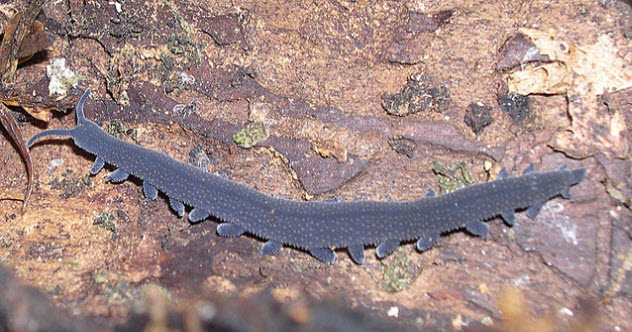
Imagine a creature assembled from spare parts after nature cleaned out its workshop: the body of a worm, the feet of a caterpillar, the claws of a tiny cat, and two face-mounted cannons loaded with instant glue. That creature is the velvet worm, an elusive predator whose scientific résumé is considerably more impressive than its slow, squishy walk suggests.
Velvet worms belong to the phylum Onychophora, a name meaning “claw bearers.” They are not earthworms, caterpillars, slugs, or insects. They occupy their own unusual branch of the animal family tree and live almost entirely out of sight in damp forests, rotting wood, leaf litter, caves, and other humid hiding places.
From oscillating slime jets to reproductive techniques that sound like rejected science-fiction plots, these ancient invertebrates are wonderfully strange. Here are 10 weird velvet worm facts that prove the forest floor can be every bit as dramatic as the African savannajust with smaller actors and more mucus.
Research basis:
What Is a Velvet Worm?
A velvet worm is a soft-bodied terrestrial predator with antennae, simple eyes, paired jaws, numerous unjointed legs, and a pair of specialized slime-producing organs near its mouth. Depending on the species, its body may be brown, blue, green, orange, black, reddish, or decorated with spots and stripes.
Modern velvet worms are found mainly in humid tropical and temperate regions of Central and South America, Africa, Southeast Asia, Australia, New Guinea, and New Zealand. Their scattered distribution reflects an exceptionally long evolutionary history, although scientists caution against imagining that today’s species have remained completely unchanged since prehistoric times.
10 Weird Velvet Worm Facts
1. The Velvet Worm Is Not Really a Worm
The name “velvet worm” is convenient, descriptive, and biologically misleading. True segmented worms belong to the phylum Annelida, while roundworms belong to Nematoda. Velvet worms have an entire phylum to themselves: Onychophora.
They are members of Panarthropoda, a larger evolutionary group that also includes arthropods and tardigrades. Evidence from anatomy, development, and molecular biology generally places onychophorans close to arthropodsthe enormous group containing insects, spiders, centipedes, crabs, and their relatives.
That relationship explains the velvet worm’s combination of familiar and alien features. It has a body covering containing chitin, paired limbs, claws, tracheal breathing tubes, and jaws derived from modified appendages. However, it lacks the hard external skeleton and fully jointed legs that characterize arthropods.
In other words, calling an onychophoran “just a worm” is like calling a platypus “just a duck.” Technically, everyone understands what you mean, but several evolutionary biologists may quietly begin sharpening their pencils.
2. Its Family History Reaches Deep Into Prehistory
Velvet worms are frequently called living fossils because their general body plan resembles ancient lobopodian animals known from Paleozoic fossils. Lobopodians were soft-bodied creatures with paired, stubby limbs, and some lived in the oceans more than 500 million years ago.
Famous Cambrian animals such as Hallucigenia help scientists investigate the early evolution of panarthropods. These fossil animals were not simply modern velvet worms wearing spikes, but they shared important features with the broader lineage from which onychophorans and arthropods emerged.
The living members of Onychophora are entirely terrestrial. Their ancestors therefore participated in one of evolution’s greatest relocation projects: moving from aquatic environments onto land. Features such as air-breathing tracheae and slime-producing papillae offer clues about that transition.
Modern velvet worms have continued evolving, diversifying, and adapting. “Living fossil” is useful shorthand for an ancient-looking lineage, but it should not be taken to mean that an animal misplaced its evolutionary calendar half a billion years ago.
Research basis:
3. Its Velvety Skin Is Covered in Microscopic Structures
The velvet worm earns its common name from the texture of its outer surface. Its body is covered with tiny projections called dermal papillae. These structures bear microscopic scales and sensory bristles, producing the soft, matte appearance that resembles velvet under ordinary light.
The papillae are not decorative upholstery. Sensory structures help the animal detect touch and chemical information as it explores its surroundings. Long antennae at the front of the body perform much of the close-range investigation, tapping objects and helping the predator locate suitable prey.
The body surface can repel water, but the animal remains highly vulnerable to dehydration. Velvet worms breathe through tracheal openings distributed across the body. Unlike many insects, they cannot tightly close these openings to conserve moisture.
Consequently, most species avoid dry air and direct sunlight. They shelter beneath bark, inside decaying logs, under stones, among moss, or deep within damp leaf litter. Many become active at night or after rain, when the world is less likely to turn them into expensive-looking raisins.
4. It Can Have More Than 80 Legsand None Are Jointed
Depending on the species and sometimes the sex, a velvet worm may possess between approximately 13 and 43 pairs of walking legs. These limbs are called lobopods or oncopods. They are short, soft, hollow, and moved partly by changes in internal fluid pressure.
Unlike an insect’s articulated legs, a velvet worm’s limbs do not contain a series of hard joints. They resemble flexible, muscular bags attached along the underside of the body. The result is a walking style that looks cautious, deliberate, and faintly concerned about whether it locked the front door.
Each walking leg ends in a pair of chitinous claws. On rough surfaces, the claws provide a secure grip. On smoother surfaces, the animal can rely more heavily on soft pads beneath the feet, reducing interference from the claws.
The number and arrangement of legs, foot pads, papillae, and claws can help taxonomists distinguish species. A velvet worm may look like an uncomplicated tube with feet, but its small anatomical details contain an impressive amount of identification data.
Research basis:
5. Its Skeleton Is Basically Pressurized Liquid
Velvet worms have no bones and no rigid exoskeleton. Instead, they depend on a hydrostatic skeleton. Their muscular body wall works against pressurized internal fluid, allowing the body and limbs to maintain shape and produce controlled movement.
When muscles contract in one area, internal pressure helps extend or reposition another part of the body. This system works well for an animal that crawls through narrow spaces, squeezes under bark, and navigates the irregular tunnels inside rotting wood.
A hydrostatic skeleton also keeps the velvet worm flexible. It can bend around obstacles without managing a suit of hard armor. The trade-off is reduced physical protection, which helps explain its secretive lifestyle and defensive reliance on slime.
Its movement is slow compared with that of many arthropod predators, but speed is not the velvet worm’s main strategy. It does not need to win a footrace when it can turn the racetrack into glue.
6. It Fires Two Rapidly Oscillating Jets of Slime
The most famous velvet worm fact is also the least polite. When hunting or defending itself, the animal ejects sticky slime from two flexible oral papillae positioned on either side of its head.
These papillae do not aim like carefully controlled water pistols. High-speed research has shown that the flowing liquid interacts with the papillae’s flexible structure, causing the jets to oscillate rapidlyroughly 30 to 60 times per second in studied specimens. The crossing streams sweep over the target and create a tangled net.
This rapid motion is produced largely by passive physical instability rather than by dozens of perfectly timed muscular commands. The velvet worm supplies pressure, and physics handles much of the frantic waving. Nature apparently invented the uncontrolled lawn sprinkler before humans did.
The slime is mostly water combined with proteins and other compounds. It leaves the body as a fluid but quickly becomes sticky and threadlike as water is lost and the material is stretched. A struggling cricket, termite, spider, or other small invertebrate can become wrapped in adhesive strands before it has time to escape.
Research basis:
7. It Liquefies Its Dinner and Recycles the Packaging
Slime does not usually kill the prey. Its main purpose is restraint. Once the victim is entangled, the velvet worm approaches and uses a pair of hard, crescent-shaped jaws hidden inside the mouth.
The jaws cut through the prey’s protective exterior. Saliva containing digestive substances is introduced into the wound, beginning the breakdown of tissues before they are swallowed. The velvet worm can then consume the softened material without having to chew through every part of a tough arthropod body.
Producing hunting slime costs valuable energy and nutrients. Velvet worms have therefore been observed eating slime left on or around captured prey. Recycling the adhesive allows them to recover part of their biological investment.
It is an efficient system: immobilize the meal, soften the contents, eat the food, and reclaim the net. Somewhere, an environmentally conscious packaging designer just felt professionally threatened.
8. Some Velvet Worms Live in Groups With a Pecking Order
Velvet worms are often imagined as solitary forest-floor hunters, but at least some species display surprisingly complex social behavior. The Australian species Euperipatoides rowelli, for example, may live in groups beneath fallen logs.
Researchers have reported groups containing multiple adults and juveniles, sometimes numbering around 15 individuals. Members can occupy the same shelter and participate in group prey capture. The arrangement is not an adorable woodland democracy.
A dominance hierarchy influences access to food. In observed groups, a dominant female typically feeds first, followed by other females, males, and younger animals. Rank may be reinforced through chasing, biting, kicking, or crawling over lower-ranking individuals.
This behavior is especially remarkable because velvet worms do not possess the obvious social organization of ants, bees, or termites. They have no queen-produced workforce or elaborate nest. They simply gather under a log and establish a dinner policy with the emotional atmosphere of a tense corporate retreat.
Research basis:
9. Velvet Worm Reproduction Gets Extremely Strange
Onychophorans use several reproductive strategies. Some species lay eggs. Others retain developing eggs within the female until the young are ready to emerge. Many give birth to live young, and certain species nourish embryos through placenta-like structures.
Mating can be even more remarkable. In some velvet worms, males transfer sperm through the female’s genital opening. In members of the genus Peripatopsis, however, a male may place a packet of sperm, called a spermatophore, directly onto the female’s body.
The tissue beneath the packet breaks down locally, allowing sperm to enter the body and travel toward the reproductive organs. This process is known as dermal insemination. It is effective, biologically fascinating, and unlikely to inspire a successful romantic comedy.
Females of some species can store sperm for extended periods, while pregnancy may last many months. Rare cases of parthenogenesisreproduction without fertilizationhave also been reported. Newborn velvet worms generally resemble miniature adults, complete with antennae and numerous tiny legs.
10. Some Are Tiny, While Others Approach the Length of a Ruler
Velvet worms are often described as small, but their dimensions vary substantially. Some species measure little more than a centimeter, while larger forms reach many times that length. A giant species described from Costa Rica included a female measuring approximately 22 centimeters, or about 8.7 inches.
Color is equally variable. Depending on the species, individuals may appear blue, purple, green, orange, red, brown, black, or patterned with lighter markings. The vivid appearance of some velvet worms seems almost wasteful for an animal that spends much of its life hiding in decomposing wood.
Finding one can be difficult even where a species is known to occur. Onychophorans require suitable moisture, temperature, shelter, prey, and stable microhabitats. A forest may look healthy to a casual visitor while lacking the old logs and consistently humid refuges these animals need.
Their dependence on small environmental pockets makes velvet worm habitat vulnerable to logging, fire, drying, soil disturbance, and removal of fallen timber. Protecting a velvet worm often means protecting the messy, damp, decaying parts of a forest that people are tempted to “clean up.”
Research basis:
A Field Experience: What Searching for a Velvet Worm Is Really Like
The following is a realistic composite field experience based on the habitats and observation methods associated with velvet worms.
Entering the Forest After Rain
A velvet worm search begins with weather rather than wildlife. A warm, damp night following steady rain offers better conditions than a bright afternoon. Moisture reduces the animal’s risk of dehydration and may encourage it to leave its shelter in search of prey.
The forest feels different after dark. Leaves shine under a headlamp, water drops from branches long after the rain has stopped, and every decaying log appears capable of hiding something prehistoric. Unfortunately, each log is also capable of hiding a spider that strongly objects to being introduced.
The goal is not to race through the area turning over everything in sight. Velvet worm habitat is fragile. Logs should be examined slowly, loose bark should not be stripped from living trees, and every displaced object must be returned to its original position.
Checking the Right Microhabitats
An old log with soft, damp wood is more promising than a dry branch exposed to sunlight. Mossy crevices, deep leaf litter, and the shaded spaces beneath stones may also provide the stable humidity onychophorans require.
At first, almost every elongated object creates false hope. A root becomes a velvet worm. A curled leaf stem becomes a velvet worm. A millipede becomes a velvet worm until it moves with far too much confidence and reveals a collection of properly jointed legs.
Then a genuine velvet worm appears. It may be only a few centimeters long, partly concealed against brown wood. Its skin absorbs the light rather than reflecting it sharply. Antennae sweep ahead while the soft legs move in coordinated waves beneath the body.
The first surprise is how deliberate it looks. Despite possessing dozens of legs, the animal does not rush. Each step seems measured, as though it has been asked to cross the log without spilling an invisible cup of coffee.
Observing Without Provoking
The responsible response is patience, not poking. A slime discharge may look spectacular on video, but producing that adhesive consumes resources. Deliberately frightening or prodding a velvet worm merely to trigger its defense can stress the animal and waste material it needs for hunting.
From a respectful distance, an observer can watch the antennae explore, see the body compress around obstacles, and notice how the claws engage with rough surfaces. A macro photograph may reveal the papillae that create the velvety texture, but handling should be avoided unless it is part of properly authorized scientific work.
The observation may last only a few minutes before the animal disappears beneath bark or into a narrow crack. There is no roaring chase and no dramatic leap. The excitement comes from briefly encountering a lineage that usually conducts its entire life beneath the level of human attention.
Leaving the Habitat as It Was Found
After the velvet worm retreats, the log is gently restored. Leaf litter is replaced, stones are returned, and photographs become the only souvenirs. Exact location details may need to remain private when a population is rare or vulnerable to collecting.
The experience changes how a forest is perceived. Dead wood is no longer waste. Moist leaf litter is not untidiness. These materials form a layered habitat in which predators, fungi, insects, microorganisms, and decomposers interact.
Velvet worm spotting teaches a useful lesson: some of the most incredible animals do not need huge bodies, loud calls, or bright feathers. Sometimes the evolutionary marvel is a quiet, many-legged hunter under a log, carrying two glue cannons on its face and waiting for the rain.
Why Velvet Worms Deserve More Attention
The incredible velvet worm combines ancient evolutionary significance with specialized modern adaptations. Its hydrostatic skeleton, clawed lobopods, moisture-sensitive respiratory system, adhesive weaponry, unusual feeding behavior, social hierarchy, and diverse reproductive biology make it one of the strangest terrestrial predators alive.
It also demonstrates why small habitats matter. A single rotting log can function as shelter, hunting ground, nursery, and humidity-controlled apartment building. Removing that log may erase an entire local population before anyone realizes it was there.
Velvet worms may not have the popularity of elephants or eagles, but they offer something equally valuable: proof that evolution’s most inventive work is often hidden in ordinary-looking places. The next time a damp forest floor seems quiet, remember that a soft-bodied claw bearer may be nearby, slowly preparing to solve a dinner problem with high-speed biological glue.














