
Note: This article is written from verified production history and carefully avoids exaggerated trivia where the facts are disputed.
Few horror movies feel as permanently lodged in the brain as The Shining. Stanley Kubrick’s 1980 adaptation of Stephen King’s novel does not simply scare viewers; it rearranges the furniture inside their heads. One minute, young Danny Torrance is riding his tricycle through the Overlook Hotel’s impossible hallways. The next, an elevator is coughing up a tidal wave of blood like the building just remembered every bad thing it ever did. Cozy family vacation? Absolutely not. Bring a coat, a therapist, and maybe do not accept any winter caretaker jobs.
But the real story behind The Shining is almost as unsettling as the movie itself. The film’s production involved massive studio sets, early Steadicam wizardry, punishing shooting schedules, rewritten scripts, improvised lines, fake snow by the ton, and a complicated legacy around how Shelley Duvall was treated during filming. These behind-the-scenes facts about The Shining reveal how Kubrick created one of the most analyzed, debated, and rewatched horror films ever made.
Why The Shining Still Haunts Horror Fans
The Shining works because it does not behave like a normal haunted-house movie. Instead of relying on jump scares every five minutes, Kubrick builds dread through silence, symmetry, sound, and uncertainty. The Overlook Hotel feels too large, too clean, too bright, and too empty. That is the trick. The terror is not hiding in darkness; it is standing right there under hotel lighting, smiling politely.
The movie has become a cornerstone of psychological horror, Kubrick film analysis, and Stephen King adaptation debates. Its most famous imagesRoom 237, the Grady twins, REDRUM, Jack Torrance’s axe, the hedge maze, and the “Here’s Johnny!” door sceneare now part of pop culture DNA. Yet the details behind those moments make the movie even stranger.
16 Bone-Chilling Behind-The-Scenes Facts About The Shining
1. The Overlook Hotel was not one real hotel
The Overlook Hotel feels like a real place, which is impressive because it is basically a cinematic Frankenstein’s monster. Stephen King’s novel was inspired by his stay at The Stanley Hotel in Estes Park, Colorado. Kubrick’s movie, however, used Oregon’s Timberline Lodge for exterior shots, while many interior design ideas came from The Ahwahnee Hotel in Yosemite National Park. Most of the film was then shot on enormous sets at EMI Elstree Studios in England.
That mix of locations helps explain why the Overlook feels familiar and impossible at the same time. It has the soul of a mountain resort, the bones of a studio set, and the logic of a nightmare that failed building inspection.
2. Room 217 became Room 237 for a practical reason
In King’s novel, the haunted room is Room 217. In Kubrick’s film, it became Room 237. The widely accepted explanation is that Timberline Lodge did not want guests to become afraid of staying in an actual Room 217. Room 237 did not exist there, making it a safer fictional number.
Ironically, horror fans are not exactly famous for avoiding spooky places. The room associated with the story has since become a point of fascination, proving once again that telling people “please do not obsess over this haunted room” is the fastest way to make them obsess over it.
3. Kubrick rejected Stephen King’s screenplay
Before Kubrick made his version, Stephen King had written a screenplay adaptation of his own novel. Kubrick did not use it. Instead, he co-wrote the film with novelist Diane Johnson, whose background in Gothic fiction helped shape the movie’s colder, more ambiguous tone.
This decision created one of the most famous author-versus-director tensions in horror history. King’s book is warmer, more emotional, and more focused on addiction, family trauma, and Jack Torrance’s tragic fall. Kubrick’s film is icier and more mysterious. It does not explain the hotel so much as lock viewers inside it and whisper, “Good luck.”
4. The movie was filmed mostly in England
Although The Shining feels tied to the American Rockies, much of the production happened thousands of miles away at EMI Elstree Studios near London. Kubrick was based in England and preferred working there, where he could maintain tight control over the production.
That studio environment allowed the crew to build enormous Overlook interiors and control lighting, camera movement, and atmosphere with obsessive precision. The result is a hotel that feels realistic enough to enter but strange enough that no hallway seems entirely trustworthy.
5. The Overlook sets were intentionally disorienting
One reason The Shining feels so unnerving is that the hotel’s geography does not quite make sense. Windows appear where windows should not be. Corridors seem to connect in impossible ways. Rooms feel too large for the building shown from the outside.
This was not just a mistake. Kubrick’s design encourages spatial confusion. The viewer may not consciously map the hotel, but the brain quietly notices something is off. The Overlook becomes a maze long before Danny ever enters the hedge maze outside.
6. A major fire damaged the production
During production, a fire at Elstree Studios badly damaged one of the film’s major sets. Reports from the time estimated the damage at around $2.5 million and said the fire added weeks to the shooting schedule.
The eerie part? In King’s novel, the Overlook Hotel burns. Kubrick’s film does not use that ending, but behind the scenes, part of the movie’s own hotel went up in flames anyway. Sometimes reality has a rude sense of symbolism.
7. The Steadicam changed horror filmmaking
The Shining is one of the great showcases for the Steadicam, a camera stabilization system that was still relatively new at the time. Inventor and operator Garrett Brown worked on the film, helping create those floating, ghostlike tracking shots that follow Danny through the hotel corridors.
The effect is terrifying because the camera does not feel like a human running after him. It feels like the hotel itself is gliding behind the boy, patient and hungry. Without the Steadicam, the Overlook would still be scary. With it, the building seems alive.
8. Danny Lloyd did not know he was making a horror movie
Danny Lloyd, who played Danny Torrance, was very young during filming. Kubrick protected him from much of the movie’s horror content, and Lloyd later said he believed he was making a drama about a family living in a hotel.
That choice makes sense. A child actor does not need to know he is starring in one of the most terrifying movies ever made. He just needs to ride the tricycle, say the lines, and avoid being emotionally traumatized by a hotel full of blood elevators and axe problems.
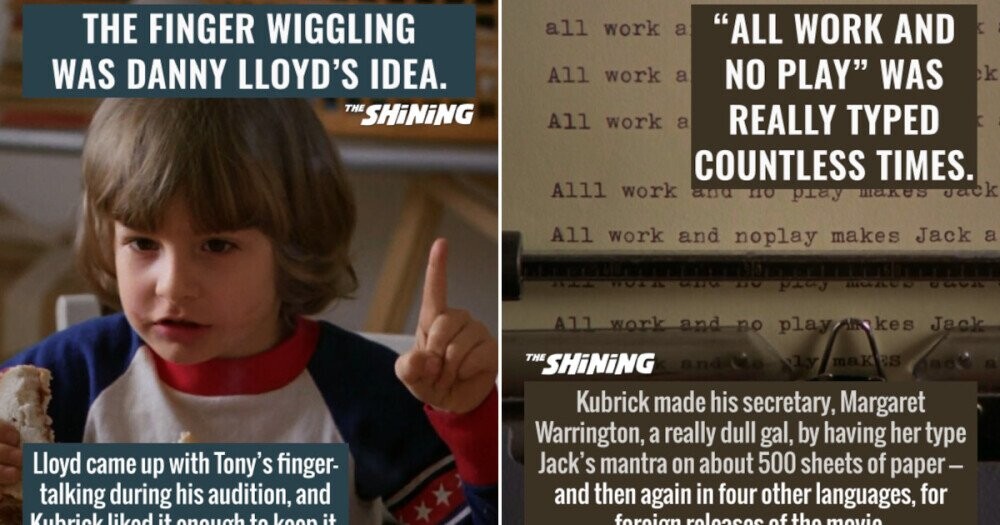
9. The “All work and no play” pages were really typed
One of the film’s most chilling reveals comes when Wendy discovers Jack’s manuscript and sees page after page of the same sentence: “All work and no play makes Jack a dull boy.” Rather than fake only the visible pages, Kubrick reportedly had hundreds of pages individually typed.
That level of detail is both impressive and slightly hilarious. The audience sees the stack for a short time, but Kubrick wanted the prop to be real enough that Wendy’s discovery would feel physically convincing. It is obsessive filmmaking about obsessive madness, which is either genius or a very expensive office prank.
10. “Here’s Johnny!” was improvised
Jack Nicholson’s most famous line in the film was not from King’s novel. When Jack Torrance smashes through the bathroom door and shouts “Here’s Johnny!” Nicholson was riffing on Ed McMahon’s introduction for Johnny Carson on The Tonight Show.
The brilliance of the line is its wrongness. It is a cheerful TV catchphrase delivered by a man with an axe and a face full of lunacy. Comedy and horror are close cousins; this scene proves they sometimes share a bathroom door.
11. The axe scene required stronger doors
The bathroom door sequence looks frighteningly physical because it was. The production reportedly began with easier breakaway doors, but Nicholson was too effective at chopping through them. His past experience with firefighting and axe work made him far more convincing than expected.
The crew eventually needed a sturdier door to slow him down and make the destruction look dramatic on camera. That is a very specific production problem: “Our movie maniac is too good with the axe.”
12. Shelley Duvall’s shoot was emotionally brutal
Shelley Duvall’s performance as Wendy Torrance has been reassessed over time, and many viewers now recognize how raw and physically committed it is. During filming, she endured a demanding process that required repeated emotional intensity, crying, panic, and fear.
Duvall later gave nuanced accounts of the experience. She acknowledged Kubrick’s brilliance and sometimes spoke warmly of him, but she also described the work as extremely difficult. The legacy of her performance is now tied not only to the film’s terror but also to conversations about actor welfare, directorial control, and how far a production should go in pursuit of realism.
13. The “127 takes” story is more complicated than many fans think
One of the most repeated The Shining facts claims that the staircase baseball-bat scene required 127 takes. It has circulated for years, but film historians and researchers have challenged the accuracy of that exact number. Some accounts suggest rehearsals may have been confused with printed takes.
What is not in doubt is that Kubrick often shot many takes and pushed scenes through long, exhausting refinement. The real lesson is not simply “127 takes happened.” It is that the film’s frightening emotional texture came from a production style built on repetition, pressure, and relentless adjustment.
14. Scatman Crothers also endured heavy retakes
Scatman Crothers, who played Dick Hallorann, had one of the film’s warmest presences. His conversation with Danny about “the shining” gives the story a rare moment of comfort and explanation. But that warmth came from a difficult process too, with accounts describing a large number of takes for his key dialogue scene with Danny.
Hallorann’s role is especially painful because he represents safety. He understands Danny. He comes back to help. Then Kubrick’s film kills him almost immediately after he arrives, a major departure from King’s novel. It is a cruel narrative choice, and it tells viewers that the Overlook does not reward kindness.
15. The snowy hedge maze was built, not found
The hedge maze is one of Kubrick’s biggest changes from the novel, which features topiary animals rather than a maze. The movie’s maze gives the ending a clean visual metaphor: Jack is lost in the very madness he has been chasing.
To create the winter finale, the production used huge amounts of artificial snow, including salt and crushed Styrofoam. The result looks freezing, endless, and hostile. It also means one of horror’s most famous snowstorms was partly a studio-made blizzard. Movie magic: beautiful, terrifying, and probably terrible to clean up.
16. The film was not immediately treated as an untouchable masterpiece
Today, The Shining is widely considered one of the greatest horror movies ever made. But its early reception was mixed. Some critics and viewers found it slow, cold, or too different from King’s novel. Shelley Duvall even received a Razzie nomination, which was later rescinded decades later in light of the circumstances surrounding her performance.
Over time, the film’s reputation grew. Its precision, ambiguity, sound design, and visual control made it a favorite for critics, filmmakers, and fans who enjoy arguing about carpets, ghosts, architecture, and whether Jack Torrance was doomed before he ever entered the hotel. In other words, normal movie-night conversation.
What These Behind-The-Scenes Facts Reveal About The Shining
The most fascinating thing about The Shining is that its production methods mirror its story. The film is about repetition, isolation, creative pressure, family strain, and a building that seems to trap people inside patterns they cannot escape. Behind the camera, the movie was also shaped by repetition, isolation, pressure, and obsessive control.
Kubrick’s perfectionism created unforgettable cinema, but it also left behind complicated questions. The movie is beautiful, terrifying, and technically brilliant. It is also connected to stories of exhaustion, emotional strain, and creative conflict. That tension is part of why the film remains so endlessly discussed. The Shining is not a simple masterpiece. It is a haunted masterpiece, and not all of its ghosts are fictional.
Personal Viewing Experience: Why The Shining Feels Different Every Time
Watching The Shining for the first time is a strange experience because the movie does not always scare you when you expect it to. Many horror films announce danger with darkness, thunder, or a suspiciously curious teenager walking into a basement. Kubrick does something more disturbing: he makes ordinary space feel infected. The Overlook’s hallways are clean. The rooms are bright. The carpets are almost aggressively stylish. Yet everything feels wrong, as if the hotel is pretending to be normal and doing a poor job of blinking like a human.
The first detail that tends to linger is the sound of Danny’s tricycle. The wheels rumble on the hard floor, then suddenly soften over carpet, then rumble again. It is such a small sound pattern, but it becomes suspense. You start waiting for the next turn before anything has happened. That is the genius of the movie’s rhythm. It trains the viewer to fear space itself.
The second viewing is often more unsettling than the first. Once you know the big momentsthe twins, Room 237, the axe, the mazeyou begin noticing the smaller ones. Jack’s smile looks wrong earlier than you remembered. Wendy’s nervousness feels more heartbreaking. Hallorann’s kindness feels doomed. Even the hotel manager’s calm explanation of past murders has a corporate cheeriness that is darkly funny. The Overlook is basically the worst workplace orientation in cinema history.
What makes the behind-the-scenes facts especially powerful is how they change the viewing experience. Knowing that Danny Lloyd was protected from the horror makes his performance feel more innocent. Knowing that the hotel interiors were built to feel spatially impossible makes the disorientation more deliberate. Knowing that Shelley Duvall’s performance came from a genuinely exhausting process makes Wendy’s panic harder to dismiss. The film becomes not just a horror story, but a record of intense filmmaking choices.
There is also a fun, almost mischievous pleasure in recognizing how practical the movie is. The snow was manufactured. The hotel was assembled from multiple inspirations. The blood elevator was a mechanical effect. The manuscript pages were actually typed. The axe scene relied on physical force, not digital enhancement. In an era when many horror effects can be created on a computer, The Shining still feels tactile. Its scares have weight. Doors splinter. Wheels roll. Paper stacks exist. Blood floods forward like a red ocean with terrible plumbing.
For modern viewers, the film also works as a lesson in patience. It does not rush to explain itself. It lets silence stretch until the room becomes uncomfortable. It lets Jack stare too long. It lets Wendy’s fear build scene by scene. It makes the audience participate by asking: Is the hotel evil? Is Jack already broken? Are the ghosts real? Is the maze outside, inside, or both?
That uncertainty is why The Shining remains so rewatchable. A simple horror movie ends when the monster is defeated. The Shining does not end so cleanly. Jack freezes, Wendy and Danny escape, and then the final photograph opens another door entirely. The movie leaves you with questions instead of comfort. That is rude, artistically speaking, but extremely effective.
In the end, the best way to experience The Shining is not to solve it completely. Let it remain strange. Let the impossible windows stay impossible. Let the carpet pattern stare back. Let the Overlook keep a few secrets behind the front desk. Some movies are puzzles. This one is a haunted maze, and the fun is realizing you may never fully find your way out.
Conclusion
The behind-the-scenes facts about The Shining prove that the film’s terror was not accidental. Kubrick built fear through architecture, repetition, performance, camera movement, and detail so precise it borders on madness. From the real hotels that inspired the Overlook to the massive Elstree sets, from Danny Lloyd’s protected innocence to Shelley Duvall’s grueling emotional work, every layer adds to the movie’s chilling legacy.
The Shining remains powerful because it does not offer easy answers. It is a horror film about a haunted hotel, yes, but it is also about isolation, family collapse, artistic frustration, addiction, control, and the terrifying possibility that some places know exactly how to bring out the worst in people. More than four decades later, viewers are still checking into the Overlook. Fortunately, unlike Jack Torrance, most of them remember to leave.










