
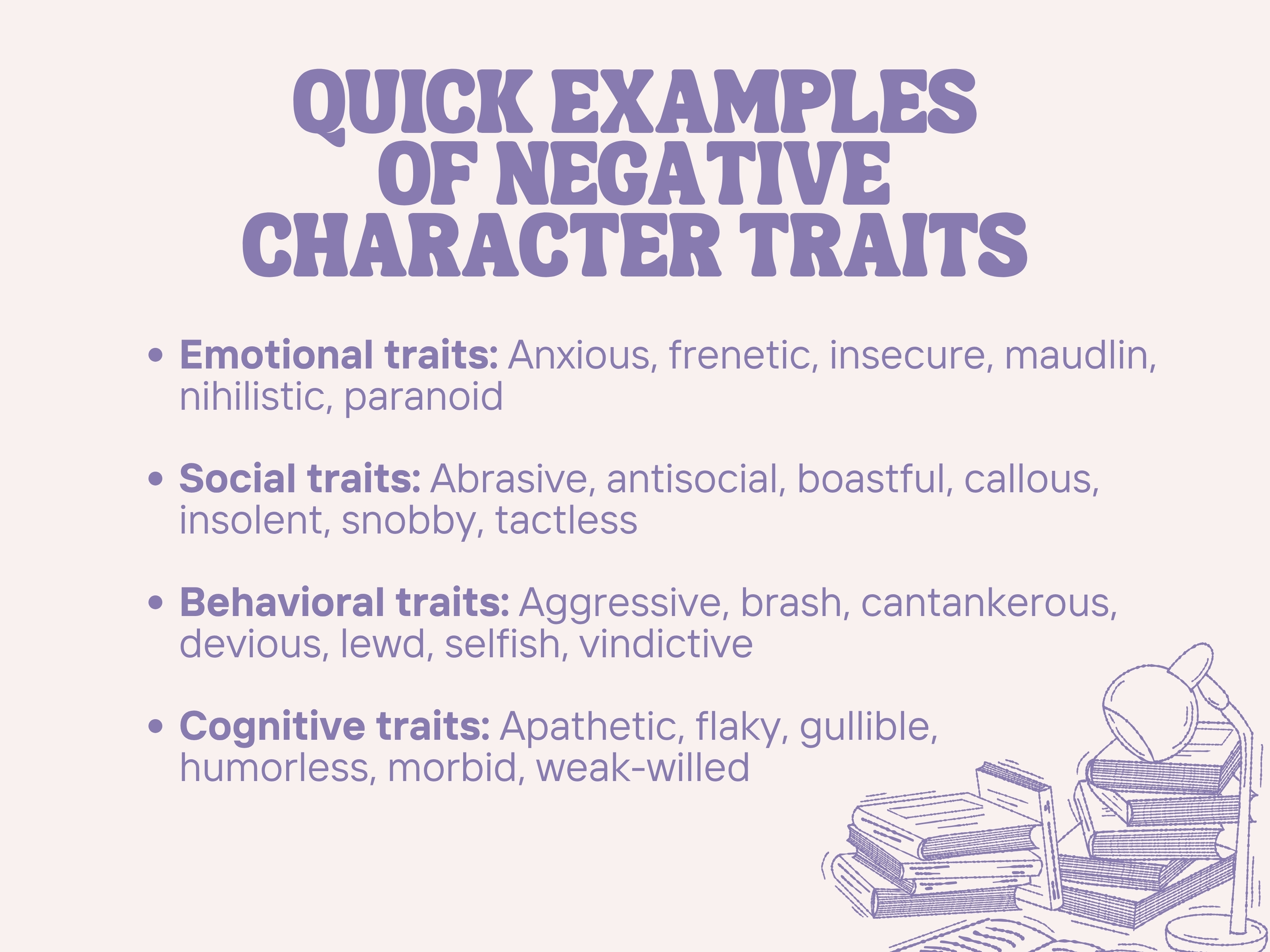
Perfect characters are suspicious. Nobody walks into a story smiling politely, making flawless choices, drinking enough water, and resolving conflict with a well-timed spreadsheet. Readers want characters who feel human, which means they need desires, contradictions, blind spots, bad habits, and the occasional emotional tire fire. That is where negative character traits become gold for writers.
A negative character trait is a recurring flaw in the way a character thinks, speaks, chooses, or treats others. It is not just “they are rude once because the coffee shop ran out of oat milk.” A true flaw keeps showing up, creates consequences, and reveals what the character fears, wants, or refuses to face. Used well, negative traits create tension, comedy, betrayal, redemption arcs, and those delicious scenes where the reader whispers, “Oh no, they are absolutely going to ruin this dinner.”
This guide gives writers a practical list of more than 200 negative character traits with clear definitions, plus advice on how to use flaws without making characters flat, cartoonish, or accidentally unbearable. Whether you are building a villain, antihero, romantic lead, unreliable narrator, or side character who causes problems with the confidence of a raccoon in a pantry, this list will help.
What Are Negative Character Traits?
Negative character traits are personality flaws, moral weaknesses, behavioral patterns, or emotional habits that cause problems for a character or the people around them. They can be small, like being forgetful or nosy, or severe, like being cruel, manipulative, or vengeful.
For fiction writers, the key is not simply choosing a flaw. The key is choosing a flaw that does story work. A jealous character may misread kindness as betrayal. A prideful character may reject help until the roof caves in, sometimes literally if you are writing gothic fiction. A cowardly character may survive longer than everyone else but hate themselves for what survival cost.
How to Use Character Flaws in Fiction
1. Connect the flaw to desire
A flaw becomes powerful when it blocks something the character wants. If your protagonist wants love but is defensive, every tender moment becomes a tiny battlefield. If your villain wants control and is paranoid, every ally becomes a suspected traitor.
2. Give the flaw a believable origin
Not every flaw needs a tragic childhood monologue beside a rainy window. Still, readers appreciate a reason. Maybe the character is controlling because chaos once destroyed their family. Maybe they are sarcastic because sincerity made them vulnerable. Maybe they are greedy because poverty taught them that enough is never enough.
3. Let the flaw create consequences
If a character is arrogant, someone should eventually stop taking their calls. If they are dishonest, the truth should knock on the door wearing heavy boots. Consequences make flaws matter.
4. Balance the flaw with strengths
The most memorable characters are not walking warning labels. A selfish character may be brave. A gloomy character may be loyal. A ruthless character may be deeply competent. Contrast creates depth.
200+ Negative Character Traits with Definitions for Writers
Use this list as a character flaw thesaurus, a plotting tool, or a quick rescue device when your cast starts acting like a group of emotionally balanced camp counselors.
| # | Negative Trait | Definition for Writers |
|---|---|---|
| 1 | Abrasive | Harsh, blunt, or unpleasant in a way that pushes people away. |
| 2 | Absentminded | Frequently forgets details, duties, or what they just promised. |
| 3 | Addictive | Compulsively attached to a habit, substance, thrill, or person. |
| 4 | Aggressive | Quick to attack, dominate, threaten, or escalate conflict. |
| 5 | Aimless | Lacks direction, purpose, or commitment to a meaningful goal. |
| 6 | Aloof | Emotionally distant and difficult for others to reach. |
| 7 | Amoral | Indifferent to right and wrong when pursuing personal gain. |
| 8 | Angry | Often driven by irritation, resentment, or explosive emotion. |
| 9 | Antagonistic | Instinctively opposes others, even when cooperation would help. |
| 10 | Anxious | Overwhelmed by worry, fear, or imagined disasters. |
| 11 | Apathetic | Shows little interest, concern, or emotional investment. |
| 12 | Argumentative | Turns ordinary conversations into debates, duels, or courtroom dramas. |
| 13 | Arrogant | Believes they are superior and expects others to notice. |
| 14 | Attention-seeking | Craves recognition and behaves dramatically to get it. |
| 15 | Authoritarian | Demands obedience and dislikes being questioned. |
| 16 | Avoidant | Escapes conflict, intimacy, or responsibility rather than facing it. |
| 17 | Backstabbing | Pretends loyalty while secretly betraying others. |
| 18 | Belligerent | Hostile, combative, and ready to fight over almost anything. |
| 19 | Bigoted | Unfairly prejudiced against people outside their preferred group. |
| 20 | Bitter | Hardened by resentment and unable to release old pain. |
| 21 | Boastful | Constantly brags to inflate status or hide insecurity. |
| 22 | Bossy | Orders people around without earning trust or authority. |
| 23 | Brash | Bold in a loud, reckless, or tactless way. |
| 24 | Brooding | Dwells darkly on problems, grudges, or disappointments. |
| 25 | Callous | Insensitive to pain, need, or emotional suffering. |
| 26 | Careless | Acts without enough attention, caution, or concern. |
| 27 | Catty | Makes cutting, spiteful remarks, often disguised as wit. |
| 28 | Chaotic | Creates disorder wherever they go, sometimes with jazz hands. |
| 29 | Childish | Immature, petty, or unwilling to handle adult responsibility. |
| 30 | Clingy | Needs constant reassurance and fears being left behind. |
| 31 | Closed-minded | Rejects new ideas before honestly considering them. |
| 32 | Cold | Emotionally unresponsive, unsympathetic, or difficult to warm. |
| 33 | Combative | Treats disagreement as a battle that must be won. |
| 34 | Complacent | Too satisfied with the current state to improve or act. |
| 35 | Compulsive | Driven to repeat behaviors even when they cause harm. |
| 36 | Conceited | Excessively proud of appearance, talent, intelligence, or status. |
| 37 | Condescending | Talks down to others as if surrounded by adorable furniture. |
| 38 | Controlling | Needs to manage people, outcomes, and sometimes the weather. |
| 39 | Conventional | Overly attached to tradition and suspicious of originality. |
| 40 | Cowardly | Avoids danger, truth, or sacrifice when courage is needed. |
| 41 | Cruel | Enjoys or ignores the suffering they cause. |
| 42 | Cynical | Assumes selfish motives and distrusts goodness. |
| 43 | Deceitful | Habitually lies, hides, misleads, or manipulates the truth. |
| 44 | Defensive | Reacts to feedback as though it is an ambush. |
| 45 | Defiant | Resists authority or advice simply because it exists. |
| 46 | Demanding | Expects too much from others without equal consideration. |
| 47 | Dependent | Relies too heavily on others for decisions or emotional stability. |
| 48 | Destructive | Damages relationships, plans, or property through harmful behavior. |
| 49 | Detached | Remains emotionally separate even in intimate situations. |
| 50 | Devious | Uses sneaky, indirect, or dishonest methods to get results. |
| 51 | Dishonest | Regularly bends or breaks the truth for convenience. |
| 52 | Disloyal | Fails to stand by people, promises, or principles. |
| 53 | Dismissive | Treats other people’s concerns as unimportant or foolish. |
| 54 | Disorganized | Lacks structure, order, or follow-through. |
| 55 | Disrespectful | Ignores boundaries, dignity, or basic courtesy. |
| 56 | Distrustful | Suspects betrayal even when evidence is thin. |
| 57 | Dogmatic | Clings rigidly to beliefs and refuses discussion. |
| 58 | Domineering | Overpowers others through pressure, authority, or intimidation. |
| 59 | Dramatic | Turns inconvenience into tragedy with theatrical commitment. |
| 60 | Egocentric | Views situations mainly through their own needs and importance. |
| 61 | Envious | Resents what others have and feels cheated by their success. |
| 62 | Erratic | Unpredictable in mood, behavior, or decision-making. |
| 63 | Evasive | Avoids direct answers, responsibility, or emotional honesty. |
| 64 | Exploitative | Uses others for benefit without care for their well-being. |
| 65 | Extravagant | Spends, performs, or indulges excessively for effect. |
| 66 | Fanatical | Obsessed with a belief or cause beyond reason. |
| 67 | Fatalistic | Believes outcomes are doomed, so effort is pointless. |
| 68 | Fearful | Lets fear control choices, relationships, and risks. |
| 69 | Fickle | Changes loyalties, opinions, or affections too easily. |
| 70 | Flaky | Unreliable, inconsistent, and prone to disappearing when needed. |
| 71 | Foolish | Makes poor decisions despite obvious warning signs. |
| 72 | Forgetful | Often loses track of commitments, facts, or people’s needs. |
| 73 | Frivolous | Treats serious matters as games or accessories. |
| 74 | Gloomy | Habitually pessimistic, joyless, or emotionally heavy. |
| 75 | Gluttonous | Overindulges in food, pleasure, comfort, or consumption. |
| 76 | Gossipy | Spreads private information for entertainment or influence. |
| 77 | Greedy | Always wants more wealth, power, praise, or control. |
| 78 | Grim | Sees the worst and makes every room feel like tax season. |
| 79 | Grudge-holding | Refuses to forgive and stores offenses like collectibles. |
| 80 | Gullible | Too easily tricked, persuaded, or exploited. |
| 81 | Haughty | Proud, superior, and dismissive of those considered beneath them. |
| 82 | Hedonistic | Pursues pleasure while neglecting duty, consequences, or others. |
| 83 | Hostile | Openly unfriendly, threatening, or emotionally armed. |
| 84 | Humorless | Unable or unwilling to laugh, especially at themselves. |
| 85 | Hypocritical | Condemns behavior in others while doing the same thing. |
| 86 | Idle | Avoids useful work, effort, or meaningful action. |
| 87 | Ignorant | Lacks knowledge and resists learning better. |
| 88 | Impatient | Cannot tolerate delay, process, or slow-moving humans. |
| 89 | Impulsive | Acts first and lets consequences file complaints later. |
| 90 | Inconsiderate | Fails to think about how actions affect others. |
| 91 | Indecisive | Struggles to choose, even when delay makes things worse. |
| 92 | Indifferent | Does not care enough to help, change, or respond. |
| 93 | Inflexible | Refuses to adapt when circumstances change. |
| 94 | Ingrateful | Fails to appreciate help, kindness, or sacrifice. |
| 95 | Inhibited | Overly restrained by fear, shame, or self-consciousness. |
| 96 | Insecure | Feels inadequate and reacts through doubt, jealousy, or control. |
| 97 | Insensitive | Misses or ignores emotional cues and personal boundaries. |
| 98 | Insincere | Says what sounds good without meaning it. |
| 99 | Intolerant | Rejects differences, mistakes, or beliefs outside their comfort zone. |
| 100 | Irresponsible | Avoids obligations and leaves others cleaning up the mess. |
| 101 | Irritable | Quickly annoyed by small frustrations. |
| 102 | Judgmental | Criticizes others harshly and often unfairly. |
| 103 | Lazy | Avoids effort even when action is necessary. |
| 104 | Lecherous | Driven by inappropriate or disrespectful sexual desire. |
| 105 | Manipulative | Controls others through guilt, charm, pressure, or deception. |
| 106 | Materialistic | Values possessions and status above people or principles. |
| 107 | Mean-spirited | Enjoys petty cruelty, mockery, or emotional pinching. |
| 108 | Melodramatic | Exaggerates emotions until every problem needs theme music. |
| 109 | Miserly | Hoarding, ungenerous, and unwilling to share resources. |
| 110 | Moody | Emotionally changeable and hard for others to predict. |
| 111 | Morbid | Fixates on death, decay, disaster, or grim possibilities. |
| 112 | Narcissistic | Excessively self-focused and hungry for admiration. |
| 113 | Neglectful | Fails to provide care, attention, or protection. |
| 114 | Needy | Requires constant emotional support or validation. |
| 115 | Nervous | Easily unsettled, tense, or frightened by pressure. |
| 116 | Nihilistic | Believes nothing matters, so rules and consequences feel meaningless. |
| 117 | Nosy | Intrudes into private matters without invitation. |
| 118 | Obnoxious | Loudly unpleasant, annoying, or socially exhausting. |
| 119 | Obsessive | Fixates intensely on a person, idea, goal, or fear. |
| 120 | Obstinate | Stubbornly refuses to change position, even when wrong. |
| 121 | Opportunistic | Takes advantage of situations without loyalty or ethics. |
| 122 | Overbearing | Dominates others with pressure, opinions, or constant interference. |
| 123 | Overcritical | Finds fault constantly and rarely offers encouragement. |
| 124 | Overdramatic | Responds to minor events with excessive emotional display. |
| 125 | Overprotective | Controls others in the name of safety or love. |
| 126 | Paranoid | Unreasonably suspicious of threats, betrayal, or hidden motives. |
| 127 | Passive | Lets events happen without speaking, choosing, or acting. |
| 128 | Passive-aggressive | Expresses resentment indirectly through sarcasm, delay, or sabotage. |
| 129 | Patronizing | Acts helpful while signaling superiority. |
| 130 | Perfectionistic | Demands flawlessness and may freeze when perfection is impossible. |
| 131 | Pessimistic | Expects failure and often discourages hope. |
| 132 | Petty | Focuses on small insults, tiny wins, and miniature revenge. |
| 133 | Possessive | Treats people, love, or loyalty as property. |
| 134 | Prejudiced | Judges people unfairly before knowing them. |
| 135 | Pretentious | Performs sophistication or importance to impress others. |
| 136 | Procrastinating | Delays necessary action until problems grow teeth. |
| 137 | Provocative | Intentionally stirs reactions, conflict, or discomfort. |
| 138 | Prying | Pushes into secrets and boundaries others try to protect. |
| 139 | Rash | Acts too quickly without considering danger or consequences. |
| 140 | Rebellious | Rejects rules or authority, sometimes for no better reason than “no.” |
| 141 | Reckless | Ignores risks that could harm self or others. |
| 142 | Relentless | Refuses to stop pursuing a goal, even when harm is obvious. |
| 143 | Remorseless | Shows no guilt after causing damage or pain. |
| 144 | Resentful | Feels wronged and carries simmering anger. |
| 145 | Rigid | Cannot bend, compromise, or tolerate ambiguity. |
| 146 | Rude | Disregards politeness, respect, or social grace. |
| 147 | Ruthless | Pursues goals without mercy or moral hesitation. |
| 148 | Sarcastic | Uses sharp irony to mock, defend, or wound. |
| 149 | Scheming | Constantly plots to gain advantage over others. |
| 150 | Secretive | Withholds information even when openness would build trust. |
| 151 | Self-absorbed | Preoccupied with personal concerns and blind to others. |
| 152 | Self-destructive | Repeatedly damages their own life, health, or happiness. |
| 153 | Selfish | Prioritizes personal needs over fairness, care, or duty. |
| 154 | Self-pitying | Dwells on personal suffering without seeking growth. |
| 155 | Shallow | Values surface appearances over depth, loyalty, or meaning. |
| 156 | Shameless | Unbothered by wrongdoing, embarrassment, or social judgment. |
| 157 | Short-tempered | Angers quickly and often regrets it too late. |
| 158 | Sly | Crafty, sneaky, and hard to trust. |
| 159 | Smug | Self-satisfied in a way that begs for narrative consequences. |
| 160 | Sneaky | Hides actions or motives to avoid accountability. |
| 161 | Snobbish | Looks down on people considered less refined or successful. |
| 162 | Spiteful | Acts to hurt others because they feel hurt first. |
| 163 | Stingy | Reluctant to give money, time, praise, or help. |
| 164 | Stubborn | Refuses to change even when change is wise. |
| 165 | Submissive | Gives up personal will too easily to avoid conflict. |
| 166 | Superficial | Concerned with image more than substance. |
| 167 | Suspicious | Distrusts people and looks for hidden threats. |
| 168 | Tactless | Says the wrong thing at the wrong time with Olympic confidence. |
| 169 | Temperamental | Prone to sudden mood shifts or emotional outbursts. |
| 170 | Thoughtless | Acts without considering emotional or practical effects. |
| 171 | Timid | Too easily frightened into silence or inaction. |
| 172 | Treacherous | Dangerously unfaithful, especially to those who trust them. |
| 173 | Unaccountable | Refuses responsibility and blames circumstances or other people. |
| 174 | Unambitious | Lacks drive, aspiration, or willingness to improve. |
| 175 | Uncharitable | Interprets others without generosity or compassion. |
| 176 | Uncommunicative | Withholds thoughts or feelings until confusion multiplies. |
| 177 | Uncooperative | Resists teamwork, compromise, or shared effort. |
| 178 | Undependable | Cannot be trusted to show up, follow through, or deliver. |
| 179 | Unethical | Breaks moral standards for convenience, profit, or revenge. |
| 180 | Unforgiving | Cannot release offenses, even after apology or change. |
| 181 | Unhinged | Behaves in an unstable, extreme, or alarming way. |
| 182 | Unimaginative | Lacks creativity and resists possibilities beyond the obvious. |
| 183 | Unkind | Fails to show basic compassion or warmth. |
| 184 | Unmotivated | Shows little energy or desire to act. |
| 185 | Unpredictable | Difficult to read, trust, or plan around. |
| 186 | Unreliable | Breaks commitments or performs inconsistently. |
| 187 | Unrepentant | Does wrong and refuses regret or change. |
| 188 | Unstable | Emotionally or behaviorally inconsistent under pressure. |
| 189 | Vain | Obsessed with appearance, admiration, or public image. |
| 190 | Venal | Willing to be bribed or morally bought. |
| 191 | Vengeful | Driven to punish perceived wrongs. |
| 192 | Vindictive | Seeks revenge in personal, persistent, often excessive ways. |
| 193 | Volatile | Emotionally explosive and prone to sudden change. |
| 194 | Weak-willed | Easily pressured away from values or commitments. |
| 195 | Whiny | Complains frequently without taking useful action. |
| 196 | Withdrawn | Pulls away from people, intimacy, or community. |
| 197 | Workaholic | Uses constant work to avoid emotions, relationships, or rest. |
| 198 | Worrisome | Obsesses over possible problems and spreads anxiety. |
| 199 | Zealous | Excessively intense about a cause, belief, or mission. |
| 200 | Jealous | Fears losing affection, status, or attention to someone else. |
| 201 | Blaming | Assigns fault to others instead of owning mistakes. |
| 202 | Calculating | Coldly weighs people as tools, threats, or assets. |
| 203 | Impressionable | Too easily shaped by stronger personalities or group pressure. |
| 204 | Entitled | Believes they deserve special treatment without earning it. |
| 205 | Flashy | Seeks attention through display rather than substance. |
| 206 | Fussy | Overly difficult about details, preferences, or comfort. |
| 207 | Graceless | Lacks tact, gratitude, or emotional elegance. |
| 208 | Martyr-like | Uses sacrifice to create guilt, praise, or control. |
| 209 | Overconfident | Trusts ability beyond evidence, planning, or common sense. |
| 210 | Unteachable | Rejects correction and treats growth as an insult. |
Types of Negative Character Traits Writers Can Use
Minor flaws
Minor flaws add texture. A character who is forgetful, fussy, nosy, sarcastic, or melodramatic may not destroy the kingdom, but they can make scenes more memorable. Minor flaws are especially useful in comedy, romance, cozy mystery, and ensemble casts.
Major flaws
Major flaws affect the plot. Traits such as jealousy, dishonesty, cowardice, arrogance, bitterness, and selfishness can damage relationships, cause betrayals, and force the character to change or lose what matters.
Fatal flaws
A fatal flaw is the weakness that can bring a character down. Pride, obsession, greed, vengeance, and paranoia are classic examples. These flaws are excellent for tragedies, villains, antiheroes, political dramas, and stories where success demands moral sacrifice.
Examples of Negative Traits in Character Development
Arrogance
An arrogant detective refuses help from a junior officer. The junior officer notices the clue that solves the case, but by then the detective has publicly accused the wrong person. Arrogance creates conflict, embarrassment, and a chance for humility.
Jealousy
A jealous best friend quietly undermines the protagonist’s new relationship. They tell themselves they are “protecting” their friend, which is the sort of excuse villains and toddlers both enjoy. The flaw reveals fear of abandonment.
Cowardice
A cowardly prince avoids battle, but later risks everything to save one wounded soldier. This works because the flaw gives the later act of courage weight. Courage means more when fear has been visible from page one.
Perfectionism
A perfectionistic artist never finishes the painting that could change their career. Their flaw is not laziness; it is fear wearing a very organized hat. The plot can force them to choose between imperfect completion and perfect invisibility.
How to Choose the Right Negative Trait
Start with the character’s wound, desire, and role in the story. A romance lead who fears rejection might be defensive, aloof, or sarcastic. A political villain who fears weakness might be controlling, ruthless, or paranoid. A comic sidekick may be dramatic, nosy, or overconfident.
Then ask three questions:
- What does this flaw make the character do? A flaw should create visible behavior.
- Who gets hurt by it? Consequences make the trait meaningful.
- What would growth look like? The opposite of the flaw often points toward the character arc.
For example, if a character is controlling, growth might mean trust. If they are cynical, growth might mean hope. If they are selfish, growth might mean sacrifice. If they are dishonest, growth might mean telling the truth when lying would be easier.
Common Mistakes When Writing Negative Traits
Mistake 1: Making the character only one flaw
A greedy character who is only greedy becomes predictable. Give them humor, skill, tenderness, fear, or a private code. Complexity keeps readers invested.
Mistake 2: Confusing flaw with diagnosis
Writers should avoid using mental health labels as shortcuts for villainy. A character can be anxious, obsessive, volatile, or withdrawn without being reduced to a diagnosis. Focus on behavior, choice, and consequence.
Mistake 3: Forgetting the character’s point of view
Most flawed characters do not think, “Today I shall be manipulative.” They think, “I am protecting myself,” “I deserve this,” or “They left me no choice.” The self-justification is often more interesting than the flaw itself.
Writer’s Experience: What Negative Traits Teach You at the Desk
After working with character lists, story outlines, and messy drafts, one lesson becomes obvious: the best negative traits are not decorations. They are engines. A decorative flaw is something like, “He is impatient,” but it never affects the plot. An engine flaw is, “He is impatient, so he interrupts the witness, misses a key detail, offends the only person willing to help, and has to solve two problems instead of one.” Same trait, much better mileage.
In practice, writers often discover the right flaw by looking at scenes that feel flat. If two characters agree too easily, give one of them pride. If the protagonist keeps making sensible decisions, add fear, guilt, or temptation. If the villain feels like a cardboard thundercloud, give them a trait that almost looks like a virtue from their perspective. Ruthlessness may look like efficiency. Control may look like responsibility. Cynicism may look like wisdom. That tiny twist makes a character feel less like a plot device and more like a person who has been making bad emotional investments for years.
One useful exercise is to write a character’s flaw as a rule they secretly live by. A jealous character’s rule might be, “If I am not chosen first, I am being abandoned.” A perfectionist’s rule might be, “If it is not flawless, I am not safe.” A greedy character’s rule might be, “If I have more, no one can hurt me.” These private rules help writers create consistent behavior without making scenes repetitive.
Another experience-based tip: flaws should change shape under pressure. A sarcastic character may be funny at breakfast, cruel during an argument, and silent when genuinely afraid. A controlling mother may organize a birthday party, interrogate a boyfriend, and later break down because nobody needs her anymore. Good flaws are flexible. They appear in dialogue, body language, decisions, secrets, and relationships.
The trick is not to punish every negative trait immediately. Let the flaw work for the character sometimes. Arrogance may help a lawyer dominate a courtroom. Suspicion may help a spy stay alive. Obsession may help a scientist solve a problem nobody else can crack. When a flaw has benefits, the character has a reason to keep it. That makes growth harder and more satisfying.
Finally, remember that readers do not need characters to be perfect. They need them to be understandable. A flawed character with a clear desire, a believable wound, and meaningful consequences can carry an entire novel. A perfect character can barely carry a grocery bag without boring everyone in line.
Conclusion
Negative character traits help writers build believable people instead of polished mannequins with dialogue tags. They create friction, reveal values, expose wounds, and drive transformation. The best flaws are not pasted onto a character at random; they grow from fear, desire, history, and pressure. Choose traits that challenge your character’s goal, complicate relationships, and force meaningful choices.
Whether your character is arrogant, jealous, cowardly, manipulative, reckless, or painfully insecure, the question is always the same: how does this flaw shape the story? Answer that, and your characters will stop behaving like fictional employees and start acting like trouble with a heartbeat.
Note: This article is original, written in standard American English, and synthesized from reputable writing-craft and personality-psychology resources. It avoids citation placeholders, source-code artifacts, and copied source text.














