
Cherry trees are botanical show-offs. In spring, they cover themselves with flowers. In summer, some produce glossy fruit. Even in winter, their bark often provides enough clues to keep a curious tree detective busy.
The trouble is that the name “cherry tree” covers many members of the Prunus genus, including sweet cherries, tart cherries, native wild species, and ornamental flowering varieties. Their close relatives include plums, peaches, apricots, and cherry laurels, so identifying one from a single photograph can be surprisingly tricky.
The most reliable approach is to examine several features together. Start with the leaves, check the flowers or fruit when available, and finish by studying the bark, twigs, and overall growth habit. When all three sets of clues point in the same direction, you can identify a cherry tree with much greater confidence.
Quick Answer: What Does a Cherry Tree Look Like?
Most cherry trees share several recognizable characteristics:
- Simple leaves arranged alternately along the twig
- Finely toothed or serrated leaf margins
- One or more small glands near the top of the leafstalk
- White or pink spring flowers, usually with five petals
- Round, fleshy fruit containing one hard stone or pit
- Smooth young bark marked with visible horizontal pores called lenticels
No single characteristic proves that a tree is a cherry. Birch leaves can resemble cherry leaves, plum trees may have similar flowers, and young buckthorn stems can imitate cherry bark. Think of identification as a three-witness investigation rather than accepting the testimony of one suspicious leaf.
Way 1: Identify Cherry Trees by Their Leaves
Leaves are usually the most practical identification tool because they remain on the tree for much of the growing season. Cherry leaves vary among species and cultivars, but their arrangement, margins, shape, and leafstalks reveal several useful patterns.
Look for Alternate, Simple Leaves
Cherry leaves are simple, meaning each leaf consists of one blade rather than several separate leaflets. They grow alternately along the twig, with one leaf attached at each node and the next positioned farther along on the opposite side.
This immediately separates cherry trees from maples, ashes, dogwoods, and horse chestnuts, which typically have leaves arranged in opposing pairs. Leaf arrangement is not particularly glamorous, but neither is checking fingerprints, and both can solve a case.
Examine the Shape and Pointed Tip
Many cherry trees have oval, elliptical, or lance-shaped leaves with a tip that narrows to a noticeable point. Sweet cherry leaves may reach several inches long, while the leaves of pin cherry, chokecherry, and some ornamental cultivars are generally smaller.
Leaf size alone is unreliable because age, growing conditions, and cultivar differences affect it. Focus instead on the overall combination: an oval-to-elongated blade, a pointed tip, and an alternate position on the branch.
Check the Serrated Leaf Margins
Run your eyesnot your fingers, unless you enjoy tiny paper cutsalong the outer edge of the leaf. Cherry leaves usually have fine teeth. Some species have single serrations, while others appear doubly toothed because smaller teeth occur along larger ones.
The exact form of those teeth can help distinguish wild species. Chokecherry commonly has fine, sharp teeth, while black cherry leaves tend to have smaller, more rounded or inward-curving teeth. Yoshino and other flowering cherries may show more obvious double serration.
Find the Tiny Glands on the Petiole
One of the best cherry tree identification clues is hidden where many people never think to look. Examine the petiole, which is the small stalk connecting the leaf blade to the twig. Many Prunus species have one or more tiny raised glands near the base of the leaf blade.
These glands may be red, brown, green, or nearly black. On some Japanese flowering cherries, they are large enough to resemble tiny beads or “spider eyes.” On other species, they are subtle bumps that require close inspection. Their presence is not exclusive to cherries, but paired with alternate serrated leaves, it strongly supports an identification within the Prunus group.
Observe Texture, Color, and the Leaf Underside
Healthy cherry leaves are generally medium to dark green during summer, although purple-leaf cultivars are common in landscapes. Some leaves are glossy, while others have a duller surface. Black cherry leaves may have rusty or yellowish hairs along the central vein on the underside.
Fall color varies widely. Yellow is common among sweet and flowering cherries, but certain ornamental species develop orange, red, bronze, or maroon foliage. Fall color is supporting evidence rather than a dependable primary feature because weather and soil conditions can change the display dramatically.
Avoid Confusing Cherry Leaves With Similar Trees
Birches often have pointed, toothed leaves, but they generally lack the characteristic cherry glands near the leaf blade. Black birch twigs also release a wintergreen scent when scratched, while some cherry twigs smell more like bitter almond.
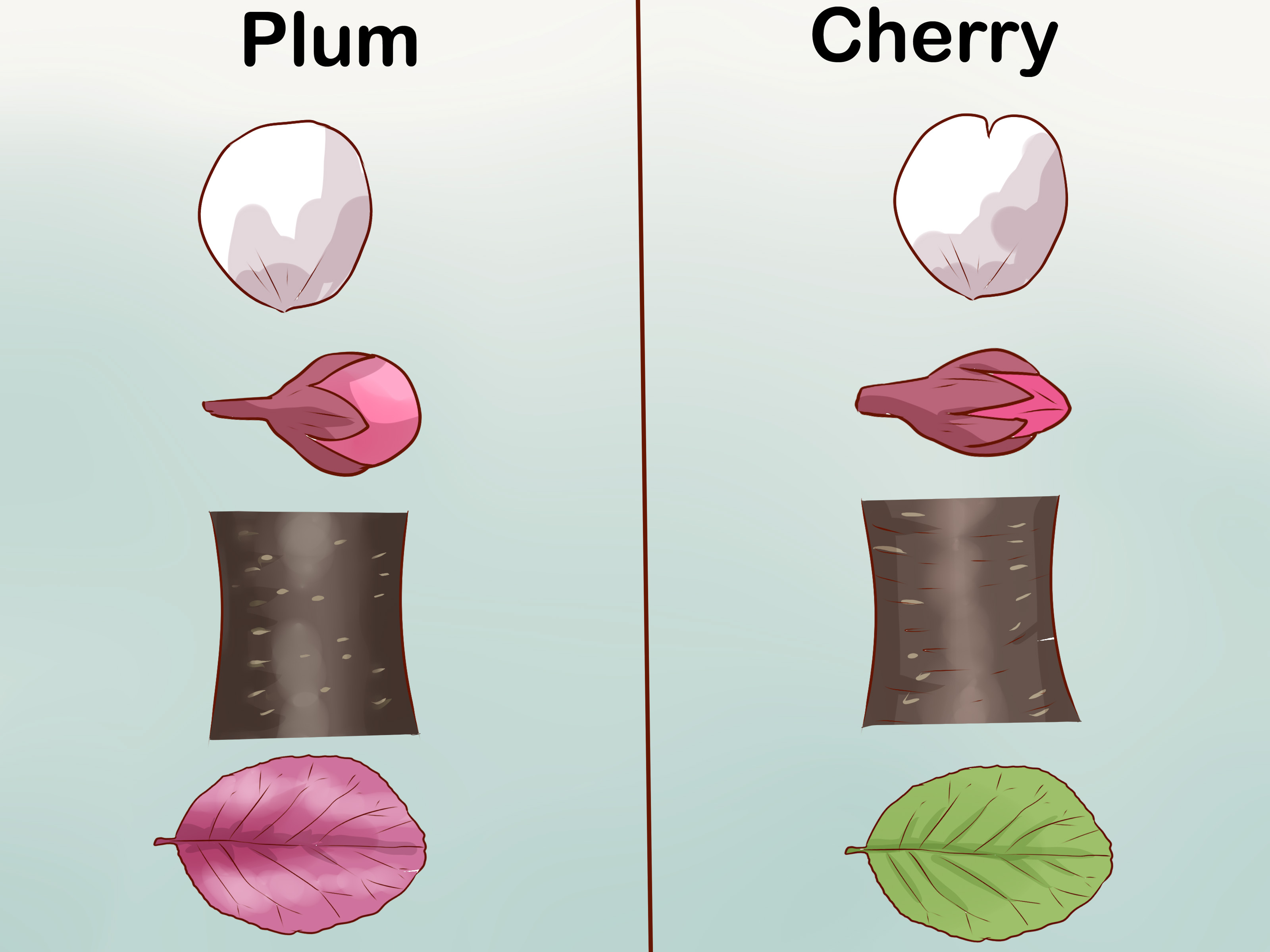
Hackberry leaves can also be toothed and pointed, but their bases are usually strongly uneven, and mature hackberry bark develops distinctive corky ridges or warts. Plums are much closer relatives and may require flowers, fruit, thorns, and bark characteristics for a confident distinction.
Way 2: Identify Cherry Trees by Their Flowers and Fruit
When a cherry tree is blooming or fruiting, identification becomes easier. Flowers and fruit provide strong evidence, although ornamental cultivars may produce little or no noticeable fruit.
Study the Spring Flowers
Typical cherry blossoms are white, pale pink, or deep pink. A basic wild or fruiting cherry flower usually has five petals surrounding numerous stamens. Many flowers have a shallow notch at the end of each petal, although that feature varies and should not be treated as a universal rule.
Flowers may open before the leaves, at the same time as the leaves, or shortly afterward. Sweet cherry flowers commonly appear in small clusters, while black cherry and chokecherry produce many small white flowers along elongated clusters called racemes.
Double-flowered ornamental cultivars are more dramatic. A tree such as ‘Kanzan’ may produce dense clusters containing many pink petals, making each blossom resemble a miniature carnation. These decorative trees were selected for floral impact, apparently on the theory that five petals were simply not trying hard enough.
Notice How the Flowers Are Grouped
Flower arrangement helps narrow down the type of cherry:
- Sweet and sour cherries: Flowers commonly occur in compact groups or small umbels.
- Black cherry: Small white flowers grow in elongated upright or spreading racemes.
- Chokecherry: White flowers form cylindrical, often drooping racemes.
- Japanese flowering cherries: Flowers may hang in clusters of two to five and can be single, semidouble, or double.
The arrangement matters because pear, apple, serviceberry, and plum trees can all produce white spring flowers. Looking at the cluster structure, petal form, emerging leaves, and bark together prevents a hasty identification.
Look for a Fleshy Fruit With One Pit
A true cherry fruit is a drupe: a fleshy outer layer surrounding one hard stone. Depending on the species and cultivar, ripe cherries may be yellow, bright red, dark red, purple, blue-black, or nearly black.
Sweet cherries often produce relatively large fruit on long stems. Tart cherries are generally bright red and smaller. Native black cherry fruits are much smaller and grow in racemes that can resemble loose bunches of tiny grapes. Chokecherries also occur in clusters and mature from red to dark purple or black. Pin cherries remain small and typically turn vivid red.
Do not assume that every ornamental flowering cherry will carry a generous crop. Some cultivars produce only pea-sized fruit, some fruit lightly, and others are effectively sterile. A magnificent spring display followed by no cherries does not disqualify the tree from the cherry club.
Use Fruit Carefully
Never eat wild fruit solely because it resembles a cherry. Correct identification must come first, and fruit condition matters. Even when the flesh of a particular species is edible, the pit should not be crushed or consumed.
Leaves, twigs, bark, and seeds of many Prunus species contain cyanogenic compounds. Wilted cherry leaves are especially dangerous to livestock. Treat scent, fruit color, and wildlife activity as identification cluesnot as invitations to conduct an unsupervised woodland taste test.
Way 3: Identify Cherry Trees by Their Bark, Twigs, and Shape
Bark becomes particularly valuable in winter, when flowers, fruit, and leaves have taken the season off. Cherry bark changes as the tree matures, so examine both younger branches and the main trunk when possible.
Search for Horizontal Lenticels
Young cherry bark is often smooth, shiny, and reddish brown, gray, bronze, or dark brown. Across that surface are narrow horizontal marks called lenticels. These pores allow gas exchange through the bark and are especially noticeable on many young cherry trees.
Lenticels may appear as pale lines, dark dashes, or raised corky bands. Their horizontal orientation is one of the classic visual clues associated with cherries, although it is not exclusive to them. Some birches, aspens, plums, and buckthorns also have visible lenticels.
Recognize Mature Black Cherry Bark
As black cherry matures, its smooth youthful bark becomes dark, rough, and scaly. The surface breaks into irregular plates with upturned edges. Field guides often compare the appearance to burnt potato chips or dark cornflakes attached to the trunk.
This texture is especially useful for identifying a large black cherry in an eastern woodland. Younger black cherries, however, may still have relatively smooth bark with obvious lenticels, so do not expect the “burnt chip” pattern on every sapling.
Inspect Twigs and Buds
Cherry twigs are usually slender, and the buds are arranged alternately. The buds often have several overlapping reddish-brown scales and may be pointed or oval depending on the species.
Black cherry twigs may release a bitter-almond or cherry-like scent when gently scratched or crushed. Chokecherry twigs can also have a strong, bitter odor. Do not chew the twig or place it in your mouth; aroma is enough for identification purposes.
Twigs may also carry lenticels similar to those on the trunk. On a dormant tree, the combination of alternate buds, smooth reddish twigs, and horizontal marks can provide a solid preliminary identification.
Consider the Tree’s Overall Form
Growth habit can help separate common cherry species:
- Sweet cherry: Usually develops a rounded crown and may reach 15 to 30 feet or more, depending on the rootstock and cultivar.
- Tart cherry: Often smaller, with a broadly rounded crown and possible basal suckers.
- Black cherry: Can become a tall forest tree with a narrow or rounded crown.
- Chokecherry: Frequently grows as a large shrub or small, multistemmed tree.
- Pin cherry: Commonly has a straight trunk and an upright, narrow form while young.
- Weeping cherry: Has strongly drooping branches and is often grafted onto an upright trunk.
Shape alone is never decisive. Pruning, storm damage, competition, grafting, and growing conditions can turn an ordinarily graceful tree into something resembling an umbrella that lost an argument with the wind.
Cherry Tree Identification Comparison Chart
| Feature | Common Cherry Characteristic | Possible Look-Alike | What to Check Next |
|---|---|---|---|
| Leaves | Alternate, simple, pointed, and serrated | Birch, plum, hackberry | Look for petiole glands and an even leaf base |
| Flowers | White or pink, often five-petaled and clustered | Apple, pear, plum, serviceberry | Compare flower grouping, bark, and emerging leaves |
| Fruit | Round drupe containing one hard pit | Plum, buckthorn, serviceberry | Check fruit stems, cluster form, and leaf structure |
| Young bark | Smooth with visible horizontal lenticels | Birch, aspen, buckthorn | Inspect buds, leaves, and bark texture |
| Mature bark | May become dark and scaly, especially on black cherry | Old birch or other rough-barked trees | Look for alternate twigs and cherry-type leaves |
How to Identify a Cherry Tree in Every Season
Spring
Spring is the easiest season. Photograph the flower clusters, count the petals, observe whether the leaves are present, and inspect the bark. Note whether the flowers grow in tight groups or long racemes.
Summer
Use leaf arrangement, serration, petiole glands, and fruit. Examine the underside of several mature leaves rather than relying on one damaged specimen.
Fall
Combine leaf structure with fruit color and bark. Fall foliage may help, but it varies too much to carry the entire identification.
Winter
Study the bark, lenticels, buds, twigs, branch structure, and any dried fruit stems. Winter identification may establish that a tree belongs to Prunus, but determining the exact species can require a return visit in spring.
Common Mistakes When Identifying Cherry Trees
- Using blossom color alone: Many unrelated trees have white or pink spring flowers.
- Assuming every cherry produces large edible fruit: Wild and ornamental cherries may have tiny, sparse, or unpalatable fruit.
- Confusing lenticels with insects: Lenticels are natural bark pores and do not scrape away like many scale insect covers.
- Ignoring graft unions: Ornamental and fruit trees may have one cherry cultivar grafted onto a different rootstock.
- Identifying from one damaged leaf: Disease, insects, drought, and herbicide exposure can distort normal leaf shape.
- Tasting an unknown plant: Wild plant identification should never begin with “I wonder what this does to my tongue.”
Field Experiences: Practical Lessons From Identifying Cherry Trees
One of the most useful lessons from identifying cherry trees outdoors is that the obvious clue is not always the best clue. A tree covered in pink flowers certainly looks convincing, but several ornamental plums can create an almost identical first impression. The dependable answer usually comes from slowing down and checking ordinary details: how the leaves attach, whether the margins are toothed, and whether glands are visible near the top of the petiole.
A helpful field routine begins with taking three photographs. The first should show the entire tree and its branching form. The second should capture a section of bark in clear light. The third should show a healthy leaf from above and below, including the petiole. During flowering or fruiting season, add close-ups of the clusters. A single zoomed photograph of a blossom may be pretty enough for social media, but it is often nearly useless for botanical identification.
Young trees regularly create confusion because their bark has not developed the texture described in mature-tree guides. A young black cherry may have smooth reddish or gray bark with pale lenticels, while an old specimen may display dark plates resembling scorched cereal flakes. Seeing both stages nearby makes the difference obvious. Seeing only one can make a beginner wonder whether the guidebook and the tree have ever met.
Another practical lesson involves location. A small multistemmed cherry growing at the edge of a woodland may be a chokecherry, while a tall tree rising through a mature eastern forest is more likely to be black cherry. A heavily flowering tree beside a driveway may be a grafted Japanese cultivar. Habitat and planting context are useful supporting clues, although escaped cultivated cherries and naturally occurring volunteers can blur the boundaries.
Fruit is especially persuasive but must be interpreted carefully. Small dark fruits arranged along a long central stalk suggest black cherry or chokecherry more strongly than a typical orchard cherry. Large red or yellow cherries hanging on longer individual stems point toward cultivated sweet or tart varieties. Meanwhile, a flowering cherry may produce almost nothing recognizable as a supermarket cherry. Waiting for a grand fruit crop from a sterile ornamental cultivar can become a very long hobby.
Winter identification teaches patience. Without leaves and flowers, bark and buds may confirm that a tree is probably a cherry, yet the exact species can remain uncertain. Marking the location and returning during bloom is often more accurate than forcing a premature conclusion. Good naturalists are comfortable saying, “This appears to be a Prunus, and I need one more seasonal clue.” Confidence is useful; evidence is better.
It also helps to compare multiple parts from the same tree. Leaves on vigorous shoots may be larger than those growing in shade. Bark near the base may look dramatically different from bark on a younger branch. Flowers exposed to strong sun may fade faster than those inside the crown. Studying several samples prevents an unusual leaf or injured branch from becoming the basis of a confident but incorrect identification.
Finally, the most memorable field habit is to use at least three independent features before naming the tree. For example, alternate serrated leaves provide the first clue, petiole glands strengthen the case, and smooth bark with horizontal lenticels supplies confirmation. Flowers, fruit, buds, scent, and growth habit can then refine the identification to a species or cultivar. This method is slower than guessing from blossom color, but it is considerably faster than explaining later why your “cherry tree” has begun producing plums.
Conclusion
The three best ways to identify cherry trees are to study their leaves, examine their flowers or fruit, and inspect their bark and twigs. Look for alternate simple leaves with serrated edges and tiny petiole glands. In spring, check for white or pink clustered flowers. Later, watch for fleshy drupes containing one hard pit. During winter, rely on alternate buds, smooth young bark, and distinctive lenticels.
Because cherries share features with other members of the rose family, no single clue should carry the identification. Use several characteristics, account for the season and age of the tree, and compare your observations with a regional tree guide or university extension resource. With practice, those small details begin to stand out, and cherry trees become recognizable long after their spring blossoms have disappeared.













