
There are beautiful spaces in this world. Sunlit kitchens. Cozy libraries. Porches with lemonade energy. And then there are corridors—those long, narrow, suspiciously quiet in-between spaces that make your brain whisper, absolutely not. A corridor is supposed to be practical. It connects Point A to Point B. That is its job. Yet the moment the lights flicker, the carpet gets weird, or the hallway stretches a little too far into the distance, practicality packs its bags and leaves town.
That is exactly why nightmare-inducing corridors make such great photos. They tap into several of our favorite human discomforts all at once: uncertainty, poor visibility, strange symmetry, bad lighting, and the deeply unsettling feeling that a place designed for passing through has somehow become the main event. The result is a gallery of creepy corridor photos that feel cinematic, surreal, and just a little too personal. You do not simply look at these images. You enter them. Your shoulders tense. Your eyes scan the corners. Your imagination starts freelancing.
From empty hotels and institutional hallways to peeling apartment corridors and abandoned passageways that look like they were decorated by existential dread itself, these images hit a sweet spot between architecture, atmosphere, and horror. They also explain why scary hallways show up again and again in pop culture, from The Shining to the internet’s obsession with the Backrooms. A corridor does not need a monster to feel threatening. Sometimes the corridor is the monster. Efficient. Minimal. Fluorescent.
Why Corridor Photos Feel So Unsettling
They are the definition of liminal spaces
A corridor is not really a destination. It is a transition zone, a place you move through on your way to somewhere more important. That in-between quality is exactly what makes it eerie. Liminal spaces feel familiar, but also slightly wrong. You know what a hallway is. You have walked through thousands of them. But when it is empty, silent, and oddly frozen in time, your brain starts treating it less like architecture and more like a riddle with bad intentions.
They limit what you can see
Good horror loves restricted sightlines, and corridors are basically sightline machines. You can see straight ahead, but not much else. Every doorway becomes a question mark. Every corner feels like an argument waiting to happen. Even in a still image, a long hallway suggests that something might appear at the far end, or worse, that something has already been there and recently left.
Lighting does half the haunting
Nothing tanks the vibe faster than harsh overhead bulbs, uneven pools of light, or one mysteriously dark section at the end of the hall. In a photo, lighting creates mood faster than almost any other design element. A brightly lit corridor can feel clean and safe. The same corridor, lit with cold fluorescent strips and shadowy edges, suddenly looks like it has opinions about your survival. Add reflective floors, buzzing fixtures, or a light that only seems half-committed to the concept of electricity, and the hallway starts working overtime as visual nightmare fuel.
Symmetry can be beautiful and creepy at the same time
Perfect symmetry is often associated with elegance, but in the wrong context, it feels uncanny. Long parallel walls, evenly spaced doors, repeating ceiling lights, and a vanishing point dead center in the frame create a visual rhythm that is almost too controlled. It stops feeling welcoming and starts feeling staged, as if the corridor is less a passageway and more a trap designed by someone who really respects geometry.
30 Photos Of Nightmare-Inducing Corridors
- The Hotel Hallway at 2:13 a.m. Plush carpet, muted sconces, identical doors, and not a single sound except the elevator dinging three minutes too late. It looks expensive, polished, and somehow still like the kind of place where your room key absolutely should not work.
- The School Basement Corridor. Beige walls, old lockers, fluorescent lights with the emotional warmth of a tax audit, and a floor that has seen things. You can practically hear the distant squeak of shoes and the collective memory of stale air.
- The Abandoned Hospital Hall. Long, pale, and stripped of activity, this kind of corridor feels eerie because it was built for motion, urgency, and care. When all of that life disappears, the emptiness becomes louder than any alarm ever was.
- The Motel Breezeway in Bad Weather. The outside corridor is somehow worse because it is open to the elements but still too enclosed to feel free. Wind moves through it, rain taps nearby, and the whole place gives off pure road-trip regret.
- The Apartment Hallway With One Working Light. You know the one. The first half looks normal, the second half disappears into a dim tunnel, and the single surviving bulb is doing its best while clearly needing emotional support.
- The Office Corridor After Everyone Leaves. During business hours it is boring. After dark it turns into corporate horror. Closed doors, motion-sensor lights, humming air vents, and a silence so complete it feels budgeted.
- The Endless White Hallway. Clean, minimalist, and medically suspicious. This style of corridor is unsettling because it removes clutter but also removes comfort. You are left alone with brightness, echoes, and your increasingly unhelpful thoughts.
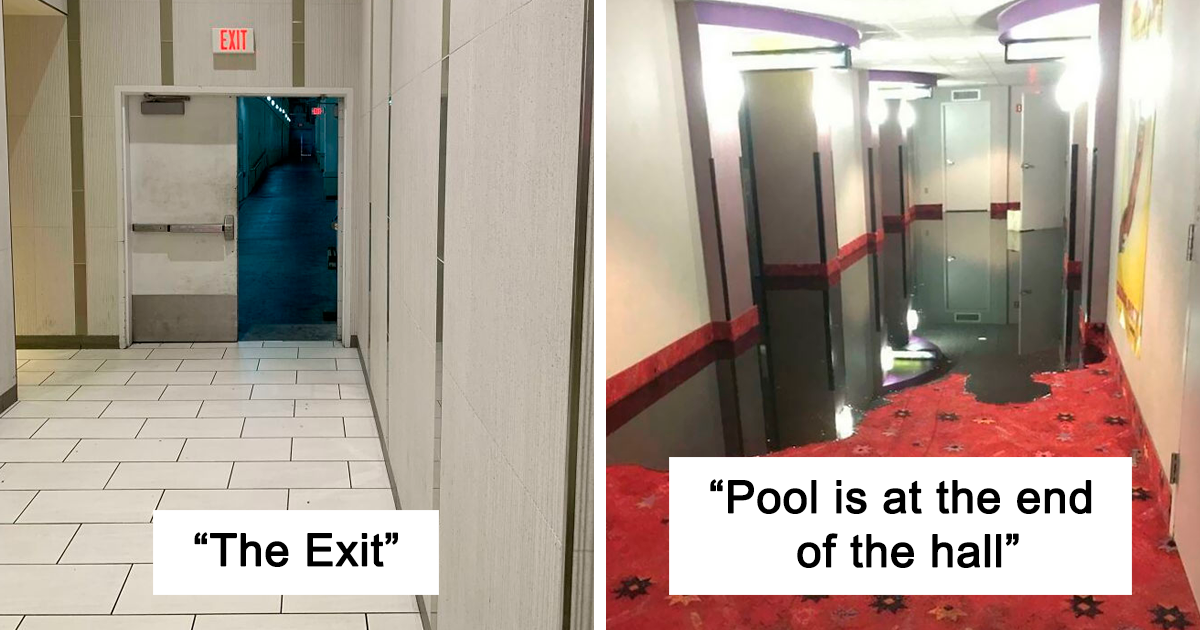
- The Corridor With Red Exit Signs and No Exit Energy. Bright signage should be reassuring. Yet in certain photos, those glowing red letters feel less like guidance and more like the corridor is taunting you with options you cannot actually use.
- The Peeling Wallpaper Hallway. Once decorative, now deeply cursed. A corridor with aging wallpaper hits that sweet spot between domestic and decayed. It suggests a former life, a vanished routine, and the possibility that nobody ever truly checked out.
- The Underground Passage. Low ceilings, concrete walls, no windows, no natural light, and a sound profile made entirely of footsteps and dread. These corridors feel especially tense because they remove every normal cue that helps orient the body.
- The Nursing Home Corridor at Night. Soft lights, muted colors, and a strange stillness that feels both tender and haunting. It is the quiet that gets you—not threatening, exactly, but heavy with memory and time.
- The Cruise Ship Hallway. Narrow, repetitive, and weirdly sealed off from the rest of reality. A corridor on a ship adds one extra layer of unease because even if you wanted to leave the whole building, congratulations, you are in the middle of the ocean.
- The Childhood Home Hallway in the Dark. Familiar spaces become stranger at night, and no photo captures that faster than a hallway you are supposed to know by heart. Same walls, same doors, brand-new sense that something is definitely off.
- The Corridor With a Mirror at the End. Mirrors in hallways already feel dramatic. Put one at the far end of a dim corridor and suddenly the photo contains double the space and triple the bad decisions.
- The Stairwell Landing Corridor Combo. A corridor attached to a stairwell is basically architecture trying to max out suspense. You have vertical uncertainty, horizontal uncertainty, and a nice echo effect to make every movement feel criminal.
- The Abandoned Dorm Hall. Faded bulletin boards, chipped paint, identical doorways, and the ghost of cheap ramen lingering in the walls. The creepiness comes from knowing this space was built for noise, connection, and late-night chaos—not silence.
- The Industrial Service Corridor. Pipes overhead, metal doors, concrete floors, and lighting that says “maintenance only” in a tone that is not a suggestion. In photos, these hallways look less like infrastructure and more like level seven of a very bad game.
- The Fancy Historic Hallway. Ornate moldings, patterned wallpaper, antique sconces, and enough old-world charm to make you forget that elegance can also be terrifying. A beautiful corridor can still feel like it is judging your breathing.
- The Hallway With One Open Door. Closed doors are fine. Reassuring, even. But one door standing open in an otherwise empty corridor turns a photo into an invitation nobody asked for. Your eyes go straight to it, against your better judgment.
- The Fluorescent Greenish Corridor. Some lights do not illuminate; they interrogate. A green-tinted hallway has instant uncanny power, making skin tones, walls, and shadows all look slightly unreal and extremely untrustworthy.
- The Corridor That Curves Out of Sight. A straight hallway is bad enough. A curved one is just showing off. The moment you cannot see the end, your imagination steps in with a full cast, soundtrack, and lawsuit.
- The Windowless Hallway With Loud Flooring. Every step echoes. Every shift in posture sounds suspicious. The lack of windows removes any sense of time, place, or normalcy, and the photo seems to hold that tension like a sealed jar.
- The Tunnel Between Buildings. Technically practical. Spiritually ominous. These connector hallways often feel unsettling because they are designed purely for function, and function without warmth can look alarmingly close to menace.
- The Hospital Corridor From a Stretcher Perspective. A hallway seen from low height changes everything. Ceiling lights stretch overhead like markers in a countdown, and the vanishing point feels less cinematic and more deeply personal.
- The Corridor With Children’s Decor. Murals, pastel paint, cartoon stickers, cheerful colors—all perfectly nice in daylight. But once the light drops and the hallway empties out, cheerful design can become unintentionally uncanny at Olympic speed.
- The Apartment Hall With Too Many Identical Doors. Repetition is the real star here. When every door looks exactly the same, the corridor stops feeling residential and starts feeling procedural, like you need authorization, backup, and maybe a priest.
- The Backrooms-Style Office Passage. Yellowish walls, stained carpet, buzzing lights, no furniture, no personality, no obvious purpose except to unsettle you at a molecular level. This is internet-era corridor horror in its purest form.
- The Corridor With Reflections Everywhere. Glossy tile, polished walls, glass panels, and enough reflective surfaces to make shadows multiply. The visual effect is stunning in photos and mildly offensive to your sense of peace.
- The Hallway at the End of Renovation. Unfinished trim, protective plastic, half-painted walls, and dangling wires. A work-in-progress corridor feels creepy because it exists in a temporary state, and temporary spaces have impeccable horror credentials.
- The Perfectly Normal Corridor That Somehow Feels the Worst. No peeling paint. No darkness. No obvious danger. Just a clean, ordinary hallway with absolutely terrible vibes. Sometimes the most unsettling image is the one that gives you no clear reason to be uncomfortable at all.
Why We Keep Looking at Creepy Corridor Photos
Part of the appeal is simple visual drama. Corridors are built around lines, repetition, rhythm, and depth. That makes them naturally photogenic. Photographers love them because the composition does half the work before anyone even touches the shutter. Viewers love them because the image pulls the eye forward, straight into the frame, whether or not the brain approves of the journey.
But the bigger reason is psychological. Eerie corridors feel close enough to real life to be believable and strange enough to trigger imagination. A castle dungeon is spooky, sure, but it belongs to fantasy. A hallway in a motel, school, office, or apartment building belongs to everyday experience. That makes the fear stickier. These are places we recognize. Places we have walked through while tired, alone, anxious, late, or already a little on edge. The photo is not just scary because of what is in it. It is scary because it activates memory.
That is why corridor horror works so well online. One image can summon half a dozen associations at once: the too-quiet dorm on winter break, the long hospital wing, the silent office after hours, the hotel floor where you forgot your room number, the childhood trip to get water at midnight while every doorway looked like a terrible opportunity. The corridor becomes a blank screen for personal dread, which is a very efficient business model for the internet.
The Experience of Walking Through a Nightmare Corridor
Looking at a photo of a creepy hallway is one thing. Walking through a real one is another. The body notices what the eyes cannot quite explain. First, your pace changes. Even if you tell yourself everything is fine, you do not walk exactly the same way. Maybe you speed up a little. Maybe you pretend not to speed up, which somehow feels more suspicious. Either way, the corridor has already won round one.
Then there is the sound. In a good corridor, sound behaves. In a nightmare corridor, every footstep comes back with editorial notes. The floor creaks one second late. The vent hums like it is considering a monologue. Somewhere far off, a door clicks or a pipe knocks, and your brain immediately begins assembling a completely unverified storyline. You are no longer just going somewhere. You are participating in an atmosphere.
Lighting changes your confidence, too. If the hallway is evenly lit, you move through it with purpose. If one end is dimmer than the other, you suddenly become very aware of distance. If the light flickers, your imagination cashes in all its chips at once. Shadows look mobile. Corners look active. Even harmless objects—a housekeeping cart, a wall-mounted extinguisher, a mirror, a laundry bin—start auditioning for a supporting role in your internal horror film.
What makes the experience so weird is how ordinary the setting usually is. You are not entering a haunted mansion in the middle of a thunderstorm. You are in a building with carpet and baseboards. Maybe there is an ice machine nearby. Maybe the walls are painted a bureaucratic off-white chosen by a committee that feared joy. That banality is part of the discomfort. The space is normal enough that you feel silly for being uneasy, but uncanny enough that your nervous system refuses to clock out.
Memory plays its part as well. A corridor can remind you of hospitals, dorms, schools, office towers, apartment buildings, hotels, and every movie that has ever taught you that the hallway is where the tension begins. So even when nothing happens, the possibility of something happening hangs in the air. The corridor becomes a stage waiting for action. Your eyes check every doorway. Your ears rank the sounds. Your hand suddenly takes your phone out for no practical reason except that the glowing screen feels like a tiny backup plan.
And then, perhaps most unsettling of all, the corridor eventually ends. You reach the elevator, the stairwell, the lobby, the room, the exit, the turn. Nothing chases you. No figure appears. No dramatic reveal occurs. Yet your body keeps that slight tension for another few seconds, as if the architecture has managed to leave fingerprints on your nerves. That is the real power of scary hallway photos and real-life eerie passageways alike. They do not need monsters, because they understand something more efficient: anticipation is often scarier than proof.
Final Thoughts
The best nightmare-inducing corridor photos are not just spooky because they are dark or old or empty. They work because corridors are already psychologically loaded spaces. They are transitional, repetitive, restrictive, and deeply dependent on atmosphere. Change the light, remove the people, extend the perspective, and suddenly a practical passageway becomes a visual panic button.
That is what makes a gallery like this so irresistible. These images let architecture and imagination collaborate in the pettiest possible way. A hallway should be harmless. Yet give it enough symmetry, silence, and fluorescent lighting, and it starts acting like the opening scene of a story you are not sure you want to finish. Which, naturally, is exactly why we keep scrolling.














