
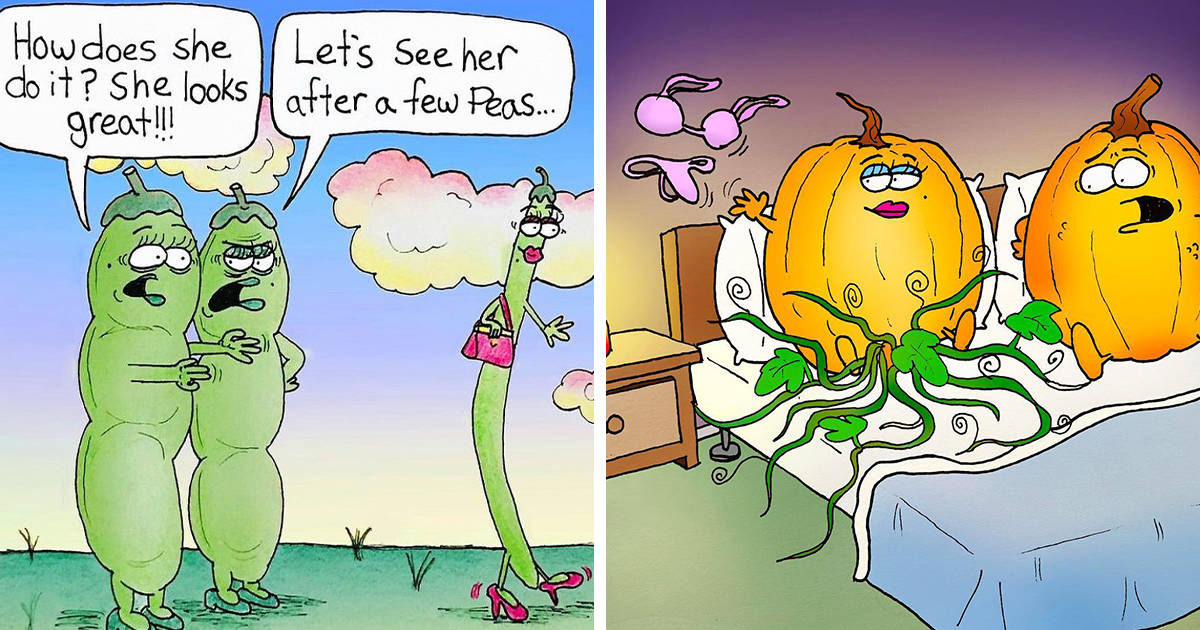
Most fruit is marketed as wholesome, colorful, and packed with vitamins. In John King’s comic universe, however, the produce aisle has apparently been left unsupervised. Bananas contemplate their inevitable transformation into bread, carrots organize cruel peeling pranks, and innocent-looking pizza slices discuss matters that would make a delivery driver quietly close the box.
Fruit Gone Bad is a one-panel comic series built around an irresistibly silly question: What would fruits, vegetables, snacks, and household objects say if they had human personalities and absolutely no filter? The answer is a cheerful mixture of visual puns, dark comedy, awkward relationships, kitchen disasters, and jokes that hover somewhere between a dad pun and something you would not repeat at Thanksgiving dinner.
The 33 funny and slightly inappropriate comics in this collection demonstrate how much comedy can fit inside a single image. There are no lengthy story arcs, complicated histories, or caped heroes saving the universe. There is simply an egg holding a whisk like an interrogation deviceand somehow that is enough.
Who Created the ‘Fruit Gone Bad’ Comics?
Fruit Gone Bad is the work of New York-based cartoonist John King. His recurring cast includes fruit, vegetables, baked goods, drinks, candles, holiday decorations, and practically any ordinary object capable of looking suspicious once someone draws two eyes on it.
King has described the series as something of a happy accident. Early ideas involving worms inside apples and celery “stalking” other characters encouraged him to explore more than simple visual puns. Over time, he began giving the characters distinctive personalities, social lives, insecurities, romantic problems, and questionable decision-making skills.
The artist’s childhood interest in action comics, humorous drawings, and fantasy eventually developed into a stripped-down cartoon style inspired in part by legendary single-panel cartoonist Gary Larson. King’s goal has been to communicate each joke with the clearest possible image and as few words as necessary.
An Old-School Drawing Process
Despite publishing his work online, King begins with traditional tools. He sketches in pencil, inks the lines he wants to keep, and sometimes adds shading with colored pencils. Digital color is frequently completed in Photoshop with help from his wife, although King has continued learning the software himself.
That combination gives the comics a warm, hand-drawn appearance without making them visually cluttered. Bold colors quickly identify the characters, while simple backgrounds keep the reader’s attention on the setup, expression, and punch line. In a one-panel cartoon, every unnecessary chair, spoon, or decorative houseplant is a potential accomplice to confusion.
Why These Funny Food Comics Work So Well
1. Ordinary Ingredients Become Tiny Disaster Machines
The central trick is anthropomorphismthe habit of assigning human emotions, intentions, and behavior to nonhuman things. People naturally see faces and personalities in animals, machines, possessions, and everyday objects, so accepting an anxious bagel or an offended potato requires almost no mental effort.
King then uses that instant connection against us. A banana is not merely a banana. It is a nervous individual with a limited shelf life and the uncomfortable knowledge that banana bread may be its final destination. Pickles are no longer preserved vegetables; they are prisoners planning an escape from a glass jar.
2. The Image and the Words Complete Each Other
A good visual pun usually depends on two meanings arriving at once. The picture establishes the literal interpretation, while the caption or dialogue activates a second meaning. Research on cartoon humor has similarly noted that readers combine verbal and visual details to understand the joke fully.
Consider a “cold case” investigated by food characters, leaves reacting to a leaf blower, or detectives asking who cut the cheese. The phrase is familiar, but the illustration makes it newly ridiculous. You understand the language first, notice the visual twist a fraction of a second later, and then experience the comedy equivalent of stepping on a rake.
3. Cute Characters Make the Naughty Material Funnier
The characters often have rounded bodies, tiny limbs, large eyes, and expressions that appear almost childlike. Their conversations are considerably less innocent. That gap between appearance and behavior creates much of the series’ comic tension.
A realistically drawn adult discussing bedroom problems might be uncomfortable. Two greasy pizza slices having the same conversation are absurd. A human character making an inappropriate threat could feel unpleasant. An egg saying it while holding a kitchen whisk becomes a breakfast-themed crime drama.
This contrast also keeps most of the humor playful rather than cruel. The jokes may flirt with mature subjects, bodily functions, dating disasters, or dark outcomes, but the characters remain so obviously fictional that the tone rarely becomes heavy.
Highlights From the 33 ‘Fruit Gone Bad’ Comics
The collection covers a surprising amount of territory for a gallery populated by groceries. Rather than repeating the original captions, the following spoiler-light highlights explain the ideas, visual setups, and comic techniques that make the selection memorable.
Produce With Existential Problems
One of the strongest images presents the life cycle of a banana as a progression toward banana bread. It is simple, instantly recognizable, and faintly horrifying if you happen to be a banana. The comic turns an ordinary kitchen habit into a complete biography: youth, maturity, brown spots, and reincarnation in a loaf pan.
Another gag places talking grapes together on a vine. Grapes are ideal Fruit Gone Bad characters because they are naturally arranged like a crowded family, office department, or neighborhood association. Personal space is impossible, gossip is inevitable, and someone is always hanging slightly lower than everyone else.
Potatoes also receive a generous helping of social anxiety. One scene plays with the familiar Mr. and Mrs. Potato Head concept and the uncomfortable subject of physical enhancement. The joke works because potatoes already resemble interchangeable body parts waiting for someone to attach an unnecessary accessory.
Kitchen Tools Become Instruments of Terror
Eggs face a particularly dangerous existence in this universe. A whisk is not a useful cooking tool; it is an explicit threat. A mixing bowl is not a container; it is a location where witnesses disappear. The familiar phrase “beaten” suddenly becomes less culinary and more criminal.
Other egg characters find themselves surrounded by rum, sugar, and holiday ingredients as they slowly realize that they are participating in the creation of eggnog. The seasonal decorations make the situation look festive, while the ingredients suggest that Christmas is about to become considerably more traumatic.
Candles encounter equally dark wordplay. A reference to a “snuffer” film becomes literal when the characters know that extinguishing a flame means ending a life. Later fireplace scenes use blowing, melting, and burning as foundations for dialogue that is far less innocent than the cozy setting suggests.
Food Relationships Are Complicated
Romance in Fruit Gone Bad is rarely smooth. Pizza slices argue about grease in bed, pasta characters discuss overcooking and dryness, and muffins question what kind of chips their partners may be hiding. These jokes succeed because food vocabulary is already packed with words that can describe bodies, relationships, and embarrassing situations.
A gingerbread couple creates one of the collection’s messiest domestic scenes. One character lies in bed while the other vacuums suspicious crumbs. The visual tells most of the story before the reader finishes processing the dialogue. Crumbs are simply part of gingerbread anatomy, but in context they become evidence of behavior no cookie wants documented.
Even champagne bottles and glasses receive social personalities. Their proportions, corks, bubbles, and habit of dramatically popping open offer more material than most respectable cartoonists would admit. King, fortunately, has never promised respectability.
Holiday Decorations Behave Badly
Christmas supplies appear repeatedly, perhaps because decorating a house already involves putting fragile objects under enormous pressure and then storing them in darkness for eleven months.
Talking Christmas trees deal with pets, ornaments, romantic implications, and the constant threat of being chopped down. Strings of Christmas lights argue, issue threats, and make color-based jokes. Their tangled wires resemble complicated relationships before a single word is added.
The holiday comics also show King’s skill at balancing seasonal familiarity with mildly inappropriate twists. A decorated tree creates expectations of warmth and nostalgia; the dialogue immediately ruins that expectation in the most efficient way possible.
Detective Stories Invade the Refrigerator
Several comics borrow the language of police dramas. Produce detectives investigate a fruitcake, food characters work on a cold case, and another investigation revolves around the eternal question of who cut the cheese.
The fruitcake scenario is especially effective because fruitcake already possesses a complicated reputation. It is given as a gift, quietly relocated, rediscovered months later, and possibly passed to another household. In detective form, its dense texture and long history make it look like both the victim and the primary suspect.
The cheese joke is proudly juvenile, but it earns its place through staging. Detective language gives the scene artificial seriousness, while the familiar childish phrase destroys that seriousness immediately. It is sophisticated presentation serving an extremely unsophisticated purposewhich is often a reliable recipe for comedy.
Vegetables Plot Revenge
Carrots respond to peeling as if it were an elaborate prank or humiliating attack. Leaves face a blower that appears less like landscaping equipment and more like a natural disaster. Pickles trapped in a jar quietly organize an escape plan.
The pickle scene is a miniature prison movie. The jar provides transparent walls, the lid acts as an impossible ceiling, and the brine becomes an environment nobody chose. With only a few details, the artist creates the suggestion of planning, betrayal, and one suspicious pickle who may not be fully committed to the mission.
Hot sauce also confronts a flaming chicken leg, dismissing the dramatic blaze as amateur behavior. The joke uses competitive toughness: when your entire identity is built around heat, meeting another burning food becomes a professional rivalry.
Sometimes the World Simply Ends
One comic places food characters in front of a massive explosion, evoking the visual language of blockbuster adventure movies. The contrast is delightfully disproportionate. Human heroes running from a fireball may look courageous; produce watching the same event looks like the refrigerator has become involved in an international incident.
These darker scenes broaden the series beyond food puns. The characters can participate in horror, romance, mysteries, disaster movies, office comedies, and holiday stories. Their physical properties still shape the jokes, but their emotions make the world feel unexpectedly consistent.
The Art of Saying More With One Panel
Single-panel comedy is unforgiving. A longer comic can explain its world gradually, but one-panel cartoons must establish the situation, identify the characters, introduce the conflict, and deliver the punch line almost simultaneously.
King has said that one of the most difficult parts of creating a comic is finding the right image and then selecting the words that communicate the joke clearly. He has also discarded completed cartoons when he believed the point was not understandable.
That willingness to remove weak ideas matters. A pun may sound funny in the artist’s head but become confusing when drawn. If readers must study a carrot for five minutes and consult a vegetable historian, the moment has probably passed.
The best Fruit Gone Bad comics can be understood almost immediately. A character’s shape supplies the premise, its expression establishes the emotion, and a short sentence changes the meaning of the entire scene. It is an efficient form of storytelling designed for readers scrolling quickly through social media.
Why Slightly Inappropriate Humor Is So Shareable
Puns depend heavily on incongruity: a familiar word or situation suddenly reveals a second interpretation. Humor writers and researchers frequently point to this violation of expectations as a basic comic mechanism.
Fruit Gone Bad adds another layer by using characters associated with health and innocence. Nobody expects a salad ingredient to make an adult joke. The surprise is immediate, easy to understand, and simple to share without explaining a complicated backstory.
King has experienced the unpredictability of online audiences firsthand. Cartoons he expected to perform well have sometimes received limited attention, while other jokes spread far beyond his expectations. One earlier comic involving an onion ring and a french fry reportedly accumulated millions of views.
That unpredictability is part of internet comedy. Readers bring different experiences to every image. One person sees an obvious pun, another notices a hidden detail, and a third races to the comments to add an even worse joke. The original cartoon becomes the opening line of a much larger conversation.
Experience Section: What It Feels Like to Read ‘Fruit Gone Bad’
Reading a large collection of Fruit Gone Bad comics creates a surprisingly specific experience. At first, the reader approaches each image normally. A banana is a banana. A candle is a candle. A bowl of eggs is simply breakfast waiting to happen.
After several panels, that confidence disappears.
You begin examining every object for evidence. Why is the muffin holding that drink? Why are those pickles whispering? Why is the whisk standing behind the egg like it has already contacted an attorney? Ordinary ingredients stop looking neutral because the series trains the reader to expect concealed motives.
The most enjoyable moment often arrives just before the joke becomes clear. You recognize the objects, read the setup, and sense that a pun is approaching. Your mind searches through familiar phrases involving peeling, beating, cutting, stuffing, squeezing, melting, or going stale. Then the visual detail clicks into place.
Sometimes the response is an immediate laugh. Sometimes it is a groan followed by reluctant admiration. Occasionally it is the quiet facial expression people make when they have understood a joke but would prefer not to explain it to the person sitting beside them.
The collection also rewards a second look. The central dialogue may deliver the obvious punch line, but background details frequently add another layer. A character’s posture, a misplaced ingredient, a box on a shelf, or the expression of a silent observer can make the scene funnier. The quietest vegetable is often the one who knows exactly what happened.
Sharing the comics produces another kind of entertainment. Different readers react to different levels of humor. A pun enthusiast appreciates the double meaning. A fan of dark comedy notices the implied disaster. Someone with the maturity of a twelve-year-oldand this is a respected demographicimmediately finds the bodily-function joke.
There is also a peculiar aftereffect: the comic vocabulary follows you into the kitchen. Cutting cheese becomes suspicious. Beating eggs sounds unnecessarily aggressive. A leaf blower appears to be committing a personal offense. A brown banana no longer looks overripe; it looks like a character who has read the final page of its own story.
That lingering change in perspective is one of the series’ greatest strengths. The drawings do not require elaborate worlds because they borrow the reader’s world. The grocery store, refrigerator, dinner table, and holiday decorations already contain everything needed for the joke. King merely adds faces, dialogue, and an alarming amount of emotional baggage.
After 33 comics, the experience feels less like viewing unrelated cartoons and more like visiting a chaotic neighborhood. Every household object has an opinion. Every snack has relationship problems. The vegetables are forming alliances, the candles are discussing mortality, and nobody should trust the pickles.
It is silly, quick, and occasionally inappropriate, but that is precisely the attraction. The series offers a short escape from serious information without pretending to teach a grand lesson. For a minute or two, the biggest problem in the world is whether a pizza slice has been too greasy in bed. Compared with most daily headlines, that is practically wellness content.
Conclusion
The 33 funny and slightly inappropriate comics from Fruit Gone Bad prove that comedy does not need an enormous cast, a complicated plot, or ten paragraphs of explanation. Sometimes it needs only a familiar object, a carefully chosen expression, and one phrase with two unfortunate meanings.
John King’s hand-drawn style gives the series personality, while his compact dialogue keeps each joke moving. More importantly, the characters are memorable because they behave like imperfect people. They gossip, flirt, panic, argue, investigate crimes, misunderstand one another, and occasionally discover that they are ingredients.
The next time you pass through the produce aisle, try not to make eye contact. The grapes are discussing you, the potatoes are feeling insecure, and one jar of pickles is considerably closer to escaping than store management realizes.
Note: This article is an independent editorial analysis based on artist interviews, established coverage of the Fruit Gone Bad series, and research concerning visual humor, puns, laughter, and anthropomorphism. It does not reproduce the original comic captions or artwork.













