
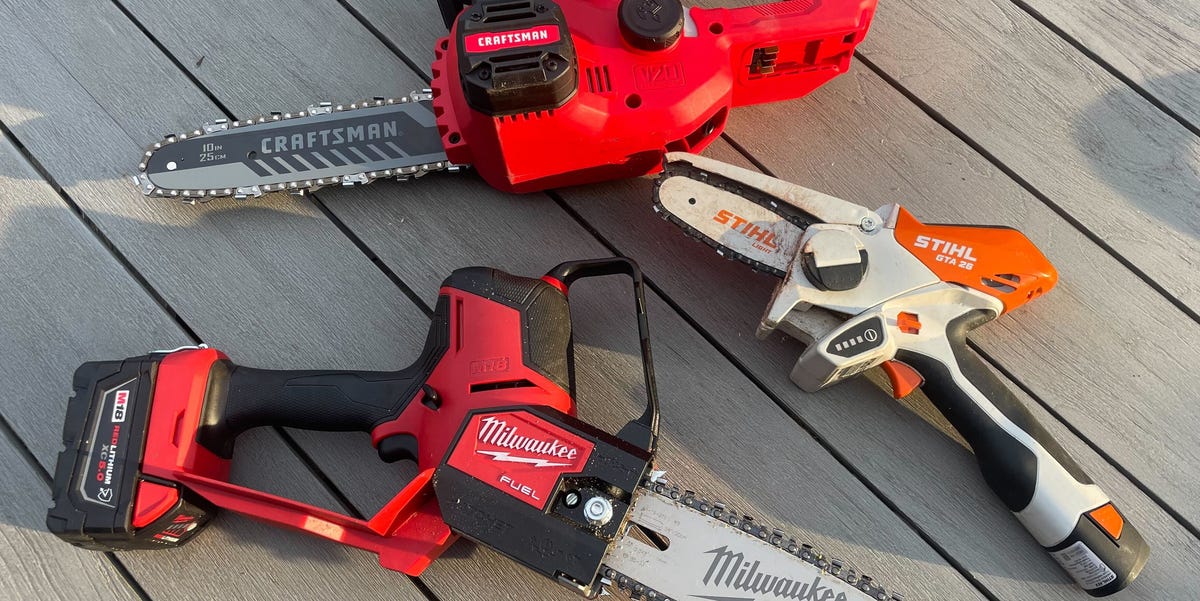
Mini chainsaws occupy the wonderfully practical space between a manual pruning saw and a full-size chainsaw. They are faster than sawing by hand, easier to control than a large gas-powered machine, and compact enough to store without evicting the lawn mower from your garage.
For homeowners, gardeners, and DIY enthusiasts, the best mini chainsaws can simplify seasonal pruning, storm cleanup, brush removal, and the occasional battle with an overgrown backyard. Modern battery-powered models start instantly, operate with less noise than gas saws, and do not require fuel mixing. Your neighbors may still notice the sudden disappearance of that unruly branch, but they are less likely to think a logging operation has opened next door.
This guide synthesizes hands-on expert testing published in 2024, including cutting trials on branches and logs of different diameters. The tools were assessed for cutting performance, battery runtime, handling, weight, maintenance, safety features, and overall value. Manufacturer specifications and U.S. safety guidance were also reviewed to provide a practical, accurate comparison.
Best Mini Chainsaws of 2024 at a Glance
| Model | Best For | Bar Length | Battery Platform | Approximate Tested Weight |
|---|---|---|---|---|
| Milwaukee M18 FUEL Hatchet | Best Overall | 8 inches | 18V M18 | 7.9 pounds with battery |
| Worx WG322 | Best Value | 10 inches | 20V PowerShare | 6.2 pounds |
| Stihl GTA 26 | Best Compact | 4 inches | AS battery system | About 3.5 pounds with battery |
| Craftsman V20 CMCCS620M1 | Best Heavy-Duty Pick | 12 inches | V20 | 12.25 pounds with battery |
| Ryobi ONE+ HP PSBCW01 | Best Low-Maintenance | 8 inches | 18V ONE+ | About 5.85 pounds with battery |
How the Mini Chainsaws Were Evaluated
Testing focused on the jobs homeowners are most likely to perform, rather than asking a tiny pruning saw to impersonate a commercial forestry machine. The saws were used on tree limbs, dense shrubs, and logs of varying thickness. Testers examined whether each tool cut smoothly, maintained chain speed under load, and remained comfortable during repeated use.
Setup also mattered. A powerful saw loses points when adjusting the chain requires a scavenger hunt for a tiny wrench. Testers therefore considered chain installation, tension adjustment, lubrication, battery charging, grip comfort, noise, vibration, and access to safety controls.
Finally, the evaluation considered value within each product’s intended role. A compact four-inch garden pruner should not be judged by the same standard as a 12-inch saw designed for larger logs. The real question is whether each tool performs its assigned job efficiently, safely, and without making the user regret every life decision that led to yard work.
1. Milwaukee M18 FUEL Hatchet 8-Inch Pruning Saw
Best Overall Mini Chainsaw
The Milwaukee M18 FUEL Hatchet earned the top position because it combines serious cutting ability with excellent control. In expert testing, it received outstanding marks for cutting performance and handling, successfully working through branches approximately six inches thick. Milwaukee lists a maximum cutting capacity of 7.5 inches, although users should leave a margin rather than trying to bury the entire guide bar in every branch they meet.
The brushless motor maintains chain speed effectively under load, making the saw feel more confident in hardwood than many compact competitors. A variable-speed trigger gives the operator control when beginning a cut, while metal bucking spikes help stabilize the tool against the wood. Its automatic oiler keeps the chain lubricated, and the translucent oil reservoir makes the remaining level easy to check.
The biggest drawback is weight. With a suitable M18 battery installed, the saw weighs close to eight pounds. That is manageable for waist-level pruning and log cutting, but repeated overhead work may quickly turn an afternoon gardening project into an unplanned shoulder workout. The saw is designed for two-handed operation, which improves stability but limits access in extremely tight spaces.
It is particularly attractive to people who already own Milwaukee M18 tools because the battery can be shared across the platform. Buyers starting from zero should remember that tool-only packages may not include a battery or charger.
- Bar length: 8 inches
- Motor: Brushless
- Maximum stated cut capacity: 7.5 inches
- Lubrication: Automatic oiler
- Best use: Frequent pruning, hardwood, and demanding residential cleanup
Pros: Excellent cutting performance, strong runtime, durable motor, effective bucking spikes, and precise trigger control.
Cons: Heavier than several competitors, requires two hands, and may be expensive when a battery and charger must be purchased separately.
Verdict: Choose the Milwaukee Hatchet when cutting strength and professional-style construction matter more than obtaining the lightest possible tool. It is the small saw most likely to make a bigger chainsaw feel unnecessary for routine property maintenance.
2. Worx WG322 20V 10-Inch Cordless Chainsaw
Best Value Mini Chainsaw
The Worx WG322 delivers a practical blend of reach, cutting capacity, and affordability. Its 10-inch guide bar is longer than the bars on most mini pruning saws, allowing it to handle medium-size limbs and small logs without jumping into the weight class of a traditional full-size chainsaw.
At approximately 6.2 pounds, the Worx remains relatively easy to maneuver. The two-handed layout feels familiar, while the automatic chain-tensioning system eliminates much of the trial and error involved in maintaining proper tension. An automatic oiling system further reduces routine maintenance.
The included 20V battery belongs to the Worx PowerShare platform, so it can be used in other compatible Worx tools. Manufacturer testing indicates that runtime varies considerably with wood density, branch diameter, and battery capacity. With a smaller 1.3Ah battery, Worx estimates up to 23 cuts through four-inch hardwood. Thinner branches should produce substantially more cuts.
The standard charger is slow, requiring roughly five hours for a full charge. That is not disastrous for occasional weekend use, but it rewards people who remember to charge batteries before the branches begin plotting their next growth spurt. A second battery or faster charger may be worthwhile for larger cleanup projects.
The brushed motor is another compromise. It provides capable performance for moderate residential work but is not expected to match the efficiency or long-term durability of premium brushless designs.
- Bar length: 10 inches
- Voltage: 20V Max
- Weight: 6.2 pounds
- Chain speed: 12.5 feet per second
- Best use: Affordable pruning, brush cleanup, and occasional small-log cutting
Pros: Competitive price, useful 10-inch bar, manageable weight, automatic oiling, and convenient chain adjustment.
Cons: Slow standard charger and a brushed motor that is less suitable for frequent heavy-duty use.
Verdict: The Worx WG322 is the strongest value for homeowners who need more capacity than a tiny garden pruner but do not want to pay premium-tool prices. Treat it like a residential chainsaw rather than a miniature lumber mill, and it should be a helpful backyard companion.
3. Stihl GTA 26 Battery Garden Pruner
Best Compact Mini Chainsaw
The Stihl GTA 26 is less a shrunken traditional chainsaw and more a powered replacement for hand pruners and pruning saws. Its four-inch guide bar, compact body, and low weight make it exceptionally easy to maneuver around shrubs, ornamental trees, and crowded planting beds.
Expert testers used the GTA 26 on approximately two-inch branches, thorny growth, and difficult-to-reach stems. Its rubberized grip, low-vibration chain, and one-handed format made it comfortable during detail work. The retractable chain guard rises as the saw enters the wood, helping shield the upper section of the chain while still allowing the tool to complete the cut.
The 10.8-volt AS-series battery provides roughly 20 to 25 minutes of estimated runtime, depending on the application. That number may sound limited, but pruning saws usually operate in short bursts. A user might spend several minutes selecting and positioning each branch, followed by only a few seconds of actual cutting.
The GTA 26 is not designed for large logs. Realistically, it is happiest on branches up to roughly three inches in diameter, with smaller material providing the quickest and cleanest experience. Users who repeatedly challenge it with oversized hardwood will discover that “compact” and “invincible” are not synonyms.
The kit is unusually complete. Depending on the package, it can include the battery, charger, carrying bag, and lubricating oil. Tool-free bar and chain removal also makes cleaning and maintenance straightforward.
- Bar length: 4 inches
- Battery: Stihl AS-series lithium-ion
- Estimated runtime: About 20 to 25 minutes
- Operation: One-handed when used according to the manual
- Best use: Shrubs, small branches, garden cleanup, and precise pruning
Pros: Extremely compact, comfortable grip, low vibration, useful chain guard, simple maintenance, and a well-equipped kit.
Cons: Limited cutting capacity and less value for users who primarily need to process logs or thick limbs.
Verdict: The Stihl GTA 26 is the best choice for gardeners who want speed and precision without the size or intimidation factor of a conventional chainsaw. It transforms a pile of small pruning jobs from an all-afternoon hand-saw marathon into a much shorter appointment.
4. Craftsman V20 12-Inch Compact Chainsaw
Best Heavy-Duty Option
With a 12-inch bar, the Craftsman V20 stretches the definition of a mini chainsaw. It is included because its compact configuration remains more approachable than many full-size saws while delivering enough capacity for larger branches and small-to-medium logs.
During expert testing, the Craftsman cut effectively through material approaching 10 inches in diameter. Its 20V battery system and four-amp-hour battery provide useful runtime, while automatic oiling and tool-free chain tensioning reduce maintenance interruptions.
The bubble level is an unusual but helpful addition for users making horizontal cuts. An onboard wrench-storage area and integrated hanging hook also make the saw easier to organize after use. These details are not glamorous, but neither is crawling under a workbench while muttering about a missing adjustment tool.
The trade-off is weight. At more than 12 pounds with its battery, this model is considerably heavier than the other products in this guide. It requires two hands, stable footing, and careful planning. It is not the model to choose for delicate pruning inside a rose bush unless the goal is to prune the rose bush, the fence behind it, and possibly a lawn chair.
It is also important to purchase bar-and-chain oil before the first use because the required lubricant may not be included in the package.
- Bar length: 12 inches
- Battery: V20 4.0Ah lithium-ion
- Lubrication: Automatic oiling
- Chain adjustment: Tool-free
- Best use: Larger branches, storm debris, and small-to-medium logs
Pros: Strong cutting capacity, generous battery, easy chain adjustment, automatic oiling, onboard storage, and useful organizational features.
Cons: Heavy, less agile than true mini saws, and oil may need to be purchased separately.
Verdict: Select the Craftsman when your projects regularly exceed the comfortable range of four-, six-, or eight-inch pruning saws. It offers a practical bridge between a compact cordless tool and a traditional chainsaw.
5. Ryobi ONE+ HP 18V 8-Inch Pruning Chainsaw
Best Low-Maintenance Mini Chainsaw
The Ryobi ONE+ HP stands out because of its oil-free design. Most chainsaws require bar-and-chain oil to minimize friction and heat, but this model is designed to operate without an oil reservoir. That means no oil level to monitor, no greasy storage shelf, and one fewer opportunity to discover that a cap was not tightened properly.
Its brushless motor improves efficiency and durability, while the eight-inch bar provides approximately six inches of practical cutting capacity. Ryobi states that the saw can deliver more than 65 cuts per charge with a two-amp-hour ONE+ battery, although actual results depend on the size and density of the wood.
At under six pounds with the battery used during testing, the Ryobi is easier to handle than the Milwaukee and dramatically lighter than the Craftsman. Its compact housing also improves access between branches. A chain guard and protected front handle provide useful barriers between the operator and moving components.
One concern is the absence of a conventional trigger lock on the tested design. The physical guard and handle layout offer protection, but operators must remain especially careful while carrying, positioning, or setting down the saw. Removing the battery before adjustments, cleaning, or transportation is a sensible habit with any cordless chainsaw.
Ryobi’s extensive ONE+ ecosystem is a major advantage. Owners of compatible drills, blowers, trimmers, and other tools may already have batteries and chargers available, significantly reducing the cost of adding the saw.
- Bar length: 8 inches
- Motor: Brushless
- Cut capacity: Approximately 6 inches
- Lubrication: Oil-free design
- Best use: Low-maintenance pruning and routine residential yard work
Pros: No chain oil, relatively light construction, brushless motor, compact dimensions, and excellent battery-platform compatibility.
Cons: The safety-control arrangement deserves careful attention, and the saw is not intended for the largest logs.
Verdict: The Ryobi is an excellent fit for homeowners who value simplicity. It provides meaningful pruning power while eliminating one of the messiest parts of normal chainsaw ownership.
How to Choose the Best Mini Chainsaw
Match the Bar Length to the Work
Bar length is the clearest indication of cutting capacity. Four- to six-inch models are best for shrubs and small branches. Eight-inch pruning saws can typically handle limbs around six inches thick, while 10- and 12-inch models are better for larger branches and small logs.
Do not automatically buy the longest bar available. A larger bar adds weight, requires more space, and can make the saw harder to control. The best mini chainsaw is the smallest model that can comfortably complete most of your planned work.
Consider Your Existing Battery Platform
A tool-only chainsaw can be an excellent bargain when you already own compatible batteries. However, a bare tool becomes much less affordable when it requires a new battery and charger. Compare complete system costs rather than focusing only on the price displayed beside the saw.
Look Beyond Voltage
Voltage alone does not determine performance. Motor design, chain speed, battery capacity, wood density, and chain sharpness all affect cutting. Amp-hour ratings indicate battery capacity, so a larger battery usually supports more cuts but also adds weight.
Think About Maintenance
Automatic oiling is convenient, but the reservoir still needs to be checked. Tool-free tensioning simplifies adjustments, although some professional-style designs use a wrench for greater precision. Oil-free products such as the Ryobi reduce mess, but users must still inspect the chain, guide bar, fasteners, and protective components.
Prioritize Safety Features
Useful safety features include trigger lockouts, chain guards, protected handles, low-kickback chains, and covers for storage. These features reduce risk but do not make a chainsaw harmless. A small fast-moving chain is still a fast-moving chain, not an enthusiastic electric butter knife.
Mini Chainsaw Safety Essentials
Read the manufacturer’s manual before operating any chainsaw. Inspect the chain, guide bar, tension, battery connection, guards, and controls before starting. Remove the battery before cleaning, adjusting, transporting, or replacing the chain.
Wear eye protection, hearing protection, sturdy footwear, gloves, snug clothing, and appropriate cut-resistant leg protection. Clear the work area of people, pets, loose debris, wire, rocks, and hidden metal. Maintain stable footing and never use a mini chainsaw from a ladder.
Do not cut directly overhead. Kickback or a falling limb can send the tool or wood toward the operator’s face and shoulders. Keep both hands on tools designed for two-handed operation, and never force a one-handed technique simply because the saw looks small enough. Watch for bent limbs and storm-damaged wood under tension, which may spring unexpectedly when cut. Jobs involving large trees, utility lines, unstable trunks, or elevated branches should be handled by a qualified arborist.
What It Is Really Like to Use a Mini Chainsaw
A 500-Word Practical Experience Guide
A realistic mini-chainsaw session usually begins with overconfidence. You charge the battery, look at a pile of branches, and assume the job will take seven minutes. Then you remember that the branches are tangled, one is pressing against a fence, and another appears to have been designed by nature specifically to slap you in the face.
The first major advantage becomes obvious as soon as the chain engages. A branch that would require repeated strokes with a manual pruning saw can often be removed in seconds. On one- to three-inch material, a sharp mini chainsaw feels almost effortless. The operator still needs to support and position the branch correctly, but the exhausting back-and-forth motion disappears.
Compact models such as the Stihl GTA 26 are especially satisfying for detail work. They fit between stems, allow accurate cuts, and can be carried around a garden without feeling like serious forestry equipment. The experience is closer to using a powerful cordless hand tool than wrestling with a traditional chainsaw.
Moving to an eight-inch model changes the character of the work. A saw such as the Milwaukee Hatchet or Ryobi ONE+ HP feels more substantial and provides enough capacity for limbs that would be frustrating with hand tools. The added power encourages faster progress, but it also demands more discipline. The operator must resist twisting the bar, cutting with the guide-bar tip, or pushing aggressively when the chain slows.
Weight matters more than specification charts suggest. A difference of two pounds seems trivial while reading product descriptions. After 20 minutes of lifting and repositioning a saw, it can determine whether the tool feels controlled or increasingly awkward. Overhead cuts amplify this problem, which is one reason they should be avoided. It is safer to use a proper pole saw or hire an arborist than to hold a chainsaw above shoulder level and hope gravity has taken the afternoon off.
Battery runtime also feels different in real use than it does on paper. Mini chainsaws rarely run continuously. Much of the session is spent moving branches, selecting cuts, checking the drop zone, and clearing debris. A battery rated for 20 or 25 minutes of operation can therefore support a much longer work period. However, dense hardwood and near-capacity cuts drain batteries faster than small green branches.
Chain sharpness has an enormous effect on the experience. A sharp chain pulls steadily into the wood and produces recognizable chips. A dull chain creates finer dust, cuts slowly, generates heat, and tempts the user to apply unsafe pressure. Cleaning the bar groove, maintaining correct tension, and sharpening or replacing the chain can restore performance more dramatically than buying a larger battery.
Cleanup is another area where mini chainsaws shine. There is no gasoline to drain and no carburetor to babysit. The user generally removes the battery, brushes away debris, checks the chain, wipes the tool, and stores it with the guide-bar cover installed. Models with automatic oilers may leave a small amount of oil beneath the saw, so storing them on a protective mat is wise.
The overall experience is best described as efficient rather than effortless. A mini chainsaw removes much of the physical labor from pruning, but the operator still has to evaluate branches, plan cuts, manage falling material, and maintain the tool. Used within its limits, it can become one of the most frequently reached-for pieces of outdoor equipment. Used carelessly, it can become the reason a peaceful Saturday includes paperwork and an urgent-care waiting room.
Final Verdict
The Milwaukee M18 FUEL Hatchet is the best overall mini chainsaw of the 2024 expert-tested group. It offers the strongest combination of power, control, runtime, and professional-quality construction.
The Worx WG322 is the better choice for value-conscious homeowners, while the Stihl GTA 26 excels at light, precise garden pruning. The Craftsman V20 12-inch chainsaw provides additional capacity for larger limbs and logs, and the Ryobi ONE+ HP wins for convenient, oil-free maintenance.
No single model is ideal for every yard. Choose according to branch diameter, expected workload, tool weight, safety controls, maintenance preferences, and any batteries you already own. The right mini chainsaw should make routine pruning faster without encouraging you to tackle work that properly belongs to a full-size saw or professional arborist.
Editorial note: This article preserves the expert-tested 2024 product lineup named in the title. Specifications were cross-checked with manufacturer information available through July 31, 2026. Product packages, prices, model availability, and included accessories may change over time.













