
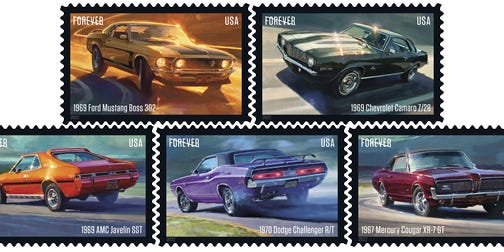
If your mailbox has been looking a little too sensible lately, the United States Postal Service found the cure: horsepower. With its Pony Cars Forever stamps, USPS turned five legendary American performance machines into tiny, collectible pieces of art. No keys, no insurance bill, no garage space required. Just peel, stick, and let a 1969 Mustang Boss 302 deliver your electric bill with more swagger than the bill deserves.
The Pony Cars Forever stamps were officially issued on August 25, 2022, at the Great American Stamp Show in Sacramento, California. The pane of 20 stamps features five classic U.S. automobiles: the 1969 Ford Mustang Boss 302, 1970 Dodge Challenger R/T, 1969 Chevrolet Camaro Z/28, 1967 Mercury Cougar XR-7 GT, and 1969 AMC Javelin SST. The artwork was created by artist Tom Fritz, with Greg Breeding serving as art director and Zach Bryant as designer. Fritz painted the cars in oil on panels, giving each stamp the rich, dramatic feel of a vintage garage poster that somehow shrank itself down to envelope size.
For stamp collectors, car lovers, and anyone who believes mail should occasionally arrive with a growl, this release is more than a novelty. It is a miniature celebration of one of the most exciting chapters in American automotive history: the rise of the pony car.
What Makes a Pony Car a Pony Car?
The term “pony car” was born in the wake of the Ford Mustang’s explosive arrival in 1964. The basic formula was simple but irresistible: long hood, short rear deck, two doors, four seats, sporty styling, affordable pricing, and a menu of options long enough to make buyers feel like they were building a personality, not just ordering transportation.
Pony cars were not exactly sports cars, though they borrowed the attitude. They were not always pure muscle cars either, though many grew increasingly muscular as the 1960s roared toward the 1970s. At their heart, pony cars were about youthful image and personalization. A buyer could get a tame six-cylinder commuter or a fire-breathing V8 street bruiser from the same basic showroom family. That flexibility helped turn the segment into a cultural event.
The USPS stamp lineup wisely focuses on the golden age of the species: 1967 to 1970. This was the moment when Detroit’s pony-car war reached full gallop. Ford, Chevrolet, Dodge, Mercury, and American Motors were fighting not only for sales but for bragging rights on the street, at the dragstrip, and in SCCA Trans-Am racing. The result was a herd of cars that looked fast standing still and, in many cases, backed up the costume with serious hardware.
The Five Classic Pony Cars Featured on the USPS Stamps
1. 1969 Ford Mustang Boss 302: The Stamp That Started a Stampede
No pony car stamp collection could begin anywhere else. The Ford Mustang did not just inspire the “pony car” name; it created the market frenzy that made every rival brand ask, “Why didn’t we think of that first?” By 1969, the Mustang had grown meaner, lower, wider, and more competitive. The Boss 302 was Ford’s road-racing special, built with SCCA Trans-Am competition in mind.
The Boss 302 combined a high-revving 302-cubic-inch V8 with handling upgrades and styling that looked like it had been drawn while someone was listening to a very loud guitar solo. Its blacked-out hood, side stripes, front spoiler, and no-nonsense stance made it one of the most recognizable Mustangs of the classic era. Advertised output was 290 horsepower, but like many performance ratings of the period, that number had a suspiciously polite handshake with reality.
What makes the Boss 302 special is balance. Many muscle-era legends were built to win stoplight battles in a straight line. The Boss wanted corners. It wanted road courses. It wanted to chase Camaros until the tires smelled like victory and poor financial planning. On a stamp, that attitude survives in compact form: a Mustang that looks ready to leap off the envelope and head for the nearest apex.
2. 1970 Dodge Challenger R/T: Mopar Arrives Fashionably Late and Loud
The Dodge Challenger entered the pony car party later than the Mustang and Camaro, but it did not arrive quietly. Introduced for the 1970 model year, the Challenger shared Chrysler’s E-body architecture with the Plymouth Barracuda, but Dodge gave it a slightly larger, more upscale presence. The R/T badge stood for Road/Track, which is a very polite way of saying, “This thing would like to make noise now.”
The 1970 Challenger R/T offered a range of V8 powerplants, starting with the 383-cubic-inch Magnum V8 and climbing into truly legendary territory with 440-cubic-inch engines and the mighty 426 Hemi. The car’s wide stance, aggressive grille, available hood scoops, bold colors, and stripe packages made it an instant visual icon. Even if parked between a Mustang and a Camaro, the Challenger looked like it had brought a brass section to a guitar fight.
On the USPS stamp, the Challenger represents the Mopar side of the pony car universe: big personality, big displacement, and a design language that favored drama over subtlety. It may have been late to the first-generation pony car war, but the Challenger made sure nobody forgot it had shown up.
3. 1969 Chevrolet Camaro Z/28: The Mustang Hunter With a Racing Degree
The Chevrolet Camaro was created as GM’s direct response to the Ford Mustang, and by 1969 the rivalry had become one of the great American automotive arguments. The Z/28 was the Camaro’s sharpest road-racing weapon, developed for Trans-Am competition and powered by a special 302-cubic-inch small-block V8 designed to meet displacement rules.
Like the Boss 302, the Camaro Z/28 was officially rated at 290 horsepower. Also like the Boss, that rating did not tell the full story. The Z/28’s solid-lifter 302 loved revs, and enthusiasts have long noted that its real-world output was considerably stronger than the brochure suggested. With a four-speed manual transmission, performance suspension, front disc brakes, and available racing-inspired equipment, the Z/28 was far more than a stripe package.
The 1969 Camaro body also hit a sweet spot: muscular but tidy, aggressive but clean, and instantly recognizable. The Z/28 added racing credibility to that shape. It is the kind of car that makes people at gas stations say, “Nice Camaro,” even if they only came in for coffee and windshield washer fluid.
As a stamp subject, the 1969 Camaro Z/28 is a perfect choice. It captures the competitive spirit that defined the pony car era. The Mustang may have started the stampede, but the Camaro made sure the race stayed interesting.
4. 1967 Mercury Cougar XR-7 GT: The Gentleman Pony Car With Claws
The Mercury Cougar is sometimes described as the Mustang’s more refined cousin, which is accurate but undersells its bite. Introduced for 1967, the Cougar shared some underlying DNA with the Mustang but wrapped it in a longer, more upscale body. The hidden headlights, sequential turn signals, and elegant roofline gave it a more sophisticated presence. If the Mustang was a varsity jacket, the Cougar was a tailored blazer with a switchblade in the pocket.
The XR-7 trim added luxury touches such as upgraded instrumentation and a more premium interior feel. The GT package brought performance credibility with a 390-cubic-inch V8, upgraded suspension, larger brakes, low-restriction dual exhaust, and special badging. Together, XR-7 and GT created a fascinating blend: comfort, class, and enough power to make the rear tires reconsider their career choices.
The Cougar also had real competition credentials. Mercury entered Cougars in Trans-Am racing in 1967 with factory support, and the brand came remarkably close to taking the championship. That racing connection gives the Cougar a stronger claim to pony car history than casual fans sometimes realize.
Including the 1967 Mercury Cougar XR-7 GT on the USPS stamp pane is a smart move. It expands the story beyond the obvious Mustang-versus-Camaro debate and reminds collectors that the pony car world had room for elegance as well as aggression.
5. 1969 AMC Javelin SST: The Underdog That Refused to Stay Quiet
The 1969 AMC Javelin SST is the stamp that will make casual fans pause and ask, “Wait, AMC made a pony car?” Yes, it did, and it was good. American Motors Corporation did not have the enormous budgets of Ford, GM, or Chrysler, but the Javelin proved that clever design and racing ambition could still punch above their weight.
Launched for the 1968 model year, the Javelin was AMC’s entry into the pony car market. Styled by Dick Teague, it had clean lines, a roomy cabin, and a distinctive personality that set it apart from the big-brand crowd. The SST trim added a more premium presentation, while available V8 engines and performance packages gave the car genuine enthusiast appeal.
By 1969, a Javelin equipped with AMC’s 390-cubic-inch V8 could be a seriously quick machine. The Javelin also became a major player in Trans-Am racing, especially as AMC’s motorsports program gained momentum and later teamed with Penske Racing and Mark Donohue. For a company often cast as the scrappy outsider, the Javelin carried itself with impressive confidence.
On a stamp, the AMC Javelin SST is more than a cool car. It is a tribute to the underdog spirit of the pony car era. It says the American performance scene was not built only by the giants. Sometimes the most interesting machines came from the brand willing to take a swing even when the other guys had deeper pockets and louder marketing departments.
Why These USPS Pony Cars Stamps Matter
At first glance, stamps and pony cars might seem like opposites. One is designed to move mail at a regulated pace. The other is designed to make a driver say, “I should probably slow down,” then not slow down quite yet. But the pairing works because stamps have always been tiny public monuments. They honor people, places, inventions, art, landscapes, and cultural moments that deserve a place in the national scrapbook.
Classic pony cars belong in that scrapbook. They were not just machines; they were symbols of youth culture, postwar confidence, design freedom, and the uniquely American belief that even an everyday car should be available with stripes, spoilers, loud paint, and an engine that makes neighbors look through the blinds.
The Pony Cars Forever stamps also bridge two collecting cultures. Philatelists appreciate the design, issue date, first-day covers, and postal history. Car enthusiasts appreciate the machinery, the rivalries, and the personal memories attached to the cars. Put the two together and you get a collectible that can appeal to someone who owns a climate-controlled stamp album and someone who owns three torque wrenches named by size.
Forever Stamps, Forever Horsepower
Because these are Forever stamps, they remain valid for the current First-Class Mail one-ounce rate regardless of future price increases. That gives the Pony Cars pane a practical side, although many buyers probably keep it untouched. After all, using a Boss 302 stamp to mail a routine form feels a little like using a vintage Shelby as a grocery cart. Technically possible, emotionally complicated.
The pane format includes 20 stamps, with each of the five cars appearing multiple times. The artwork emphasizes motion, color, and attitude rather than sterile catalog accuracy. That is the correct choice. Pony cars were emotional objects. They were bought with spreadsheets sometimes, but mostly with pulse rates. Fritz’s painted approach gives the stamps a sense of speed and theatrical lighting that suits the subject beautifully.
For USPS, the release fits into a long tradition of transportation-themed stamps, from trains and aircraft to motorcycles, hot rods, and classic cars. For enthusiasts, it is a welcome reminder that automotive history is cultural history. The cars we build, buy, race, restore, and argue about become part of the national language.
Experience: Why These Five Tiny Cars Hit So Hard
There is something funny about seeing a car reduced to stamp size. A real 1970 Dodge Challenger R/T takes up a parking space, shakes the air, and announces itself like a marching band falling down the stairs. On a stamp, it is smaller than a cracker. Yet somehow, the feeling remains. That is the magic of good design and the reason this USPS release works so well.
For many people, classic pony cars are not just objects of horsepower worship. They are memory machines. Maybe your uncle had a Camaro that smelled like vinyl, gasoline, and questionable decisions. Maybe a neighbor owned a Cougar and washed it every Saturday with the seriousness of a museum curator. Maybe you saw a Boss 302 at a local cars-and-coffee event and suddenly understood why grown adults will stand in a parking lot for two hours discussing carburetors like they are rare orchids.
The Pony Cars stamps tap into that emotional garage. They make the cars accessible in a way the real vehicles often are not. A restored 1969 Mustang Boss 302 or Camaro Z/28 can cost serious money today. A Hemi Challenger can enter the financial atmosphere where normal wallets require oxygen masks. Even the once-overlooked AMC Javelin has earned new respect among collectors. But a stamp pane lets almost anyone own a little piece of the story.
That matters because car culture is often built through small entry points. A kid might not start with a restoration project. They might start with a Hot Wheels car, a poster, a racing game, a magazine article, or yes, a USPS stamp. The image comes first. The curiosity follows. Then one day they are learning why the Trans-Am series had displacement rules, why Chevrolet built a 302, why Ford cared about handling, why Mercury tried to make performance luxurious, and why AMC deserves more credit than it usually gets at family cookouts.
These stamps also make ordinary mail feel personal again. In a world of instant messages and digital bills, a letter with a classic pony car stamp has personality. It says someone chose the stamp on purpose. It adds a wink before the envelope is even opened. A birthday card with a Javelin stamp feels different from one with a generic flag stamp. A thank-you note wearing a Mustang Boss 302 has the postal equivalent of side stripes.
For collectors, the best experience may be the overlap of detail and imagination. You can study the artwork, compare it to factory photos, admire the color choices, or build a small display around the five models. You can also simply enjoy the absurdly pleasant idea that five of America’s loudest classic coupes have been hired for mail duty. They will not actually make the mail arrive faster, but emotionally, a Camaro Z/28 on the corner of an envelope feels at least 12 percent quicker.
In the end, the Pony Cars Forever stamps are not just about nostalgia. They are about how certain designs keep moving through culture long after their original model years have passed. These cars went from dealer lots to racetracks, from teenage dreams to auction blocks, from garage walls to USPS stamps. That is quite a journey for machines originally built to sell speed, style, and freedom to young drivers. The engines may be silent on paper, but the attitude still idles loud enough to hear.
Conclusion
The USPS Pony Cars Forever stamps prove that American performance history does not need a full-size garage to make an impression. With the 1969 Ford Mustang Boss 302, 1970 Dodge Challenger R/T, 1969 Chevrolet Camaro Z/28, 1967 Mercury Cougar XR-7 GT, and 1969 AMC Javelin SST, the Postal Service captured five different flavors of classic pony car greatness. Each stamp celebrates not only a car, but a moment when Detroit chased youth, style, racing glory, and showroom excitement with glorious enthusiasm.
Whether you are a stamp collector, a classic car fan, or simply someone who believes envelopes deserve more horsepower, this release is a charming tribute to an era when American coupes wore stripes proudly and every brand wanted a piece of the pony car dream. Some stamps whisper. These ones rev.














