
The banking panic of 2023 was the financial world’s version of a fire alarm going off during a very serious board meeting: sudden, loud, confusing, and impossible to ignore. In only a few days, Silicon Valley Bank collapsed, Signature Bank was closed, nervous depositors started refreshing their banking apps like they were watching playoff scores, and regulators rushed in with emergency measures to stop fear from spreading through the U.S. banking system.
Unlike the 2008 financial crisis, this panic was not mainly about bad mortgages, exotic derivatives, or Wall Street mystery boxes with three-letter names. The 2023 banking crisis was about something older and simpler: confidence. Banks borrow short and lend long. Depositors expect their money immediately. Banks invest and lend over time. That arrangement works beautifully until everyone asks for their cash at once. Then even a bank that looks fine on a spreadsheet can start sweating through its suit.
This article answers eight major questions about the banking panic of 2023: what happened, why Silicon Valley Bank failed so quickly, how interest rates played a role, whether depositors were bailed out, what made Signature Bank and First Republic vulnerable, and what ordinary consumers and business owners can learn from the drama. The short answer? The panic was not the end of banking, but it was a very expensive reminder that risk management is not decorative office furniture.
1. What Was the Banking Panic of 2023?
The banking panic of 2023 was a sudden crisis of confidence centered on several U.S. regional banks, especially Silicon Valley Bank, Signature Bank, and First Republic Bank. Silicon Valley Bank was closed on March 10, 2023. Signature Bank was closed two days later. First Republic Bank failed on May 1, 2023, after weeks of pressure and deposit outflows.
The panic began when depositors, investors, and analysts realized that some banks had a dangerous mix of large uninsured deposits, unrealized losses on securities, and customers who could move money instantly. In the old days, a bank run involved people standing in line outside a branch. In 2023, the line was digital. Depositors could move millions with a few clicks, while group chats, social media, and venture-capital networks spread fear faster than any marble-column bank lobby could handle.
The phrase “banking panic” does not mean every bank was failing. Most U.S. banks continued operating normally. The problem was that a few institutions had unusually fragile funding models. They relied heavily on large depositors whose balances exceeded the standard FDIC insurance limit. When those depositors became nervous, they had every reason to leave quickly. That speed turned bank-specific problems into a broader market scare.
2. Why Did Silicon Valley Bank Fail So Fast?
Silicon Valley Bank, often called SVB, served a concentrated client base of technology startups, venture-capital firms, and life-sciences companies. During the low-interest-rate boom of 2020 and 2021, deposits poured in as startups raised record amounts of funding. SVB grew rapidly and invested much of that money in longer-term securities, including government-backed bonds and mortgage securities.
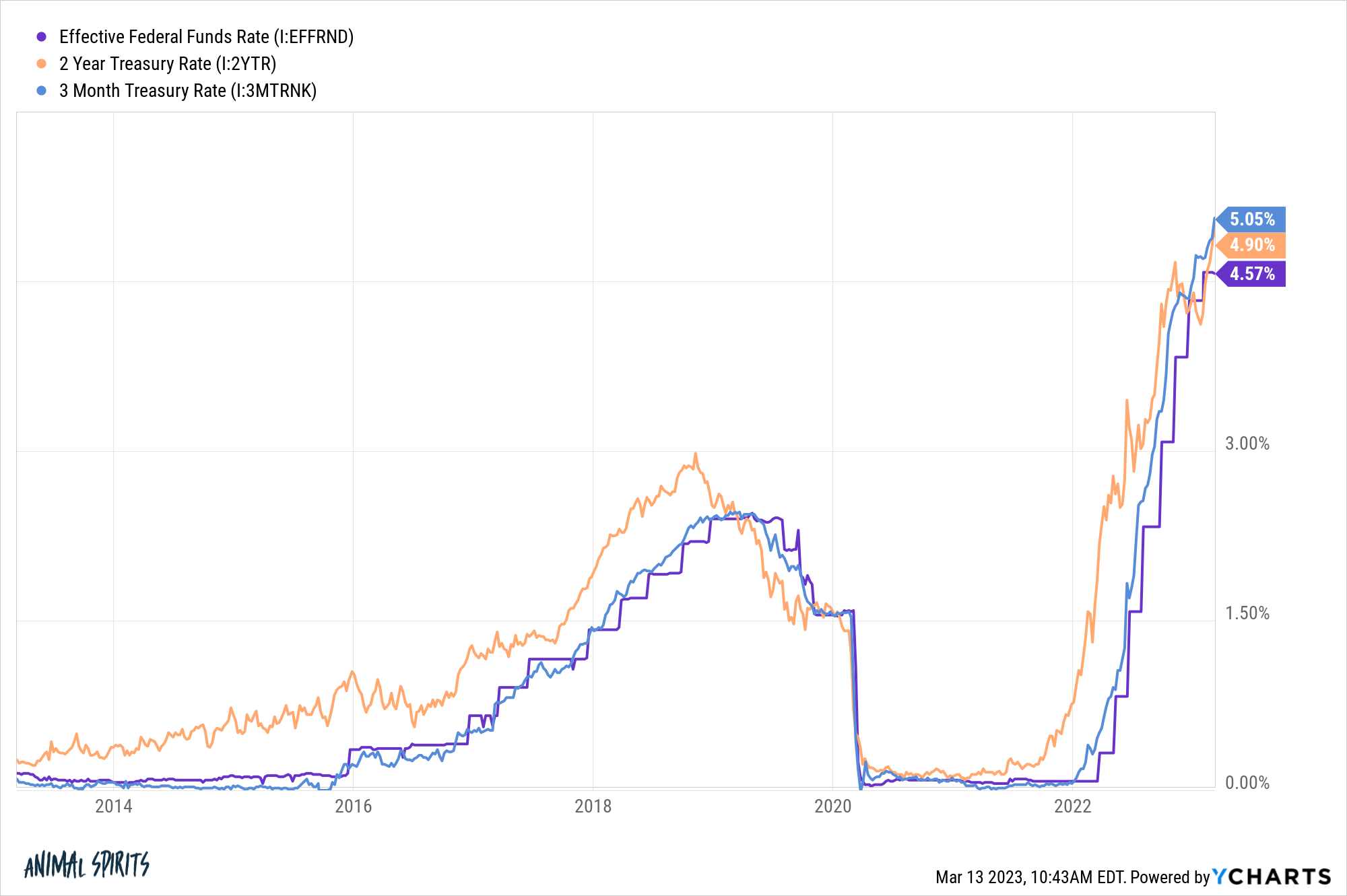
Those securities were generally high quality from a credit perspective. The problem was interest-rate risk. When the Federal Reserve raised rates aggressively in 2022 and 2023 to fight inflation, the market value of older, lower-yielding bonds fell. SVB was sitting on large unrealized losses. In plain English: the bank owned safe-looking assets that had become worth less on paper because newer bonds paid better yields.
At the same time, many startup clients were burning cash because venture funding slowed. That meant deposits were leaving. SVB needed liquidity, announced plans to raise capital, and disclosed losses from selling securities. Instead of calming the market, the announcement spooked depositors. A wave of withdrawal requests followed. The result was a classic bank run with modern technology: no torches, no pitchforks, just mobile banking and panic.
The Core SVB Problem
SVB did not fail because its customers were ordinary people buying too many lattes. It failed because management did not adequately manage liquidity risk, interest-rate risk, and concentration risk. Its customer base was too connected, too uninsured, and too capable of leaving at once. When confidence cracked, the exit door was not wide enough.
3. What Role Did Rising Interest Rates Play?
Rising interest rates were central to the banking panic of 2023. Banks often hold securities as part of normal balance-sheet management. When rates rise, the value of existing fixed-rate securities falls. That does not always create an immediate problem if a bank can hold those assets to maturity. But if the bank needs to sell them quickly to meet withdrawals, paper losses can become real losses.
That is exactly why interest-rate risk matters. A bank can look comfortable when depositors are calm. But if depositors suddenly demand cash, the bank may have to sell assets at a bad time. It is a little like owning a house you planned to keep for 30 years, then being forced to sell it during a neighborhood panic because everyone on your block heard a rumor about termites.
The Federal Reserve’s rate hikes were not aimed at hurting banks. They were aimed at bringing inflation under control. But rapid rate increases exposed banks that had not prepared for the possibility that deposits would leave while securities portfolios were underwater. In the case of SVB, the combination was especially toxic because many depositors were large businesses with balances above FDIC insurance limits.
4. Were Depositors Bailed Out?
The word “bailout” became one of the most debated terms of the 2023 banking crisis. Regulators announced that all depositors at Silicon Valley Bank and Signature Bank would have access to their money, including balances above the standard FDIC insurance limit. That protected startups, payroll accounts, small businesses, nonprofits, and other organizations that had large deposits at those banks.
However, shareholders and certain unsecured debtholders were not protected. Senior management was removed. The official message was that depositors were protected to prevent wider panic, while investors in the failed banks still absorbed losses. In other words, it was not a rescue of the banks’ stock prices. If you owned the wrong bank shares at the wrong time, the market did not send flowers.
The government also emphasized that losses tied to protecting uninsured depositors would not be borne by taxpayers in the ordinary sense. Instead, losses to the Deposit Insurance Fund would be recovered through assessments on banks. Still, the decision raised serious policy questions. If large uninsured depositors are protected during a panic, does the FDIC insurance limit still mean what people think it means? That question remains one of the biggest aftershocks of the crisis.
5. Why Was Signature Bank Closed?
Signature Bank was a New York-based institution with significant commercial clients and exposure to digital-asset-related customers. It was not identical to Silicon Valley Bank, but it shared several vulnerabilities: rapid growth, a large share of uninsured deposits, liquidity concerns, and a customer base that could become nervous very quickly.
After SVB failed, Signature faced heavy withdrawal pressure. Regulators worried that if Signature opened normally after the weekend, it might not be able to meet depositor demands and could spread panic further. The bank was closed on March 12, 2023, and regulators invoked a systemic risk exception so depositors would be made whole.
Signature’s failure showed that contagion does not require two banks to have the exact same business model. In a panic, markets look for family resemblance. If one bank fails because of uninsured deposits and weak liquidity, investors and depositors start asking which other banks share those traits. That is how fear travels: not by perfect logic, but by pattern recognition wearing running shoes.
6. What Happened to First Republic Bank?
First Republic Bank became the next major pressure point. It served many wealthy clients and had a high level of uninsured deposits. It also held long-term assets, including loans made during a lower-rate environment. As confidence weakened across regional banks, First Republic experienced large deposit outflows.
A group of major U.S. banks attempted to stabilize First Republic by placing deposits with it, but the relief was temporary. Eventually, regulators seized the bank, and JPMorgan Chase acquired most of its assets and deposits. First Republic became one of the largest bank failures in U.S. history.
First Republic’s story reinforced the key lesson of the panic: liquidity can disappear faster than accounting statements can reassure people. A bank may have valuable assets, loyal clients, and a respected brand, but if enough depositors decide to leave at the same time, reputation alone cannot fund withdrawals.
7. Was the 2023 Banking Panic Like the 2008 Financial Crisis?
The 2023 banking panic and the 2008 financial crisis had one major similarity: both involved a sudden loss of confidence. But the causes were different. The 2008 crisis centered on mortgage credit losses, complex securities, excessive leverage, and deep problems across major financial institutions. The 2023 panic was more focused on regional banks with concentrated uninsured deposits, interest-rate risk, and liquidity stress.
In 2023, the assets causing concern were often government-backed or high-quality securities whose market value had fallen because interest rates rose. That is different from owning loans that borrowers cannot repay. The problem was not mainly that the assets were junk. The problem was that the banks might need cash immediately while their assets were worth less if sold immediately.
Another difference was speed. In 2008, panic spread through financial markets, wholesale funding channels, and complex securities. In 2023, digital banking and online communication made depositor behavior astonishingly fast. A nervous founder could text a group chat, call a venture investor, and wire funds before lunch. By afternoon, the bank’s liquidity team might be staring at withdrawal requests that looked like a horror movie for accountants.
8. What Did Regulators Do to Stop the Panic?
Regulators took several emergency steps. First, the FDIC created bridge-bank arrangements to protect deposit access and manage failed institutions. Second, the Treasury, Federal Reserve, and FDIC announced that all depositors at SVB and Signature would be protected. Third, the Federal Reserve created the Bank Term Funding Program, which allowed eligible banks to borrow against high-quality securities so they would not have to sell those securities at depressed market values during a liquidity crunch.
The goal was to stop a bank-specific panic from turning into a nationwide depositor stampede. Regulators wanted households and businesses to believe that their money was safe and that banks could meet withdrawal demands. The response was fast, forceful, and controversial. Supporters argued that it prevented a broader crisis. Critics worried that protecting uninsured depositors could encourage future risk-taking if large customers assume they will always be rescued.
The FDIC later examined options for deposit insurance reform, including limited coverage, unlimited coverage, and targeted coverage for certain business payment accounts. Targeted coverage received particular attention because business accounts often need balances above $250,000 for payroll, rent, taxes, and operations. A family checking account and a company payroll account face very different practical risks.
Key Lessons From the Banking Panic of 2023
Lesson 1: Uninsured Deposits Are Flighty
Deposits above FDIC insurance limits can leave quickly during stress. That does not mean every large depositor is reckless. Businesses often need large balances to operate. But banks that rely heavily on uninsured deposits must manage liquidity with extra caution.
Lesson 2: “Safe Assets” Can Still Create Risk
Treasury and agency securities are generally high-quality assets, but their market values still move when interest rates change. A bond can be safe from default and still painful to sell at the wrong time. That distinction matters.
Lesson 3: Growth Is Not Always Strength
Rapid growth can look impressive in investor presentations, but it can also hide operational weaknesses. If deposits triple but risk management crawls forward like it is waiting at the DMV, trouble may be forming.
Lesson 4: Supervision Must Be Timely
Regulators identified concerns before the failures, but reviews after the crisis found that supervisory actions were not always escalated quickly enough. A warning that arrives too late is less like a smoke detector and more like a historian.
Lesson 5: Banking Is Built on Confidence
Banks are not vaults with everyone’s money sitting untouched in labeled drawers. They are confidence-based institutions that transform deposits into loans and investments. That model supports economic growth, but it requires trust, liquidity planning, and credible supervision.
Experience Notes: Practical Takeaways From the Banking Panic of 2023
The banking panic of 2023 offers practical lessons for business owners, startup founders, finance teams, and ordinary depositors. The first experience-based takeaway is simple: know where your money sits. Many people learned about FDIC insurance limits only after headlines started screaming. The standard FDIC limit is not a decorative footnote. It affects how much protection a depositor has at one insured bank, per depositor, per ownership category. For individuals, that means checking account structure matters. For businesses, it means cash management should not be an afterthought handled five minutes before payroll.
Second, companies should avoid treating one bank relationship as a personality trait. A strong banking relationship is valuable, especially for businesses that need credit, treasury services, or industry expertise. But operational cash deserves backup plans. That can include multiple bank relationships, insured cash sweep services, treasury bills, money market funds that match the company’s risk policy, or other approved liquidity tools. The right setup depends on the business, but the wrong setup is easy to identify: all cash in one uninsured account, no contingency plan, and a finance team hoping nothing weird happens. Hope is not a treasury strategy.
Third, leadership teams should practice crisis communication before the crisis. During the 2023 panic, some companies had to decide quickly whether to move funds, notify employees, delay payments, or contact investors. In moments like that, confusion becomes expensive. A useful plan answers basic questions in advance: Who has authority to move cash? What approvals are required? Which payroll provider is connected to which account? Which board members, investors, or advisers should be notified? Where are emergency banking instructions stored? These details sound boring until they become the only thing standing between a company and missed payroll.
Fourth, investors and depositors should read bank risk differently. A bank with a famous client list, modern branding, and a polished app can still have old-fashioned balance-sheet risk. The banking panic of 2023 proved that financial danger does not always arrive wearing a dusty 2008 costume. Sometimes it wears a startup hoodie and talks about innovation while holding too many long-duration securities.
Fifth, the crisis showed that regulators matter, but they are not magicians. Emergency actions can slow panic, but they cannot replace good management before panic begins. Bank boards and executives are responsible for understanding their own interest-rate exposure, liquidity position, depositor concentration, and contingency funding options. Supervisors can push, warn, and enforce, but the first line of defense is still the bank itself.
Finally, consumers should not panic every time a bank appears in the news. Most depositors with insured balances at FDIC-insured banks are protected within the insurance rules. The smarter response is not fear; it is organization. Check account titles, understand coverage categories, keep emergency records, and ask your bank clear questions. The banking panic of 2023 was dramatic, but its best lesson is wonderfully practical: boring financial hygiene beats exciting financial improvisation.
Conclusion
The banking panic of 2023 was not a repeat of 2008, but it was not a minor hiccup either. It revealed how quickly modern bank runs can unfold when uninsured deposits, rising interest rates, concentrated customer bases, weak risk management, and instant communication collide. Silicon Valley Bank became the symbol of the crisis because its failure was sudden and spectacular. Signature Bank and First Republic showed that the vulnerabilities were not isolated to one institution.
The biggest lesson is that confidence is both powerful and fragile. Banks need strong liquidity planning, regulators need timely escalation, and depositors need to understand how their money is protected. The panic ended without becoming a full-scale financial collapse, but it left behind serious questions about deposit insurance, regional bank supervision, and the speed of digital-age bank runs. In finance, as in life, it is usually better to fix the roof before everyone on Twitter notices it is raining indoors.














