
For most of aviation history, airplanes had one very demanding request: give me a runway, preferably a long one, flat as a dining table, and not currently occupied by cows, enemy artillery, or rush-hour traffic. Vertical take-off and landing, better known as VTOL, was aviation’s cheeky answer: “What if we just went straight up?”
That simple idea created one of the most fascinating branches of flight. VTOL aircraft can rise, hover, land, and sometimes transition into fast forward flight without needing a conventional runway. The family includes helicopters, tiltrotors, tail-sitters, lift-fan jets, tilt-wing transports, unmanned drones, and today’s electric air taxis. Some became workhorses. Some became museum pieces. Some looked as if a committee asked a lawn chair, a jet engine, and a submarine periscope to collaborate.
This brief history of vertical take-off and landing follows the machines, ideas, and engineering headaches that turned “straight up” from a dream into a serious aviation capability.
What Does VTOL Mean?
VTOL stands for vertical take-off and landing. In plain English, it means an aircraft can take off and land vertically, rather than rolling down a runway like a conventional airplane. Helicopters are the most familiar VTOL aircraft, but the term also applies to fixed-wing aircraft that can hover, transition, and fly forward using rotors, vectored thrust, lift fans, or tilting wings.
Closely related terms include STOVL, meaning short take-off and vertical landing, and V/STOL, meaning vertical or short take-off and landing. These distinctions matter because vertical takeoff is power-hungry. A combat jet may lift more fuel and weapons if it uses a short rolling takeoff, then returns with a vertical landing after burning fuel and expending stores. In other words, even in aviation, nobody likes carrying groceries upstairs unless absolutely necessary.
Early Dreams of Vertical Flight
The dream of vertical flight is older than powered airplanes. Long before jet fighters hovered over amphibious ships, inventors imagined flying machines that could rise like birds, seeds, or spinning toys. Leonardo da Vinci sketched an aerial screw in the 15th century, and centuries of experimenters chased the same basic question: how do you create lift without forward speed?
The first practical answer came through rotary-wing aircraft. Helicopters solved the runway problem by using large rotating blades as wings in motion. Instead of needing the aircraft to move forward quickly, the rotor moved through the air and generated lift. That breakthrough made vertical flight useful for rescue, observation, medical transport, military operations, and reaching places where roads and runways were unavailable.
The Helicopter Makes VTOL Practical
Igor Sikorsky and the VS-300
One of the most important milestones in VTOL history arrived in 1939, when Igor Sikorsky flew the VS-300 in Stratford, Connecticut. The early flight was brief, tethered, and probably not the sort of thing that would make nervous passengers reach for a brochure. Still, it proved a practical configuration: a single main rotor for lift and a tail rotor for anti-torque control.
The VS-300 helped establish the helicopter layout that remains familiar today. By 1940, it had made untethered flights, and by 1941 it was setting endurance records. The design path led to military helicopters such as the Sikorsky R-4, often remembered as the first mass-produced helicopter. From that point forward, VTOL was no longer only an inventor’s fantasy. It was a working aircraft category.
Why Helicopters Mattered
Helicopters showed the core value of vertical flight: access. They could land near hospitals, on ships, in mountain clearings, beside highways, and in disaster zones. They did not replace airplanes, because helicopters are generally slower and less efficient in cruise, but they created a new kind of mobility. If airplanes were the express trains of the sky, helicopters were the taxis willing to pull up at the front door.
The Jet Age Asks: Can Fixed-Wing Aircraft Go Vertical?
After World War II, military planners worried about runway vulnerability. A modern air base was powerful, but also obvious. If runways were destroyed, conventional aircraft could be trapped on the ground. The Cold War made that problem feel urgent, and engineers began exploring VTOL fighters and transports that could disperse, launch from small pads, and operate away from big airfields.
The 1950s became a wonderfully strange laboratory for vertical flight. Designers tried tail-sitters, tilt-wings, thrust-vectoring jets, ducted fans, and convertiplanes. Some aircraft worked just well enough to teach valuable lessons. Others worked just poorly enough to teach even more valuable lessons.
The Tail-Sitter Era: Brave Pilots, Awkward Landings
Ryan X-13 Vertijet
The Ryan X-13 Vertijet was one of the boldest American VTOL experiments. Built to prove that a jet could take off vertically, transition to horizontal flight, and return to a vertical landing, the X-13 looked like something designed after someone turned the blueprint sideways and forgot to turn it back.
The aircraft launched from a mobile platform in a nose-up position. After climbing vertically, it transitioned into forward flight. For landing, the pilot had to bring it back into a vertical attitude and hook it onto a cable on the trailer. This was technically brilliant and emotionally rude. Imagine parallel parking a jet while staring at the sky.
In 1957, the X-13 completed a full vertical-to-horizontal-to-vertical flight cycle. It proved that jet VTOL was possible, but it also showed why tail-sitters were difficult to operate. Pilot workload, landing visibility, and practical mission limitations kept the concept from becoming a mainstream combat aircraft.
Bell X-14
The Bell X-14 took a different approach. Instead of sitting on its tail, it used vectored thrust to rise vertically and transition to forward flight. Built with practical simplicity in mind, the X-14 became an important research aircraft for the U.S. Air Force and NASA. It helped pilots and engineers understand jet VTOL handling, control response, and transition behavior.
The X-14 also contributed to later thinking about vectored thrust, a concept that would become famous through the Harrier jump jet. It was less glamorous than a front-line fighter, but research aircraft rarely complain. They do the homework so operational aircraft can look cool later.
Tiltrotors and Tilt-Wings: The Best of Both Worlds?
Bell XV-3
The tiltrotor concept promised a beautiful compromise: take off like a helicopter, then fly like an airplane. The Bell XV-3, developed through a U.S. Air Force and U.S. Army initiative, became the first successful tiltrotor aircraft. Its rotors tilted from vertical for hovering to horizontal for airplane-like forward flight.
The XV-3 did not become an operational aircraft, but it proved the architecture. It demonstrated repeated transitions between helicopter mode and airplane mode, giving engineers the data needed to improve stability, rotor design, drive systems, and control methods.
LTV XC-142A
The LTV XC-142A explored the tilt-wing idea. Instead of tilting only the rotors, the aircraft tilted the entire wing and propeller system. Built in the 1960s, the XC-142A was tested by the U.S. Army, Navy, Air Force, and NASA as a possible V/STOL transport.
The aircraft showed real promise. It could move troops and supplies into areas without prepared runways, exactly the kind of mission that makes military planners lean forward in their chairs. Yet the program faced vibration, complexity, reliability, and operational concerns. Like many VTOL experiments, it proved the concept but also proved the maintenance department would need coffee, patience, and possibly therapy.
The Harrier: VTOL Becomes Operational
The Hawker Siddeley Harrier changed the story. Earlier VTOL jets were often experimental curiosities; the Harrier became an operational combat aircraft. Developed in Britain and later used by the U.S. Marine Corps as the AV-8A and AV-8B Harrier II, it used vectored thrust from the Rolls-Royce Pegasus engine to perform vertical and short takeoffs and landings.
The Harrier’s genius was practical. Its nozzles could rotate downward for lift and backward for forward flight. That allowed the aircraft to operate from small ships, expeditionary sites, and damaged or improvised airfields. It was not the fastest jet, nor the longest-legged, but it gave commanders flexibility.
In combat aviation, flexibility is not a luxury. It is often the difference between being useful and being parked somewhere scenic but irrelevant. The Harrier served in multiple conflicts and became an icon of V/STOL flight. It also proved that vertical capability came with trade-offs: fuel consumption, payload limits, heat effects on decks and surfaces, and demanding pilot training.
The V-22 Osprey: Tiltrotor Goes to Work
The Bell Boeing V-22 Osprey brought the tiltrotor concept into operational military service. It combines helicopter-like takeoff, landing, and hovering with turboprop-like speed and range in forward flight. For the U.S. Marine Corps, Air Force, and Navy, that combination opened missions that conventional helicopters could not perform as quickly or as far.
The Osprey’s rotors tilt upward for vertical lift and forward for airplane-mode cruise. This lets it self-deploy over long distances, move troops, support special operations, conduct medical evacuation, and assist in disaster relief. In concept, it is the aviation equivalent of wearing hiking boots that turn into running shoes.
Its development was long and controversial. The V-22 faced cost growth, technical challenges, crashes, safety investigations, and intense political debate. Yet it also proved that tiltrotor aircraft could serve real missions at scale. The Osprey did not make VTOL simple; it made a complex version of VTOL operationally valuable.
The F-35B: Supersonic STOVL
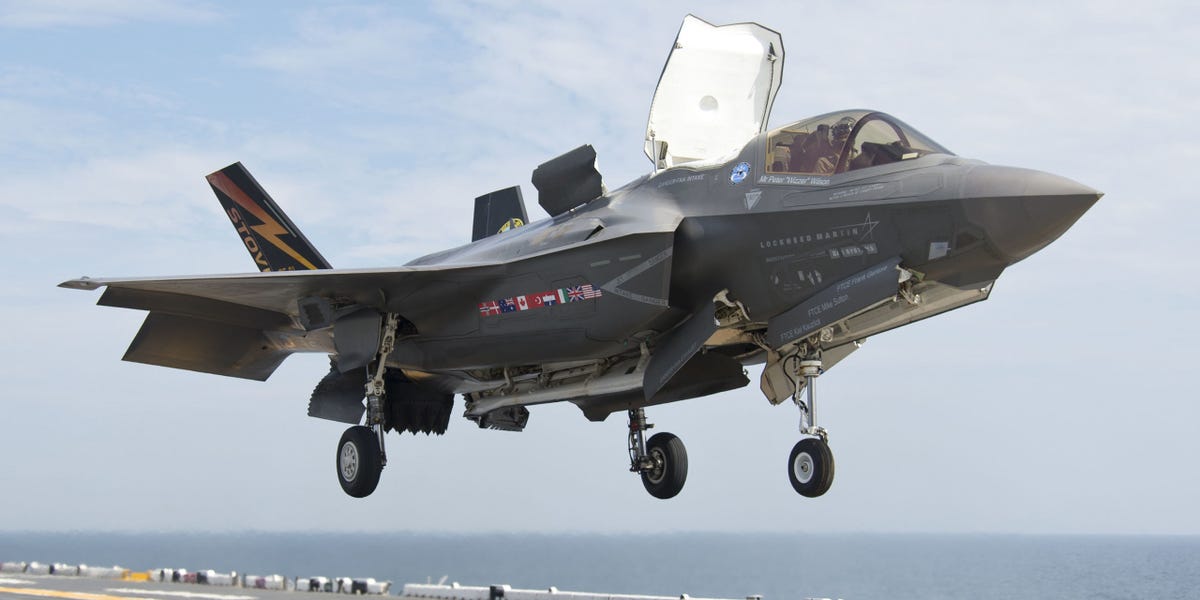
The Lockheed Martin F-35B represents another major branch of VTOL evolution: short take-off and vertical landing for a stealth fighter. Unlike the Harrier, which relied on a single vectored-thrust engine concept, the F-35B uses a shaft-driven lift fan behind the cockpit, a swiveling rear nozzle, and roll posts for stability.
The X-35B demonstrator famously performed a short takeoff, supersonic flight, and vertical landing in a single mission during the Joint Strike Fighter competition. That “hat trick” helped show that STOVL did not have to mean giving up modern fighter performance entirely.
The operational F-35B gives the U.S. Marine Corps and allied forces the ability to fly from amphibious assault ships and austere bases. It is not a magic airplane; it still faces cost, maintenance, thermal, and logistics challenges. But it shows how far VTOL technology has come from the days when landing a jet vertically involved hooking a cable on a trailer and hoping everyone had eaten a light breakfast.
Drones and eVTOL: Vertical Flight Enters the Electric Age
In the 21st century, VTOL has expanded beyond military aircraft. Multirotor drones made vertical flight familiar to consumers, photographers, surveyors, farmers, filmmakers, and emergency responders. Small electric motors, lithium batteries, sensors, and flight-control software made hovering aircraft easier to stabilize and cheaper to build.
That same technology wave helped launch the electric vertical take-off and landing, or eVTOL, industry. Companies are developing aircraft for air taxi services, regional mobility, cargo delivery, emergency response, and defense missions. The FAA describes Advanced Air Mobility as a new aviation era involving aircraft that are often electric, automated, and capable of vertical takeoff and landing.
Modern eVTOL designs vary widely. Some use tilting propellers. Some use lift-plus-cruise layouts, with separate rotors for hovering and fixed wings for efficient forward flight. Some resemble futuristic helicopters; others look like someone asked a drone to attend business school.
The promise is appealing: quiet aircraft, small landing pads, reduced local emissions, and faster trips across congested cities. The challenges are equally real: certification, battery energy density, noise standards, weather limits, air traffic integration, vertiport infrastructure, public acceptance, and the timeless aviation rule that gravity never takes a day off.
Why VTOL Is So Difficult
Vertical flight is hard because hovering demands power. A fixed-wing airplane uses forward speed to make its wings efficient. A VTOL aircraft must generate lift while nearly stationary, which means engines, rotors, fans, or propellers must push enough air downward to hold the entire aircraft up.
Transition is another challenge. Aircraft that hover like helicopters and cruise like airplanes must pass through an awkward middle phase where airflow, lift, control surfaces, and propulsion all change roles. Engineers must manage stability, vibration, heat, downwash, noise, and pilot workload. This is why VTOL history is filled with brilliant ideas that worked in tests but struggled in everyday use.
There is also the problem of trade-offs. Add vertical-lift equipment and the aircraft becomes heavier. Add powerful engines and fuel burn increases. Add batteries and range may suffer. Add more rotors and maintenance becomes more complicated. VTOL is not free magic; it is a carefully negotiated contract with physics, and physics always reads the fine print.
The Lasting Impact of VTOL
Despite the challenges, vertical take-off and landing changed aviation. Helicopters transformed rescue, policing, offshore energy, firefighting, military mobility, and medical evacuation. The Harrier proved fixed-wing V/STOL combat operations were possible. The V-22 showed tiltrotors could combine speed, range, and vertical access. The F-35B brought STOVL into fifth-generation fighter aviation. Drones and eVTOL aircraft are now pushing VTOL into civilian transportation and automation.
The history of VTOL is not a straight line. It is more like a hover test in gusty wind: corrections, surprises, occasional wobbling, and a lot of engineers pretending they are not nervous. But the direction is clear. Aviation has spent more than a century trying to escape the runway, and each generation has found new ways to rise vertically.
Experience-Based Reflections on VTOL: What the History Teaches Us
Looking at the history of vertical take-off and landing from a practical perspective, one lesson appears again and again: the aircraft is only half the story. The mission matters just as much as the machine. Many VTOL prototypes were technically impressive but operationally awkward. They could hover, transition, and land vertically, but the question remained: could they do useful work better than a helicopter, airplane, truck, ship, or cheaper alternative?
That is why the helicopter succeeded early. It did not need to be fast to be useful. It could land near a wounded soldier, lift a stranded climber, inspect power lines, or reach a ship at sea. Its mission matched its strengths. The Harrier succeeded for similar reasons. It gave military forces a way to operate combat aircraft from short decks and rough forward locations. The aircraft had compromises, but its unique ability solved a real operational problem.
The V-22 Osprey offers another experience-based lesson: revolutionary aircraft often have long, uncomfortable childhoods. New configurations expose problems that older aircraft have already solved through decades of refinement. Tiltrotors involve rotorcraft aerodynamics, airplane flight, complex transmissions, conversion systems, and demanding maintenance. That combination can deliver extraordinary capability, but only after years of testing, redesign, training, and hard-earned operating experience.
For modern eVTOL developers, the same pattern applies. A sleek prototype hovering in a test video is exciting, but commercial aviation requires more than a good hover. It needs certified aircraft, trained pilots or validated automation, reliable maintenance systems, weather procedures, charging infrastructure, emergency planning, passenger confidence, and economics that survive outside a pitch deck. A flying taxi must not merely fly; it must arrive safely, repeatedly, affordably, quietly, and without causing the neighborhood dog population to file a formal complaint.
Another key experience is that VTOL aircraft must respect the landing environment. Downwash from rotors can throw debris, damage surfaces, and create hazards for people nearby. Jet exhaust from vertical-lift fighters can punish decks and landing pads with heat. Electric aircraft may reduce local emissions, but they still move air, make noise, and require carefully designed vertiports. In VTOL, the ground is part of the aircraft system whether designers like it or not.
Pilot workload also runs through VTOL history like a recurring character. Tail-sitters demanded unusual attitudes and difficult landings. Early vectored-thrust aircraft required careful control during transition. Harrier pilots needed extensive training to manage hovering, nozzle control, and shipboard operations. Modern flight computers reduce workload enormously, but they do not eliminate the need for disciplined design. The best VTOL systems make difficult physics feel manageable rather than theatrical.
Finally, VTOL history teaches patience. The idea is glamorous, but progress is incremental. The leap from the VS-300 to the V-22, from the X-14 to the F-35B, and from hobby drones to certified eVTOL aircraft took decades of experiments, failures, and quiet improvements. The future of vertical flight will likely follow the same path. Some concepts will vanish. Some will become niche tools. A few may become as ordinary as helicopters are today.
That is the charm of VTOL. It keeps asking aviation’s most stubborn question: why should an aircraft need a runway? The answer has never been simple, but the pursuit has produced some of the most inventive machines ever built. From Sikorsky’s early helicopter to today’s electric air taxi prototypes, VTOL remains a story of ambition, engineering courage, and the very human desire to skip traffic by going straight up.
Conclusion
The history of vertical take-off and landing is a story of access, compromise, and imagination. Helicopters made vertical flight practical. Experimental jets and tail-sitters explored what fixed-wing VTOL could do. Tiltrotors and tilt-wings tried to combine hovering with efficient cruise. The Harrier turned V/STOL into an operational combat capability. The V-22 expanded tiltrotor missions, and the F-35B brought STOVL into the stealth era. Today, drones and eVTOL aircraft are carrying the idea into new civilian and commercial spaces.
VTOL has never been easy. It asks aircraft to do two difficult things: hover like a rotorcraft and travel efficiently like an airplane. Yet that challenge is exactly why the field is so compelling. Every successful VTOL aircraft is a small argument against the tyranny of the runwayand sometimes, a loud argument with rotors.
Note: This article is written for web publication in standard American English and is based on synthesized historical aviation information from reputable public sources.










