
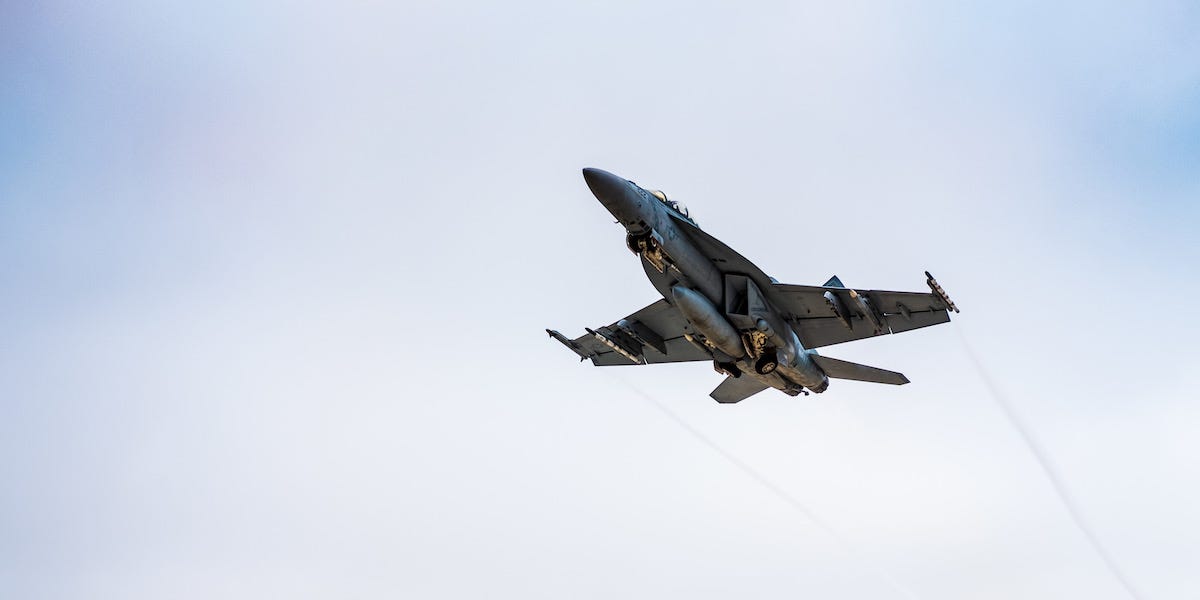
Every so often, a photo of a military aircraft appears online and makes defense watchers do the aviation equivalent of spilling coffee on a keyboard. That happened when a U.S. Navy F/A-18 Super Hornet was seen carrying what appeared to be an air-launched version of the SM-6 missilea weapon already famous for being able to do far more than its original job description suggested.
The headline almost writes itself: a strike fighter carrying the Navy’s “kill-anything missile.” Is that dramatic? Absolutely. Is it completely unfair? Not really. The Standard Missile-6, commonly known as the SM-6, has been developed into one of the most flexible weapons in the U.S. Navy’s arsenal. It can help defend ships from aircraft and missiles, intercept certain ballistic missile threats in their final phase, strike ships at sea, and potentially support other long-range missions. Now, with the AIM-174B air-launched configuration associated with the Super Hornet, the Navy appears to be giving its carrier air wings a much longer arm.
That matters because modern naval warfare is no longer just about whose ships are bigger, louder, or covered in more antennas. It is about range, sensors, networks, and the ability to hit first from a safe distance. In a world where rival militaries are building longer-range aircraft, missiles, drones, and anti-ship systems, the Navy wants its carrier-based fighters to reach farther without having to fly directly into the dragon’s mouth. The SM-6-derived AIM-174B may be one answer.
What Was Spotted Under the Super Hornet?
The aircraft involved was an F/A-18E/F Super Hornet, the Navy’s workhorse carrier-based strike fighter. The Super Hornet is not the newest or stealthiest jet in the American inventory, but it is rugged, proven, carrier-friendly, and versatile enough to perform air defense, strike, reconnaissance, refueling support, and electronic warfare-adjacent missions when paired with other aircraft.
What caught everyone’s attention was the missile. The weapon looked like an air-launched variant of the SM-6, a missile normally fired from vertical launch cells aboard U.S. Navy cruisers and destroyers. Seeing that large weapon under the wing of a fighter jet is like seeing a refrigerator strapped to a sports car. Technically impressive? Yes. Subtle? Not exactly.
The air-launched version has been publicly identified as the AIM-174B, and Raytheon has described the SM-6 AIM-174B Air Launch Capability as pairing the shipboard missile family with the Navy’s F/A-18 Super Hornet. That is a big deal because it takes a weapon originally tied to ships and puts similar long-range capability into the hands of carrier aviation.
Why the SM-6 Earned the “Kill-Anything” Nickname
The phrase “kill-anything missile” is not an official Navy label. No admiral is likely walking around the Pentagon saying, “Please pass the kill-anything budget spreadsheet.” Still, the nickname sticks because the SM-6 family has become unusually adaptable.
It Started as an Air Defense Missile
The SM-6 was designed to defend naval forces from aircraft and cruise missiles at long range. Unlike older missiles that relied more heavily on shipboard guidance, the SM-6 combines long-range reach with an active radar seeker, allowing it to engage targets beyond the radar horizon when connected to the right sensors and battle network.
That networked capability is crucial. A missile is only as useful as the targeting information behind it. The SM-6 can be guided using data from ships, aircraft, and other sensors, which means the launching platform does not always need to see the target directly. In modern combat, that is not a nice bonus. It is the whole game.
Then It Became a Missile Defense Tool
The SM-6 has also been used in roles involving ballistic missile defense, particularly against threats in the terminal phase of flight. That does not mean it magically swats every ballistic missile out of the sky like a video game power-up. Missile defense is brutally difficult. Speeds are extreme, timelines are short, and physics has a bad habit of being rude.
Even so, the SM-6 has demonstrated enough flexibility to be part of the Navy’s layered defense approach. A missile that can chase aircraft, cruise missiles, and certain ballistic missile threats already sounds like an overachiever in a weapons catalog.
It Can Also Threaten Ships
One of the most important developments in the SM-6 story is its anti-ship potential. The Navy has tested and discussed the missile in surface warfare roles, giving ships and now potentially aircraft another way to attack enemy vessels from long range. In a high-end maritime conflict, that kind of flexibility is valuable because commanders rarely get perfect conditions or perfect weapon matchups.
If a missile can defend a carrier group one day and threaten an enemy surface combatant the next, it becomes more than a single-purpose tool. It becomes a strategic Swiss Army knife, except the knife costs a lot more and nobody should bring it camping.
Why Put This Missile on a Strike Fighter?
Mounting a large, long-range missile on a Super Hornet changes the geometry of a fight. Ships are powerful, but they are limited by geography, enemy anti-ship threats, and the range of their sensors and weapons. Aircraft can move the launch point hundreds of miles away from the carrier or surface fleet.
That means a carrier air wing could potentially push long-range missile capability forward without moving the carrier itself into a more dangerous area. In practical terms, the Super Hornet becomes a flying launch platform for a weapon with much greater reach than traditional air-to-air missiles.
This is especially relevant in the Indo-Pacific, where distances are enormous and potential adversaries have invested heavily in long-range missiles designed to keep U.S. ships and aircraft at arm’s length. In that environment, range is not a luxury. It is oxygen.
The Super Hornet Gets a Much Longer Punch
The F/A-18E/F Super Hornet has carried a wide variety of weapons, including AIM-9X Sidewinders, AIM-120 AMRAAMs, Harpoon anti-ship missiles, Joint Direct Attack Munitions, laser-guided bombs, and standoff weapons. But the AIM-174B is in a different size and range category.
The AMRAAM has long been the standard U.S. beyond-visual-range air-to-air missile. It is highly capable, but rival air forces have developed or fielded longer-range missiles that challenge American aircraft and supporting assets. An air-launched SM-6 derivative gives the Navy a weapon that can reach much farther, potentially allowing Super Hornets to threaten high-value targets before those targets can comfortably operate.
Those high-value targets could include bombers, maritime patrol aircraft, airborne early warning aircraft, surveillance platforms, or aircraft carrying long-range anti-ship missiles. Taking out those platforms is not just about winning a dogfight. It is about breaking the enemy’s “kill chain”the sequence of detecting, tracking, targeting, and attacking U.S. forces.
Why This Matters for Carrier Strike Groups
A carrier strike group is built around layers. There are fighters, destroyers, cruisers, submarines, electronic warfare aircraft, radar aircraft, satellites, drones, and command networks all working together. The carrier itself is not supposed to duel threats alone like a cowboy in a parking lot. It survives by creating distance, confusion, and overlapping defensive and offensive bubbles.
The AIM-174B strengthens that layered approach. Instead of relying only on ship-launched missiles or shorter-range fighter weapons, the Navy can potentially send Super Hornets forward with a missile that reaches deep into contested airspace. This can force an opponent to think twice before sending large aircraft or missile carriers near the fight.
In simple terms, the missile may help the Navy say, “You may have long arms, but we brought a ladder.”
Could It Be Used Against More Than Aircraft?
The SM-6 family is known for multiple roles, but the exact operational envelope of the AIM-174B is not fully public. That is normal. Militaries tend not to publish every detail of a new missile’s capabilities, because “Dear adversary, here is our complete instruction manual” is not a winning strategy.
However, because the AIM-174B is derived from the SM-6 family, analysts have naturally discussed whether it could support missions beyond long-range air-to-air combat. These could include anti-ship operations or other specialized strike roles, depending on software, seeker configuration, targeting support, and rules of engagement.
What is safe to say is this: the missile gives the Navy options. In modern warfare, options are precious. A commander who can use one aircraft and one missile family across several mission types has more flexibility than a commander stuck with a single-purpose weapon that only works in one carefully scripted scenario.
The China Factor: Range, Risk, and the Indo-Pacific
Any discussion of the AIM-174B quickly turns toward China, even when nobody says the quiet part loudly. The People’s Liberation Army has invested heavily in anti-access and area-denial systems, including long-range anti-ship missiles, advanced air defense, modern fighters, and powerful surveillance networks. These systems are designed to make it difficult and dangerous for U.S. forces to operate close to China’s coastline or around key flashpoints.
For the U.S. Navy, the answer is not simply to build tougher ships or faster jets. The answer is to extend reach, improve networking, and complicate enemy targeting. A Super Hornet carrying the AIM-174B can potentially engage critical aircraft at ranges that make enemy planning much harder.
Imagine an opposing force relying on airborne radar aircraft or bombers to launch long-range anti-ship missiles. If those aircraft must stay farther back because Navy fighters can now threaten them from greater distances, the whole enemy attack plan becomes less comfortable. Nobody likes being forced to move their chess pieces backward, especially when the other side just put a very large missile on the board.
What About the F-35C?
A natural question is why the missile is associated with the Super Hornet rather than the F-35C, the Navy’s stealth fighter. The answer likely comes down to size, integration, mission roles, and practicality.
The AIM-174B is a large missile. The F-35C is optimized for stealth and internal weapons carriage, and putting large missiles externally can reduce its low-observable advantage. The Super Hornet, by contrast, is already a payload truck in many carrier air wing scenarios. It can carry big weapons externally without pretending to be invisible.
That does not make the Super Hornet better than the F-35C. It means they may work together. The F-35C can use its sensors and stealth to gather and share targeting data, while the Super Hornet carries heavier weapons. In that pairing, one jet acts like the sneaky scout with night vision, and the other shows up with the oversized toolbox.
How the AIM-174B Fits Into Modern Air Combat
Air combat is often imagined as close-range dogfighting: two pilots twisting through the sky, pulling hard turns, and trading dramatic radio calls. That still matters, but modern air combat often begins long before pilots can see each other. Sensors, datalinks, electronic warfare, and missile range can decide the outcome before anyone gets into a turning fight.
A very long-range missile changes behavior. It can force enemy aircraft to fly defensively, turn away early, or avoid certain zones altogether. Even if it is never fired, its presence can shape the battle. That is the quiet power of deterrence: the weapon does not need to explode to influence decisions.
The AIM-174B may also help compensate for the retirement of older long-range Navy air-to-air weapons. Since the AIM-54 Phoenix left service with the F-14 Tomcat, the Navy has lacked a comparable long-range air-to-air missile. The Super Hornet and AMRAAM combination has been effective, but the strategic environment has changed. The Navy now needs reach that matches the scale of the Pacific and the sophistication of rival forces.
There Are Trade-Offs, Because Physics Is Annoying
Of course, carrying a large missile is not free. A Super Hornet loaded with AIM-174B missiles may face penalties in drag, range, maneuverability, and fuel efficiency. Large weapons also take up hardpoints that could otherwise carry fuel tanks, bombs, sensors, or other missiles.
Carrier aviation is always a balancing act. Do you want more fuel, more missiles, more sensors, more electronic warfare support, or more bombs? The answer is usually “yes,” followed immediately by the aircraft politely refusing to carry the entire defense budget under its wings.
That means the AIM-174B will probably be used in carefully selected mission profiles rather than slapped onto every Super Hornet like a bumper sticker. It is a specialized tool for situations where long reach matters more than maximum agility or mixed payload flexibility.
What This Reveals About the Future of Naval Warfare
The sight of a Super Hornet carrying an SM-6-derived missile tells us something bigger than “large missile looks cool under jet.” It reveals a Navy trying to stretch existing platforms and weapons into new roles quickly.
Developing a brand-new missile from scratch can take many years and enormous cost. Adapting an existing missile family can be faster and more practical, especially when that missile already has a production base, testing history, and known performance characteristics. The SM-6 is already part of the Navy’s inventory, so an air-launched configuration offers a way to add capability without starting from zero.
This approach reflects a broader trend in defense modernization: use what works, connect it better, and launch it from more places. The future is not only about shiny new platforms. It is also about turning existing systems into networked, multi-role tools that make an adversary’s planning headache worse.
Public Photos, Private Details
One reason this story generated so much attention is that the first clues came from public images. Aviation enthusiasts, photographers, and defense analysts often notice changes before official announcements fully explain them. A different missile shape, an unusual pylon, a new sensor pod, or a strange test load can spark serious analysis.
Still, photos only tell part of the story. They show that something can be carried, but not exactly how it will be used. Important questions remain: How far can it fly in the air-launched configuration? What targets is it optimized for? How many can a carrier air wing realistically deploy? How will targeting data be passed in real time? What tactics will pilots use?
Those answers are likely classified or only partially public. For readers, the key takeaway is not to treat every photo as a complete operational manual. The image is a clue, not the whole mystery novel.
Why Defense Watchers Are So Excited
The excitement comes from the combination of platform, missile, and timing. The Super Hornet is widely deployed. The SM-6 family is proven and versatile. The Indo-Pacific security environment is increasingly tense. Put those pieces together, and the AIM-174B looks less like a science project and more like a serious operational tool.
It also represents a practical form of innovation. Instead of waiting for a perfect next-generation aircraft or a totally new missile, the Navy is squeezing more combat value out of what it already has. That is not glamorous in the Hollywood sense, but it is often how real military advantage is built.
Sometimes the future of warfare does not arrive as a silver spaceship. Sometimes it arrives as a familiar fighter carrying a very unfamiliar missile under its wing.
Experience-Based Reflections: What This Moment Feels Like for Military Aviation Followers
For anyone who has spent years following military aviation, the sight of a Super Hornet carrying a massive SM-6-derived missile feels like one of those moments when scattered puzzle pieces suddenly snap together. You remember seeing carrier air wings evolve after the retirement of the F-14 Tomcat. You remember the debates about whether the Navy had lost too much long-range air-to-air reach. You remember endless discussions about the Pacific, anti-ship missiles, and whether aircraft carriers could still survive in a high-end fight.
Then a photo appears, and it is not a PowerPoint slide, not a think tank paragraph, not a budget line item written in language only a procurement lawyer could love. It is a real aircraft carrying a real missile. That has a different kind of weight.
From an enthusiast’s perspective, the Super Hornet has always been easy to underestimate. It is not as romantic as the Tomcat, not as futuristic as the F-35, and not as meme-friendly as some experimental aircraft that look like they were designed by a geometry teacher during a thunderstorm. But the Super Hornet keeps showing up. It launches from carriers, hauls weapons, supports missions, and adapts. Seeing it carry the AIM-174B reinforces a familiar lesson: the most important aircraft is not always the flashiest one. Sometimes it is the one that can be upgraded, trusted, and launched from a pitching deck at night.
There is also something fascinating about watching naval aviation return to the importance of long-range interception. The F-14 and AIM-54 Phoenix combination existed to defend carrier groups from distant threats. After the Cold War, that mission seemed less urgent, and the Navy shifted toward strike operations in regional conflicts. Now the strategic pendulum has swung back. Long-range threats are again central to planning, and the carrier air wing needs weapons that can reach far beyond the horizon.
The AIM-174B does not mean the Navy has solved every problem. It does not make carriers invincible. It does not erase the challenges posed by submarines, cyber attacks, satellites, drones, or massed missile salvos. But it does show adaptation. It shows that the Navy understands the range problem and is looking for ways to make its existing aircraft more dangerous at greater distances.
For writers, analysts, and aviation fans, this is the kind of development that makes defense technology compelling. It is not just a missile story. It is a story about how old assumptions change. A ship missile becomes an aircraft missile. A strike fighter becomes a long-range air-defense platform. A carrier air wing gains a new way to influence battlespace far from the ship. The labels blur, and the mission set expands.
That is why the phrase “kill-anything missile” resonates, even if it sounds like something a defense contractor would definitely not put on a polite brochure. The SM-6 family represents a modern preference for weapons that are flexible, networked, and adaptable. In a fight where targets may include aircraft, missiles, ships, and high-value support platforms, flexibility can be the difference between having the right tool and wishing you had packed differently.
The lasting impression is simple: this sighting was not just aviation trivia. It was a glimpse of how the Navy is preparing for a tougher, longer-range, more networked era of combat. The Super Hornet may be a familiar jet, but with the AIM-174B under its wing, it suddenly looks like it has learned a new and very serious trick.
Conclusion
The sight of a U.S. Navy strike fighter carrying an SM-6-derived missile is more than an eye-catching aviation moment. It signals a major shift in how the Navy may use carrier-based aircraft in long-range air combat and maritime operations. The AIM-174B gives the Super Hornet a much longer reach, potentially helping carrier strike groups defend themselves, threaten high-value enemy aircraft, and complicate rival military planning across vast regions like the Indo-Pacific.
The missile’s reputation as a “kill-anything” weapon comes from the SM-6 family’s unusual versatility. It has roots in air defense, missile defense, and anti-ship capability, making it one of the Navy’s most adaptable weapons. Putting that kind of capability on a fighter jet does not just add another missile to the inventory. It changes the shape of the battlefield.
For readers watching the future of naval warfare, this development is worth attention. It shows how the Navy is extending the value of proven platforms, adapting existing weapons, and preparing for conflicts where range, networks, and flexibility may matter more than ever. The Super Hornet may not be new, but with the AIM-174B, it has become much harder to ignore.










