
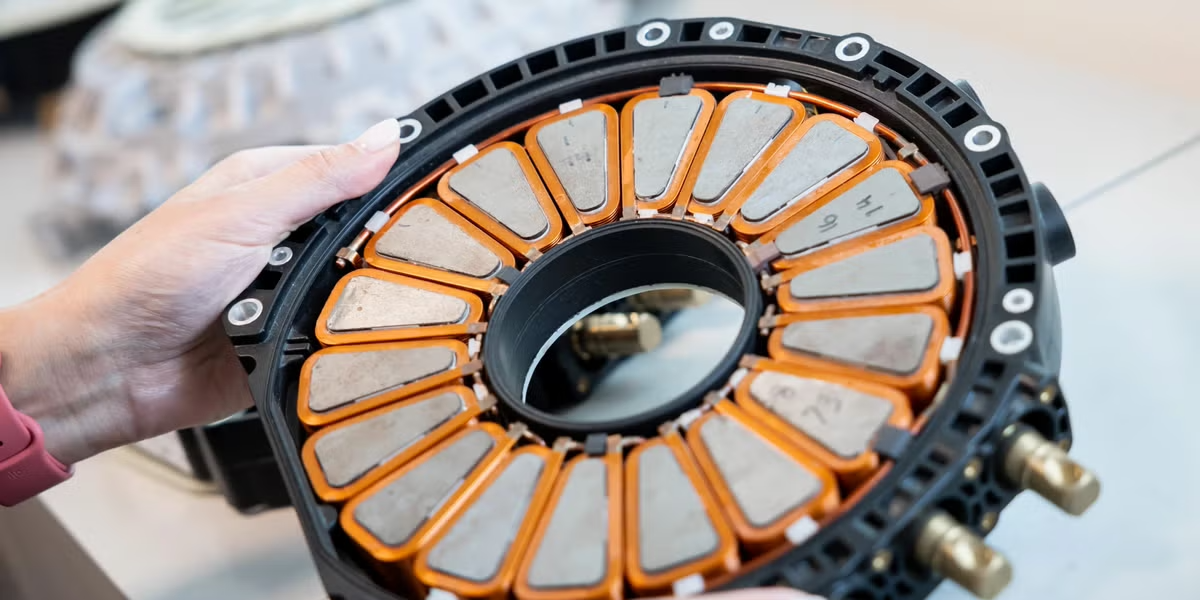
Electric motors are usually impressive in a quiet, responsible, engineering-department sort of way. They do their work efficiently, avoid dramatic exhaust noises, and rarely demand their own highlight reel. Then YASA built a prototype weighing only 29 pounds and extracted 550 kilowattsabout 738 horsepowerfrom it.
That combination produced a claimed power density of 42 kilowatts per kilogram, setting an unofficial benchmark when the results were revealed in July 2025. In practical terms, YASA squeezed the output of a serious supercar powertrain into a disc-shaped motor light enough for one person to carry. It was less an ordinary motor and more a pancake with a doctorate in electromagnetism.
The achievement was not simply about winning a horsepower trivia contest. High power density can reduce vehicle weight, free up space, improve handling, and give manufacturers more freedom when designing electric cars. It may also influence aircraft, marine propulsion, industrial equipment, and other machines in which every pound matters.
The 29-Pound Electric Motor at a Glance
| Specification | Reported Figure |
|---|---|
| Developer | YASA, a Mercedes-Benz subsidiary |
| Motor architecture | Axial-flux permanent-magnet motor |
| Motor weight | 13.1 kilograms, or approximately 29 pounds |
| Tested peak output | 550 kilowatts, or approximately 738 horsepower |
| Claimed power density | 42 kilowatts per kilogram |
| Status when announced | Prototype and unofficial power-density record |
The word prototype matters. The test demonstrated what the motor architecture could achieve under controlled conditions. It did not mean that drivers could immediately order a production vehicle containing this exact 550-kilowatt unit.
Even so, the result was important because YASA said the motor did not depend on laboratory curiosities such as cobalt-iron laminations, elaborate additive manufacturing, or unusually expensive winding materials. The company described it as a scalable design that could be produced in sports-car volumes using commercially realistic manufacturing methods.
What Power Density Actually Means
Motor power density describes how much output a motor can produce relative to its mass. It is commonly expressed in kilowatts per kilogram. The calculation is straightforward:
Power density = motor output divided by motor mass.
For YASA’s original record-setting prototype, dividing 550 kilowatts by 13.1 kilograms produces roughly 42 kilowatts per kilogram.
Why should anyone beyond an electric-motor laboratory care? A power-dense motor performs more work without forcing the vehicle to carry as much hardware. Removing motor mass can produce benefits throughout the car. Mounts can become lighter, crash structures may be packaged differently, suspension engineers have less weight to control, and designers gain room for passengers, aerodynamics, batteries, or cargo.
However, power density is not a complete score for motor quality. Engineers must also consider efficiency, torque, durability, cooling demands, speed range, cost, noise, vibration, inverter mass, and continuous output. A motor that produces a spectacular number for several seconds but overheats during sustained operation may be perfect for a drag-style acceleration run and rather less charming halfway up a mountain.
Why Axial-Flux Motors Can Be So Compact
Radial Flux Versus Axial Flux
Most electric cars use radial-flux motors. In a typical radial design, the rotor turns inside a cylindrical stator, and magnetic flux travels outward or inward across the motor’s radius. The result resembles a conventional metal cylinder.
An axial-flux motor rearranges that geometry. Its magnetic flux travels parallel to the shaft, crossing a narrow air gap between disc-shaped components. Instead of looking like a coffee can, the motor resembles a thick dinner plate.
That wide, flat shape can create a large effective torque radius without requiring a long or heavy motor. More of the active electromagnetic material contributes directly to producing torque. Shorter axial length also opens packaging opportunities that are difficult to achieve with a conventional cylinder.
The Meaning Behind YASA
YASA stands for “Yokeless and Segmented Armature.” The company’s design removes the heavy stator yoke found in many motors and divides the stator into individual segments. Each segment can be wound separately before the complete motor is assembled.
Removing unnecessary iron reduces mass, while segmented construction simplifies winding and gives cooling fluid better access to heat-producing components. That combination attacks two major enemies of electric-motor performance: excess weight and excess heat.
The concept grew from work by YASA founder Tim Woolmer while he was studying at the University of Oxford. Axial-flux machines were not new, but historically they had been difficult to manufacture consistently. Maintaining precise air gaps, controlling mechanical forces, cooling the windings, and automating production all created headaches. YASA’s contribution was not merely drawing a flatter motor; it was developing a version that could move toward repeatable automotive production.
Cooling Is the Quiet Hero of the Record
When current flows through a motor’s copper windings, electrical resistance generates heat. As temperatures climb, resistance increases, efficiency can decline, and magnets or insulation may approach their safe operating limits. Eventually, the control system must reduce power to protect the hardware.
This is why a motor’s thermal system can be as important as its electromagnetic design. A brilliant motor that cannot discard heat is like a championship runner wearing a winter coat in July.
YASA’s short, concentrated windings are directly cooled with dielectric oil. The fluid can reach the active components more effectively than a cooling jacket placed only around the outside of a conventional motor. Better thermal contact helps the motor tolerate high electrical loads and recover quickly between bursts of acceleration.
The 550-kilowatt figure was a peak test result, so it should not automatically be interpreted as unlimited continuous output. Nevertheless, YASA emphasized that the prototype used standard cooling fluids and temperatures rather than a wildly impractical laboratory setup. That detail suggested the architecture had value beyond a single headline-generating dynamometer run.
How the 29-Pound YASA Motor Compared With Its Rivals
Before YASA announced its 42-kilowatt-per-kilogram result, several companies had already produced remarkably compact electric motors.
Equipmake’s HPM-400, originally developed for applications including a rocket fuel pump, produced a reported peak output of 400 kilowatts from a 30-kilogram motor. That works out to approximately 13.3 kilowatts per kilogram.
Helix later presented its SPX177 for a hypercar project. The company reported 650 kilowatts of continuous output from a 28-kilogram motor, or a little more than 23 kilowatts per kilogram. That was an extraordinary result, particularly because Helix described the figure as continuous rather than short-term peak power.
Koenigsegg’s Dark Matter motor offers another useful reference point. Its unusual “raxial-flux” layout combines radial- and axial-flux principles, producing 800 horsepower and 1,250 newton-meters of torque from a 39-kilogram package. Unlike a pure experimental benchmark, it was engineered as automotive hardware for the Gemera.
YASA’s 42-kilowatt-per-kilogram number therefore looked enormous. But comparisons must be handled carefully. One company may publish peak output while another reports continuous power. Some figures include a housing, coolant, inverter, gearbox, or cables; others count only the motor. Maximum speed, voltage, test temperature, and allowable operating time can also differ.
In other words, the scoreboard is real, but not every competitor is playing under identical rules. YASA itself called the achievement an unofficial world record rather than pretending an independent governing body had created one universal test procedure.
Why a Smaller EV Motor Can Change the Whole Car
Lower Vehicle Weight
Electric vehicles carry large battery packs, reinforced structures, cooling equipment, and high-voltage electronics. Saving 40 or 60 pounds in a motor does not magically turn a luxury EV into a featherweight roadster, but weight reductions accumulate. A lighter motor may permit lighter mounts, housings, subframes, and suspension components.
More Flexible Packaging
A thin axial-flux motor can fit into spaces that would be awkward for a long radial motor. Manufacturers could place multiple motors near an axle, use separate units for torque vectoring, or leave more space for a low hood, larger cabin, better crash structures, or aerodynamically useful bodywork.
Better Performance Without Simply Adding Hardware
The easiest way to make a powerful EV is to add more motors and a larger battery. It is also an excellent way to make the vehicle heavy, complicated, and expensive. Increasing motor power density offers another route: obtaining more output from less material.
Potential Range and Efficiency Benefits
A smaller motor does not directly increase battery capacity, but reducing total vehicle mass lowers the energy required during acceleration and climbing. Packaging gains may also allow engineers to improve aerodynamics or install additional battery cells without increasing exterior dimensions.
The greatest benefit may be system-level optimization. The motor is one piece of an interacting machine, and improving that piece gives every other engineering team more room to make intelligent trade-offs.
From Prototype Record to Mercedes-AMG Production
YASA’s technology was already more than an academic exercise when the 29-pound prototype appeared. Its axial-flux motors had been used in electrified performance cars from manufacturers including Ferrari, Lamborghini, McLaren, and Koenigsegg. Mercedes-Benz acquired YASA in 2021 and began preparing the architecture for a larger role in its electric-performance strategy.
The Concept AMG GT XX demonstrated how that strategy could work at vehicle scale. Its drivetrain used three axial-flux motorstwo at the rear and a booster motor at the frontwith combined peak output exceeding 1,000 kilowatts. Mercedes said the motors offered roughly three times the power density of conventional alternatives while requiring considerably less installation space.
The company did not simply bolt a record prototype into a show car and declare victory. Production hardware must survive vibration, weather, contamination, repeated thermal cycles, manufacturing tolerances, warranty expectations, and the occasional driver who treats every traffic light like a qualifying session.
In June 2026, Mercedes-Benz announced the start of large-scale axial-flux motor production at its Berlin-Marienfelde facility. The plant uses automated manufacturing, laser processes, rectangular copper conductors, intelligent control systems, and AI-assisted quality inspection. Mercedes identified its upcoming high-performance AMG GT four-door model as the first production application.
The specifications of a road-going motor will not necessarily match the record prototype. Production engineers may trade some peak power density for lower cost, quieter operation, longer life, easier servicing, or a broader efficiency range. The important development is that axial-flux technology is progressing from exotic supercars and dynamometer demonstrations into repeatable manufacturing.
YASA Then Beat Its Own 29-Pound Record
The electric-motor record did not remain untouched for long. In October 2025, YASA announced additional testing of a refined prototype weighing 12.7 kilograms, or approximately 28 pounds. On a more powerful dynamometer, that unit reached a short-term peak output of 750 kilowattsmore than 1,000 horsepower.
The newer result raised the claimed power density from 42 to 59 kilowatts per kilogram. YASA estimated continuous output in the region of 350 to 400 kilowatts, although the company described the machine as a development prototype rather than a finalized production motor.
This update does not make the original 29-pound achievement irrelevant. The 550-kilowatt test was the breakthrough that revealed how far YASA’s architecture had advanced. The later result simply showed that the engineering team had not finished turning the adjustment knobs.
The Important Reality Checks
First, a motor cannot power a car by itself. It needs an inverter, high-voltage cables, control software, a cooling circuit, a reduction gear or direct-drive arrangement, and a battery capable of supplying enormous current. A 550-kilowatt motor connected to an inadequate battery is an expensive metal plate with unrealized ambitions.
Second, peak power and continuous power answer different questions. Peak output determines how hard a vehicle can accelerate for a short period. Continuous output matters during sustained high-speed driving, towing, aircraft operation, or long climbs. Both numbers are useful, but they are not interchangeable.
Third, exceptional power density does not guarantee exceptional efficiency at every speed and load. Road vehicles spend far more time cruising at modest power than launching at maximum output. Engineers must optimize the complete efficiency map rather than one dramatic point.
Finally, cost and materials remain significant. High-performance permanent-magnet motors often rely on rare-earth materials with complicated supply chains. Axial-flux construction also demands tight tolerances and specialized production equipment. Mercedes and YASA appear confident that these challenges can be managed, but widespread adoption will depend on economics as much as electromagnetic elegance.
Conclusion: Small Motor, Large Consequences
YASA’s 29-pound electric motor mattered because it changed the scale of what engineers could consider plausible. Producing approximately 738 horsepower from a 13.1-kilogram motor created an unofficial 42-kilowatt-per-kilogram benchmark and placed axial-flux technology firmly in the performance spotlight.
The record was not a promise that every future EV would become a 700-horsepower missile. Its deeper value was showing how weight, cooling, geometry, and manufacturing could be rethought together. A more power-dense motor can make a car lighter, create new packaging options, and reduce the temptation to solve every performance problem by adding more hardware.
YASA has already surpassed the original figure, while Mercedes-Benz has moved axial-flux motors into large-scale production. The tiny 29-pound prototype therefore looks less like an isolated science experiment and more like the opening chapter of a substantial change in electric propulsion.
What Experiencing This Motor Technology Could Be Like
The most revealing experience would probably begin not behind the wheel, but inside an engineering workshop. Imagine seeing a technician carry a 29-pound motor toward a dynamometer without a crane, hoist, or dramatic lower-back support belt. Its size would create an immediate mismatch between appearance and expectation. A component that resembles a compact metal disc would soon be commanded to produce more power than many complete sports cars.
As the test begins, the experience would not resemble watching a gasoline engine on a stand. There would be no exhaust thunder, turbocharger whistle, or frantic collection of pistons trying to escape through the hood. Instead, the dominant sounds would come from the test equipment, cooling pumps, gears, and the increasingly high-frequency note of the rotating assembly. The violence would be visible on the computer screen: voltage, current, torque, temperature, and output climbing at a pace that makes the motor’s modest dimensions look almost comical.
For a vehicle designer, the experience would be different but equally important. Traditional powertrain packaging often begins with large fixed objects that dictate where passengers, suspension parts, crash structures, and aerodynamic surfaces can go. A short axial-flux motor changes that conversation. Designers can explore a lower hood, a tighter rear drive unit, a longer cabin, or independently controlled motors without automatically creating a vehicle the size of a studio apartment.
Behind the wheel, drivers would not necessarily recognize the motor by its sound. They would experience its consequences. A lighter drivetrain could make the car respond more naturally when changing direction. Multiple compact motors could adjust torque between the wheels with extraordinary precision. Acceleration could remain strong after repeated high-load runs because direct oil cooling would help manage heat.
The most impressive sensation might not be the first launch. Plenty of modern EVs already produce acceleration that rearranges passengers’ opinions about gravity. The meaningful difference could appear on the fifth or tenth hard acceleration, when a thermally limited vehicle might begin reducing output. A well-cooled axial-flux system is intended to make high performance more repeatable rather than offering one heroic burst followed by an electronic request to calm down.
Owners of ordinary electric cars may eventually experience the technology in less theatrical ways. A compact motor could contribute to more interior space, lower energy consumption, improved towing capability, or a lighter vehicle that does not require an enormous battery to achieve useful range. Most drivers would never calculate kilowatts per kilogram. They would simply notice that the car feels quick, efficient, roomy, and less burdened by its own hardware.
That may be the most realistic future for the 29-pound motor’s legacy. Record figures attract attention, but successful technology eventually becomes invisible. The ultimate compliment would be thousands of drivers benefiting from axial-flux motors without knowing the name of the architecture hiding beneath the floor.













