
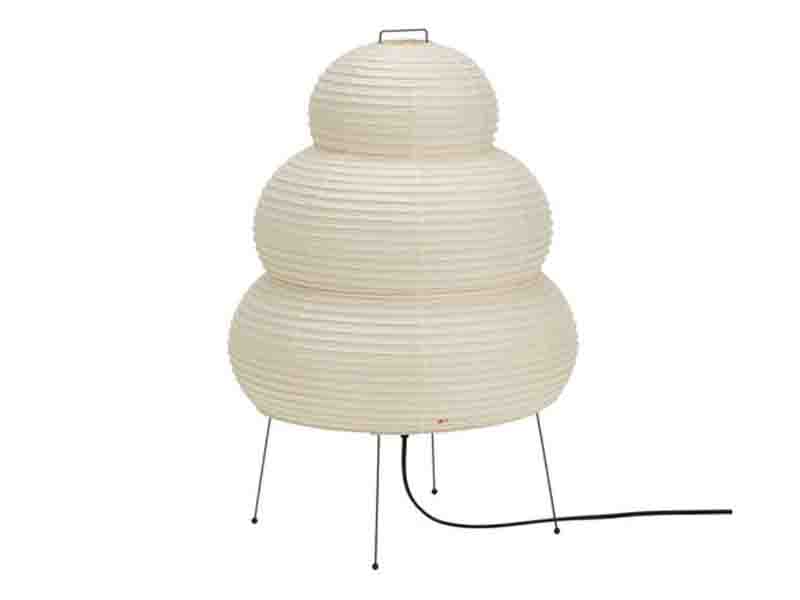
The Akari Table Lamp 24N is what happens when a practical light fixture decides it would rather be a sculpture. Designed by Japanese American artist Isamu Noguchi, this handmade paper lamp combines a softly billowing silhouette, delicate bamboo ribs, and slender metal legs. The result feels remarkably light yet commands attention even when the bulb is off.
At approximately 23 inches tall and 15.7 inches wide, the 24N is substantial enough to anchor a side table, console, or quiet reading corner without becoming a glowing roommate who demands half the apartment. This guide explores its history, construction, lighting performance, styling possibilities, authenticity markers, and everyday care.
What Is the Akari Table Lamp 24N?
The Akari 24N is a freestanding light sculpture designed by Isamu Noguchi and handmade in Gifu, Japan. Its shade is formed from washi paper stretched across bamboo ribbing and supported by a metal frame. Four narrow black legs raise the shade above the surface beneath it, making the illuminated form appear almost weightless.
Its organic profile is neither a perfect sphere nor a predictable cylinder. Instead, the paper body expands and contracts in gentle curves, giving the lamp a pillowy, slightly asymmetrical presence. The visible bamboo lines add rhythm and reveal how the shade was constructed rather than disguising the craftsmanship.
Akari 24N specifications
- Designer: Isamu Noguchi
- Product family: Akari Light Sculptures
- Height: 23 inches (58 centimeters)
- Width: 15.7 inches (40 centimeters)
- Shade materials: Handmade washi paper and bamboo ribbing
- Support: Metal frame and four slender legs
- Manufacturing location: Gifu, Japan
- Bulb base: Standard E26
- Suggested bulb: LED equivalent to approximately 20–60 watts
The Noguchi Museum listed the lamp at $475 at the time of research, although availability and pricing can change. Because every shade is handmade, tiny variations in texture, rib alignment, or paper wrinkles are normal. They are evidence of the process, not an indication that someone assembled the lamp during a particularly energetic earthquake.
The Story Behind Noguchi’s Akari Light Sculptures
Noguchi began developing Akari in 1951 after visiting Gifu, a Japanese city with a long tradition of producing paper lanterns and umbrellas. Local craftspeople used bamboo and handmade paper derived from mulberry bark to create chōchin, lightweight lanterns that could collapse for storage.
Gifu’s mayor encouraged Noguchi to help modernize the regional lantern industry. Noguchi replaced the traditional candle with an electric bulb, but his achievement went much further than a simple technical update. He transformed a familiar craft object into modern sculpture intended for ordinary homes.
Why the name “Akari” matters
“Akari” refers to illumination in Japanese while also carrying associations with lightness. That double meaning suits the collection beautifully: the lamps provide light, yet their paper-and-bamboo construction appears almost immaterial. The name is also associated with the Japanese character combining the sun and moon, imagery that later informed the collection’s identifying logo.
Noguchi eventually created a broad family of table, floor, and hanging lights in geometric and organic forms. Their materials remained humble, but their cultural reach became enormous. Akari examples entered major museum collections and appeared in residences ranging from modest rooms to meticulously designed celebrity homes.
Traditional craft meets modern electricity
The success of Akari rests on a productive contradiction. Electricity can feel technical and harsh, while washi is tactile, irregular, and connected to centuries of craft. Passing electric light through translucent paper softens the source and gives it a more natural character. Instead of staring at an exposed bulb, viewers see a luminous volume.
This principle is especially clear in the Akari 24N. The light does not merely escape through a shade; it reveals the entire shade as a sculptural object. Bamboo ribs become dark lines, creases acquire depth, and the irregular form gains dimension. The lamp effectively switches from quiet paper sculpture during the day to warm architectural presence at night.
Why the Akari 24N Still Looks Contemporary
Many midcentury objects arrive with visual baggage: one look and you can practically hear a cocktail shaker from 1958. The Akari Table Lamp 24N feels different. Its simple materials and organic shape allow it to coexist with midcentury modern, minimalist, Scandinavian, Japandi, contemporary, and eclectic interiors.
A sculptural form without visual heaviness
At 23 inches high, the 24N has enough scale to become a focal point. Nevertheless, white paper, open space beneath the shade, and thin legs prevent it from feeling bulky. This balance makes the model useful in small rooms where a conventional ceramic or stone lamp might appear heavy.
Texture that works with many materials
Washi has a softly fibrous surface that pairs naturally with oak, walnut, linen, wool, rattan, raw plaster, stone, and matte-painted walls. The black frame adds a precise graphic element, helping the lamp work alongside steel furniture or dark window frames as well.
The lamp can also soften highly polished settings. Place it near glass, lacquer, marble, or chrome, and its warm paper texture prevents the room from looking like a luxury airport lounge where nobody is allowed to touch anything.
What Kind of Light Does the Akari 24N Produce?
The Akari 24N is primarily an ambient light rather than a focused task lamp. Its washi shade diffuses illumination in several directions, reducing glare and spreading a gentle glow around the immediate area. It is ideal for relaxed evenings, conversations, background lighting, and creating depth within a layered lighting plan.
For North American models, the Noguchi Museum recommends a standard E26-base LED bulb in the approximate range of a 20- to 60-watt incandescent equivalent for table lamps. A warm-white LED around 2700K generally emphasizes the paper’s creamy tone. A 3000K bulb produces a cleaner appearance while remaining comfortable in most homes.
Is it bright enough for reading?
That depends on placement, bulb output, and the reader. The lamp may provide pleasant nearby illumination, but the shade intentionally scatters light instead of directing it onto a page. For serious reading or detailed work, combine the 24N with a directional floor lamp, wall light, or discreet task light.
A dimmable LED can increase flexibility, provided the bulb, switch, and any external dimmer are compatible. Lower output makes the lamp wonderfully atmospheric; higher output allows it to contribute more useful illumination. Always follow the manufacturer’s electrical and bulb guidance.
Where to Place an Akari Table Lamp 24N
On a living room side table
A broad end table beside a sofa gives the 24N room to breathe. Its irregular shape offers a welcome contrast to rectangular seating and straight architectural lines. Keep a little open space around the lamp rather than surrounding it with frames, candles, and seventeen decorative objects auditioning for attention.
On a console or credenza
A long console provides an effective stage for the lamp. Balance it with a low stack of books, a small ceramic vessel, or a restrained piece of art. Avoid forcing perfect symmetry; the 24N’s organic personality usually benefits from a looser arrangement.
In a bedroom
The lamp can produce a soothing nighttime atmosphere on a spacious nightstand, low dresser, or bedroom bench with an appropriate hard surface. Confirm that the shade will not be struck by bedding, curtains, or a half-awake arm searching for the alarm clock.
In an entryway or quiet corner
An entry console lets the 24N greet visitors with warm light instead of the interrogation-room enthusiasm of a bright ceiling fixture. It can also activate an unused corner, particularly when paired with a small chair, natural-fiber rug, or simple artwork.
How to Identify an Authentic Akari 24N
Authentic contemporary Akari shades carry Noguchi’s red sun-and-moon emblem and the “I. Noguchi” signature. The logo was trademarked in 1955 and remains an important way to distinguish authorized production from the enormous population of lookalikes.
In North America, the Noguchi Museum states that it is the sole official distributor of Akari light sculptures. Buyers should be cautious when unfamiliar retailers claim to offer new, authentic examples. Vintage lamps require additional scrutiny because shades, wiring, frames, and labels may have been replaced during their lifetime.
A replica may imitate the broad silhouette, but the original’s value also lies in its relationship to Noguchi, Ozeki’s Gifu workshop, and the continuing craft tradition. Buyers deciding between an authentic lamp and a less expensive paper light should be honest about their priority. If the goal is simply soft illumination, alternatives exist. If the goal is to own Noguchi’s authorized design, provenance and identifying marks matter.
Assembly, Safety, and Everyday Care
Akari shades can be shipped in a collapsed form, reflecting the construction of traditional Japanese lanterns. Assembly involves carefully expanding the paper shade over its internal support. Use clean, dry hands, follow the official assembly guide, and work without rushing. Washi is tougher than it looks, but it does not enjoy being challenged to a wrestling match.
Cleaning the shade
Routine cleaning should be dry and gentle. The Noguchi Museum recommends a soft microfiber cloth, clean dry paintbrush, or another nonabrasive dusting tool. Avoid liquid cleaners because moisture can stain, weaken, or distort the paper.
For particular marks, the museum suggests specialized dry methods such as lightly adhesive cleaning tape, an art-gum eraser, cornstarch for oil, or a soft semi-tacky clay. These techniques should be applied cautiously and tested in an inconspicuous area. Minor tears may be repaired with translucent archival mending material, although valuable or vintage examples may deserve professional conservation advice.
Heat, moisture, and electrical considerations
Keep the Akari 24N indoors and away from radiators, fireplaces, open flames, cooking heat, damp areas, and prolonged direct sunlight. LEDs are preferable because they use less energy and generally emit less heat than incandescent bulbs.
The Noguchi Museum notes that complete Akari light sculptures are not UL listed, although electrical components for most models are UL recognized. Buyers should review current product documentation and determine whether local building, insurance, or commercial-use rules impose additional requirements.
Is the Akari Table Lamp 24N Worth Buying?
The 24N makes the strongest case for itself when viewed as functional art rather than a conventional table lamp. It provides ambient illumination, but it also changes the composition of a room during daylight hours. Its handcrafted construction and authorized connection to Noguchi’s work help explain why it costs more than mass-produced paper lanterns.
It may be worth the investment if you appreciate design history, subtle craftsmanship, gentle lighting, and objects that remain visually relevant across changing interiors. It may be less suitable if you need strong directional light, have pets that attack paper, or want a shade that can be scrubbed with household cleaner after every encounter with a flying glass of red wine.
The paper will also age. Fading and gradual deterioration are natural possibilities, particularly if the lamp is exposed to sunlight, humidity, rough handling, or heat. Treating this fragility as part of the object’s character makes ownership more satisfying than expecting it to behave like an indestructible plastic appliance.
Living With the Akari 24N: Practical Experiences and Scenarios
The most noticeable experience associated with an Akari 24N is not raw brightness but a change in atmosphere. Imagine a living room illuminated only by recessed ceiling lights. The furniture is visible, the floor is visible, and every crumb appears ready for a police lineup. Switching on the 24N adds a lower, warmer point of light. Shadows soften, the corner gains depth, and the room suddenly feels intended for people rather than inventory.
During the day, the experience is quieter but still significant. Natural light exposes the paper fibers, wrinkles, and horizontal bamboo ribs. From across the room, the lamp reads as a clean white form. Up close, it reveals the handwork and slight irregularities that distinguish it from a molded synthetic shade. This makes the 24N especially effective in neutral rooms, where texture must perform the work that bright color might do elsewhere.
Placement has an immediate effect on how the lamp is perceived. On a low side table, its 23-inch height brings the glowing shade close to eye level, producing considerable presence. On a tall console, it becomes more like a small beacon. A crowded tabletop makes the delicate legs difficult to appreciate, while an open surface lets the entire silhouette remain legible.
In a bedroom, a warm LED gives the lamp a calm, almost moonlike quality. It is well suited to the hour before sleep, when bright overhead lighting feels less like illumination and more like a personal accusation. The diffuse glow is comfortable for winding down, although readers may still want a directional light aimed at the book.
Owners also become more aware of traffic patterns. A ceramic lamp can survive an occasional sleeve brushing past it; a paper sculpture deserves more strategic thinking. A narrow hallway table, unstable pedestal, or energetic toddler zone is not ideal. A broad credenza against a wall is safer. Cat owners should conduct their own negotiations with management.
The assembly experience reinforces the lamp’s delicacy. Expanding a flattened paper shade into a sculptural form can feel counterintuitive at first, so patience matters. Clean hands, a clear surface, and close attention to the official instructions turn the process into a satisfying introduction to the object. Forcing one stubborn section usually creates more problems than it solves.
Routine ownership is otherwise simple. Dust accumulates gradually on the ribs and folds, but a clean, soft brush can remove it without moisture. The lamp does not require polishing, complicated smart-home programming, or an app that sends six notifications because a bulb turned on. Its technology is deliberately modest.
Perhaps the most rewarding long-term experience is its versatility. Change the sofa, repaint the walls, add an antique chest, or move from a minimalist apartment to a more eclectic house, and the 24N can still belong. It does not depend on a fashionable finish or a specific color trend. Instead, it relies on proportion, material, and lightthe design equivalent of having excellent manners and never overstaying its welcome.
Conclusion
The Akari Table Lamp 24N is a remarkably complete expression of Isamu Noguchi’s belief that art could participate in everyday life. Handmade washi, bamboo ribbing, and a nearly weightless metal frame transform an ordinary electric bulb into a glowing sculpture.
Its warm ambient light, generous scale, and adaptable organic form make it suitable for living rooms, bedrooms, entryways, and other spaces that benefit from visual softness. Thoughtful placement and gentle maintenance are essential, but the reward is an authentic modern design that remains engaging whether illuminated or switched off.










