
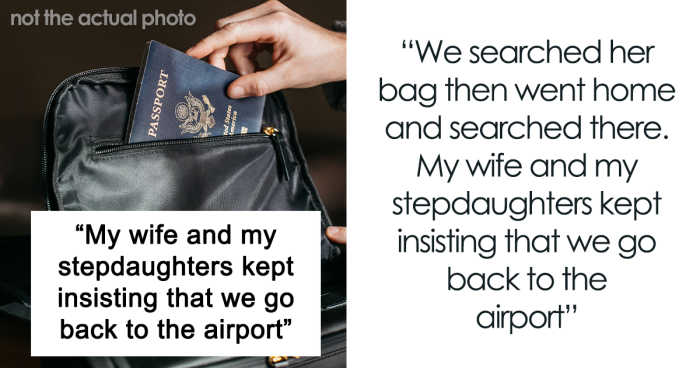
A family vacation is supposed to begin with overpacked suitcases, overpriced airport snacks, and at least one person asking whether the stove was left on. It is not supposed to begin with the discovery that two family members deliberately hid another child’s passport so she would be excluded from the trip.
In this scenario, a parent learned that his stepdaughters had concealed his daughter’s passport because they wanted her to stay home. Instead of allowing the people responsible to enjoy the vacation they had tried to sabotage, he canceled the entire trip.
Was that an overreaction? Not necessarily. Canceling a costly vacation is dramatic, but so is secretly removing a child from the family itinerary. This was not a forgotten charger, a misplaced swimsuit, or an argument over who gets the hotel bed nearest the air conditioner. It was a coordinated attempt to isolate one child from a major family experience.
The cancellation may have been justified. However, whether it becomes effective parenting or merely an expensive explosion depends on what happens afterward.
The Core Verdict: Canceling the Vacation Was Understandable
Based on the facts presented, the parent was not a jerk for canceling the vacation. He stopped an event that had become morally compromised before it even began.
Had the trip continued without the daughter, the stepdaughters’ scheme would have succeeded. They would have learned that calculated exclusion works. The daughter would have learned something even worse: that her place in the family could be secretly voted away by other children.
Continuing the vacation with everyone after locating the passport would not have been much better. Imagine sitting beside the people who had just tried to strand you at home while they debated which poolside appetizers to order. “Welcome to paradise; please ignore the recent conspiracy” is not a convincing family-bonding strategy.
Blended families commonly experience competition, divided loyalties, uncertainty about parental attention, and difficulty forming comfortable stepsibling relationships. Children may feel that they did not choose the new family structure, while stepsiblings can initially feel more like strangers sharing adults than naturally bonded brothers and sisters. Those tensions deserve empathy, but they do not excuse deliberate cruelty.
Why Hiding the Passport Was More Than a Prank
It Was Planned Exclusion
A prank is normally intended to produce brief surprise or embarrassment. Hiding a passport immediately before international travel is designed to produce a concrete outcome: the owner cannot leave the country.
The stepdaughters were not merely expressing that they disliked their stepsister. They allegedly identified the document she needed, removed it, kept their actions secret, and waited for the travel deadline to do the rest. That requires forethought.
The distinction matters because planned behavior reveals more than a momentary loss of temper. A child who shouts, “I don’t want her to come,” during an argument needs help managing emotions. A child who quietly sabotages travel plans needs help with empathy, honesty, conflict resolution, and respect for other people’s property and security.
It Created Real Practical Risks
A passport is not a replaceable vacation accessory. If a valid U.S. passport is genuinely lost or stolen, the State Department advises reporting it promptly. Once it has been reported, it is canceled and cannot be used even if someone later finds it. Replacement arrangements can also involve applications, appointments, fees, and travel disruption.
Depending on when the deception was discovered, the family could have lost money on flights, lodging, tours, transfers, or reservations. The daughter might also have experienced panic while believing that she had misplaced an essential identity document.
In other words, this was not the domestic equivalent of hiding someone’s left shoe. It was sabotage with a boarding time.
It Attacked the Daughter’s Sense of Belonging
The most serious harm was emotional. The hidden message was not simply, “We are annoyed with you.” It was, “We do not consider you part of the family experience, and we are willing to deceive the adults to remove you.”
That can leave the targeted child wondering whether she is safe around her stepsisters, whether her father will protect her, and whether future family plans can be trusted. In blended households, where children may already be sensitive to favoritism or displacement, an exclusion attempt can land like a wrecking ball wearing a tiny sun hat.
Experts on sibling conflict recommend looking beneath the immediate dispute for competition, insecurity, attention needs, and family patterns. Understanding the motive is important, but it should occur alongside firm boundariesnot instead of them.
Why Canceling Everyone’s Vacation Can Be a Fair Consequence
The Trip Was No Longer Emotionally Safe
A family vacation requires more than valid documents. It requires a basic willingness to travel together without plotting one another’s disappearance from the guest list.
Once the parent discovered the scheme, the original purpose of the tripshared enjoymentwas gone. Forcing the daughter to travel immediately with the people who betrayed her could have made her feel trapped. Allowing only the daughter and parent to go might have intensified divisions. Taking everyone and pretending nothing happened would have rewarded deception with beachfront accommodations.
Canceling the trip created a pause. It said that family privileges depend on minimum standards of trust and safety.
The Natural Reward Had to Be Removed
The stepdaughters’ apparent goal was to enjoy the vacation without the daughter. Letting them take the trip would have delivered precisely the reward they sought.
Consequences are most effective when they are logically connected to the misconduct. Because the wrongdoing targeted the vacation itself, losing the vacation is more relevant than an unrelated punishment such as taking away video games for a week.
Parents addressing bullying or deliberately harmful behavior are generally encouraged to discuss what happened directly, state clear expectations, and establish meaningful consequences while avoiding the conclusion that a child is permanently “bad.”
Canceling Protected the Targeted Child
The parent’s first responsibility after discovering the deception was to reassure his daughter that she would not be sacrificed for everyone else’s convenience.
Canceling the vacation sent a direct message: “You are not disposable, and nobody gets rewarded for trying to exclude you.” That reassurance may matter more than the canceled reservations.
A parent should not make the daughter responsible for deciding whether the vacation proceeds. Asking her, “Do you still want everyone to go?” can look considerate, but it puts an unfair burden on the injured child. She may feel pressured to forgive instantly so she is not blamed for ruining the trip.
Where the Parent Could Still Go Wrong
A justified cancellation does not automatically guarantee a healthy outcome. The parent could still mishandle the aftermath by turning the incident into a permanent family war.
Public Humiliation Would Be Counterproductive
The stepdaughters should be held accountable, but they should not be branded as monsters, criminals, or hopeless members of the family. Children and teenagers can make serious, calculated choices without those choices becoming their entire identities.
The parent should describe the behavior precisely: “You hid her passport to prevent her from traveling. That was dishonest, unsafe, and cruel.” Precision leaves room for change. Labels such as “You are evil” usually produce defensiveness rather than responsibility.
Collective Punishment Needs Careful Explanation
Canceling the trip affects innocent family members, including the targeted daughter. That does not automatically make the decision wrong, but the parent should acknowledge her loss.
He might say, “You did nothing to cause this. I am sorry that you lost a vacation because of what happened. I canceled because I will not make you travel in an unsafe family situation or allow the plan to reward your exclusion.”
If finances permit later, he could create a separate experience for his daughternot as a theatrical act of favoritism, but as recognition that she unfairly lost something. The goal is restoration, not posting smiling photos online with captions clearly designed to start World War III in the family group chat.
The Biological Parent Must Participate
In stepfamilies, discipline can become especially combustible when one adult believes the other is attacking “my children.” Guidance for blended families consistently emphasizes that adults should agree privately on rules, roles, and consequences instead of undermining each other in front of the children. Stepparents often need to prioritize relationship-building while biological parents take a leading role in major discipline.
The stepdaughters’ biological parent should not minimize the incident as ordinary sibling drama. At the same time, the father should not use the event as proof that the stepdaughters never belonged in the family. Both adults need to present one standard: every child has an equal right to safety, dignity, and inclusion.
What Should Happen After the Cancellation?
1. Establish Exactly What Happened
Before assigning further consequences, the adults should determine who planned the act, who physically hid the passport, who knew about it, whether anyone objected, and why they wanted the daughter excluded.
This is not an invitation to conduct a six-hour courtroom drama beneath the dining-room pendant light. It is an effort to distinguish leadership, participation, and silence. Equal consequences are not always appropriate when responsibility differs.
2. Protect Important Documents
Passports, birth certificates, financial records, medications, keys, and other sensitive items should be stored where children cannot secretly remove them. This is not paranoia after the trust has already been breached; it is ordinary risk management.
The adults should confirm that the passport has not been damaged or reported missing. If its location remains unknown, they should follow official reporting and replacement guidance rather than hoping it appears in a laundry basket five minutes before check-in.
3. Require Accountability, Not a Forced Performance
A mumbled “sorry” delivered while staring at the carpet is not complete repair. The stepdaughters should be able to explain what they did, identify the likely impact, and accept consequences without blaming the daughter for provoking them.
A meaningful apology might include:
- A clear statement of the action without excuses.
- Recognition of the fear, humiliation, and exclusion it caused.
- An explanation of what they should have done instead.
- A practical commitment to prevent repetition.
The daughter should not be required to accept the apology immediately. Forgiveness cannot be scheduled like an airport shuttle.
4. Create Consistent Family Rules
The household needs explicit rules concerning personal property, privacy, bullying, lying, exclusion, and retaliation. Consequences should apply to every child, regardless of biological relationship.
Consistency is especially important in a blended family because unequal enforcement quickly becomes evidence in everyone’s internal favoritism trial. Healthy stepfamily guidance emphasizes respectful treatment, clear adult roles, patience, and realistic expectations rather than demanding instant closeness.
5. Investigate the Underlying Conflict
Why did the stepdaughters want the daughter to stay home? Were they jealous of her relationship with their stepfather? Did they believe she received special treatment? Was there an unresolved argument? Had exclusion or bullying been occurring for months?
The motive cannot excuse the act, but it determines what repair is needed. Jealousy requires reassurance and individual attention. A pattern of bullying requires stronger supervision and intervention. A serious dispute may require mediated conversations. A belief that one child is consistently favored requires the adults to examine their own behavior honestly.
6. Consider Professional Family Support
If the children remain hostile, the adults disagree about consequences, or the daughter no longer feels safe, family counseling may be appropriate. Family therapy is commonly used for parent-child conflict, sibling conflict, major transitions, and communication problems. It can help family members discuss the structure of the conflict instead of repeatedly arguing about the latest explosion.
Related Experiences: What Similar Family Conflicts Can Teach Us
Many families have experienced a less dramatic version of this conflict. One sibling “forgets” to tell another about an outing. A stepchild deletes a message containing event details. Someone hides a favorite outfit before a school dance. A child convinces a parent that another sibling does not want to attend. The objects and events change, but the goal is often the same: control who gets included.
In one common pattern, the adults focus entirely on the missing object. They search bedrooms, question everyone, find the item, and consider the crisis solved. Yet the object is only the delivery system. The real issue is that one child tried to manipulate the family’s decisions without adult knowledge.
Another pattern occurs when parents minimize the conduct because the perpetrator is jealous or struggling with the blended-family transition. Empathy is useful, but empathy without boundaries can accidentally teach that emotional pain grants permission to hurt someone else. A child can be genuinely insecure and still be responsible for a harmful choice. Both things can be true before breakfast.
Some parents go to the opposite extreme and demand an instant group hug. They require everyone to apologize, smile, and proceed with the planned activity because “family is family.” This produces a photograph, not reconciliation. The targeted child learns to perform comfort for the adults, while the aggressor learns that saying the correct words restores privileges without deeper change.
Families tend to recover more successfully when the response unfolds in stages. First comes safety: stop the harmful event and protect the targeted person. Second comes truth: establish what happened without minimizing or exaggerating it. Third comes accountability: apply consequences connected to the misconduct. Fourth comes repair: rebuild trust through repeated behavior rather than one emotional conversation.
Consider a hypothetical situation in which two stepsiblings intentionally exclude a third child from a concert. They hide the ticket, claim it was lost, and hope the family will leave without her. Once the plan is exposed, the parents cancel the concert. The children responsible are furious because “everyone lost the money.” But that complaint overlooks the obvious point: the family did not lose the event because the deception was discovered; it lost the event because the deception occurred.
Now imagine the parents later reschedule a different activity after several weeks of improved behavior, supervised conversations, and sincere repair. The new outing is not a declaration that the original conduct no longer mattered. It demonstrates that consequences can end when trust begins to return.
Successful repair also includes individual relationships. The father may need private time with his daughter so she feels protected rather than merely defended during arguments. The biological parent of the stepdaughters may need private conversations with them about jealousy, loyalty, and fear of losing attention. The couple may need to examine whether they have unintentionally created competing camps inside the home.
Stressful family events can turn small disagreements into much larger confrontations, which is why calm communication and structured problem-solving matter after the immediate crisis has passed. Adults should choose a time when nobody is rushing, shouting, or dragging luggage toward the front door.
The lesson from these experiences is not that every sibling offense should cancel a vacation. Consequences must fit the behavior. The lesson is that deliberate exclusion deserves a response strong enough to interrupt the reward, protect the target, and make honest repair necessary.
So, Was the Parent a Jerk?
Nonot for canceling the vacation after discovering that his stepdaughters deliberately hid his daughter’s passport to force her to stay home.
The cancellation was a defensible response because the misconduct directly targeted the trip, continuing would have rewarded the intended exclusion, and the daughter needed immediate evidence that her place in the family was not negotiable.
Still, canceling the vacation should be the opening action, not the entire parenting plan. The family now needs age-appropriate consequences, honest conversations, document security, consistent household rules, and a gradual process for rebuilding trust.
The goal is not to make the stepdaughters suffer forever or to declare the blended family a failed experiment. The goal is to teach a durable principle: anger may be discussed, jealousy may be admitted, and conflict may be negotiatedbut nobody gets to secretly erase another child from the family.
Vacations can be rebooked. Trust takes considerably longer, and unfortunately, it does not come with complimentary breakfast.
Note: This article analyzes a family-conflict scenario for informational and editorial purposes. The appropriate response may vary according to the children’s ages, the complete history, and any safety or legal concerns involved.













