
Animal Spirits Episode 35: Individual Alpha sounds like it might be about hedge-fund sorcery, secret spreadsheets, or a trader in a fleece vest discovering a magic Bloomberg terminal. Thankfully, it is much more useful than that. The episode, hosted by Michael Batnick and Ben Carlson, uses the usual Animal Spirits recipe: markets, personal finance, investor psychology, fintech, a few sharp jokes, and just enough humility to remind listeners that nobody gets a trophy for pretending the future is obvious.
The central idea behind “individual alpha” is simple but powerful: most investors do not need to become the next Warren Buffett. They need to make fewer unforced errors, build systems that fit their lives, avoid expensive nonsense, and understand where their real edge comes from. Sometimes that edge is behavioral. Sometimes it is tax planning. Sometimes it is staying calm while everyone else is sprinting toward the financial equivalent of a flaming bounce house.
This article breaks down the major themes surrounding Animal Spirits Episode 35, including household stock exposure, Robinhood’s fintech ambitions, collective investment trusts, inconsistent income planning, money and happiness, factor investing, CAPE valuation debates, forecasting, Ponzi schemes, personalized indexing, and the surprisingly underrated skill of not doing dumb things with your money.
What “Individual Alpha” Really Means
In traditional investing, alpha means return above a benchmark after accounting for risk. If the S&P 500 returns 10% and a manager earns 13% with similar risk, congratulations, someone gets to use the word “skill” at a conference panel. But for everyday investors, individual alpha is broader and more personal.
Individual alpha can come from saving more consistently, keeping taxes low, avoiding panic selling, controlling fees, diversifying intelligently, and matching a portfolio to real-life goals. It is the difference between chasing the hottest stock on social media and quietly funding a retirement account like a responsible adult who owns more than one spatula.
Episode 35 explores this idea indirectly through a wide range of topics. The show moves from macro questions, such as whether households own too much stock, to personal questions, such as how people with irregular income should plan their finances. That mix matters because investing is not separate from life. A portfolio is not a video game score. It is a tool for rent, college, retirement, freedom, security, generosity, and occasionally replacing a water heater that chooses violence at 2 a.m.
Are Household Stock Allocations Too High?
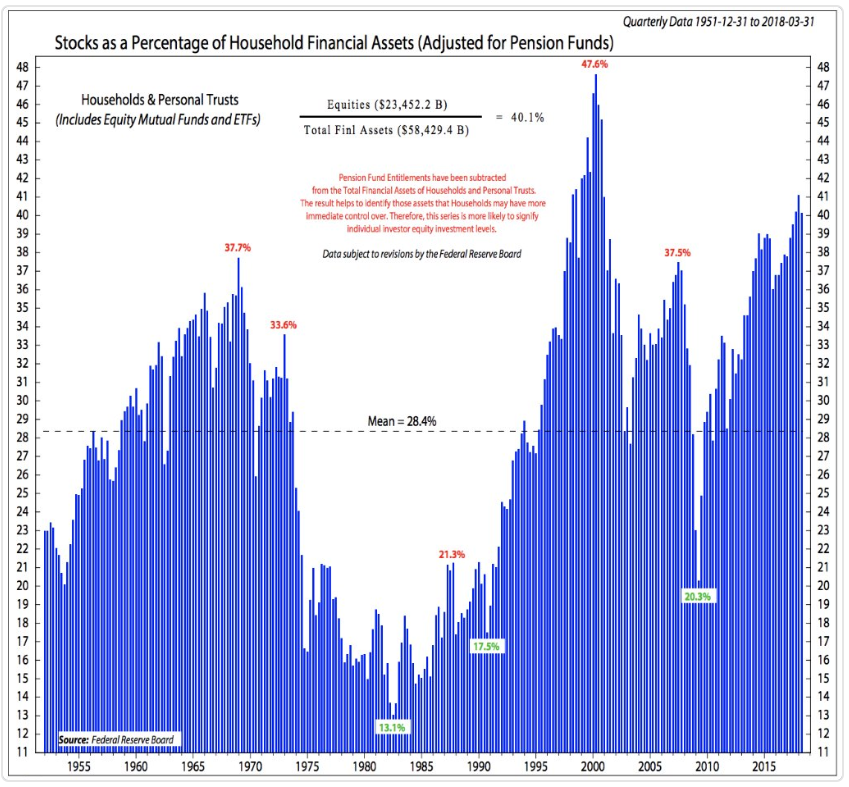
One of the episode’s big questions is whether household allocations to stocks were getting too high. This is a classic Animal Spirits topic because it sounds simple until you poke it with a stick. High stock allocations can mean optimism, stretched valuations, strong past returns, retirement-account growth, or wealth inequality. Sometimes it means all of the above wearing the same trench coat.
When households hold more of their financial assets in equities, future returns may become more sensitive to sentiment and valuation. But high allocations are not automatically a sell signal. Wealthier households tend to own more stocks than middle- and lower-income households, so aggregate data can make “the average household” look more invested than many real families actually are.
The individual-alpha lesson is not “sell stocks because a chart looks scary.” It is “know what role stocks play in your plan.” Stocks are powerful long-term wealth builders, but they are also emotionally rude. They decline without asking permission. They make smart people question their entire identity. A portfolio that looks brave in a spreadsheet can feel very different when the market is down 25% and financial television starts using thunderstorm graphics.
Robinhood, Millennials, and the Fintech Promise
Another major discussion point was whether Robinhood could become the bank of choice for Millennials. In 2018, that was a fascinating question. Robinhood had already changed expectations around commission-free trading and mobile-first investing. The bigger question was whether a brokerage app could expand into a broader financial hub.
The fintech dream is attractive: one app, clean design, instant access, low friction, and fewer legacy-bank headaches. But financial products are not ordinary consumer apps. A photo filter can glitch and make someone look like a haunted avocado. A banking product glitch can create regulatory issues, insurance confusion, or real customer harm.
The Robinhood discussion highlights a key tension in modern finance: convenience is wonderful, but it is not the same as safety. Fast access to markets can help new investors get started, but it can also encourage overtrading, leverage, options speculation, and the belief that investing should feel like ordering tacos. Good fintech should reduce complexity without hiding risk. When an app makes risky behavior feel frictionless, the user’s individual alpha can disappear faster than free pizza in an office kitchen.
Collective Investment Trusts: The Quiet Giant
Episode 35 also touched on collective investment trusts, commonly called CITs. These investment vehicles are often used in retirement plans, especially 401(k) plans, and they can be much larger than many people realize. They are not as famous as mutual funds or ETFs, partly because they are less visible to retail investors.
CITs can offer institutional pricing, flexible structures, and lower costs in certain retirement plans. For workers, this matters because fees are one of the few investment variables people can actually control. Nobody can control next year’s market return. Everyone can at least try to avoid paying luxury-hotel prices for motel-level portfolio management.
The lesson is not that CITs are always better. The lesson is that fund structure matters. Two investments can look similar on the surface but differ in cost, liquidity, governance, tax treatment, and accessibility. Individual alpha often begins with asking boring questions. What does this cost? Where is it held? What benchmark does it track? What risks am I taking? Boring questions are underrated because they rarely go viral, but they do tend to save money.
Planning With Inconsistent Income
One of the most practical themes in the episode is how to plan personal finances with inconsistent income. This applies to freelancers, salespeople, small-business owners, creators, consultants, gig workers, and anyone whose monthly cash flow looks like it was drawn by a caffeinated squirrel.
The best approach is to build a plan around the floor, not the ceiling. If income ranges from $3,000 to $9,000 per month, the dangerous move is designing a lifestyle around the $9,000 months. That is how people end up with a luxury-car payment and a pantry full of emotional-support ramen.
A stronger system starts with baseline expenses: housing, food, insurance, utilities, debt payments, taxes, and essential transportation. From there, variable earners should maintain a larger emergency fund, separate tax money immediately, automate percentage-based savings, and treat high-income months as opportunities to strengthen the balance sheet rather than upgrade every subscription known to mankind.
For inconsistent income, consistency must come from the process rather than the paycheck. That is individual alpha in its most useful form. The goal is not to predict every month perfectly. The goal is to survive the bad months without wrecking the good ones.
Can Money Buy Happiness?
The episode also explored the kind of money that can increase happiness. This is where personal finance gets more interesting than “skip coffee and become a millionaire,” which is both mathematically lazy and spiritually hostile to mornings.
Research on money and happiness has evolved. Older discussions often suggested that emotional well-being rises with income up to a point and then plateaus. More recent research has complicated that view, suggesting that for many people, higher income continues to improve well-being, although the effect often depends on circumstances, stress levels, control, and expectations.
The practical takeaway is that money helps most when it buys stability, time, autonomy, and reduced anxiety. An emergency fund can buy sleep. A flexible job can buy time with family. A paid-off credit card can buy the feeling that your mailbox is no longer a tiny paper-based horror movie.
But money is less effective when it becomes a scoreboard. If every raise simply moves the goalpost, income can rise while satisfaction stays stuck in traffic. Individual alpha means knowing what money is supposed to do for you before the world tells you what to want next.
The 7% Payout Temptation
Episode 35 mentioned a new ETF aiming to provide a steady 7% annual distribution. Products like this are always interesting because investors love income. A steady payout sounds comforting, especially to retirees or conservative investors who want cash flow. Unfortunately, yield is one of the most misunderstood words in finance.
A high distribution rate does not automatically mean a high total return. The payout may come from dividends, interest, options premiums, capital gains, return of capital, or some combination. A product can send cash to investors while the underlying value declines. That is not magic; it is just accounting wearing tap shoes.
The individual-alpha question is: “What am I really receiving, and what risk am I taking to receive it?” A 7% payout may be reasonable in some structures and dangerous in others. Income investors should look beyond the headline yield and examine total return, volatility, tax treatment, fees, drawdown risk, and whether the payout is sustainable under different market conditions.
Value, Momentum, and the Pain of Being Early
The episode also discussed factor investing, including value and momentum. Value strategies generally favor cheaper securities, while momentum strategies favor securities with strong recent performance. Both have long histories in investment research, but neither works all the time. That last sentence is where many investor dreams go to stretch before being humbled.
Value can underperform for painfully long periods. Momentum can reverse sharply. Quality can become expensive. Low-volatility stocks can disappoint when interest rates shift. Every factor has a bad neighborhood, and investors must decide whether they can live there long enough for the strategy to work.
This is where “trust the process” becomes more than a slogan. A process is only useful if it is evidence-based, understandable, and survivable. If an investor abandons a factor strategy during its inevitable rough patch, the strategy’s historical return is irrelevant. You do not earn backtested returns. You earn the returns you can actually sit through without launching your laptop into a decorative pond.
The Problem With CAPE
CAPE, or the cyclically adjusted price-to-earnings ratio, is one of the most famous valuation tools in market history. It compares stock prices with inflation-adjusted earnings over a long period, often ten years. The appeal is obvious: smooth out the business cycle and get a better sense of whether the market is expensive or cheap.
But CAPE has limitations. Accounting standards change. Interest-rate regimes change. Profit margins shift. Index composition evolves. Buybacks alter payout behavior. A high CAPE can signal lower long-term expected returns, but it does not reliably tell investors what the market will do next month, next year, or during the exact window when they are feeling most smug.
The individual-alpha lesson is to use valuation as a dimmer switch, not a light switch. Valuation can inform expectations and risk management. It should not become a market-timing button that gets mashed every time a chart looks dramatic.
Better Forecasts, Fewer Certainties
Forecasting is another theme from Episode 35. Markets are full of forecasts: earnings forecasts, recession forecasts, rate forecasts, return forecasts, and the always-popular “this time is definitely different” forecast. The trouble is that many predictions are delivered with confidence levels that would embarrass a weather app.
Better forecasting usually means thinking in probabilities, updating when new evidence appears, and tracking results honestly. Instead of saying, “A recession is coming,” a better forecast asks, “What is the probability of recession over the next twelve months, and what evidence would change that probability?”
That mindset is valuable for individual investors. You do not need to know the future. You need a portfolio that can survive multiple futures. A good plan should work if stocks rise, if stocks fall, if inflation cools, if rates stay high, if your career changes, or if your roof suddenly decides it would like to become an indoor waterfall.
Placebos, Mean Reversion, and Investor Psychology
The episode’s mention of placebo effects and mean reversion gets to the heart of behavioral finance. Investors often mistake luck for skill and temporary results for permanent truths. A fund manager beats the market for three years, and suddenly everyone wants the secret sauce. A stock triples, and people invent a brilliant story after the fact. A strategy fails for two years, and investors declare it dead right before it wakes up and steals the blankets.
Mean reversion is uncomfortable because it attacks our favorite narratives. Great returns can lead to high expectations and crowded trades. Terrible returns can create future opportunities. But mean reversion is not guaranteed on a convenient schedule. Expensive markets can become more expensive. Cheap assets can get cheaper. The market enjoys teaching humility, usually with invoices attached.
Individual alpha comes from separating process from outcome. A good decision can lose money. A bad decision can make money. The trick is not to confuse the two.
Why Ponzi Schemes Never Disappear
Ponzi schemes remain a recurring topic in finance because human nature has not received a software update. People want safety, status, certainty, and high returns. Fraudsters package those desires into smooth promises: consistent profits, little risk, exclusive access, and a friendly person who says, “Trust me.” Historically, “trust me” has done a tremendous amount of damage per syllable.
The warning signs are familiar: guaranteed returns, pressure to act quickly, vague explanations, unregistered products, difficulty withdrawing money, and performance that looks too smooth. But scams persist because they appeal to emotion before logic has time to put on shoes.
The defensive version of individual alpha is skepticism. Verify credentials. Understand the strategy. Avoid investments that cannot be explained clearly. Be suspicious of exclusivity. Never confuse social proof with due diligence. If the pitch sounds like it was engineered to bypass your brain and go straight to your fear of missing out, politely back away while protecting your wallet.
Personalized Indexing and the Future of Individual Alpha
Episode 35 also raised the idea that personalized index funds, now commonly discussed as direct indexing, could become a major trend. This idea has only grown more relevant. Instead of owning an index fund, investors can own the underlying stocks directly in a customized portfolio that tracks an index while allowing tax-loss harvesting, exclusions, or tilts.
For high-net-worth investors in taxable accounts, direct indexing may offer real benefits. It can harvest losses, manage concentrated stock positions, and align portfolios with personal preferences. But it also adds complexity. More moving parts mean more chances to over-optimize, overtrade, or pay extra for features that may not matter.
The key question is whether personalization improves the investor’s actual outcome after fees, taxes, tracking error, and behavior. Customization is useful when it solves a real problem. It is less useful when it merely allows investors to build a portfolio that reflects every passing opinion they had after reading three headlines and half a podcast transcript.
Practical Experiences Related to Animal Spirits Episode 35: Individual Alpha
The most relatable experience connected to Animal Spirits Episode 35: Individual Alpha is realizing that investing success rarely feels dramatic in real time. It often feels boring, repetitive, and slightly underwhelming. You set up automatic contributions. You rebalance occasionally. You resist buying the shiny thing. You keep cash for emergencies. Nobody claps. No one sends a cake. Yet ten years later, those quiet habits may matter more than the thrilling stock tip that made everyone at dinner sound like a temporary genius.
Many investors first discover individual alpha after making a mistake. Maybe they sold during a downturn and watched the market recover without them. Maybe they chased a hot fund after its best years were already behind it. Maybe they bought a complex product for income and later realized the “yield” was not the same as free money. These experiences sting, but they can become tuition. The market is an expensive university, and unfortunately the mascot is volatility.
For people with irregular income, the lesson becomes even more personal. A freelancer may have one amazing month followed by two quiet ones. Without a system, the good month creates confidence and the bad month creates panic. A better approach is to smooth spending, save aggressively during strong months, set aside tax money immediately, and build a buffer large enough to turn income chaos into manageable inconvenience. That is not glamorous, but it is real alpha because it prevents forced selling, credit-card debt, and late-night financial doom-scrolling.
Another common experience is learning that personality matters. Some people can own a concentrated portfolio and sleep fine. Others check prices every hour and interpret a 2% drop as a personal insult from capitalism. The best portfolio is not the one that looks smartest in a vacuum. It is the one the investor can hold through bad news, political drama, recession fears, inflation scares, and the occasional headline written specifically to raise blood pressure.
Animal Spirits works because it treats markets as human systems. Numbers matter, but so do incentives, stories, habits, fear, envy, confidence, and confusion. Individual alpha lives in that messy space. It is the calm decision to avoid leverage when everyone else is bragging. It is the humility to admit that forecasts are probabilities, not prophecies. It is the patience to let compounding work without interrupting it every six weeks for emotional maintenance.
In practice, individual alpha is not about being the smartest person in the room. It is about being the person least likely to sabotage a good plan. That may sound modest, but in personal finance, modest advantages repeated for decades can become life-changing. The boring investor, armed with discipline and a decent emergency fund, often defeats the brilliant investor who cannot stop touching the stove.
Conclusion: The Real Edge Is Personal
Animal Spirits Episode 35: Individual Alpha remains useful because it points toward a timeless truth: the best financial edge for most people is not secret information. It is self-knowledge. It is knowing your goals, your temperament, your tax situation, your income pattern, your risk tolerance, and your tendency to do something weird when markets get loud.
Markets will always offer new products, new worries, new forecasts, and new ways to feel behind. There will always be a hot platform, a clever ETF, a valuation debate, a factor strategy, a scary chart, and someone promising high returns with suspiciously low effort. The investor’s job is not to react to all of it. The job is to build a process strong enough to filter the noise.
That is the essence of individual alpha. It is not flashy. It is not guaranteed. It does not come with a theme song. But it is available to anyone willing to combine common sense, patience, skepticism, and planning. In a world obsessed with beating the market, sometimes the bigger win is not letting the market beat you.













