
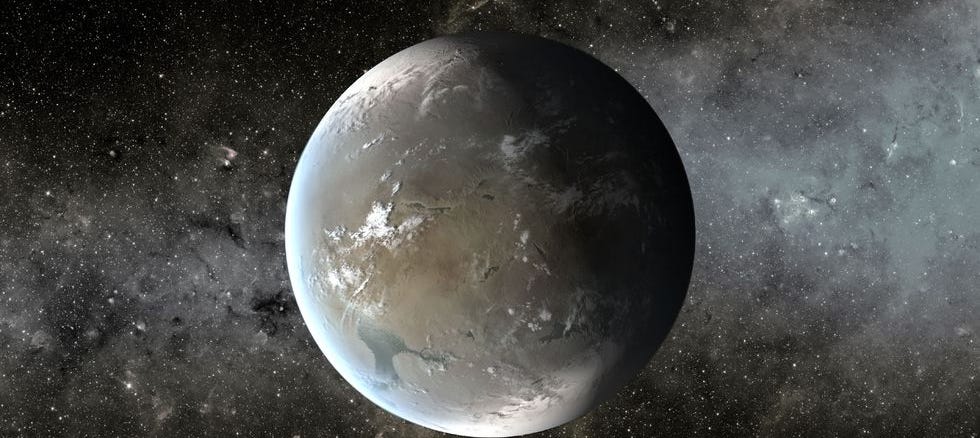
Imagine being an alien engineer on a super-Earth: smart, ambitious, probably drinking something stronger than coffee, and absolutely determined to reach orbit. Your civilization has telescopes, mathematics, rockets, mission patches, and perhaps a heroic little space agency with a logo that looks great on T-shirts. There is just one problem. Your planet is enormous. Every launch attempt feels like trying to throw a grand piano out of a swimming pool while gravity stands nearby with a clipboard saying, “Cute effort.”
The idea sounds funny, but the science is serious. Super-Earths are among the most common and fascinating worlds found beyond our solar system. They are larger or more massive than Earth, but smaller than ice giants such as Neptune. Some may be rocky. Some may have thick atmospheres. Some may be lava nightmares. Some may even sit in regions where liquid water could exist. But if intelligent life ever evolved on one, getting from the surface into space could be far harder than it is for us.
On Earth, spaceflight is already brutally difficult. Rockets are not giant fuel tanks because engineers enjoy minimalism with explosions; they are giant fuel tanks because gravity demands payment up front. On a super-Earth, that payment could be so high that chemical rockets become wildly inefficient or, in extreme cases, almost impractical. In other words, aliens might look up at the stars and say, “Beautiful view. Shame about the launch budget.”
What Is a Super-Earth?
A super-Earth is not necessarily a better Earth, a deluxe Earth, or an Earth with heated seats. The term mainly describes size and mass. In astronomy, a super-Earth is generally more massive than our planet but less massive than Neptune or Uranus. That category can include rocky worlds, water-rich planets, planets with thick atmospheres, and strange hybrids that do not fit neatly into our solar system’s familiar lineup.
This matters because our solar system has no super-Earth. We have small rocky planets like Mercury, Venus, Earth, and Mars, then much larger gas and ice giants. Other planetary systems are less polite. Many contain planets between Earth and Neptune in size, and astronomers have discovered thousands of exoplanets across a wild range of masses, orbits, densities, and climates.
Super-Earths are especially interesting because they raise two big questions. First, could they be habitable? Second, if they are habitable, could life there become technological? The first question gets most of the headlines. The second question is where the rocket problem enters the room wearing heavy boots.
Why Gravity Is the Ultimate Gatekeeper
To leave a planet, a spacecraft must overcome gravity. The larger and denser the planet, the more energy is needed to reach orbit or escape into deep space. Surface gravity depends on a planet’s mass and radius. Escape velocity depends on how strongly the planet holds onto objects near its surface. A super-Earth with several times Earth’s mass can have much higher surface gravity and a much higher escape velocity.
On Earth, escape velocity is about 11.2 kilometers per second. Reaching low Earth orbit requires less than full escape speed, but it still demands enormous velocity, careful staging, and a mountain of propellant. That is why even modern launch vehicles are mostly fuel. The payload is usually only a small fraction of the total launch mass. Rockets are not inefficient because humans are bad at engineering. They are inefficient because physics is a very strict accountant.
Now scale the planet up. If a rocky super-Earth has two or three times Earth’s gravity at the surface, a rocket must fight harder during launch. It must also reach a higher orbital speed. Higher speed means more required delta-v, and delta-v is where rocketry becomes merciless.
The Rocket Equation: Nature’s Most Expensive Cover Charge
The heart of the problem is the Tsiolkovsky rocket equation. In plain English, it says that the speed a rocket can gain depends on how fast it throws exhaust backward and how much of its starting mass is propellant. The catch is that propellant needs to be lifted too. Add more fuel, and you also add more weight. Add even more fuel to lift that fuel, and suddenly your rocket has become a tower of anxiety.
The important part is that fuel requirements grow exponentially as the required velocity increases. That word “exponentially” is doing a lot of work. It means the problem does not get a little harder. It can get absurdly harder. A modest increase in gravity or required launch speed can force a huge increase in rocket mass.
Michael Hippke’s study, “Spaceflight from Super-Earths is difficult,” explored this problem directly. The study found that chemical rockets could still work on some super-Earths, especially those up to around 10 Earth masses under certain assumptions, but the rockets would become enormous. For more massive rocky planets, chemical propulsion could become so difficult that alternative methods, such as nuclear propulsion, might be needed.
That is a stunning idea. A civilization could understand physics, invent engines, build computers, and map the heavens, yet still be stuck under a gravitational ceiling. Their problem would not be imagination. It would be mass ratio.
Kepler-20b: A Heavyweight Example
One often-discussed example is Kepler-20b, a super-Earth discovered by NASA’s Kepler mission. It has a mass around 9.7 times that of Earth and a radius less than twice Earth’s. That combination suggests a very dense, heavy world. For a rocket trying to leave such a planet, the escape velocity would be far higher than Earth’s, roughly in the neighborhood of the high 20s kilometers per second depending on the planetary values used.
That difference is not small. It is the difference between “difficult but doable with heroic engineering” and “please ask the finance department whether we can turn the entire continent into a launch vehicle.” A Saturn V-style rocket, already one of the most powerful machines ever built by humans, would look almost modest compared with what a dense super-Earth launch system might require.
For aliens on such a world, launching even a small satellite could be a historic national achievement. Launching astronauts could be a civilization-defining project. Launching large space stations, moon missions, or interplanetary craft might require technologies beyond chemical rockets, or infrastructure built over centuries.
Would Super-Earth Aliens Be Trapped Forever?
Not necessarily. “Hard” does not mean “impossible.” A technological civilization on a super-Earth could develop clever workarounds, especially if it had abundant energy, advanced materials, and a lot of patience. But the path to space would look very different from ours.
They Could Build Bigger Rockets
The most direct answer is brute force: build larger rockets with more stages. Staging is the trick Earth rockets use to drop empty tanks and engines during flight, making the remaining vehicle lighter. On a super-Earth, staging would still help, but the launch vehicle might need to be dramatically larger for the same payload.
The problem is practical. A rocket cannot be infinitely large. Materials must support the vehicle’s weight. Engines must produce enough thrust. Launchpads must survive. Manufacturing and transportation become harder. If the rocket is so large that building it requires unreasonable resources, then the civilization may decide that spaceflight is possible but painfully rare.
They Could Use Nuclear Propulsion
Nuclear propulsion could offer higher performance than ordinary chemical rockets. A nuclear thermal rocket, for example, can heat propellant to high temperatures and expel it efficiently. More advanced nuclear concepts could deliver even greater advantages. For super-Earth civilizations, nuclear propulsion might not be a futuristic luxury. It might be the first practical ticket to orbit.
Of course, launching nuclear systems from the surface raises engineering and safety challenges. If an alien civilization has three times Earth gravity, thick weather, and public comment meetings, their space agency may need both excellent science and very calm spokespersons.
They Could Launch From High Mountains
Launching from high altitude can reduce atmospheric drag and slightly reduce the energy needed to reach orbit. On Earth, high-altitude launch sites help, but they do not magically solve the rocket equation. On a super-Earth, tall mountains could help only if the planet’s geology allows them. Stronger gravity tends to limit mountain height because rock deforms under its own weight more easily.
So, while “launch from the tallest mountain” sounds good, the tallest mountain on a high-gravity world may not be as impressive as one might hope. Their Mount Everest may be more like an overachieving hill with excellent branding.
They Could Build Space ElevatorsMaybe
Space elevators are a favorite science-fiction solution: build a cable from the surface to space and climb it. Unfortunately, they require incredibly strong materials even on Earth. On a super-Earth, the tension problem becomes worse. Higher gravity and higher orbital speeds make the engineering demands extreme.
A space elevator might be easier on a smaller moon, if the super-Earth has one. That creates an interesting scenario. Aliens might reach space first not from their home planet, but by using a moon, asteroid, or captured object as a lower-gravity stepping stone. If they can get there in the first place, such places could become their true gateways to the cosmos.
How a Thick Atmosphere Could Make Things Worse
Many super-Earths may have thick atmospheres. That can be good for habitability, radiation protection, and dramatic sunsets. It can be terrible for rockets. A dense atmosphere increases drag during launch, heats the vehicle, and can create crushing pressure at the surface. Rockets must push through air before they can enjoy the vacuum of space.
A thick atmosphere could also complicate astronomy. If clouds, haze, or atmospheric distortion block the view, a civilization may have a harder time studying the stars from the ground. They might still invent astronomy, but their early understanding of the universe could develop more slowly. Imagine a civilization smart enough to build radio telescopes but living under a sky that says, “Stars? Never heard of them.”
That said, a dense atmosphere could support aircraft, balloons, or floating platforms. A super-Earth civilization might use high-altitude balloons or airborne launch systems to reduce drag before igniting rockets. These would not eliminate the gravity problem, but they could shave off some difficulty.
Could Super-Earth Civilizations Detect Space Without Visiting It?
Yes. Even if rockets are difficult, aliens do not need to visit space to study it. They could build telescopes, develop mathematics, observe planetary motions, detect radio waves, and infer the existence of other worlds. Earth’s own scientific revolution began long before humans launched satellites.
A super-Earth civilization might know a great deal about astronomy while remaining physically confined to its planet. It could understand galaxies, stellar evolution, black holes, and exoplanets. It might even detect biosignatures on distant worlds using ground-based or balloon-based instruments. But without easy access to orbit, it would miss many advantages we take for granted: weather satellites, global navigation systems, orbital observatories, communications constellations, and deep-space probes.
This creates a fascinating possibility. Some intelligent civilizations may be scientifically advanced but space-poor. They may look outward with brilliant instruments while struggling to place even a small probe above their own atmosphere.
What About 55 Cancri e and Other Extreme Super-Earths?
Not every super-Earth is a comfortable place for life. 55 Cancri e, also called Janssen, is a famous super-Earth about 41 light-years away. It orbits extremely close to its star and completes a year in less than one Earth day. NASA’s James Webb Space Telescope has provided evidence that this hot rocky planet may have an atmosphere, possibly rich in carbon monoxide or carbon dioxide, sustained by outgassing from a molten surface.
That world is not a cozy home for alien engineers. It is more like a luxury resort designed by a volcano. But it shows how diverse super-Earths can be. Some are dense and rocky. Some may have atmospheres. Some are roasted by their stars. Others may orbit in more temperate regions. The category is broad, and that is why scientists treat each planet as its own mystery.
The Great Filter Nobody Talks About: Launch Difficulty
When people discuss alien civilizations, they often ask why we have not heard from them. This is sometimes called the Fermi paradox: if the galaxy is full of planets, where is everybody? Many possible answers exist. Life may be rare. Intelligent life may be rarer. Civilizations may not last long. Interstellar travel may be too difficult. Or perhaps many civilizations live on planets where getting to orbit is much harder than it was for us.
Launch difficulty is not usually treated as the main answer, but it is an intriguing piece of the puzzle. A civilization trapped on a high-gravity world might never build large satellites, never establish space industry, and never spread beyond its planet. It could still send radio signals. It could still develop art, science, cities, and philosophy. But it might not become a spacefaring civilization in the way humans imagine.
This also makes Earth look unusually fortunate. Our planet is massive enough to hold an atmosphere and oceans, but not so massive that chemical rockets are hopeless. We live in a narrow engineering sweet spot. Earth is not easy to leave, but it is leaveable. That may be one of the quiet reasons our space age happened at all.
Could Aliens on Super-Earths Be More Advanced Than Us?
Absolutely. A hard launch environment does not mean a civilization is primitive. In fact, the challenge might push them toward extraordinary technologies. They might master high-energy physics, advanced materials, fusion power, or orbital launch loops before they ever build a practical satellite network. Their first successful orbital mission might represent a level of engineering far beyond our early space age.
Think of how aviation developed on Earth. We went from wood-and-fabric aircraft to supersonic jets in a few decades because flight was difficult but possible. On a super-Earth, the path could be slower and stranger. Their “Wright brothers moment” for space might require global industry, advanced computation, and engines that would make our launch vehicles look like fireworks taped to a refrigerator.
Why This Topic Matters for Astrobiology
The question of aliens on super-Earths is not just a fun thought experiment. It affects how scientists think about habitability, technology, and detectable civilizations. A planet may be biologically habitable but technologically restrictive. It may support oceans, continents, and life while making spaceflight painfully expensive.
That means the search for extraterrestrial intelligence should not assume every advanced civilization becomes spacefaring quickly. Some may remain planet-bound for physical reasons. Others may focus on underground infrastructure, atmospheric platforms, or oceanic technology instead of rockets. Their technological fingerprints might look different from ours.
For example, a super-Earth civilization might produce strong radio emissions but have few satellites. It might use powerful ground-based lasers or radio telescopes. It might develop energy systems visible through atmospheric signatures rather than spacecraft. If we search only for civilizations that behave like us, we may miss civilizations shaped by very different worlds.
Experience Section: Imagining Life Under a Stronger Sky
One of the best ways to understand the super-Earth spaceflight problem is to imagine an ordinary day on such a planet. Start with your own body. If surface gravity were twice Earth’s, standing up would feel like carrying another version of yourself on your shoulders. Walking would be exercise. Running would be a heroic act. Sports would look very different. Basketball players would not leap; they would negotiate briefly with the floor and lose.
Now imagine building machines. Cranes, towers, bridges, elevators, aircraft, and rockets would all face stricter limits. Every structure would need to support more weight. Materials would fail sooner. Engines would need more thrust just to lift the same mass. A small airplane on Earth might become impractical without a denser atmosphere or much stronger propulsion. A rocket would face the harshest challenge because it must climb fast, carry its own propellant, and accelerate to orbital velocity.
Picture a launch day on a super-Earth. The spaceport is not a simple coastal facility. It may be an enormous industrial zone built on the highest stable plateau available. The rocket is not just tall; it is monstrous, perhaps assembled in sections because moving it fully stacked would crush roads and patience. The launch tower looks less like a tower and more like a vertical city. Engineers check weather obsessively because dense air and high gravity leave little room for error.
When the engines ignite, the sound is not merely loud. It is geological. The vehicle rises slowly at first, fighting a planet that seems personally offended by the idea of departure. Every second near the surface wastes precious fuel. The rocket must become lighter quickly, dropping stages with perfect timing. A tiny payload at the top represents years of work, national pride, and possibly the most expensive object ever built by that civilization.
From the perspective of people watching below, the launch would feel almost mythological. On Earth, we already treat space launches as events that mix science, danger, and wonder. On a super-Earth, a successful launch might be closer to building a pyramid, splitting the atom, and winning the World Series at the same time. Children might memorize the names of the first orbital engineers. Museums might preserve pieces of discarded engines as sacred technology. The phrase “we reached orbit” could carry the emotional weight of “we touched the impossible.”
This thought experiment also changes how we experience our own planet. Earth’s gravity, which feels so permanent and ordinary, becomes part of our cosmic luck. It is strong enough to keep air, water, and life, but weak enough that chemistry can push metal into orbit. Every satellite above us is a reminder that we live on a world generous enough to let us leave, provided we bring enough fuel and accept a few terrifying vibrations.
For writers, scientists, students, and space fans, the super-Earth launch problem is a beautiful reminder that intelligence does not exist in a vacuum. Civilizations are shaped by their planets. A species born under heavier gravity might become patient, compact, muscular, cautious, and incredibly good at energy management. Their dreams of space would not be smaller than ours. They might be larger because the barrier is higher.
So when we ask whether aliens on super-Earths would have a tough time flying to space, the answer is yes. They would have a very tough time. But that difficulty makes the story more interesting, not less. A super-Earth civilization that finally reaches orbit would not just be launching a spacecraft. It would be winning an argument with its own planet.
Conclusion
Any aliens on super-Earths would face a brutal road to space because gravity changes everything. Larger rocky planets can demand higher escape velocities, higher orbital speeds, stronger structures, larger rockets, and far more propellant. The rocket equation turns those extra requirements into an exponential headache. Chemical rockets may still work on some super-Earths, but they would likely be enormous, expensive, and limited. On heavier worlds, advanced propulsion could become necessary.
The idea does not mean super-Earth civilizations are impossible. It means their technological history could be very different from ours. They might become brilliant astronomers before becoming space travelers. They might build huge ground observatories, atmospheric platforms, or nuclear-powered launch systems. They might know the stars intimately while struggling to reach them physically.
In the end, the topic gives us a new appreciation for Earth. Our planet is not easy to escape, but it is not a prison. We live on a world where rockets are difficult enough to inspire awe, yet possible enough to change history. Somewhere out there, if alien engineers are trying to launch from a super-Earth, we should wish them luck. They are going to need excellent math, heroic engines, and probably a very large coffee machine.













