
The Apollo program has a reputation that’s basically: “We’re going to the Moon, and we’re going to do it the hard way.”
Rockets shook like washing machines on spin cycle. Computers threw tantrums in the worst possible moments. And one mission famously turned into a survival
class 200,000 miles from home. In that lineup, Apollo 12 should’ve been just another headline-shaped problem.
Instead, Apollo 12 became the mission that took a punch, checked its teeth, and kept walkingthen proceeded to nail a precision landing near an old robot,
haul back science, and quietly prove the Apollo system could take chaos and still deliver. In a program full of close calls, Apollo 12 was the “lucky number”
not because it avoided trouble, but because it turned trouble into a controlled experiment.
The Apollo Program’s “Disaster Resume” (A.K.A. Why Everyone Was Nervous)
By the time Apollo 12 rolled out, NASA had already learned a brutal lesson: danger wasn’t reserved for deep space. A ground test could be deadly.
Hardware that looked perfect on paper could misbehave in flight. And “routine” was not a word anyone should say out loud in Mission Control unless
they wanted to anger the space gods.
When the risk starts before liftoff
Early Apollo was shaped by tragedy and hard engineering reality. The program’s safety culture evolved fastsometimes because it had to.
Designs changed. Procedures tightened. The whole architecture matured under pressure, with every mission feeding the next with fixes, updates,
and a growing respect for what could go wrong.
When rockets and computers have opinions
Even uncrewed tests had drama. Saturn V had to be proven, and it didn’t always behave politely. Meanwhile, the guidance computers were revolutionary
for their timesmall, fast, and expected to make real-time decisions. Which sounds great… until a computer throws an alarm while you’re trying to land
on another world. Apollo became famous not just for bold exploration, but for building systems that could fail gracefully and still keep the mission alive.
Apollo 12: The Mission That Tried to Fail in the First Minute
Apollo 12 launched into dark, rainy skies. Not a great start for a mission that involved a several-million-pound rocket stuffed with propellants and dreams.
But the Saturn V lit up, the stack rose, and for a few heartbeats it looked normal.
The lightning double-tap
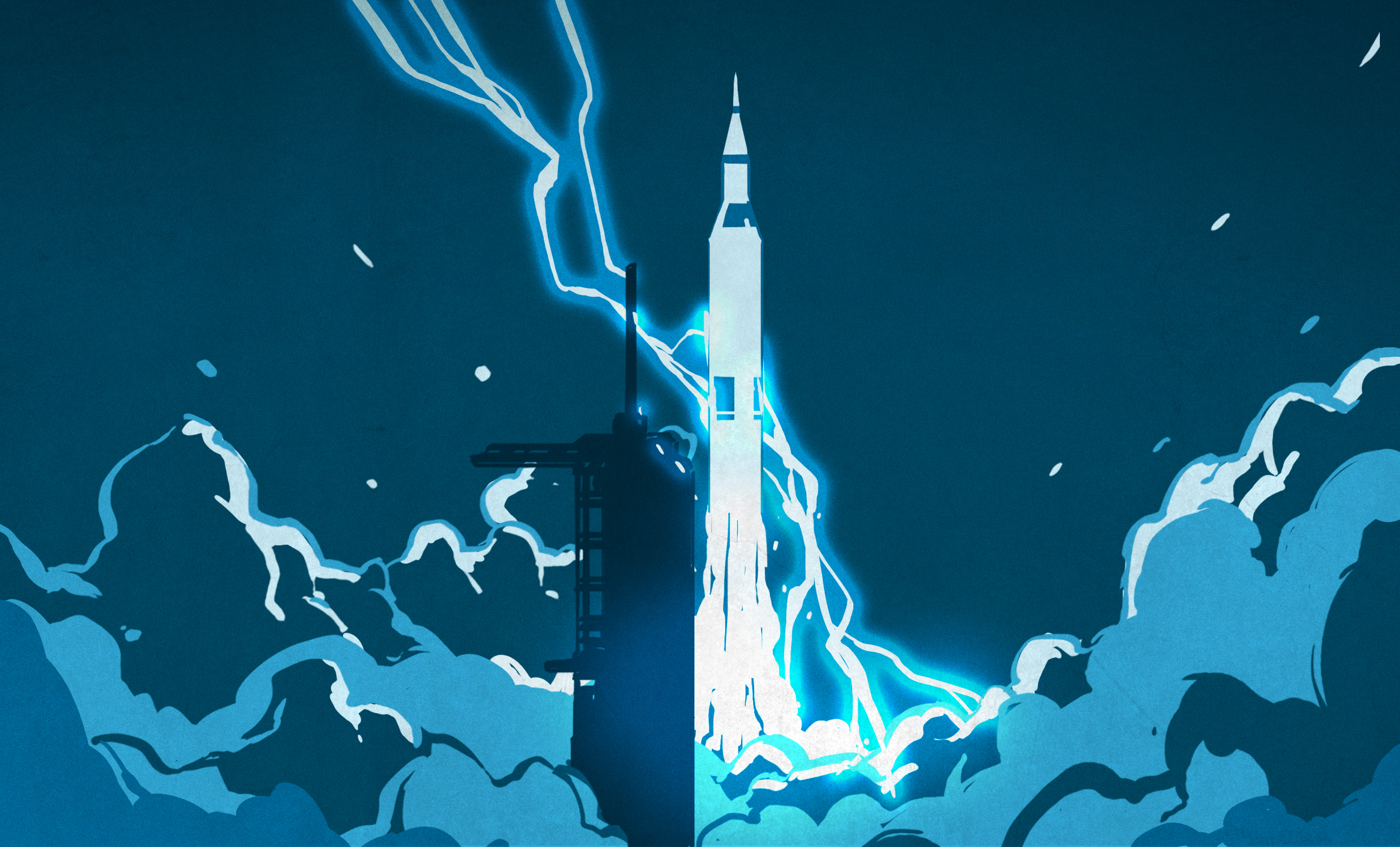
Then the universe pulled out a prank buzzer: Apollo 12 was struck by lightningtwiceduring the first minute of flight. Inside the spacecraft, the crew saw
a flash and suddenly the command module’s systems started dropping offline. Fuel cells went down. Telemetry got messy. Guidance took a hit. It looked, in the most
technical language possible, “bad.”
In that moment, Apollo 12 had two options: become a cautionary tale or become a masterclass. What happened next is why people still bring this mission up
whenever anyone says “Don’t worry, it’ll be fine.”
“SCE to AUX”: the nerdiest save in spaceflight history
Mission Control had to figure out what was actually happeningfastwhile a Saturn V kept climbing. A young engineer monitoring spacecraft systems recognized
a signature: the Signal Conditioning Equipment (SCE) had likely been “upset” by the lightning. The fix was simple but obscure:
switch the SCE to auxiliary power. The call went up. The crew flipped the switch. Telemetry came back. Systems stabilized. The mission stayed on track.
It wasn’t movie-style heroics with dramatic music and slow-motion running. It was the Apollo style: a prepared team, a weird little switch, and a shared refusal
to panic. Apollo 12 didn’t escape disaster by luck aloneit escaped because the program had built depth: training, redundancy, and people who understood
the hardware deeply enough to diagnose a problem while the rocket was still basically saying hello to the clouds.
How one storm rewrote the rules
Apollo 12 also changed how launches were managed. Lightning risk wasn’t treated as “just weather” anymore. The program refined lightning launch criteria so
future missions would be less likely to trigger or invite strikes. In other words: Apollo 12 didn’t only survive; it improved the odds for everyone coming after.
Precision Landing: Apollo 12’s Quiet Flex
Apollo 11 proved humans could land on the Moon. Apollo 12 proved NASA could land where it actually meant to. That sounds like a small difference until you
realize lunar exploration isn’t a “land anywhere and call it science” situation. If you want specific rocks, specific terrain, or a specific old spacecraft to inspect,
you need accuracy.
Ocean of Storms: a landing site with a mission
Apollo 12 targeted the Ocean of Storms (Oceanus Procellarum), aiming to set down near Surveyor 3, an uncrewed lander that had arrived years earlier.
That goal wasn’t just for bragging rightsit tested whether Apollo could do pinpoint landings. Conrad and Bean brought the lunar module down within
easy walking distance of Surveyor 3, turning the landing into a navigation and mission-planning victory.
This mattered because future missions would chase more challenging, more scientifically valuable sitesplaces where “close enough” wasn’t good enough.
Apollo 12 made “aim small” part of the Apollo identity.
Visiting an old robot like it’s a national monument
Surveyor 3 wasn’t just a targetit was a time capsule. Conrad and Bean walked to it, photographed it, and removed selected parts to bring back to Earth.
Engineers wanted to know what the lunar environment did to materials over long exposure: dust, radiation, thermal cycling, and vacuum. Apollo 12 turned
a robotic lander into a scientific instrument you could literally pick up and study.
Not “No Problems”Just Problems That Stayed Manageable
Apollo 12’s luck wasn’t a magical force field. Plenty went sideways. The key difference is that the issues didn’t cascade into a mission-ending chain reaction.
When something broke, it broke in a way the team could contain.
The color TV camera mishap (oops, the Sun)
Apollo 12 brought a color television camera to the lunar surfacegreat for the public, great for history, and great for anyone who loves space footage.
Unfortunately, the camera’s sensor was damaged when it was accidentally pointed at the Sun. Live TV from the Moon ended early. NASA still got what it needed:
mission success, samples, experiments, and a lot of photographs. But it’s a classic Apollo 12 moment: even the “minor” mishaps became legendary.
ALSEP, moonquakes, and science that kept talking for years
Apollo 12 deployed the Apollo Lunar Surface Experiments Package (ALSEP), including instruments like a seismometer. These weren’t just props for a flag-and-footprints
moment. They were long-duration science stations. The seismometer detected moonquakes and helped scientists infer details about the Moon’s interior.
In the Apollo era, that was the difference between “we visited” and “we learned.”
Moon dust: the clingy souvenir nobody asked for
Apollo 12 also reinforced a less glamorous truth: lunar dust gets everywhere. It clung to suits and equipment and made moving parts less happy than they’d like to be.
Crews joked about it, but it was real operational data. Today’s lunar mission planners still obsess over dust mitigation for a reason.
So Why Call Apollo 12 “The Lucky Number”?
Because it’s the mission where the bad-luck story begins… and then stops being a tragedy.
It took a major hit and didn’t spiral
Lightning strikes during ascent could have forced an abort or caused permanent damage. Instead, the system recovered, the crew and controllers stabilized the spacecraft,
and the mission proceeded. That’s not “nothing went wrong.” That’s “wrong happened, and the design plus the people were good enough to handle it.”
It proved Apollo could land with intention
Precision landing sounds like a technical footnote until you connect it to what came later: harder sites, bigger science goals, and missions that pushed exploration
beyond “first time” into “best use of time.” Apollo 12 helped give NASA the confidence to aim for complexity.
It turned lessons into lasting policy
Apollo 12 fed improvements back into the programespecially around weather and lightning launch rules. In a program where the margin was always thin,
reducing one category of risk mattered.
What Apollo 12 Teaches Modern Spaceflight
Apollo 12 is a reminder that “success” in spaceflight isn’t a perfect day. It’s a messy day that stays within the boundaries of what you planned forand what you trained for.
The mission’s real legacy isn’t that it was lucky. It’s that NASA built an approach where luck didn’t have to do all the work.
- Redundancy matters: obscure backups are only useful if someone remembers they exist.
- Training matters: a calm crew is a system feature, not a personality trait.
- Data discipline matters: Mission Control had to interpret confusing signals instantly and correctly.
- Policy matters: Apollo 12 changed launch-weather thinking in ways that carried forward.
FAQ: Quick Answers About Apollo 12 and Apollo “Disasters”
Was Apollo 12 actually “lucky,” or just well-managed?
Both, depending on how you define luck. The lightning strikes were bad fortune. The recovery was preparation, design, and skill. Apollo 12 is often remembered as lucky
because a scary start didn’t turn into a catastrophic outcome.
Why was landing near Surveyor 3 such a big deal?
It proved NASA could aim for a specific spot on the Moon, not just “somewhere that looks flat.” That capability mattered for later missions that targeted tougher terrain
and more specialized science goals.
Did Apollo 12 bring back different rocks than Apollo 11?
Yes. Apollo 12 returned mostly basalt samples from a different region, and many were younger than Apollo 11’s, helping scientists map volcanic history across lunar sites.
What was the biggest “oops” on the surface?
The color TV camera was accidentally pointed at the Sun and failed. It didn’t end the mission, but it did end live color broadcasts from the Moon for that mission.
Why do people list Apollo 12 among “Apollo disasters” if it succeeded?
Because it began with a situation that looked like it could become a disaster. Apollo 12 is often used as the example of a near-disaster that stayed contained.
Conclusion: Apollo 12’s Real Superpower Was Staying Upright
Apollo 12 doesn’t get as much pop-culture attention as the first landing or the famous rescue mission. But if the Apollo story is about turning impossible goals into
repeatable capability, Apollo 12 is a cornerstone. It absorbed a lightning strike, recovered in real time, landed precisely where it planned to land, did serious science,
and came home with proof that the program was growing up fast.
In a lineup of Apollo missions where disaster sometimes arrived uninvited, Apollo 12 stands out as the one that got the “disaster” invitation, read it, smiled politely,
and RSVP’d: “No thanks. We’ve got a Moon landing to do.”
The Apollo 12 Experience: of “Being There” Without Leaving Earth
Apollo 12 is one of those missions that sneaks up on people. It doesn’t always have the instant recognition of “first steps” or the cinematic tension of a crippled spacecraft.
But the experience of diving into Apollo 12watching it, reading it, tracing ithas a special flavor: it feels like discovering the most competent “supporting character”
in a story full of famous leads.
Start with launch footage and you’ll feel the emotional whiplash. One second it’s a Saturn V climbing into ugly weather like it owns the sky. The next second, there’s a flash,
and suddenly you’re watching a mission that looks like it might end before most people have finished their coffee. That shift creates a very specific kind of viewer experience:
you stop admiring the rocket and start studying the humans. You begin noticing how quickly professionals move from surprise to diagnosis. The vibe becomes less “space spectacle”
and more “high-stakes troubleshooting, live.”
Then comes the oddly satisfying part: discovering that the save wasn’t mystical luckit was a switch, a call, and a chain of people who knew what the data meant.
For a lot of space-history fans, that moment becomes addictive. It’s like finding out the most dramatic moment in the story was solved by someone calmly saying,
“Try the backup.” There’s a weird comfort in that. It suggests the Apollo program wasn’t powered only by bravery; it was powered by preparation that held up when the universe
got rude.
The Moon surface portion has its own “you had to be there” quality, tooespecially if you picture the walk to Surveyor 3. There’s something deeply human about the idea
of traveling a quarter-million miles to visit a machine that arrived years earlier. It’s like showing up at a remote trailhead and finding an old backpack someone left behind,
except the backpack is on another world and you brought bolt cutters. People who explore the mission transcripts and photos often describe a shift in perspective here:
the Moon stops being an abstract place and becomes a worksitedusty, practical, full of tasks, jokes, and “okay, now move that instrument over there” energy.
Even the mistakes feel relatable. The TV camera incidentaccidentally pointing it at the Sunlands like a very Apollo kind of irony. After surviving lightning on ascent,
a mission can still lose a major capability because the Sun is, as it turns out, extremely bright. Reading about that moment often triggers the same reaction people have
when they drop a phone after surviving a car crash: “Seriously? That’s how it breaks?”
The longer you spend with Apollo 12, the more it feels like a blueprint for confidence. It’s the experience of watching a program go from “we hope this works” to
“we can handle this.” And that’s why Apollo 12 sticks. It’s not just a mission you learn aboutit’s a mission you feel: the jolt of uncertainty, the calm recovery,
and the quiet satisfaction of competence winning the day.














