
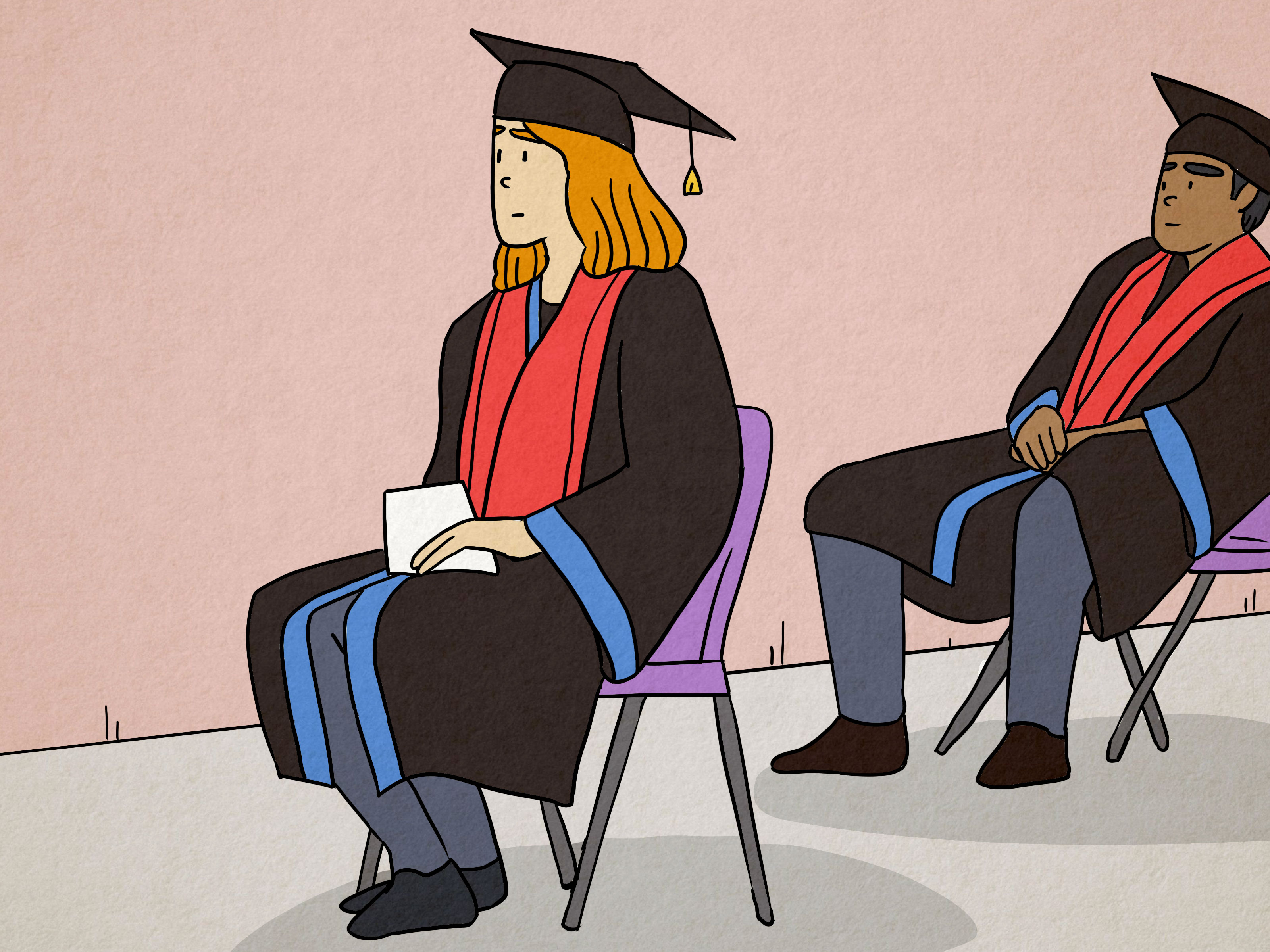
It sounds like a harmless question, the kind you might ask at a family dinner right before someone brings out a trivia deck and suddenly Uncle Dave is yelling about the capital of Vermont. But “Are you smarter than a college grad?” is more than a party-game challenge. It taps into a bigger cultural debate: What does it really mean to be educated, intelligent, career-ready, or “smart” in modern America?
For decades, the college degree has been treated like the golden ticket: proof that a person can read deeply, think critically, meet deadlines, write papers, survive group projects, and locate a missing syllabus at 11:58 p.m. before an assignment closes at midnight. Yet today, employers, students, parents, and workers without degrees are asking a sharper question. Is a college graduate automatically smarteror just formally trained in certain ways?
The honest answer is both simpler and more interesting than the question suggests: a college graduate is often more educated in a specific academic pathway, but intelligence is broader than a diploma. Practical wisdom, communication, problem-solving, creativity, emotional intelligence, financial judgment, curiosity, and the ability to learn quickly all matter. In other words, you may not have a bachelor’s degree, but you might still outthink a college grad in business, mechanics, parenting, negotiation, technology, cooking, gardening, leadership, or spotting a suspiciously vague meeting invite.
So let’s turn this question into a smart, funny, and surprisingly useful exploration of education, knowledge, skills, and everyday brainpower.
What Does “Smarter Than A College Grad” Actually Mean?
Before anyone starts waving a diploma like a championship belt, we need to define “smart.” A person can be smart in many ways. Academic intelligence is one form. It includes reading comprehension, writing, abstract reasoning, research, test-taking, memory, and the ability to discuss 19th-century literature without visibly falling asleep.
But academic intelligence is not the whole brain buffet. A contractor who can diagnose a structural problem in five minutes is smart. A nurse who notices a subtle change in a patient’s condition is smart. A small-business owner who can manage cash flow, customers, inventory, taxes, and three broken printers in the same day is smart. A parent who can explain long division while making dinner and preventing a toddler from coloring the dog is operating at a level of executive function that deserves a federal grant.
When people ask, “Are you smarter than a college grad?” they are usually asking one of three things:
1. Do You Know More Facts?
This is trivia-smart. Can you name U.S. presidents, solve basic algebra, identify famous authors, understand science terms, or remember what mitochondria do? Trivia knowledge is fun, useful, and occasionally humbling. It is also not the same as deep intelligence.
2. Can You Think Better?
This is reasoning-smart. Can you evaluate evidence, avoid scams, compare options, solve problems, notice contradictions, and make decisions under pressure? This kind of intelligence often matters more in real life than memorizing the year the War of 1812 began. Yes, the answer is in the name, and yes, many people still panic.
3. Can You Apply What You Know?
This is life-smart. Can you use knowledge in a practical setting? Can you communicate clearly, adapt, build trust, manage time, and finish projects? Employers often care deeply about this category because the workplace does not usually hand out multiple-choice exams. It hands out messy problems, vague emails, budget limits, and deadlines with a personality disorder.
Why College Graduates Often Have an Advantage
College can be valuable because it trains people to learn systematically. Students are pushed to read, write, analyze, discuss, research, revise, and defend ideas. Over four years, a student may take courses in math, science, history, writing, communication, statistics, ethics, technology, and specialized major requirements. Even when a graduate forgets half the dates and formulas, the repeated practice of learning can leave a lasting mark.
Higher education also builds social and professional capital. College students often gain access to professors, internships, alumni networks, career centers, research opportunities, and peer communities. These advantages can shape confidence and career direction. A degree can also serve as a signal to employers that the candidate completed a long-term program, met academic standards, and persisted through challenges.
Labor-market research still generally shows that bachelor’s degree holders tend to earn more over time and experience lower unemployment than people with only a high school diploma. However, the story has become more complicated. Major, school quality, debt, internships, technical skills, location, industry, and economic timing all influence the payoff. A computer science graduate with strong internship experience and a portfolio may have a different outcome than a graduate with a less marketable major and no work experience.
So yes, college can make a person “smarter” in structured, measurable, and career-relevant ways. But that advantage is not magic. A degree does not automatically install wisdom. If it did, every graduate would read the lease before signing, stop replying-all unnecessarily, and understand that “just one more episode” is one of humanity’s greatest lies.
Where Non-Graduates Can Outperform College Grads
Many people without college degrees are exceptionally intelligent, skilled, and successful. Some learn through apprenticeships, military service, trade programs, entrepreneurship, caregiving, self-study, certifications, online courses, or pure trial by fire. Real-world learning can be intense, fast, and unforgiving. Nobody gives partial credit when the pipe bursts, the customer is angry, or the website crashes during a product launch.
Non-graduates may outperform college grads in several areas:
Practical Problem-Solving
Some people develop sharp problem-solving skills by doing. Electricians, mechanics, chefs, salespeople, designers, technicians, and business owners often learn through direct feedback. The result either works or it does not. There is no elegant essay defending why the refrigerator is still broken.
Financial Judgment
A person who avoids unnecessary debt, builds a profitable business, invests consistently, and lives below their means may be financially wiser than someone with an expensive degree and no budget. Education helps, but money habits are learned through behavior.
Communication With Real People
Academic writing can be powerful, but everyday communication is its own art. Explaining a complicated idea to a customer, calming a frustrated client, leading a team, or persuading a skeptical audience requires emotional intelligence and clarity.
Adaptability
People who learn outside formal systems often become highly adaptable. They know how to search, test, ask, observe, and improve. In a changing economy, this ability may matter as much as any single credential.
The College Grad Knowledge Test: What Would Be Fair?
A fair “Are You Smarter Than A College Grad?” quiz should not simply ask obscure facts. That would turn intelligence into a game of mental storage space. Instead, it should test a mix of general knowledge, reasoning, communication, and applied judgment.
Here are sample categories that would make the challenge more meaningful:
General Knowledge
Questions might cover history, science, literature, government, and geography. For example: What branch of government interprets laws? What is photosynthesis? What is inflation? What ocean borders California? These questions test basic civic and academic knowledge.
Numeracy
Numeracy is the ability to work with numbers in practical life. A good test might ask someone to compare loan offers, calculate a discount, read a chart, estimate interest, or understand probability. This is where many confident adults suddenly discover that percentages have been quietly plotting against them.
Critical Thinking
A critical-thinking section might present a claim and ask whether the evidence supports it. For example, if a supplement company says “people who used our product felt better,” what else would you need to know? Was there a control group? How many people participated? Who funded the study? Were the results measured objectively?
Communication
A communication challenge could ask participants to rewrite a confusing email, summarize a complex paragraph, or explain a technical topic to a beginner. Smart people are not only those who know things. They can make other people understand things.
Real-Life Judgment
This section might involve workplace dilemmas, household budgets, health decisions, or online misinformation. For example: You receive an urgent message from your bank asking you to click a link and confirm your password. What should you do? The correct answer is not “click faster because urgency means trust.”
Why Trivia Makes Smart People Look Silly
Trivia is entertaining because it exposes the weird gaps in everyone’s knowledge. A person can have a master’s degree and still forget how many cups are in a quart. Someone can run a company and still lose to a fifth grader on a question about cloud types. This does not mean the person is unintelligent. It means human memory is selective, context-based, and occasionally rude.
College graduates are often trained in specialized knowledge. A biology major may know cell structure but not Supreme Court history. An English major may analyze symbolism beautifully but need a calculator to split a restaurant bill. An engineer may solve advanced equations but still write emails that sound like they were assembled by a tired robot in a windowless basement.
The fun of “Are You Smarter Than A College Grad?” is not proving that college is useless. It is proving that knowledge is uneven. Everyone has strong zones and weak zones. The smartest people are usually the ones humble enough to admit what they do not know and curious enough to learn it.
What Employers Really Mean by “Smart”
Employers rarely hire someone just because they can answer trivia questions. They want people who can solve problems, communicate, collaborate, adapt, use technology, show professionalism, and keep learning. These are often called career-readiness skills or transferable skills.
A college degree may help develop these abilities, but it does not guarantee them. Employers may value a degree while still worrying that some graduates lack practical experience, clear communication, or workplace judgment. That is why internships, portfolios, certifications, volunteer projects, part-time jobs, and real examples of completed work have become so important.
For job seekers, the lesson is clear: do not only say you are smart. Show it. If you are a graduate, connect your coursework to real outcomes. If you are not a graduate, highlight your results, skills, experience, and proof of learning. A hiring manager does not need a philosophical speech about intelligence. They need evidence that you can do the work without turning every Tuesday into a group emergency.
How to Become Smarter Than Yesterday
The best version of this question is not “Are you smarter than a college grad?” It is “Are you smarter than you were last year?” That is the competition that actually matters.
Here are practical ways to build your intelligence, whether or not you have a degree:
Read Across Subjects
Read books, long-form articles, research summaries, and thoughtful essays. Mix practical topics with big ideas. Read about finance, science, history, psychology, health, technology, and communication. A broad mind has more tools to work with.
Practice Numeracy
Learn to understand charts, percentages, interest rates, budgets, and risk. Numeracy is not just “math class.” It is life defense. It helps you evaluate loans, salaries, investments, medical statistics, and suspicious online claims.
Ask Better Questions
Smart people ask: How do we know? What is the evidence? What are the alternatives? What could go wrong? Who benefits? What am I missing? These questions can prevent bad decisions in work, money, health, and relationships.
Learn in Public
Write, teach, discuss, build, or share what you are learning. Teaching a concept exposes gaps quickly. Nothing reveals shaky knowledge like trying to explain it to another person without using the phrase “you know what I mean” every eight seconds.
Build a Portfolio of Proof
Whether you have a degree or not, create evidence of your skills. Publish writing samples, build projects, document case studies, earn respected certifications, volunteer for meaningful work, or track measurable outcomes. Proof beats vague confidence.
Are College Grads Overrated?
Not exactly. College graduates are not overrated as a group. Many have worked hard, developed valuable skills, and gained knowledge that benefits society. Doctors, engineers, teachers, researchers, accountants, analysts, designers, and many other professionals rely on college-level learning.
What is overrated is the idea that a diploma alone defines intelligence. A degree can open doors, but what a person does after walking through those doors matters more. Some graduates stop learning the moment they leave campus. Others become lifelong learners who keep improving for decades. The same is true for non-graduates. Some avoid education entirely; others become self-taught experts with remarkable discipline.
The real divide is not college versus no college. It is curious versus passive, adaptable versus rigid, evidence-based versus assumption-driven, and humble versus allergic to correction.
Are You Smarter Than A College Grad? Try This Mini Self-Test
Answer these honestlynot to judge yourself, but to see how you think.
Question 1: Evidence
A headline says, “New Study Proves Coffee Drinkers Are More Successful.” What should you ask first?
Smart answer: Who conducted the study, how success was measured, whether the sample was large and representative, and whether the research shows correlation or causation.
Question 2: Money
You can buy a $1,000 item at 20% off, but sales tax is 8%. About how much will you pay?
Smart answer: The discounted price is $800. Sales tax is $64. Total: about $864.
Question 3: Communication
Your coworker sends a confusing message. What is the best response?
Smart answer: Ask a clarifying question politely and summarize what you think they mean before acting.
Question 4: Learning
You are wrong about something in a meeting. What is the smartest move?
Smart answer: Acknowledge the correction, ask for the right information, and update your view. Defending a mistake just because it is yours is not confidence. It is intellectual cling wrap.
The Experience Side: What This Question Feels Like in Real Life
At the end of the day, “Are You Smarter Than A College Grad?” is not just a quiz idea. It is an experience many people quietly live through. Someone without a degree may feel underestimated in a room full of graduates. A college graduate may feel embarrassed when a practical task exposes a gap in their knowledge. A young professional may have academic confidence but struggle with workplace communication. A skilled tradesperson may not use academic language but can solve complex real-world problems before lunch.
Imagine a college graduate starting their first office job. They know theories, frameworks, and research methods. They can write a polished paper and cite sources correctly. But then they are asked to manage a difficult client, fix a spreadsheet error, prioritize five urgent tasks, and explain a delay without sounding defensive. Suddenly, intelligence becomes less about grades and more about judgment. The graduate is not unintelligent; they are simply learning a new kind of smart.
Now imagine a person who skipped college and went straight into work. They learned customer service, scheduling, negotiation, budgeting, and technical skills through experience. They may not know academic terminology, but they understand people. They know when a customer is confused, when a project is about to go over budget, and when a “quick fix” will create three new problems wearing fake mustaches. This person may feel out of place in a college-heavy environment, yet their intelligence is visible in action.
One of the most common experiences related to this topic is the awkward moment when credentials and competence do not line up neatly. A degree holder may be brilliant in one setting and helpless in another. A non-degree worker may be overlooked on paper and outstanding in practice. These moments remind us that intelligence is not a single scoreboard. It is a toolbox. Some people carry academic tools. Some carry technical tools. Some carry social tools. The strongest people keep adding tools instead of bragging about the ones they already have.
Another real-life experience is the shock of realizing that school knowledge fades if you do not use it. Many adults once knew algebra, biology, grammar rules, historical timelines, and the parts of a cell. Years later, the information has moved into the brain’s attic, somewhere behind old song lyrics and the password to an account from 2014. This is why a trivia quiz can make almost anyone look less educated than they are. Memory needs practice. Skills need use. Learning is not a trophy you put on a shelf; it is a muscle that gets stronger when exercised.
There is also a confidence lesson here. People who feel insecure about not having a degree may assume college graduates are always smarter. People with degrees may assume their credential proves more than it does. Both assumptions can be limiting. The better approach is to respect education while also respecting experience. A diploma deserves recognition, but so does a decade of skilled work, a successful business, a strong portfolio, military training, caregiving expertise, or self-taught mastery.
The most empowering experience is discovering that you can become smarter on purpose. You can read more. You can learn math again. You can take online courses, ask mentors for advice, practice public speaking, study personal finance, build projects, and improve your writing. You can become more curious, more careful, more thoughtful, and more useful. That is true whether you graduated from college, left college, skipped college, or are still trying to decide whether the campus dining hall counts as a character-building institution.
So, are you smarter than a college grad? Maybe. Maybe not. But you can definitely become smarter than the version of yourself who started reading this article. And that version already had good taste, so the competition is respectable.
Conclusion: The Smartest Answer Is Bigger Than a Degree
“Are You Smarter Than A College Grad?” is a catchy question because it invites comparison. But the smarter answer is not about defeating college graduates or defending degrees at all costs. It is about understanding that intelligence is layered. College can build knowledge, discipline, and opportunity. Experience can build judgment, adaptability, and practical skill. The best thinkers combine both: they learn formally when useful, learn informally every day, and never confuse confidence with correctness.
A college degree can be valuable, but it is not the only proof of intelligence. The real measure is whether you can keep learning, solve meaningful problems, communicate clearly, evaluate evidence, and apply what you know in the real world. That is the kind of smart that lasts longer than a test score and travels farther than a diploma frame.













