
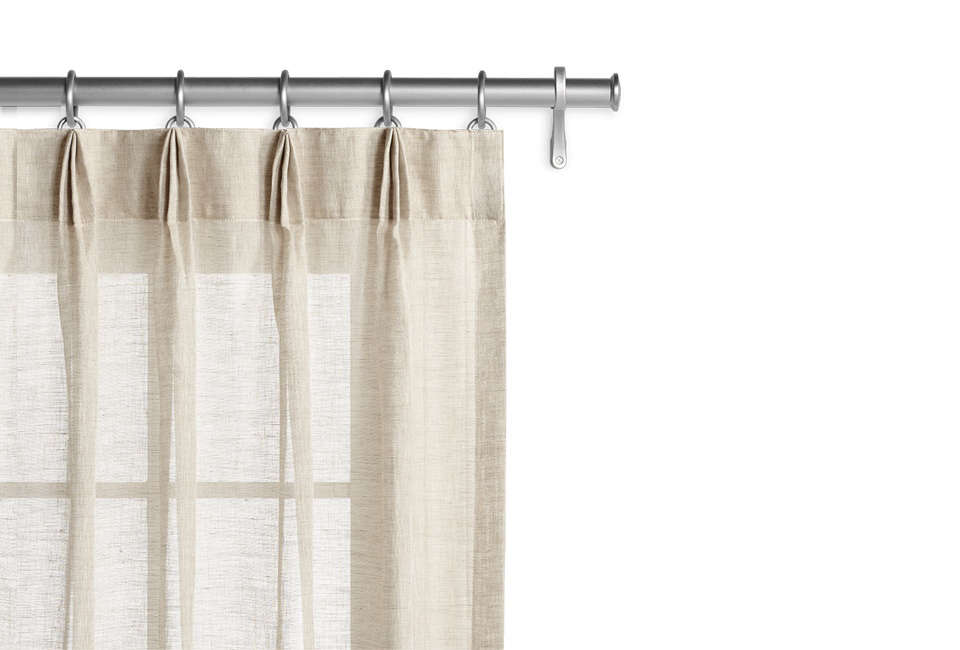
Some curtains announce themselves with dramatic patterns, oversized tassels, and enough velvet to make a theater director emotional. The Barn & Willow Belgian Sheer Euro Pleat Linen in Oatmeal takes the opposite approach. It relies on natural texture, soft filtered light, a warm neutral color, and carefully structured pleats to make a room feel finished without making the windows look overdressed.
This linen drapery is designed for homeowners who want brightness and privacy without turning their living room into a blackout bunker. The sheer Belgian linen introduces an airy, organic quality, while the Euro pleat gives the panel a tailored shape. Oatmeal, meanwhile, is warmer than white, softer than gray, and considerably easier to live with than a trendy color that may look dated before the curtain rod is fully installed.
Availability note: Barn & Willow currently maintains a customizable Belgian Sheer Linen Drapery page in Oatmeal. An older Remodelista product listing describes a specific 50-by-84-inch single-panel configuration as discontinued, so shoppers should verify current sizes, lining choices, hardware requirements, production details, and delivery estimates directly before ordering.
What Is the Barn & Willow Belgian Sheer Linen Drapery?
The product is a premium linen window treatment made for a custom or designer-style installation. Barn & Willow categorizes Euro pleats as a modern drapery style and offers measurement assistance, fabric swatches, design support, and custom window-covering options. The company’s Belgian linen collection is intended to work with modern and transitional interiors rather than only traditional formal rooms.
An archived product specification identifies the material as 100% Belgian sheer linen with a light, airy, light-bodied texture. That listing also identifies the heading as a Euro pleat, recommends dry cleaning, and describes a 50-by-84-inch single panel with privacy lining. Because the contemporary Barn & Willow page emphasizes customization, those archived dimensions and lining details should be treated as historical specifications rather than universal features of every current order.
Quick Product Overview
- Product: Belgian Sheer Linen Drapery
- Color: Oatmeal
- Featured heading: Euro pleat
- Overall look: Warm, natural, tailored, and light
- Light control: Sheer to light-filtering, depending on fullness and lining
- Best suited for: Living rooms, dining rooms, offices, guest rooms, and layered bedroom windows
- Care: Follow the order-specific label; an archived listing recommends professional dry cleaning
Why Belgian Sheer Linen Looks Different
Linen does not try to imitate the perfectly flat surface of a synthetic fabric. Its small slubs, subtle variations, and relaxed folds are part of the attraction. Sunlight interacts with those irregular fibers, creating a softer and more dimensional glow than it would through a smooth polyester voile.
That natural irregularity also means two sections of the fabric may not look absolutely identical when examined from six inches away with the intensity of a museum conservator. From normal viewing distance, however, the variation gives the curtains depth and prevents a large neutral panel from appearing bland.
Sheer linen is especially effective when a room needs visual softness. Hard flooring, stone counters, metal furniture, glass tables, and large windows can make an interior feel acoustically and visually sharp. Linen introduces movement and texture without adding a loud pattern. Design publications regularly recommend sheer or lightweight linen for creating an airy atmosphere while preserving natural light, particularly when panels extend from near the ceiling to the floor.
Understanding the Oatmeal Color
Oatmeal is not bright white, yellow beige, or cold gray. It is a warm natural neutral that typically contains touches of cream, flax, taupe, and pale tan. The color can shift throughout the day. Morning sunlight may make it look creamy, midday light may reveal more of the flax tone, and warm evening lamps can pull out its beige undertones.
This adaptability is one of the strongest reasons to choose Oatmeal. A brilliant white curtain can look crisp in a coastal room but overly sharp beside aged wood, warm stone, or off-white walls. Oatmeal creates a gentler transition between the window and the rest of the room.
Colors That Pair Well With Oatmeal Linen
- Warm white, ivory, cream, and soft greige walls
- Natural oak, walnut, reclaimed wood, and rattan
- Black, antique brass, bronze, or brushed nickel hardware
- Terracotta, rust, olive, sage, and muted blue accents
- Charcoal upholstery and dark-stained furniture
- Travertine, limestone, plaster, concrete, and natural stone
The color is particularly useful in rooms where several neutral shades must cooperate. It can connect white walls, a beige rug, a brown sofa, and a black metal coffee table without looking like it was chosen to match only one item.
What Makes a Euro Pleat Special?
A Euro pleat is gathered and stitched at the top while opening into softer folds below. Depending on the construction, it may be described as a two-fold or three-fold pleat, but its defining visual effect remains the same: structure at the header and relaxation through the body of the panel.
This creates a useful middle ground. A standard pinch pleat can look highly traditional, while an unstructured rod-pocket panel may look too casual for a carefully designed room. The Euro pleat appears polished without behaving like it expects guests to arrive in tuxedos.
Design experts often recommend Euro pleats for transitional rooms because the top looks tailored while the lower fabric falls more freely. The format is also practical for curtains that need to open and close regularly, provided they are paired with appropriate rings, hooks, or a compatible track.
Light Filtering, Privacy, and Room Function
The word “sheer” deserves attention. Sheer linen filters and diffuses sunlight; it does not automatically provide complete privacy or darkness. During the day, the woven fabric can soften glare and reduce direct views from outside, especially when the exterior is brighter than the interior. At night, an illuminated room can reveal shapes and silhouettes through an unlined sheer panel.
For a living room, dining room, or home office, that balance may be ideal. The curtains reduce the harshness of direct sunlight while maintaining the bright atmosphere that makes a room feel open. Tested curtain guides similarly distinguish sheer and light-filtering panels from room-darkening and blackout products, emphasizing that linen is valued for its graceful drape and softened daylight rather than total light blockage.
When to Add Another Layer
Layer the Oatmeal sheer linen with a shade, blind, or heavier outer drape when the room requires:
- Reliable nighttime privacy
- Improved control of television or computer glare
- A darker sleeping environment
- More insulation around drafty windows
- Protection from intense afternoon sun
- Flexible day-to-night light control
A woven shade beneath the linen creates a natural, relaxed combination. A roller shade offers a cleaner modern look. Blackout panels on a double rod provide the strongest bedroom performance, while the linen remains visible during the day.
Where These Curtains Work Best
Living Room
This is arguably the strongest location for Oatmeal Euro pleat linen. The fabric softens large windows, complements wood and upholstered furniture, and lets the room remain bright. The structured heading can also make an otherwise casual living room appear more intentional.
Dining Room
Euro pleats add enough formality for a dining area without introducing the heaviness of velvet or lined damask. Oatmeal works especially well with wood dining tables, linen chairs, brass fixtures, ceramic accessories, and warm pendant lighting.
Primary Bedroom
The fabric can create a peaceful bedroom atmosphere, but most sleepers will need a second privacy or blackout layer. Use the sheer panel as the decorative face of the window treatment and let a roller shade, Roman shade, or lined curtain handle darkness.
Home Office
Filtered light can be more comfortable than uncovered direct sun, particularly around a monitor. Position the panels so they can be adjusted during the brightest part of the day. For severe glare, add an interior shade rather than expecting sheer linen to perform like technical solar fabric.
Nursery or Media Room
These are less suitable as standalone sheers. Nurseries often benefit from reliable room darkening, while media rooms need stronger glare control. The Oatmeal linen can still provide the decorative outer layer, but it should have a functional partner.
How to Measure for a Designer-Looking Result
Even beautiful linen cannot rescue a curtain rod installed at an unfortunate height. The most flattering approach is usually to mount the hardware above the window and extend it beyond the frame. This makes the window appear larger and allows more glass to remain exposed when the drapes are open.
Professional guidance commonly recommends measuring from the installed rod or track rather than relying only on the window-frame dimensions. Depending on the room and hardware, rods are often extended several inches beyond each side. Sheer panels usually need generous fullness because lightweight material can appear sparse when stretched across a wide opening. Some designers use roughly three times the track width for sheers, compared with lower fullness ratios for heavier fabrics.
Recommended Length
For the cleanest contemporary result, let the curtains barely touch or “kiss” the floor. A small break can make linen feel relaxed, but a large puddle collects dust and may become a favorite resting place for pets. Linen can also react to humidity and settle after installation, so exact custom measurements should account for the fabric, pleat type, rings, hooks, and track position.
Measure the left, center, and right drop whenever floors or ceilings may be uneven. A quarter-inch difference is almost invisible in the architecture but surprisingly talented at making a curtain hem look crooked.
Hardware and Installation Choices
Euro pleat drapery generally looks best when suspended from rings, pleat hooks, or a track rather than pushed directly onto a rod through a pocket. The hanging method preserves the shape of the header and helps each fold fall vertically.
Choose hardware that supports the weight and width of the finished panels. For a quiet, refined appearance, use a slim black, bronze, or brass rod. A ceiling-mounted or wall-mounted track creates a more architectural effect and allows the fabric to become the main visual feature.
After hanging the curtains, arrange the folds by hand from top to bottom. Lightly tie the stacked folds in place for a short training period if recommended by the installer. This encourages the linen to open and close in orderly columns rather than wandering around the window like it has forgotten the meeting agenda.
Advantages and Potential Drawbacks
Advantages
- Natural texture gives neutral rooms more depth
- Oatmeal coordinates with many warm and cool materials
- Sheer linen softens sunlight without eliminating brightness
- Euro pleats provide a custom, tailored appearance
- The style suits modern, organic, transitional, coastal, and farmhouse interiors
- Custom sizing can solve unusually tall or wide windows
- Layering options allow flexible privacy and light control
Potential Drawbacks
- Sheer linen alone may not provide nighttime privacy
- Natural linen will show wrinkles and fiber variation
- Custom panels can cost more than ready-made curtains
- Precise measuring is essential
- Professional cleaning may be recommended
- Light-colored fabric can show dust near vents or frequently opened doors
- Additional shades may be needed in bedrooms and street-facing rooms
Care and Maintenance
Always follow the care instructions supplied with the finished order. The archived listing for this specific product recommends dry cleaning, which is the safest default for structured, custom pleated drapery. Washing can affect the panel length, pleat construction, lining, or overall drape even when the face fabric itself is linen.
For routine maintenance, gently vacuum the surface with a clean upholstery attachment on low suction or remove dust with a soft brush. Pay attention to the leading edges, lower hem, and folds near open windows.
A garment steamer can relax shipping creases while the panels remain hanging. Work carefully, test an inconspicuous section first, and avoid excessive heat or moisture around delicate lining, trim, paint, or hardware. Curtain-care specialists often prefer steaming for restoring natural folds between deeper cleanings.
Who Should Consider Buying It?
The Barn & Willow Belgian Sheer Euro Pleat Linen in Oatmeal is a strong match for someone who values natural material, warm minimalism, customized dimensions, and soft daylight. It is especially appealing when the window treatment is expected to become part of the room’s architecture rather than a temporary decorative accessory.
It may not be the right choice for shoppers who want inexpensive machine-washable curtains, perfectly uniform synthetic fabric, instant blackout performance, or a panel that can be ordered without measuring. It rewards planning. The good news is that measuring a window is less painful than assembling flat-pack furniture, and there are dramatically fewer mysterious leftover screws.
Experience Guide: What Living With Oatmeal Euro Pleat Linen Feels Like
The following section is an editorial ownership scenario based on the product’s materials, construction, light-filtering behavior, and common installation practices. It is not presented as a claim of personal purchase or long-term laboratory testing.
The Swatch Experience
The first useful experience happens before ordering the full panels. An Oatmeal linen swatch may look simple when held in the hand, but its real character appears when it is taped beside the window for an entire day. In cool morning light, it can lean toward pale flax. Under warm lamps, it becomes creamier and more inviting. Against a pure white wall, the color appears distinctly warm; against beige paint, it can look quieter and more neutral.
This test also reveals how the weave handles privacy. Hold the swatch against the glass, step back, and examine it from both inside and outside. Repeat the test after dark with interior lights on. A fabric that feels private at noon may become surprisingly transparent at night.
The Installation-Day Experience
Fresh linen will probably arrive with packing folds. Once the Euro pleats are connected to suitable hooks or rings, the top immediately looks organized, while the lower body may need time to settle. A careful steaming session and gentle fold training can transform the panel from “newly unpacked textile” to “quietly expensive window treatment.”
The greatest visual change often comes from the placement rather than the fabric alone. When the rod is mounted high and wide, the window appears taller, the wall looks more balanced, and the closed curtains retain generous fullness. When the rod is too narrow, even luxurious linen can look squeezed against the frame.
Morning, Afternoon, and Evening
In the morning, Oatmeal linen reduces the sharp edge of direct sunlight. Instead of bright rectangles cutting across the floor, the room receives a warmer, diffused glow. Wood grain looks richer, neutral upholstery feels softer, and dust floating through the sunbeam becomes slightly less theatrical.
At midday, the fabric preserves brightness while reducing visual glare. The window remains present, but it no longer dominates the room. This is particularly useful in open living spaces where uncovered glass can make one side of the room feel much brighter than the other.
Evening reveals the limitations of any sheer treatment. With lamps on, the panel may provide atmosphere without providing complete concealment. Closing a shade behind it solves the problem while allowing the Euro pleat linen to remain the decorative layer.
Everyday Use
Well-installed pleated curtains are satisfying to operate because the folds stack predictably. They are less likely to bunch randomly than loose rod-pocket panels, although the exact movement depends on the hardware. Rings or a smooth track make frequent opening easier.
The Oatmeal color is forgiving of design changes. A new rug, different throw pillows, or darker furniture can be introduced without replacing the curtains. This is valuable because custom window treatments are not something most people want to reconsider every time a trend report announces that another shade of green has become fashionable.
The Long-Term Impression
Over time, the appeal is less about one dramatic feature and more about consistency. The linen contributes texture every day. The pleats keep the room looking composed. The warm neutral color connects surrounding materials without demanding attention.
Wrinkles and slight movement are part of the experience. Anyone expecting a perfectly rigid surface may find natural linen too relaxed. Anyone who appreciates materials that look better when they are not perfectly mechanical will probably consider those irregularities a feature rather than a defect.
Final Verdict
The Barn & Willow Belgian Sheer Euro Pleat Linen in Oatmeal combines two design personalities successfully. Belgian sheer linen supplies softness, texture, and filtered daylight, while the Euro pleat supplies structure. Oatmeal bridges the two with a versatile neutral tone that works with wood, stone, plaster, metal, and upholstered furniture.
Its greatest strengths are atmosphere and visual refinement. Its main limitation is function when used alone: sheer linen should not be mistaken for blackout fabric or guaranteed nighttime privacy. With accurate measurements and the right secondary shade where necessary, it can create a layered window treatment that feels bright during the day, private at night, and appropriately dressed at all hours.
Research note: This editorial review synthesizes current and archived product information with U.S.-focused guidance on linen curtains, Euro pleats, privacy, light filtration, installation, styling, and maintenance from Barn & Willow, Remodelista, Better Homes & Gardens, Southern Living, Architectural Digest, Apartment Therapy, Martha Stewart, House Beautiful, Homes & Gardens, Pottery Barn, West Elm, The Spruce, and The Good Trade.










