
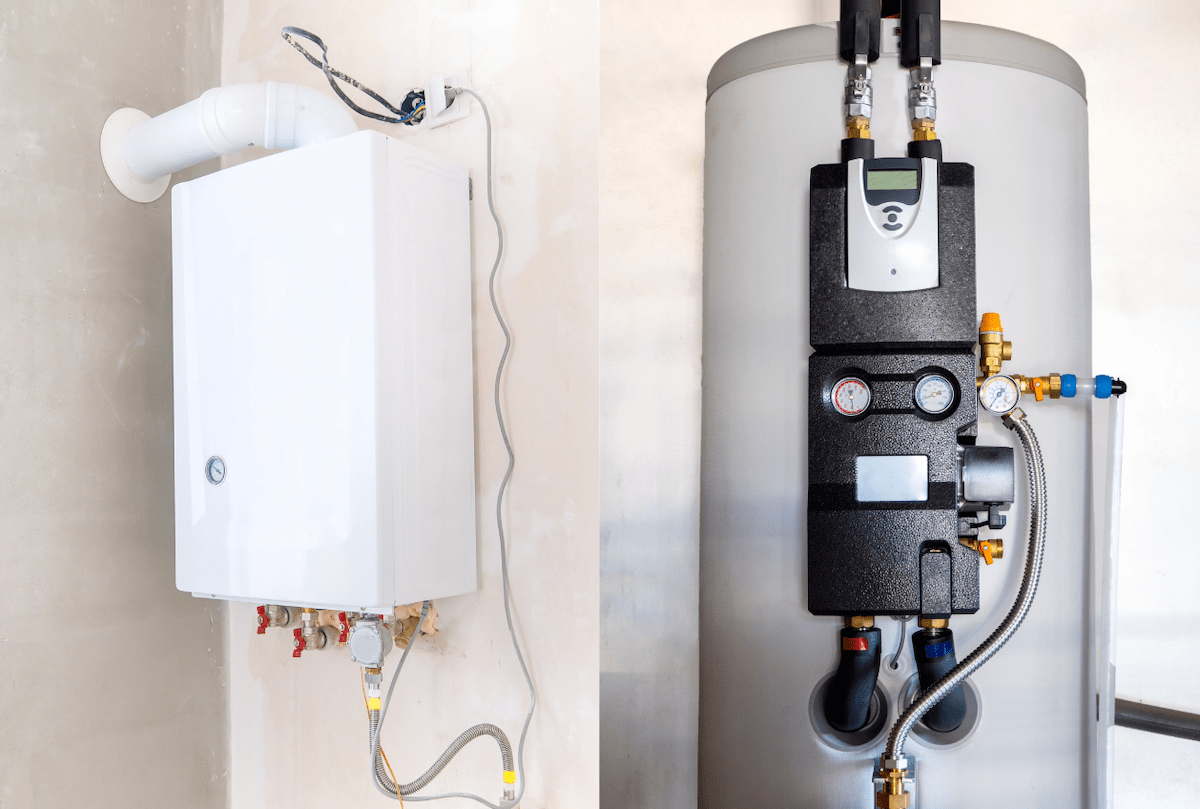
A boiler and a water heater may both warm water, occupy a mysterious corner of the basement, and occasionally does not make them interchangeable. Their main jobs, plumbing connections, efficiency ratings, sizing methods, maintenance needs, and replacement decisions are different.
In the simplest terms, a boiler heats a building, while a water heater heats water for household use. A boiler usually sends hot water or steam through radiators, baseboards, or radiant-floor tubing. A water heater sends potable hot water to showers, sinks, dishwashers, and washing machines. Some systems perform both jobs, which is where the terminology starts behaving like a tangled extension cord.
Boiler vs. Water Heater at a Glance
| Feature | Boiler | Water Heater |
|---|---|---|
| Primary purpose | Space heating | Domestic hot water |
| Water use | Usually circulates non-potable system water in a closed loop | Heats potable water used at fixtures and appliances |
| Heat delivery | Radiators, baseboards, radiant floors, or steam piping | Faucets, showers, tubs, dishwashers, and washing machines |
| Common fuels | Natural gas, propane, oil, or electricity | Natural gas, propane, electricity, heat-pump technology, or solar energy |
| Main efficiency rating | AFUE | UEF |
| Typical sizing basis | Home heat-loss calculation | Peak hot-water demand, first-hour rating, or flow rate |
| Can it perform both jobs? | Yes, with a combi boiler or indirect water heater | Usually no, unless designed as part of a combination heating system |
What Is a Boiler?
A residential boiler is a central heating appliance. It transfers heat to water and distributes that heat through a home. Despite the name, many modern hot-water boilers do not boil water; they warm it to a controlled temperature and circulate it through a closed hydronic loop.
Hot-Water and Steam Boilers
In a hydronic system, a pump moves heated water through baseboards, radiators, fan-coil units, or radiant-floor tubing. After releasing heat, the cooler water returns to the boiler. Steam boilers instead create steam that travels to radiators, condenses, and returns. Steam remains common in older homes and requires technicians who understand its pressure, venting, and piping.
Condensing Boilers
High-efficiency condensing boilers recover heat from combustion gases that older equipment sends up the flue. They perform best when system temperatures and controls allow condensation. A premium boiler connected to poorly designed piping may therefore deliver ordinary results. Efficiency is a team sport, not a sticker contest.
Research support: n>
What Is a Water Heater?
A water heater produces domestic hot water. Cold potable water enters the appliance, is heated, and travels to faucets, showers, tubs, dishwashers, and washing machines. Unlike boiler-loop water, this water is intended for household use.
Storage-Tank Water Heaters
A storage model keeps a reservoir of hot water ready. Gas units use a burner, while conventional electric units use resistance elements. Tanks handle short bursts of demand well when correctly sized, but they lose some heat while water waits for use.
Tankless Water Heaters
A tankless unit heats water when flow is detected. It reduces storage losses and can support long showers, but every model has a maximum flow rate at a stated temperature rise. Several fixtures can overwhelm an undersized unit.
Heat-Pump Water Heaters
A heat-pump water heater moves heat from surrounding air into a storage tank. It can use far less electricity than resistance heating, but it needs suitable air volume, temperature, drainage, and placement. It may also cool and dehumidify the roompleasant in a warm basement, less delightful in a cramped closet.
Research support: n>
The Biggest Difference: Space Heat vs. Domestic Hot Water
A boiler is sized to replace heat escaping through walls, windows, ceilings, floors, and air leakage. A proper replacement starts with a heat-loss calculation, not the old boiler’s nameplate. Oversized boilers may short-cycle, waste fuel, and create uneven comfort.
A water heater is sized around usage. For a storage model, the first-hour rating estimates how much hot water it can deliver during a busy hour. For tankless equipment, installers calculate gallons per minute and temperature rise. The same tankless model can deliver less water in a cold climate because incoming water starts at a lower temperature.
Research support: n>
Efficiency Ratings: AFUE and UEF Are Not the Same
Boilers and water heaters use different measurements, so comparing their labels directly is like comparing miles per gallon with refrigerator capacity.
Boiler Efficiency: AFUE
Annual Fuel Utilization Efficiency, or AFUE, estimates the percentage of fuel converted into useful space heat over a heating season. ENERGY STAR eligibility for residential boilers depends on fuel type and efficiency.
Water-Heater Efficiency: UEF
Uniform Energy Factor, or UEF, measures water-heating efficiency under standardized use. Higher is generally better within the same category. Heat-pump water heaters can exceed a UEF of 1 because they move environmental heat rather than creating all heat through electric resistance.
Real operating cost also depends on climate, utility rates, sizing, installation, piping losses, and maintenance. A high-rated appliance that is oversized or poorly installed can produce disappointing bills with impressive paperwork.
Research support: n>
Can a Boiler Also Heat Household Water?
Yes. Two common arrangements allow one boiler system to serve space heating and domestic hot water.
Combi Boilers
A combi boiler provides space heat and on-demand domestic hot water in one compact appliance. It can save space and eliminate a separate tank. Domestic hot water usually receives priority, so heating may pause briefly during a shower. That is often unnoticeable in a well-insulated home, but sizing becomes tricky when hot-water demand is much larger than the heating load.
Indirect Water Heaters
An indirect water heater is a storage tank with an internal heat exchanger. Boiler water flows through the coil and heats potable tank water without mixing with it. This can provide fast recovery and works well with an existing efficient boiler. The trade-off is dependence: when the boiler is unavailable, both heating and hot water may be unavailable.
Research support: n>
Installation Cost and Complexity
A like-for-like water-heater replacement is usually simpler than replacing a boiler. Boiler work may involve fuel piping, controls, venting, pumps, expansion tanks, multiple zones, chimney conditions, and system water quality. Steam adds specialized piping requirements.
Water-heater upgrades can still become complex. A tankless conversion may require a larger gas line, new venting, condensate drainage, electrical work, or recirculation changes. A heat-pump model may need more room, drainage, and a different circuit. Compare proposals that include the same permits, removal, venting, safety devices, electrical work, warranties, and commissioning.
Maintenance and Expected Service Life
Fuel-burning equipment benefits from regular professional inspection. Boiler service may include combustion testing, burner cleaning, pressure and expansion-tank checks, pump inspection, air removal, condensate service, and safety-control testing.
Storage water heaters may need flushing, relief-valve checks, anode inspection, and vent or electrical inspection. Tankless units often require descaling in hard-water areas; heat-pump models add an air filter and condensate system. Service life varies with water chemistry, maintenance, installation, temperature, duty cycle, and materials. Storage heaters commonly last less time than many tankless units, but no appliance has a universal retirement birthday.
Research support: n>
Safety Differences Homeowners Should Know
Fuel-burning boilers and water heaters require correct combustion air, venting, clearances, commissioning, and carbon-monoxide alarms. Hydronic boilers also rely on expansion tanks and relief valves; steam boilers require proper pressure and water-level controls. Water heaters use temperature-and-pressure relief valves. Never cap or casually alter a relief discharge pipe.
Hot-water temperature also affects scald risk. Mixing valves may allow hotter storage while delivering safer water at fixtures, but the final setup must follow local codes, product instructions, and professional guidance.
Research support: n>
Which System Is Better for Your Home?
Neither appliance is universally better because they solve different problems. Use the following questions to narrow the choice:
- Do you have radiators, baseboards, or radiant floors? You likely need a boiler or another hydronic heat source.
- Do you have a forced-air furnace? You generally need a separate water heater for domestic hot water.
- Are you replacing a boiler in a small or medium home? A combi boiler may reduce equipment count if its hot-water capacity is sufficient.
- Do you already have an efficient boiler and need abundant hot water? An indirect tank may be a strong option.
- Is low operating cost the priority and the installation space suitable? Consider an ENERGY STAR heat-pump water heater.
- Is space tight and demand relatively predictable? A tankless water heater may fit, provided gas, venting, electrical, and flow requirements are addressed.
- Does your household use several showers at once? Prioritize recovery rate, first-hour rating, or tankless flow capacity over trendy labels.
The best decision comes from matching equipment to the building, not matching the building to whichever appliance has the most dramatic brochure. Ask for a heat-loss calculation for boiler work and a documented peak-demand calculation for water-heater work.
Common Homeowner Experiences: What Living With Each System Feels Like
The following composite scenarios reflect recurring homeowner and contractor observations. Climate, household size, utility rates, equipment design, and workmanship can change the outcome.
Quiet Hydronic Comfort
People moving from forced-air heat to a boiler often notice the absence of blowing air and fan noise. Radiators and radiant floors can feel steady and comfortable, while zoning allows different temperatures in different areas. The surprise comes in summer: a boiler does not provide air conditioning. The home still needs ducts, mini-splits, or another cooling system.
The Cold-Shower Storage Lesson
A family with a modest electric tank may run a shower, dishwasher, and washing machine close together, then blame the appliance when hot water disappears. Often, nothing is broken; demand has exceeded the tank’s first-hour capability. A correctly sized high-recovery replacement can solve the problem more effectively than simply buying the largest tank that fits through the basement door.
Tankless Convenience Meets Flow Limits
A couple may love the floor space and long showers provided by a tankless heater. Then guests arrive, two showers run, and outlet temperature drops. The unit has reached its flow limit. Once the owners understand simultaneous demand and temperature rise, performance becomes predictable. “Endless” hot water means long duration within the rated flownot unlimited fixtures at once.
The Combi Boiler Trade-Off
In a compact, insulated home, a wall-hung combi boiler can replace two appliances and reclaim valuable space. During a shower, the control may prioritize domestic water and briefly reduce space-heating output. Most owners never notice because the building retains heat. In a draftier home during extreme cold, the pause may be more apparent, making accurate load calculations essential.
Fast Recovery From an Indirect Tank
A household that repeatedly drains a conventional tank may add an indirect water heater to an existing boiler. Recovery can be rapid because the boiler transfers substantial heat through the tank coil. Morning routines improve, but the owners learn that boiler downtime now removes two services at once. Consolidation saves equipment, yet creates a shared point of failure.
Heat-Pump Savings With Placement Surprises
A heat-pump water heater in a warm basement may lower electricity use, dehumidify the room, and release cool air. The compressor hum and slower recovery in efficiency mode can surprise new owners. Hybrid mode and sensible scheduling often balance comfort and savings. In a cramped closet, however, the same unit may be louder and less effective.
Maintenance Changes the Verdict
Two neighbors can install similar tankless units and report opposite experiences years later. One descales regularly because the water is hard; the other waits for reduced flow and error codes. Boilers tell a similar story. Clean heat exchangers, correct combustion, healthy controls, and suitable system water often matter more than brand debates conducted in online comment sections.
Final Verdict
A boiler and a water heater are not competing versions of the same appliance. A boiler primarily provides space heating through hot water or steam. A water heater supplies potable hot water. A combi boiler performs both jobs, while an indirect tank lets a boiler heat stored domestic water through a separate heat exchanger.
Choose according to the load, existing distribution system, fuel options, climate, household demand, installation conditions, and service requirements. Ask for a heat-loss calculation for boiler work, a first-hour rating for storage heaters, and a flow calculation at the required temperature rise for tankless equipment.
The best appliance performs so consistently that you stop thinking about itthe highest compliment a basement machine can receive.
Research support: n id=”seo-metadata”>
SEO Metadata
Note: This article synthesizes guidance from U.S. energy agencies, safety regulators, efficiency-certification organizations, consumer publications, heating-industry resources, and manufacturer technical materials. Equipment selection, permits, venting, piping, electrical work, maintenance, and safety requirements should be confirmed with current local codes, the manufacturer’s instructions, and a qualified licensed professional.













