
Hollywood is famous for smooth lighting, careful camera angles, and makeup teams capable of convincing us that no human being has ever had a pore. Yet some of the most recognizable celebrities have visible scars they neither erase nor apologize for.
These marks come from childhood accidents, medical emergencies, serious crashes, chronic health conditions, and unexpected violence. In several cases, a scar even influenced the roles an actor was offered or changed how a celebrity thought about beauty. The stories behind famous scars are not always glamorous, but they are deeply humanand considerably more interesting than another airbrushed red-carpet photo.
Why Celebrity Scars Capture Our Attention
A visible scar interrupts the illusion of perfection that surrounds fame. It reminds viewers that celebrities have experienced fear, pain, surgery, embarrassment, recovery, and awkward childhood accidents just like everyone else.
Scars can also become part of a public identity. A mark that might once have caused insecurity may eventually look inseparable from the person who carries it. In Hollywood, where distinctive features can be edited, covered, or digitally softened, choosing not to conceal a scar can become a quiet act of confidence.
Famous Celebrities With Visible Scars and Their Stories
1. Tina Fey: A Childhood Attack Left a Scar on Her Cheek
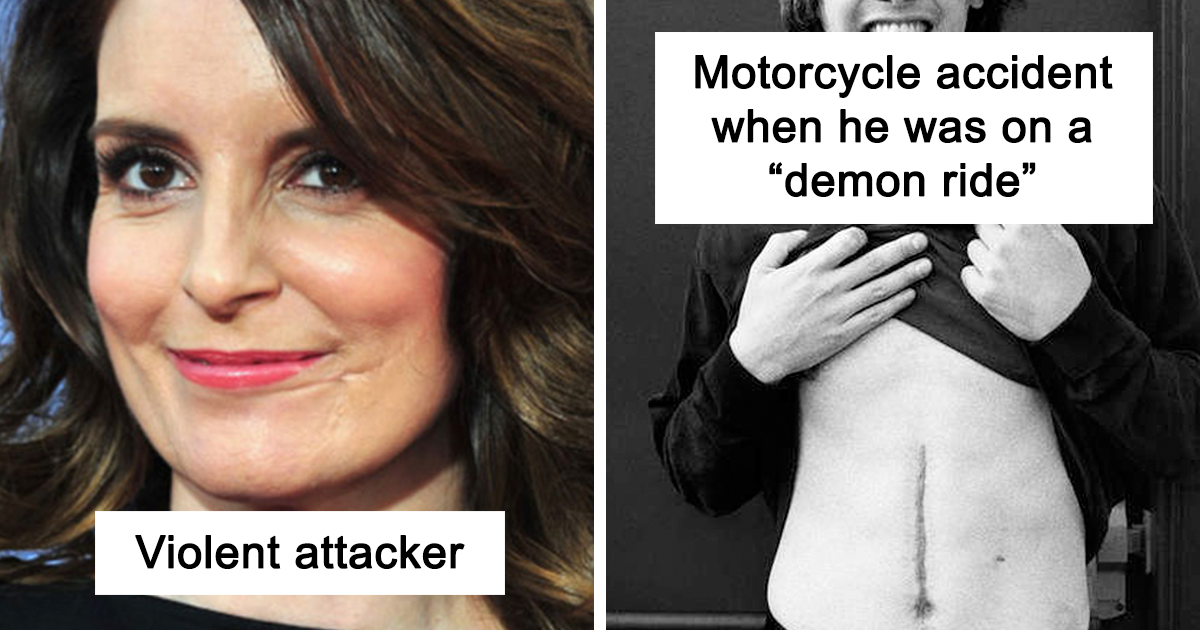
Tina Fey has a thin scar running along the left side of her face. When she was five years old, she was playing outside her family’s home in Pennsylvania when a stranger approached and cut her cheek. Fey was so young that she initially believed someone had marked her with a pen.
The comedian has generally avoided discussing the attack in detail because she does not want to sensationalize it. She has said that she grew up largely unaware of the scar until appearing on camera made other people pay attention to which side of her face was being photographed.
That response feels characteristically Fey: acknowledge the difficult reality, decline to turn it into melodrama, and finish with a joke about everybody having a better side.
2. Padma Lakshmi: A Car Accident Changed Her Relationship With Beauty
Padma Lakshmi’s prominent arm scar resulted from a serious car crash when she was 14. The accident fractured her hip and shattered part of her right arm, requiring surgery that left a long scar between her elbow and shoulder.
During her early modeling years, Lakshmi felt self-conscious about the mark and underwent painful treatments in an attempt to reduce its appearance. Over time, however, she stopped viewing it as something that needed correction. She has described the scar as an inseparable part of her identity and has deliberately left it visible in photographs and advertising campaigns.
Her experience shows how self-acceptance is rarely an instant movie-montage moment. Sometimes it takes years, several uncomfortable photo shoots, and the realization that the so-called flaw is not actually ruining anything.
3. Jason Momoa: More Than 140 Stitches Created His Eyebrow Scar
Jason Momoa’s eyebrow scar looks so perfectly suited to his action-star image that it could be mistaken for something invented by a costume department. In reality, it came from a violent altercation in 2008, when a man smashed a pint glass into Momoa’s face at a Hollywood bar.
The injury required reconstructive treatment and more than 140 stitches. Hair no longer grows through part of the damaged eyebrow, leaving the distinctive line visible today.
Momoa has joked that the mark helped end the “pretty boy” label that followed him early in his career. Soon afterward, his rugged appearance became an asset in roles such as Khal Drogo and Aquaman. That does not make the incident fortunate, but it demonstrates how the entertainment industry can turn an unplanned feature into an entire casting category.
4. Seal: Facial Scars Caused by Discoid Lupus
Singer Seal’s facial scars are the result of discoid lupus erythematosus, a chronic autoimmune skin condition. The disease can cause inflamed lesions, changes in pigmentation, hair loss, and permanent scarring, particularly on areas of skin frequently exposed to sunlight.
Seal developed symptoms when he was young and has spoken about struggling to receive an accurate diagnosis. Although the condition later went into remission, the scarring remained and became one of his most recognizable physical features.
He has referred to the marks as battle wounds rather than defects. His story is especially important because not every visible scar comes from an accident. Some are evidence of living with a long-term medical condition that the public may know very little about.
5. Harrison Ford: A Car Crash Produced His Famous Chin Scar
Harrison Ford’s chin scar has accompanied him through decades of adventures involving archaeological traps, galactic empires, replicants, and unusually aggressive snakes. The real cause, however, was much less cinematic.
Before becoming a major star, Ford was driving to his job at a department store when he crashed into a telephone pole. He reportedly struck his chin on the steering wheel, leaving the permanent mark.
Filmmakers later invented explanations for the scar within his movies. In Indiana Jones and the Last Crusade, young Indiana Jones accidentally cuts his chin with a whip. Apparently, even fictional heroes need continuity paperwork.
6. Kaley Cuoco: Her Leg Scars Mark an Extraordinary Recovery
Kaley Cuoco suffered a devastating equestrian accident in 2010 after falling from a horse. The frightened animal landed on her left leg, causing a severe compound fracture. The damage was so serious that Cuoco had to acknowledge before surgery that doctors might need to amputate the leg.
Surgeons managed to save it, and her recovery moved faster than expected. She returned to work on The Big Bang Theory after missing only two episodes and eventually resumed riding horses.
Cuoco has said that the remaining scars make her feel tough rather than embarrassed. They represent a moment when the future of her mobility was uncertainand the recovery that followed. Calling the scars “badass” seems appropriate. They have certainly earned the adjective.
7. Catherine Zeta-Jones: A Scar From a Life-Saving Tracheotomy
Catherine Zeta-Jones has a small scar on her neck from an emergency tracheotomy performed during childhood. A serious viral illness made it difficult for her to breathe, and doctors created an opening in her windpipe to restore her airway.
Makeup artists have sometimes offered to conceal the mark, but Zeta-Jones has said she does not want it covered. Her reasoning is simple and powerful: the scar exists because the procedure kept her alive.
It is hard to classify a life-saving scar as an imperfection. It is closer to a receipt from the universe confirming that the emergency exit worked.
8. Queen Latifah: A Childhood Game Left a Forehead Scar
Queen Latifah’s forehead scar came from a childhood game of tag. At around three years old, she reportedly tripped over a telephone cord and struck her head against the corner of a bathroom wall. The injury required stitches, and a later fall reopened the wound.
She has not treated the scar as something that must be hidden. Instead, it has remained visible throughout a career spanning music, television, film, and producing.
The story is a reminder that toddlers do not need dramatic action sequences to acquire permanent marks. A sibling, a telephone cord, and a badly positioned wall will do the job efficiently.
9. Miles Teller: Facial Scars From a Near-Fatal Crash
When Miles Teller was 20, he was a passenger in a car that lost control while traveling at high speed. The vehicle crossed several lanes and rolled repeatedly, throwing Teller from the car. He woke up bloodied and several feet away from the wreckage.
The crash left scars across his face, chin, and neck. He underwent numerous laser treatments to reduce some of the damaged tissue, but doctors advised against removing two small pieces of gravel embedded in his face because doing so could create additional scarring.
Teller has said that his appearance initially complicated auditions because casting professionals did not always know how to work with the marks. Eventually, the scars became part of the face audiences recognized in films such as Whiplash and Top Gun: Maverick.
10. Michael K. Williams: A Facial Scar Redirected His Career
The late Michael K. Williams received the prominent scar across his face during a barroom confrontation on his 25th birthday. He was cut with a razor, leaving a mark that ran from his forehead toward his cheek.
Before the incident, Williams had been pursuing a career as a dancer. Afterward, photographers and casting directors began responding to his distinctive appearance, leading to work in music videos and acting roles. He eventually became celebrated for complex performances such as Omar Little in The Wire.
Williams did not romanticize the violence that caused the injury. Nevertheless, he recognized that the scar altered how others saw him and unexpectedly opened a different professional path. It became visually powerful, but his talent gave that image depth.
11. Sandra Bullock: A Childhood Fall Left a Mark Near Her Eye
Sandra Bullock has a small scar near her left eye that dates back to childhood. Reports describe her falling into a creek or lake and striking her face against a rock.
The mark is subtle enough that many viewers never notice it, yet it demonstrates how a scar can remain visible without becoming the defining feature of a face. Bullock has spent decades playing romantic leads, action heroes, comedy characters, and dramatic roles without needing the mark erased from her image.
12. Jonah Hill: An Arm Scar Became a Reminder to Change Direction
Jonah Hill has a long scar across his right arm and elbow from a car accident when he was 15. During a difficult period in which his mother was undergoing cancer treatment, Hill began acting rebelliously and went for a ride with a friend. The vehicle crashed while Hill’s arm was positioned near an open window.
The injury was so severe that doctors considered amputating his arm. They ultimately saved it, leaving a large scar that Hill has described as a lasting reminder of the choices he was making at the time.
For him, the mark became less about the crash itself and more about deciding what kind of life he wanted afterward.
How Visible Scars Can Affect a Celebrity’s Career
In an appearance-driven business, scars can influence how performers are photographed and cast. Some actors are initially encouraged to cover their marks. Others discover that a scar gives casting directors an immediate impression of toughness, vulnerability, experience, or mystery.
That creates an uncomfortable contradiction. A person may spend years learning to accept a scar, only for the entertainment industry to treat it as useful branding. Jason Momoa and Michael K. Williams both found that their changed appearances influenced the roles available to them. Miles Teller encountered early hesitation but later built a career in which his facial scars no longer needed explanation.
The most respectful approach is not to declare every scar inspirational. Some people cherish their scars; others would prefer not to discuss them. The meaningful point is that a visible mark does not reduce someone’s beauty, professionalism, humor, talent, or right to privacy.
Experiences and Lessons Behind Living With Visible Scars
People Often Ask Before Thinking
One common experience among people with visible scars is receiving questions from strangers. Curiosity is natural, but being asked “What happened?” repeatedly can make someone feel that the most noticeable thing about them is an old injury.
The context matters. A close friend asking respectfully is different from a stranger demanding a personal medical history while waiting for coffee. Nobody owes the public an origin story simply because part of that story can be seen.
Acceptance Does Not Always Happen Immediately
Celebrity profiles sometimes compress years of insecurity into one uplifting sentence: first the star disliked the scar, then the star embraced it, and now everyone applauds. Real adjustment is usually less organized.
A person may feel confident one day and uncomfortable the next. They may proudly wear clothing that reveals a scar at one event and cover it at another. Neither choice invalidates the other. Acceptance can mean loving a mark, feeling neutral about it, or simply refusing to let it control every decision.
Padma Lakshmi’s experience illustrates this gradual process. She once pursued treatments to reduce her arm scar but later insisted that photographers leave it untouched. Her confidence was built through time and experience, not delivered overnight by a motivational quote printed over a sunset.
Scars Can Hold Several Meanings at Once
A scar may symbolize survival while also recalling a frightening event. Kaley Cuoco can view her leg scars as evidence of strength while remembering how close she came to losing her leg. Catherine Zeta-Jones can appreciate the mark that proves a procedure saved her life without pretending the medical emergency was pleasant.
People do not have to choose between gratitude and discomfort. Both can exist together. A scar can be a source of pride, sadness, relief, frustration, humor, or complete indifferenceoccasionally all before lunch.
Media Representation Can Normalize Real Skin
When public figures leave scars visible in films, advertisements, interviews, and red-carpet photographs, audiences see a broader definition of normal appearance. That visibility can matter to viewers who have surgical scars, burns, birthmarks, injuries, or skin conditions of their own.
Representation does not require turning every scar into a dramatic storyline. Sometimes the most effective image is simply a famous person appearing on screen without the camera treating their skin as a problem that requires explanation.
A Scar Is Part of a Story, Not the Whole Story
The celebrities discussed here are not memorable merely because they have scars. Tina Fey is known for writing and comedy. Seal is known for his voice. Harrison Ford is known for bringing some of cinema’s most famous heroes to life. Padma Lakshmi is a writer, host, producer, and advocate. The scars add context, but talent and character create the legacy.
That may be the most useful lesson for anyone living with a visible mark. Other people might notice it first, but they do not get to decide what matters most about the person carrying it.
Conclusion
The stories behind celebrity scars range from ordinary childhood mishaps to life-threatening medical emergencies and violent accidents. Tina Fey’s cheek scar recalls an attack she rarely discusses. Seal’s facial marks reveal the lasting effects of an autoimmune condition. Kaley Cuoco’s leg scars represent a recovery doctors once feared might be impossible.
What connects these experiences is not a perfect message about bravery. It is the reality that bodies record history. Some marks fade, some remain visible, and some become familiar features that audiences would barely recognize their owners without.
Celebrity culture may specialize in polishing away imperfections, but these famous scars tell a better story: a person can be successful, attractive, funny, confident, complicated, and completely human without looking untouched by life.










