
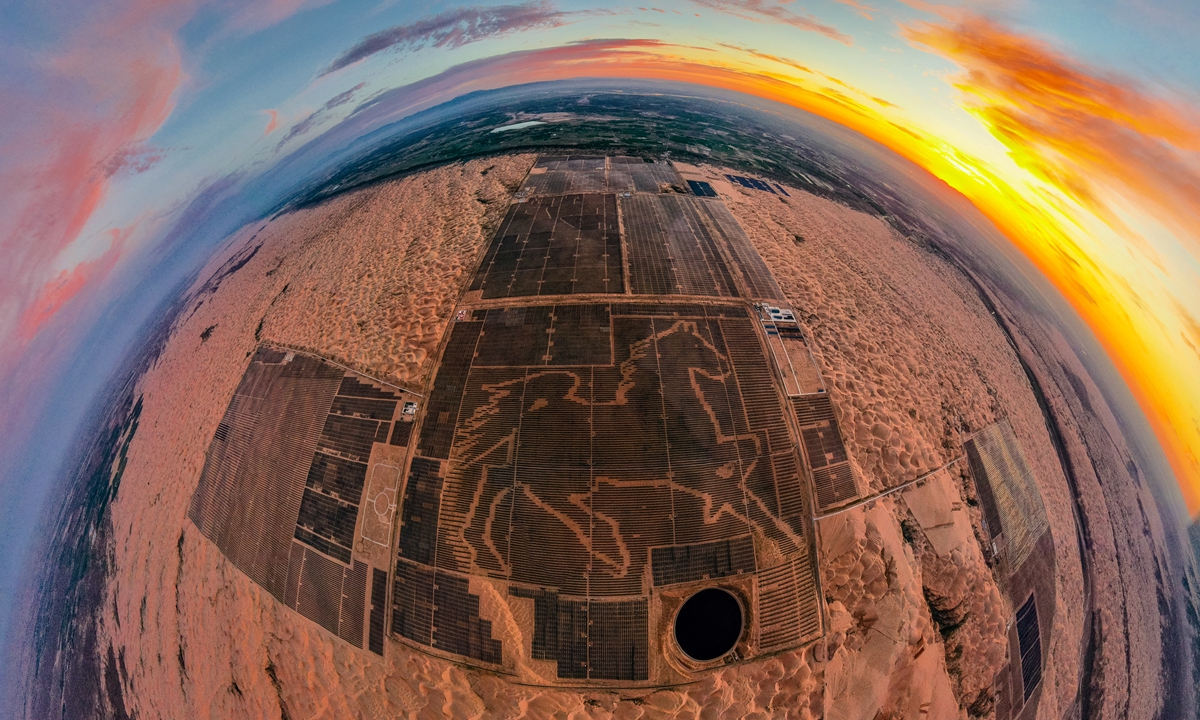
China has built plenty of things on a scale that makes the rest of the world blink twice: high-speed rail networks, mega-ports, entire new cities, and infrastructure projects that look as if someone accidentally left the “copy-paste” button pressed. But the country’s newest desert-sized ambition may be one of its most important yet: the Great Solar Wall, a vast solar energy project rising across the Kubuqi Desert in Inner Mongolia.
This is not a cute little row of panels behind a municipal building. The plan is massive: a solar corridor roughly 400 kilometers long and 5 kilometers wide, with a target generating capacity of about 100 gigawatts when complete. In everyday terms, that is the difference between “we installed solar” and “we may have just rearranged the energy map.” The project is expected to help supply electricity to the Beijing-Tianjin-Hebei region, including Beijing, one of the world’s largest metropolitan areas.
The big deal is not just that China is building a lot of solar panels. China has been doing that for years. The bigger story is how the Great Solar Wall combines clean power, desert control, land restoration, industrial policy, grid expansion, and climate strategy into one enormous project. It is a solar farm, yes, but it is also a message: the future of energy will not be won by slogans alone. It will be built, wired, financed, maintained, and connected to the places where people actually use electricity.
What Is China’s Great Solar Wall?
The Great Solar Wall refers to a huge photovoltaic development in the Kubuqi Desert, a sandy region in Inner Mongolia located south of the Yellow River. NASA satellite imagery has shown dramatic changes in the area, with large stretches of desert increasingly covered by solar panels between 2017 and 2024. The project has been described as part of China’s multiyear plan to build a “solar great wall” capable of producing enough electricity to help power Beijing.
The name is catchy, and frankly, it does some heavy lifting. “Great Solar Wall” sounds like something a science-fiction novelist would invent after drinking too much coffee near a climate conference. But behind the branding is a serious engineering plan. The project is designed as a long, narrow band of solar installations across desert terrain, taking advantage of high sunlight exposure, flat land, and relative proximity to northern industrial centers.
By 2030, the project aims to reach about 100 GW of capacity. To put that into perspective, many countries operate far less total solar power than that. Even if actual generation depends on weather, panel efficiency, grid availability, and seasonal conditions, the planned scale is enormous. It is not just one plant; it is a renewable energy landscape.
Why Build It In The Desert?
Solar power loves sunlight, and deserts tend to be very generous with it. The Kubuqi Desert offers broad open space, strong solar resources, and relatively few obstacles compared with dense urban or agricultural regions. Installing solar panels in a desert is not automatically easydust, wind, transmission distance, maintenance logistics, and harsh temperatures all show up like unpaid interns with clipboardsbut the basic geography is favorable.
China’s government has also tightened restrictions on using arable land for large solar projects, making desert and degraded land more attractive for future renewable energy expansion. That matters because solar power needs space. Rooftop solar is valuable, but utility-scale solar can deliver huge volumes of electricity when land, grid access, and investment align.
The Kubuqi project also fits into a broader Chinese strategy: build renewable energy bases in northern and western regions, then move electricity toward eastern population and industrial centers. This is where ultra-high-voltage transmission lines enter the story. They are not glamorous. Nobody makes blockbuster movies about transmission lines. Yet without them, desert solar is just a very expensive way to make electricity where not enough people can use it.
The Great Solar Wall And China’s Solar Boom
The Great Solar Wall is impressive on its own, but it becomes even more important when seen against China’s national solar surge. In 2024, China added about 277 GW of new solar capacity, bringing total installed solar capacity to roughly 886-887 GW. That single-year addition was more than twice the total utility-scale solar capacity of the United States at the end of 2024.
China also added record amounts of wind and solar power in 2024, reaching its combined 2030 renewable capacity target years ahead of schedule. That is not a typo. While many countries are still arguing over permit forms, China blew past a major milestone early. This does not mean China has solved climate change, and it certainly does not erase its continued dependence on coal. But it does show that renewable energy deployment at extreme scale is possible when policy, manufacturing, finance, and infrastructure all push in the same direction.
China’s solar manufacturing dominance is part of the equation. The country produces a large share of the world’s solar panels, inverters, wafers, and related components. That creates a feedback loop: domestic factories help reduce costs, lower costs support more installations, more installations create more demand, and more demand keeps factories humming. It is not magic. It is industrial strategy with a hard hat.
Why This Project Matters For Climate Goals
China is the world’s largest carbon emitter, so its energy choices matter enormously. When China burns more coal, the whole planet feels it. When China installs massive amounts of solar and wind, the whole planet feels that too. The Great Solar Wall is important because it adds clean electricity capacity in a country where electricity demand continues to rise due to manufacturing, electric vehicles, data centers, air conditioning, rail systems, and urban growth.
Clean electricity growth has already begun changing China’s emissions outlook. Analysts have found that rapid growth in solar, wind, nuclear, and other low-carbon sources has helped reduce or flatten emissions in some recent periods, even as power demand continued to increase. That is exactly what the energy transition needs to do: not merely add clean energy as decoration, but add enough of it to cover new demand and then push fossil generation down.
The Great Solar Wall can help with that transition, but only if its electricity is used effectively. A solar panel that produces power during a sunny afternoon is useful. A solar panel whose power cannot reach the grid, gets curtailed, or arrives when demand is low is less useful. The climate impact depends not only on capacity, but also on generation, storage, transmission, and market design.
Desert Control: The Underrated Part Of The Story
One of the most fascinating parts of China’s Great Solar Wall is that it may help fight desertification. In northern and western China, desertification has long threatened farmland, settlements, and air quality. Sandstorms do not politely stay in the desert. They travel, and sometimes they introduce themselves to major cities with all the subtlety of a leaf blower in a library.
Solar panels can reduce wind speed near the ground, provide shade, lower surface evaporation, and create microclimates where certain plants may survive more easily. In some desert solar projects, vegetation or crops are grown under or between panels. This model, sometimes called agrivoltaics when agriculture and solar generation share land, can turn a single-use solar project into a dual-use environmental system.
In places like Ningxia, solar panels have been used above goji berry fields, helping reduce moisture loss while generating electricity. Similar ideas are relevant to Kubuqi: panels can stabilize sand, reduce direct sun exposure on soil, and support ecological restoration when combined with smart planting and land management. The panels are not magic umbrellas, but they can behave a bit like them.
This does not mean every desert should be covered in glass and metal. Deserts are ecosystems, not empty parking lots waiting for better branding. Large solar projects must consider habitat disruption, dust management, water use for cleaning, local biodiversity, and long-term maintenance. Still, when projects are placed on degraded or low-productivity land and paired with restoration efforts, desert solar can deliver benefits beyond electricity.
The Engineering Challenge Nobody Should Ignore
Building 100 GW of solar capacity is not like assembling patio furniture, although both may involve confusing diagrams and a moment when someone says, “Wait, where does this bolt go?” The Great Solar Wall requires enormous coordination: site preparation, panel installation, substations, grid interconnection, roads, cleaning systems, monitoring equipment, storage, maintenance crews, and transmission infrastructure.
Solar power is variable. It produces during daylight and fluctuates with weather. That means China must pair projects like the Great Solar Wall with grid flexibility. Batteries, pumped hydro storage, demand response, smart dispatch, long-distance transmission, and market reforms all matter. Without these, solar power can be wasted during periods of oversupply.
Curtailment is already a concern in China’s renewable energy sector. Some regions produce more wind and solar power than local grids can absorb. When transmission cannot move that power to demand centers, operators may limit output. That is painful: the sun did its job, the panels did their job, and then the grid said, “Sorry, no room at the table.”
For the Great Solar Wall to become a true clean-energy landmark, China must solve the less photogenic parts of the energy transition. Panels make great satellite images. Grid reform does not. But grid reform may be what decides how much of the project’s potential becomes real electricity and real emissions reduction.
Economic Impact: Jobs, Manufacturing, And Energy Security
The Great Solar Wall is also an economic project. Solar construction creates jobs in installation, engineering, transport, grid work, operations, maintenance, and local services. Large renewable energy bases can bring investment to inland regions that historically have not benefited as much as China’s coastal manufacturing hubs.
At the national level, solar supports China’s energy security. China imports large volumes of oil and gas, but sunlight is not waiting in a tanker queue. Domestic solar generation reduces exposure to volatile fossil fuel markets and geopolitical risks. It also strengthens China’s position as a global supplier of clean energy technology.
There is a downside: China’s solar industry has faced overcapacity, falling panel prices, and pressure on manufacturers. Cheap solar panels are good for buyers and global deployment, but brutal for companies with thin margins. In response, some Chinese solar manufacturers are expanding into energy storage, trying to capture value beyond panels alone.
This is why the Great Solar Wall is more than an environmental project. It is part of a broader industrial ecosystem that includes solar modules, batteries, electric vehicles, grid technology, and power-market reforms. In the clean energy race, the winner is not just the country that installs the most panels. It is the country that builds the full stack.
How It Compares With Other Mega Solar Projects
China is already home to some of the world’s largest solar installations, including enormous projects in Xinjiang, Qinghai, Gansu, Ningxia, and Inner Mongolia. The 3.5 GW solar farm near Urumqi in Xinjiang has been described as one of the world’s largest operating solar farms. On the Tibetan Plateau, China has also been developing huge clean energy bases that combine solar, wind, hydropower, and transmission infrastructure.
What makes the Great Solar Wall stand out is not only the capacity target, but the shape and symbolism. A 400-kilometer solar belt is easy for the public to understand. It turns an abstract energy transition into a physical landmark. The original Great Wall was built for defense. The Great Solar Wall is being built for power, climate strategy, and desert control. That symbolism may be a little dramatic, but sometimes drama helps people pay attention.
What The United States And Other Countries Can Learn
China’s model cannot be copied perfectly everywhere. The United States, for example, has different land ownership rules, permitting processes, electricity markets, labor systems, environmental review requirements, and political conditions. A project that moves quickly in China might face years of lawsuits, county hearings, interconnection delays, and “my view will be ruined” yard signs in the U.S.
Still, there are lessons. First, transmission matters. The cleanest electricity in the world is not very helpful if it cannot reach consumers. Second, industrial policy matters. Countries that want affordable clean technology need supply chains, skilled workers, financing, and predictable demand. Third, land-use creativity matters. Solar projects can be paired with grazing, crops, pollinator habitat, brownfield cleanup, or desert restoration.
Finally, scale matters. Climate change is not a boutique problem. It will not be solved by one inspirational rooftop and a reusable water bottle named Brad. Small actions are valuable, but the world also needs enormous infrastructure. The Great Solar Wall is a reminder that decarbonization requires projects big enough to look slightly unreasonable at first glance.
The Risks: Coal, Curtailment, And Reality Checks
It would be easy to turn the Great Solar Wall into a fairy tale: desert becomes power plant, emissions fall, everyone claps, credits roll. Reality is more complicated. China still relies heavily on coal for electricity and industrial heat. Coal plants continue to play a major role in grid stability, local employment, and energy security. Building solar does not automatically shut coal down.
There is also the issue of timing. Solar generation peaks during the day, while demand may peak at different times depending on season and region. Storage and flexible grids are essential. Without them, solar can flood the system at noon and leave fossil fuels to cover evening demand.
Environmental management also matters. Desert solar projects can disturb soil crusts, wildlife corridors, and local ecosystems. Cleaning panels in dusty regions may require water or specialized dry-cleaning systems. Roads and construction can fragment landscapes. The best projects will measure ecological outcomes, not simply assume that “renewable” means “impact-free.”
In other words, the Great Solar Wall is a big deal, but it is not a free pass. It is a major step in the right direction, provided China keeps building the grid, storage, market systems, and environmental safeguards needed to make the project live up to its promise.
Why The Great Solar Wall Is Bigger Than Solar
The Great Solar Wall matters because it shows how the energy transition is becoming a land, industry, and infrastructure story. It is about where panels are made, where they are installed, how electricity is transmitted, how grids respond, how deserts are managed, and how nations compete in clean technology.
It also changes expectations. A decade ago, 100 GW of solar capacity sounded almost absurd. Today, China can discuss it as a single mega-project target. That shift is extraordinary. Solar power has moved from alternative energy to mainstream infrastructure, from “nice idea” to “national strategy.”
The Great Solar Wall is not important because it is perfect. It is important because it is big, visible, measurable, and tied to several of the hardest problems of the twenty-first century. It is about clean electricity, climate change, desertification, energy security, and industrial competition all at once. That is a lot of responsibility for a bunch of panels sitting in the sand.
Experiences And Practical Reflections: What The Great Solar Wall Teaches Us
A useful way to understand the Great Solar Wall is to imagine standing at the edge of a desert solar site. At first, the view might feel strange. Deserts are usually associated with emptiness, heat, silence, and the occasional movie scene where someone dramatically runs out of water. Then the rows of panels appear, stretching farther than the eye can comfortably process. Suddenly, the desert is not empty. It is working.
That experience changes how people think about renewable energy. Rooftop solar can feel personal and practical: a homeowner lowering a utility bill, a school cutting electricity costs, a warehouse turning its roof into a power source. Desert solar feels different. It feels national. It feels like infrastructure on the scale of railroads, dams, highways, and ports.
For communities near large solar projects, the experience can be mixed. There may be new jobs, road improvements, rental income, local tax revenue, and business opportunities. There may also be concerns about land access, dust, construction traffic, visual impact, and whether promised benefits actually reach local residents. The lesson is simple: big clean energy must still be good local development. A project can be green on paper and unpopular on the ground if people feel excluded from decisions.
For engineers and energy planners, the Great Solar Wall is a reminder that solar success does not end when panels are installed. In some ways, that is when the real work begins. Panels must be cleaned, monitored, repaired, and connected to a grid that can handle variable power. Dust storms, temperature swings, inverter failures, and transmission bottlenecks are not exciting headlines, but they decide whether a mega-project performs well year after year.
For ordinary readers, the project offers a more hopeful experience: proof that climate solutions can be visible and physical. Climate news often feels abstract, filled with percentages, targets, and acronyms that sound like rejected robot names. But a 400-kilometer solar wall is easy to picture. It turns “energy transition” into something you can almost see from space.
There is also a lesson for businesses. Companies that consume huge amounts of electricity should watch projects like this closely because clean power is becoming a competitiveness issue. Factories, data centers, logistics hubs, and manufacturers increasingly care about energy cost, carbon footprint, and supply reliability. The regions that can deliver abundant clean electricity may attract the next wave of industrial investment.
For travelers and observers, the Kubuqi Desert story also changes the emotional meaning of a desert. A landscape once described as harsh and nearly lifeless is being reimagined as a power source and restoration zone. That does not mean every desert should become an energy facility, but it does show that degraded land can sometimes be part of a climate solution when projects are carefully planned.
The most important experience, however, is psychological. The Great Solar Wall makes the clean energy transition feel less like a distant ambition and more like a construction project already underway. It reminds us that the future is not waiting politely in 2050. It is being installed, row by row, panel by panel, cable by cable, in places like Kubuqi. And yes, it probably needs someone to clean the dust off the panels. Even the future has chores.
Conclusion: A Solar Wall With Global Consequences
China’s Great Solar Wall is a big deal because it compresses the entire energy transition into one dramatic project. It is huge in physical scale, ambitious in energy capacity, strategic in national planning, and potentially valuable for desert restoration. It also exposes the hard parts of clean energy: transmission, storage, curtailment, market reform, ecological management, and the need to reduce coal use rather than simply build renewables alongside it.
If the project succeeds, it could become one of the defining clean energy landmarks of the decade. It may help power northern China, support Beijing’s electricity needs, reduce pressure on fossil fuels, and demonstrate how desert regions can contribute to a low-carbon future. If it falls short, the reasons will likely be familiar: grid bottlenecks, uneven planning, environmental trade-offs, and the difficulty of replacing coal in a fast-growing economy.
Either way, the world should pay attention. The Great Solar Wall is not just China showing off. It is China showing what happens when renewable energy becomes national infrastructure. For anyone interested in climate, technology, energy security, or the future of global industry, this is not a side story. It is the main event, with sand in its shoes and sunlight on its face.
Note: This article synthesizes publicly available information from reputable energy, science, climate, and news sources, including government energy data, satellite-based observations, renewable energy reports, and major international reporting.













