
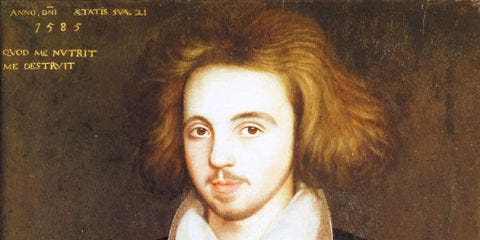
For centuries, William Shakespeare occupied literature’s most impressive one-person office. His name appeared above the door, his face appeared on the merchandise, and generations of readers assumed he personally wrote every line attributed to him. Then modern scholarship examined the paperwork and discovered something very Elizabethan: the office may have been an open-plan workspace.
In 2016, The New Oxford Shakespeare credited Christopher Marlowe as a co-author of all three Henry VI plays. The decision did not mean Marlowe secretly wrote Shakespeare’s entire canon, survived his documented death, or spent decades hiding behind an unusually committed pen name. Instead, Oxford’s editors argued that Marlowe and Shakespeare collaborated on portions of Henry VI, Part 1, Part 2, and Part 3.
The announcement attracted attention because it challenged the familiar picture of Shakespeare as a solitary genius. It also demonstrated how computational analysis, close reading, theater history, and old-fashioned scholarly disagreement can work together to reopen a 400-year-old literary case.
Which Shakespeare Plays Credit Christopher Marlowe?
The co-credit applies to the three plays forming Shakespeare’s first historical tetralogy:
- Henry VI, Part 1
- Henry VI, Part 2
- Henry VI, Part 3
Set during the political and military conflicts preceding the rise of Richard III, these plays follow England’s loss of territory in France, the weakness of Henry VI, the ambitions of powerful nobles, and the increasingly bloody Wars of the Roses. Their crowded plots contain royal arguments, battlefield reversals, betrayals, executions, and enough competing dukes to make a family reunion require armed security.
Oxford’s attribution was especially significant because Marlowe’s name appeared on the plays’ title pages in a major scholarly edition. It transformed a long-running theory into a formal editorial decision. That distinction matters: the publisher did not issue a universal decree binding every scholar, theater, and English department. It presented a carefully argued attribution within one influential edition.
Co-credit does not mean equal credit
Authorship in early modern drama was rarely divided into tidy percentages. Marlowe may have drafted particular scenes, helped create an earlier version, revised existing material, or supplied language later altered by Shakespeare and other writers. Some scholars also associate Thomas Nashe and unidentified dramatists with portions of the trilogy.
Consequently, “co-author” should not be imagined as Shakespeare writing every odd-numbered line while Marlowe handled the even ones. Collaboration could involve separate scenes, revised drafts, shared story structures, or a playhouse commissioning several writers to finish a script quickly.
Why Marlowe Was Considered a Plausible Collaborator
Christopher Marlowe was not an obscure playwright rescued from a literary attic. Born in 1564the same year as Shakespearehe became one of the most important dramatists in London before Shakespeare reached the height of his fame.
Works such as Tamburlaine, Doctor Faustus, The Jew of Malta, and Edward II helped establish the forceful blank verse that came to dominate the English stage. Marlowe’s heroes pursue power, knowledge, conquest, and wealth with such intensity that moderation seems to have been removed during rehearsal.
The Henry VI plays were probably written and revised during the early 1590s, when Marlowe and Shakespeare were active in the same theatrical world. Their overlapping careers, the Marlovian qualities detected in parts of the trilogy, and the normality of dramatic collaboration make direct cooperation historically possible.
A debate older than computers
Doubts about the sole authorship of Henry VI did not begin when someone opened a laptop. In 1787, editor Edmond Malone argued that Shakespeare had not originally written all three plays in their received form. Later researchers proposed various combinations of Shakespeare, Marlowe, Robert Greene, George Peele, and Thomas Nashe.
The surviving publication history makes the mystery harder. Early versions related to Henry VI, Parts 2 and 3 appeared in print during Shakespeare’s lifetime, while the familiar three-part sequence entered the 1623 First Folio. Scholars must determine whether textual differences represent revision, memorial reconstruction, adaptation, printing complications, or multiple authors. Four centuries later, the paperwork remains less than ideal.
How Scholars Detected Marlowe’s Hand
The New Oxford team did not base its conclusion on one dramatic speech that simply “felt like Marlowe.” Its attribution research combined several approaches, including historical evidence, close textual comparison, vocabulary studies, metrical analysis, and computational stylometry.
Function words and linguistic habits
Stylometry searches for recurring linguistic habits that writers may not consciously control. Rare and colorful words attract human attention, but ordinary terms such as “and,” “with,” “by,” “of,” and “from” can be more useful to a computer. Writers tend to combine common words in subtly consistent ways.
Researchers compare disputed passages with bodies of text considered securely attributable to possible authors. If a section repeatedly resembles Marlowe’s established work more than Shakespeare’s, the result supports Marlovian authorship. One clue is rarely decisive, but many independent patterns pointing in the same direction can form a persuasive case.
Word-adjacency networks
A University of Pennsylvania research team examined how frequently certain words appeared near one another. Instead of treating a text as a sack of vocabulary, the method mapped relationships among words, producing something like a linguistic social network.
The analysis found evidence of mixed authorship throughout the Henry VI trilogy and identified Marlowe as the strongest candidate for the outside contribution. This result was important because it emerged from a method developed independently of conventional literary judgments.
Collocations, phrases, and verse patterns
Researchers also study collocationswords that repeatedly travel togetheras well as distinctive phrases, grammatical preferences, imagery, rhyme, and blank-verse construction. Marlowe’s dramatic language often favors powerful declarations and heavily end-stopped lines, while Shakespeare developed different rhythmic tendencies.
Yet style is not a fingerprint in the forensic sense. Young dramatists imitated successful writers, actors influenced scripts, and revisers could transform earlier material. Shakespeare may have sounded Marlovian because he worked with Marlowe, because he admired him, or because Marlowe’s style had become fashionable. That is precisely why responsible attribution relies on converging evidence rather than one dazzling similarity.
Why Collaboration Was Normal in Elizabethan Theater
Modern readers often approach Renaissance drama with a Romantic-era image of the author: one inspired individual, alone at a desk, waiting for genius to arrive with excellent punctuation. Commercial theater operated differently.
London’s playing companies needed a steady supply of new material. A collaborative script could be completed faster, and different writers could handle different strengths. One playwright might shape the plot, another contribute comic scenes, and a third revise the language for a particular company or production.
Other Shakespeare plays are widely accepted or strongly argued to contain collaborative work. George Peele is commonly associated with parts of Titus Andronicus; Thomas Middleton with Timon of Athens; George Wilkins with Pericles; and John Fletcher with Henry VIII and The Two Noble Kinsmen. Shakespeare’s name remains central, but the canon increasingly resembles a busy theatrical workshop.
Collaboration does not diminish Shakespeare
Giving Christopher Marlowe co-credit does not reduce Shakespeare’s achievement. Great writers routinely create within communities of actors, editors, patrons, rivals, and fellow writers. Recognizing those relationships produces a more realistic account of how theater was made.
In fact, collaboration may reveal one of Shakespeare’s greatest abilities: he could absorb, revise, and respond to other dramatic voices while producing a coherent theatrical experience. Genius does not become less impressive when it knows how to work with colleagues.
The Case Is Strong, but It Is Not Closed
The Oxford attribution remains influential, but not every specialist accepts every conclusion. Critics have raised legitimate questions about the limits of stylometry and the assumptions required to construct an author’s linguistic profile.
A computer needs reliable comparison texts. Marlowe died young in 1593, and his surviving dramatic corpus is relatively small. Some works attributed to him may themselves be collaborative or textually unstable. If the baseline is uncertain, the resulting comparison can inherit that uncertainty.
Genre also affects style. A battle scene, comic exchange, and royal council naturally use different language, even when written by the same person. Later testing of prominent attribution methods has suggested that factors such as genre, sample size, and uneven datasets can influence results.
There is also the problem of imitation. A young Shakespeare writing in the wake of Tamburlaine might deliberately echo Marlowe’s rhythms. Statistical resemblance can identify a connection, but distinguishing influence from direct authorship requires historical and textual judgment.
These cautions do not make computational research useless. They show why authorship attribution is strongest when algorithms, documentary evidence, chronology, close reading, and theatrical knowledge support one another. The computer can identify a suspicious verbal footprint; it cannot yet put the playwright under oath.
What the Marlowe Co-Credit Changes
It revises the solitary-genius narrative
The Marlowe attribution encourages readers to see early modern theater as a network. Playwrights competed for audiences, borrowed conventions, shared source material, revised scripts, and sometimes worked together. The celebrated “Bard” was part of an industry rather than a visitor from a literary planet with a population of one.
It gives other dramatists greater visibility
Shakespeare’s cultural prominence can make his contemporaries look like supporting characters in his biography. Co-authorship research restores some balance. Marlowe was an innovator in his own right, while Nashe, Peele, Greene, Middleton, Fletcher, and other writers helped shape English drama.
It changes editing and teaching
An authorship decision affects title pages, introductions, notes, classroom discussions, and performance choices. Editors may divide scenes according to likely authorship or explain where evidence remains uncertain. Teachers can compare passages from Henry VI with Edward II or Tamburlaine, turning attribution into an accessible lesson about language and evidence.
It separates scholarship from conspiracy
The claim that Marlowe contributed to the Henry VI plays is not the same as the theory that he wrote all of Shakespeare’s works. The latter generally requires Marlowe to have faked his death and continued writing in secret. Mainstream co-authorship research requires only that two living playwrights in the same small theatrical community worked together before Marlowe’s death. One proposition is historically ordinary; the other needs a cloak, a coded identity, and an exceptionally cooperative coroner.
Experiencing the Plays After Discovering the Co-Authorship Debate
Learning that Christopher Marlowe may have helped write the Henry VI trilogy changes the experience of reading it. A first-time reader often meets these plays as a dense parade of nobles, claims, counterclaims, and sudden violence. With the authorship question in mind, the apparent shifts in tone become part of the attraction. A grand speech about power may feel recognizably Marlovian, while a politically complicated exchange may seem closer to Shakespeare’s developing historical drama.
The pleasure lies in listening for contrasts without turning every page into a guessing game. Readers can compare the vaulting ambition of York or Suffolk with Marlowe’s Tamburlaine and Barabas. They can then examine quieter scenes for Shakespeare’s growing interest in hesitation, theatrical performance, and unstable identity. The exercise does not produce an answer key, but it sharpens attention to rhythm, vocabulary, and dramatic structure.
A classroom becomes a literary laboratory
In a classroom, the attribution debate creates an unusually lively bridge between literature and data science. Students can mark repeated phrases, count common words, compare sentence structures, or test short passages with simple text-analysis software. They quickly discover that evidence is rarely as obedient as a textbook summary suggests.
One method may identify a passage as Marlovian, another may favor Shakespeare, and close reading may suggest imitation instead of collaboration. That friction is educational. Students learn that humanities research involves hypotheses, datasets, limitations, and revisionnot merely memorizing the year in which a playwright died.
Actors and directors gain new choices
For performers, possible co-authorship can become a practical rehearsal tool. A director might ask actors to emphasize the rhetorical force of passages associated with Marlowe, then contrast them with scenes that appear more conversational or psychologically layered. Different textures can help clarify a trilogy whose population sometimes resembles an overcrowded royal directory.
A production does not need to label each scene by author. Instead, the company can treat collaboration as part of the plays’ energy. The political world of Henry VI is fragmented, with competing voices struggling to control England’s story. A script assembled by multiple dramatists may reinforce that sense of instability rather than weaken it.
A title page tells a different story
Simply seeing Marlowe’s name beside Shakespeare’s can be a revealing experience. A title page normally looks like administrative furniture, but here it becomes an argument about cultural memory. Shakespeare remains famous enough to fill theaters, festivals, and gift shops. Marlowe’s co-credit asks readers to notice the creative community standing behind that fame.
It can also prompt broader questions. Who disappears when history celebrates one name? How much creative work is collaborative even when only one person receives the applause? The issue feels surprisingly modern in an era of writers’ rooms, shared screenplays, remix culture, and disputes about training data.
The most rewarding experience is uncertainty
The co-authorship debate is satisfying because it resists a perfectly neat ending. Oxford’s editors made a substantial case for Marlowe, independent computational research added support, and historical conditions made collaboration plausible. At the same time, methodological criticism reminds readers that a probability is not a signed contract recovered from beneath a London floorboard.
Approaching the plays with that uncertainty can deepen appreciation for both writers. Marlowe emerges as more than Shakespeare’s doomed rival, while Shakespeare becomes more human: a young professional learning, competing, adapting, and possibly sharing a script with one of the boldest dramatists of his generation.
Conclusion: Two Playwrights, One Larger Theatrical World
Christopher Marlowe’s co-credit on the three Henry VI plays represents a major change in how an influential edition presents Shakespearean authorship. It rests on centuries of textual debate strengthened by stylometry, word-adjacency analysis, phrase comparison, historical research, and close reading.
The attribution is not unanimous, and the precise division of labor remains uncertain. Nevertheless, the broader lesson is persuasive: Elizabethan theater was collaborative, commercial, and socially connected. Shakespeare could be extraordinary without being alone.
Marlowe’s restored presence makes the plays more interesting, not less. It invites readers to hear several creative voices inside the history cycle and to recognize that literary greatness can emerge from rivalry, cooperation, revision, and the occasional deadline panic. Apparently, even immortal geniuses may have needed a co-worker.













