
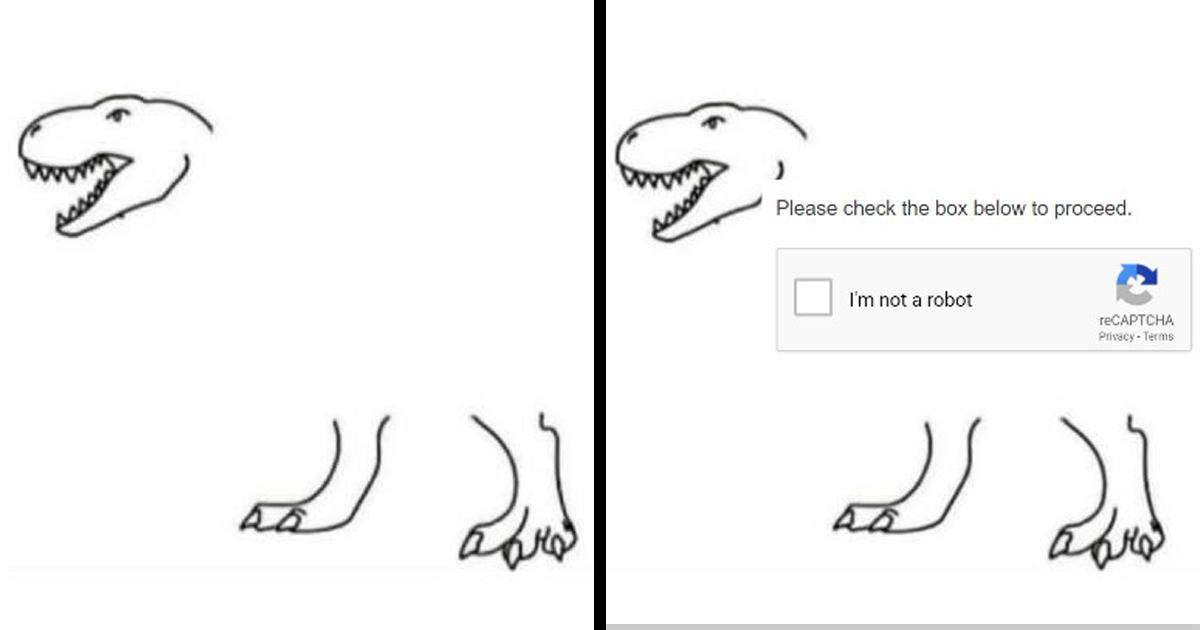
Give 30 people the same unfinished T-Rex sketch, and you will not receive 30 slightly different dinosaurs. You will receive visual jokes, pop-culture references, anatomical surprises, surreal disasters, questionable fashion decisions, and at least one prehistoric creature that looks ready to update its dating profile.
That was the delightful result of an online drawing challenge built around a simple instruction: Complete this image in a way that proves you won’t be replaced by AI. The original prompt, shared by artist and social media user @anloremi, featured only part of a Tyrannosaurus rex. Participants had to decide what existed beyond the visible lines.
The challenge spread because it arrived at exactly the right cultural moment. Generative AI image tools were becoming astonishingly capable, while artists were asking uncomfortable questions about originality, employment, training data, ownership, and whether a machine could imitate the wonderfully strange decisions that make human art memorable.
The finished T-Rex drawings did not settle that debate. They did, however, demonstrate something important: human creativity is not merely the ability to produce a polished picture. It is the ability to misunderstand a prompt productively, connect unrelated ideas, recognize a cultural reference, tell a joke, break an expectation, and occasionally draw something so gloriously ridiculous that nobody can explain why it works.
How One Unfinished T-Rex Became a Creativity Test
The challenge began with an incomplete outline. Viewers could recognize enough of the subject to assume they were looking at a T-Rex, but much of the scene remained open. That missing information was the engine of the exercise.
A conventional response would simply complete the dinosaur. Add the torso, legs, tail, shading, and perhaps a respectable Cretaceous landscape. There is nothing wrong with that approach. A scientifically convincing T-Rex requires knowledge of anatomy, balance, proportion, musculature, and movement.
But the prompt did not ask participants to finish the dinosaur accurately. It asked them to prove they were irreplaceable.
That wording transformed a drawing exercise into a dare. The goal was no longer technical completion. The goal was surprise.
People responded by treating the existing lines as ingredients rather than instructions. Some expanded the sketch into elaborate illustrations. Others turned it into a visual gag. Readers recognized references to 1980s disco, Alien, progressive-rock album covers, dating-profile photography, tattoos, and Miss Frizzle from The Magic School Bus. One artist could see a dramatic fantasy scene where another saw an opportunity to give a dinosaur an absurdly confident backside.
In other words, the T-Rex stopped being a T-Rex. It became a setup.
Why the Same Lines Produced Wildly Different Results
The Challenge Encouraged Divergent Thinking
Creativity researchers often discuss divergent thinking, which is the ability to produce multiple possible answers to an open-ended problem. Instead of searching for the single correct solution, a person explores unusual associations, alternative interpretations, and unexpected combinations.
The unfinished T-Rex was practically a divergent-thinking machine. Everyone received the same visual information, but there was no official destination. One person could complete the animal realistically. Another could turn its body into a vehicle. A third could place it in a scene that depends on a movie reference. A fourth could deliberately produce the ugliest dinosaur ever committed to a screen.
The freedom mattered. When a task has one correct answer, skill is often measured by accuracy. When it has hundreds of defensible answers, creativity becomes visible through variation.
Constraints Made the Artists More Inventive
Unlimited freedom sounds ideal, but a completely blank page can be strangely intimidating. A partial drawing provides something to resist, reinterpret, or build upon.
The existing T-Rex lines created boundaries. Participants could not begin anywhere they pleased; they had to negotiate with a shape already present. That negotiation encouraged cleverness. The artist had to ask questions such as:
- What else could these lines represent?
- What scene would make this pose unexpectedly funny?
- Which familiar character has a compatible silhouette?
- How can I make the viewer believe one thing before revealing another?
This is why creative prompts, coloring exercises, writing games, and collaborative doodles are so effective. A constraint narrows the field enough to make exploration manageable, but leaves enough space for personality to escape.
Humor Rewarded Cultural Knowledge
Many of the funniest completions depended on shared experience. A viewer had to recognize a movie scene, a music aesthetic, a dating-app pose, or a familiar cartoon character before the joke fully landed.
That kind of humor contains several layers. The drawing must resemble the reference, the artist must understand why the reference is funny in this context, and the audience must possess enough cultural memory to complete the connection.
A T-Rex presented like a glamorous profile picture is amusing because it collides with a recognizable modern ritual. The joke is not simply “dinosaur plus camera.” It is about self-presentation, vanity, online dating, posing, and the deeply human desire to select a photograph that says, “I enjoy travel, good food, and occasionally chasing a Jeep.”
Could an AI Image Generator Complete the Sketch?
Absolutely. Modern generative AI can produce sophisticated illustrations, imitate broad visual genres, generate dinosaurs in improbable situations, and create numerous variations within seconds. It would be misleading to claim that artificial intelligence is incapable of making a funny T-Rex picture.
Generative models learn patterns from large collections of existing material and use those patterns to create new outputs. With a detailed prompt, an image system could produce a T-Rex at a disco, a dinosaur on a dating app, or a prehistoric monster styled like an album cover.
The stronger question is not whether AI can produce one creative-looking image. It is how, why, and under whose direction the image is made.
A human artist brings an intention to the page. The artist chooses whether the result should be elegant, stupid, disturbing, nostalgic, political, or unexpectedly emotional. The person may draw from a childhood memory, an inside joke, a failed relationship, a favorite film, or something overheard on a bus that morning.
An AI system can model associations present in its training data. A person decides which association matters right now.
Research Shows That the AI-Creativity Question Is Complicated
Scientific research does not support a simple “humans creative, machines uncreative” conclusion. In some controlled tests of divergent association and creative writing, large language models have performed as well as or better than many human participants. AI can generate large numbers of plausible ideas quickly, which makes it useful for brainstorming and early-stage exploration.
However, average quality is not the same as collective variety. Research examining AI-assisted idea generation has found that pools of machine-generated ideas may cluster around similar themes. Prompting methods can improve their diversity, but groups of humans often explore a broader conceptual territory because different people bring different histories, tastes, values, obsessions, and misunderstandings.
That distinction helps explain the appeal of the 30 T-Rex drawings. The collection is entertaining not because every image is a technical masterpiece, but because the answers disagree with one another so enthusiastically.
One participant sees science fiction. Another sees fashion. Another sees body humor. Another sees an opportunity for polished fantasy art. The value comes from the range of minds involved.
The Best Human-AI Creativity May Be Collaborative
The T-Rex prompt was framed as a competition between artists and AI, but the future of creative work is likely to be more collaborative than the slogan suggests.
Studies of human–AI teamwork indicate that generative tools can be particularly helpful for content creation, rapid variation, and visual inspiration. Designers can use AI to explore compositions, test color directions, generate rough concepts, or escape a creative rut. Human judgment remains essential for selecting, refining, rejecting, and contextualizing the results.
The quality of that collaboration depends heavily on the user. Research from MIT Sloan suggests that people with strong metacognitive skills benefit more creatively from generative AI. These users monitor their own thinking, question the machine’s suggestions, change strategies, and remain actively involved. They use AI as a sparring partner rather than an automatic answer dispenser.
Passive use can have a different effect. Experiments have found that AI assistance may provide an immediate creative boost while weakening later performance when users must work independently. The concern is not that using AI instantly destroys imagination. It is that repeatedly outsourcing the uncomfortable first stages of thinking may reduce the practice that creative ability requires.
A calculator is useful, but it is still wise to understand numbers. An image generator is useful, but it is still wise to know why one composition communicates more clearly than another.
What the T-Rex Challenge Reveals About Human Art
Human Creativity Includes Intentional Imperfection
Several responses were funny because they were awkward, crude, exaggerated, or deliberately excessive. A polished image was not automatically better than a messy one. Sometimes a fast doodle delivered the strongest joke because the roughness supported the idea.
Humans are remarkably skilled at deciding when not to optimize. We enjoy wobbly lines, disproportionate bodies, terrible puns, badly drawn hands, and visual jokes that would lose their charm if rendered with cinematic realism.
Art can be successful because it is beautiful. It can also be successful because it looks as though someone made it during a meeting while pretending to take notes.
Context Changes the Meaning of an Image
A T-Rex is already one of the most recognizable animals in popular culture. The real creature lived in western North America near the end of the Cretaceous Period, approximately 66 to 68 million years ago. Its massive head, powerful jaws, heavy tail, and famously reduced forelimbs make its silhouette immediately identifiable.
Those characteristics also make it excellent comedy material. The tiny arms invite jokes. The enormous skull supports exaggeration. The contrast between terrifying power and limited reach gives artists a ready-made comic premise.
By moving the dinosaur into a modern social situation, participants changed its meaning. A predator becomes a performer, model, romantic prospect, movie fan, or confused citizen of the internet. The humor comes from applying human behavior to a creature that predates social media by roughly 66 million years and therefore had a healthier relationship with notifications.
Authorship Still Matters
The legal treatment of AI-generated work also emphasizes the continuing importance of human contribution. The U.S. Copyright Office has maintained that copyright protects human-authored expression. A person may receive protection for creative modifications, selections, arrangements, or other clearly human contributions within a work involving AI, but machine-generated material is not automatically treated as human authorship.
This does not answer every ethical question surrounding training data or artistic imitation. It does show that the law continues to distinguish between operating a system and making expressive creative decisions.
Why Online Art Challenges Are So Addictive
Online completion challenges create an unusually satisfying combination of consistency and surprise. Every participant begins at the same point, allowing viewers to compare decisions directly. The format resembles a scientific experiment conducted by people who cannot stop drawing dinosaurs in inappropriate situations.
These challenges also lower the barrier to participation. An artist does not need to invent an entire concept. The prompt supplies a starting point, while social media supplies an audience and immediate feedback.
Community responses become part of the artwork’s life. Viewers identify references, rank favorites, add captions, and suggest interpretations the original artist may never have considered. A simple sketch becomes a collaborative cultural event.
That communal layer is difficult to reduce to image quality alone. People are not merely consuming 30 pictures. They are witnessing 30 personalities collide with the same problem.
How Artists Can Make Their Work Harder to Replace
No drawing can permanently prove that technology will never reproduce its style. Tools evolve, models improve, and yesterday’s impossible effect may become tomorrow’s preset.
Artists can nevertheless strengthen the qualities that make their work valuable:
- Develop recognizable judgment. Style is not only a brushstroke. It is the pattern of choices an artist repeatedly makes.
- Use specific experiences. Personal memories and observations produce details that generic prompts often miss.
- Build cultural awareness. Humor and storytelling become richer when artists understand the communities addressing their work.
- Practice fundamentals. Anatomy, composition, value, color, and perspective help artists evaluate both handmade and AI-assisted images.
- Show the process. Sketches, revisions, mistakes, and explanations reveal the thinking behind a finished piece.
- Use AI deliberately. A tool should expand decisions rather than quietly make every decision on the artist’s behalf.
The goal is not to become more machine-like by producing endless content at impossible speed. The goal is to become more specific, observant, intentional, and unmistakably yourself.
Conclusion: The T-Rex Did Not Defeat AI, but It Made a Strong Point
The 30 T-Rex sketch completions do not prove that artificial intelligence can never make surprising art. AI can already produce images that are beautiful, funny, strange, and technically impressive. Its capabilities will continue to change.
What the challenge proves is that creativity is larger than output. It includes the decision to join a public joke, the memory that inspires a reference, the willingness to draw something foolish, and the satisfaction of seeing another person understand exactly why the foolish thing is funny.
The most interesting future may not involve humans desperately racing machines to produce more images. It may involve people using every available tool while protecting the habits that make creative work meaningful: curiosity, practice, context, judgment, humor, and the courage to choose an answer nobody requested.
After all, a machine may be able to generate a thousand dinosaurs before lunch. A human is still the one who decides that one of them needs disco pants.
Extended Experience: Try Completing the T-Rex Yourself
Trying a drawing-completion challenge reveals something that is easy to miss while scrolling through other people’s results: coming up with a genuinely unexpected idea is uncomfortable.
At first, the obvious answer dominates. You see the T-Rex head and begin mentally attaching a body, two strong legs, a long tail, and perhaps a few palm-like plants. Your brain wants to finish the pattern correctly. It has recognized a dinosaur and would appreciate it if everyone stopped causing problems.
The challenge becomes more interesting when you refuse that first solution.
Set a timer for ten minutes and write down possible completions before drawing anything. The first few ideas may be predictable: a realistic T-Rex, a cartoon dinosaur, a robot dinosaur, or a T-Rex wearing a hat. Keep going. Once the obvious answers are exhausted, your associations become stranger.
Perhaps the open mouth is not roaring but singing into a microphone. Maybe the dinosaur is a frustrated dentist examining another dinosaur’s teeth. The partial outline could belong to a parade balloon, an amusement-park ride, a badly designed handbag, or an exhausted parent trying to assemble furniture with arms that cannot reach the instructions.
This stage often produces an internal argument. One voice asks whether the idea is clever enough. Another wants to begin shading immediately. A third suggests abandoning the project and checking the refrigerator despite knowing perfectly well what is in it.
Continue anyway.
Choose the concept that makes you slightly nervous because it seems too weird, too simple, or too silly. That reaction can be useful. It often indicates that the idea is moving beyond the safest visual conventions.
As you draw, the concept will probably change. A line placed too low may become part of the joke. A poorly proportioned leg may suggest a different pose. An accidental shape may resemble a costume, machine, or second character. Rather than correcting every deviation, ask whether the mistake offers a better direction.
Then show the result to someone without explaining it. Their reaction provides information that no private evaluation can supply. They may understand the joke instantly, misread it in a funnier way, or stare silently while reconsidering the decisions that led them to know you.
Comparing your completion with other versions is equally revealing. Someone with less drawing experience may produce a much funnier concept. A technically skilled illustrator may create an image full of cinematic detail. Another participant may alter only one tiny element and completely change the scene.
The experience demonstrates why creative communities matter. Originality does not develop in isolation. People borrow structures, challenge assumptions, remix cultural references, and respond to one another. The same unfinished sketch becomes a shared language through which different minds introduce themselves.
Repeat the exercise a week later and deliberately choose a new rule. Complete the image using only geometric shapes. Turn it into a political cartoon without naming a politician. Make it understandable to a child. Create a version that tells a sad story, then another that could appear on a cereal box.
You may not prove that you are permanently irreplaceable. Nobody can guarantee that. You will, however, practice the part of creativity that matters most: moving past the first acceptable answer and searching for the one that carries your particular combination of knowledge, taste, experience, and cheerful nonsense.
Note: This article discusses the artistic challenge and broader creativity research rather than reproducing or ranking the original participants’ images.













