
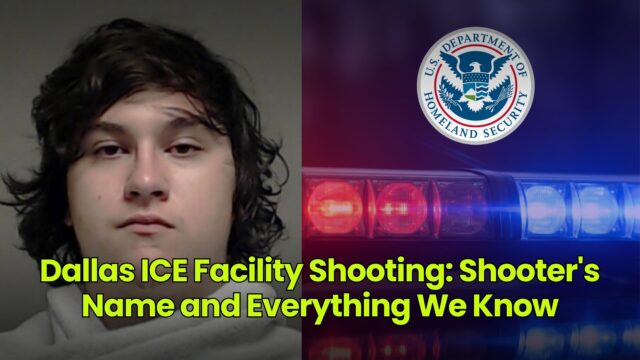
Editor’s Note: This article summarizes publicly available information about the Dallas ICE facility shooting, with careful attention to verified facts, context, and community impact. Because this was a real violent incident, details are presented responsibly and without graphic descriptions.
The Dallas ICE facility shooting was one of those news events that arrived before most people had finished their first cup of coffee and immediately made the country stop scrolling. Early on September 24, 2025, authorities say a gunman opened fire near a U.S. Immigration and Customs Enforcement facility in Dallas, Texas, striking three detainees who were in a transport area. No ICE officers were physically injured, but the attack left two detainees dead, one injured, and a city asking the same question everyone asks after a shocking act of violence: how did this happen?
The incident took place at an ICE field office near North Stemmons Freeway in the Love Field area of Dallas. According to federal officials and law enforcement reports, the attacker fired from an elevated position near the facility and targeted the area where detainees were being moved. The suspect was later identified as 29-year-old Joshua Jahn, a North Texas resident. Officials said he died at the scene.
In the days and weeks that followed, investigators released additional details that changed the public understanding of the case. What first looked like a sudden burst of violence was later described by federal authorities as a planned attack aimed at ICE personnel. At the same time, the people who were harmed were not ICE officers but detainees, a tragic detail that made the case even more bitter and complicated.
What Happened at the Dallas ICE Facility?
The shooting happened in the early morning hours, around the time the facility was beginning its regular operations. Law enforcement responded quickly after reports of gunfire near the government building. The first official updates were confusing, as often happens in breaking news. Initial reports about the number of fatalities shifted before authorities clarified the situation.
Federal officials later said three detainees were hit while inside a transport vehicle or in the facility’s secure intake area. One detainee died at or near the scene. Two others were taken for medical care in critical condition. Later reporting identified a second detainee who died after being hospitalized, while the third injured detainee was eventually released from the hospital.
The victims were later identified in public reporting as Norlan Guzman-Fuentes, 37, from El Salvador, and Miguel Angel Garcia-Hernandez, 32, from Mexico, as the two deceased detainees. The injured survivor was identified as Jose Andres Bordones-Molina. Behind every name is a family, a history, and a life interrupted by something no one should ever have to experience while in government custody.
Who Was the Suspect?
Authorities identified the suspect as Joshua Jahn, 29. Public reporting described him as a Dallas-area resident with a limited public profile. Investigators searched his background, his writings, and his digital activity to determine whether he acted alone, whether he belonged to any organized group, and what might have motivated the attack.
Federal officials said evidence pointed to pre-attack planning. According to the FBI, investigators found writings that indicated Jahn intended to target ICE agents. Officials also said he had researched ICE-related locations and ways to track ICE activity. However, authorities also stated that they had not found evidence tying him to a specific organization.
That distinction matters. In the age of instant internet arguments, everyone wants the villain filed neatly into a labeled folder. Real investigations are not that tidy. Sometimes the answer is not a clean political category but a messy combination of grievance, planning, isolation, and violence. That may not fit nicely into a social media caption, but reality rarely asks permission before being inconvenient.
Was the Shooting Politically Motivated?
Federal officials described the shooting as targeted violence against ICE. Investigators reported finding anti-ICE language connected to the suspect and said his writings suggested he wanted to frighten ICE personnel and interfere with their work. The FBI also said the attack appeared to involve significant planning.
Still, responsible reporting requires a careful line. Authorities said the suspect’s apparent anger was directed at ICE and the federal government, but they also said he did not appear to be part of a known organized group. That means the attack can be discussed as targeted violence without pretending every unanswered question has been solved by a hot take wearing sunglasses indoors.
The case landed during a period of intense national tension over immigration enforcement. ICE facilities had become flashpoints for protests, political arguments, and security concerns. Supporters of ICE argued that officers were facing rising threats. Critics of ICE argued that aggressive immigration enforcement had created fear in immigrant communities. The Dallas shooting did not settle that debate. It made the stakes feel much more human.
Were ICE Officers Injured?
No ICE officers were reported physically injured in the shooting. That fact has been emphasized by multiple reports, partly because investigators said the suspect intended to target federal personnel. Instead, the people harmed were detainees in custody.
This is one of the most painful contradictions of the case. If the suspect’s intended targets were ICE agents, his victims were people with far less control over the situation. They were in a transport process, under government supervision, and unable to simply leave the area. The result was not political theater. It was loss, injury, fear, and another wound in an already divided national conversation.
How Authorities Responded
Dallas police, federal agents, emergency medical responders, and other law enforcement personnel converged on the scene. The facility was secured, surrounding areas were blocked off, and investigators began processing evidence. For people nearby, it was the kind of morning where routine suddenly turns into sirens, barricades, and alerts from relatives asking, “Are you okay?”
The Department of Homeland Security and FBI released statements in the days after the attack. The FBI’s Dallas office said the suspect carried out a targeted ambush-style attack and that investigators believed he acted alone based on information available at the time. DHS also announced plans to review and increase security at ICE facilities following the shooting.
Months later, local reporting noted that federal officials honored ICE officers who were present during the attack. The recognition focused on actions taken during the emergency and on the broader risks faced by personnel working at immigration facilities.
Why the Location Matters
The Dallas ICE office was not a remote site hidden in the middle of nowhere. It was located in a busy urban area near major roads, businesses, and other buildings. That matters because the shooting raised questions about physical security at government facilities, especially those involved in controversial or high-risk operations.
Security experts often talk about “soft targets,” which is a fancy way of saying places that do important work but were not built like fortresses. Many government field offices are designed for daily administrative operations, appointments, interviews, transport, and processing. They are not always designed to withstand an attack from a nearby elevated position.
After the Dallas shooting, one of the major questions became whether ICE facilities nationwide needed stronger perimeter security, better sightline protection, improved transport procedures, or updated risk assessments. That may sound dry, like something printed in a government memo that could cure insomnia, but it is exactly the kind of boring safety work that can save lives.
The Victims and the Human Cost
News stories about shootings often move quickly from “what happened” to “who did it” to “what does it mean politically.” But the victims deserve more than being treated like footnotes in someone else’s argument.
Norlan Guzman-Fuentes and Miguel Angel Garcia-Hernandez were not symbols. They were people. Their families and communities were left to absorb a loss that arrived suddenly and publicly. Jose Andres Bordones-Molina survived, according to later reporting, but survival does not mean the event simply disappears. Trauma has a way of staying in the room long after the cameras leave.
The Dallas ICE facility shooting also highlighted the vulnerability of detainees. Whatever one thinks about immigration enforcement, people in custody depend on the government for basic safety. When violence reaches them inside that system, the public has a right to ask hard questions about protection, procedures, and accountability.
What Investigators Said About Planning
Federal investigators said the suspect appeared to have planned the attack in advance. Officials reported that he looked up information related to ICE facilities and tracking ICE activity. They also said writings suggested a desire to frighten federal agents and interfere with their work.
That detail is important because it separates the case from a random outburst. A planned attack requires more time, more choices, and more opportunities for warning signs to be missed or misunderstood. It also raises questions about how agencies detect threats in a world where people can research targets, consume extremist content, and spiral into grievance without necessarily belonging to a formal group.
There is no magic software button labeled “Stop All Bad Ideas.” If there were, someone in IT would have already hidden it behind a password reset portal. But investigators and policymakers continue to debate how to identify credible threats while protecting civil liberties and avoiding overreach.
How the Shooting Affected the Immigration Debate
The Dallas ICE shooting quickly entered the national immigration debate. Supporters of stricter enforcement pointed to the attack as evidence that anti-ICE rhetoric can create danger for law enforcement. Critics of ICE warned against using the tragedy to silence legitimate criticism of immigration policy. Both conversations happened almost immediately, because America apparently cannot let even five minutes pass before turning grief into a panel discussion.
There is a serious point underneath the noise. Public officials, activists, media voices, and everyday citizens all have the right to criticize government agencies. But criticism should not become dehumanization, and political disagreement should never become an excuse for violence. A democracy needs fierce debate. It does not need people turning public servants, migrants, detainees, or political opponents into targets.
What Remains Unclear
Even after major updates, some questions remain. Investigators have described the suspect’s apparent intent and planning, but the deeper personal path that led him to violence may never be fully understood. Public records and family comments offered pieces of a picture, not a complete biography.
It is also unclear exactly how security procedures may change long term at ICE offices and similar facilities. DHS indicated that security would be reviewed and strengthened, but specific measures are often not shared publicly for obvious reasons. If someone tells the whole internet where every security camera is pointed, that person should probably not be in charge of security cameras.
Another ongoing question is how agencies balance openness and safety. Immigration offices must serve people with appointments, legal obligations, check-ins, and hearings. Turning every public-facing government office into a bunker could create new problems. Leaving vulnerable spaces unchanged could create others.
Lessons From the Dallas ICE Facility Shooting
The first lesson is painfully simple: political violence harms real people, often not the people the attacker claims to be targeting. In Dallas, detainees paid the price for an attack officials say was aimed at ICE personnel. That fact should humble anyone tempted to reduce the case to a slogan.
The second lesson is that facility security cannot be treated as a dusty checklist. Transportation areas, loading zones, nearby rooftops, sightlines, public access points, and emergency response protocols all matter. Safety is not glamorous. It is not viral. It rarely trends. But when it fails, everyone notices.
The third lesson is about language. Heated political speech does not automatically cause violence, and criticism of government agencies is protected and necessary. But responsible speech matters, especially from people with large platforms. Words do not pull triggers, but they can shape the weather in which unstable people decide what actions feel justified.
Experience-Based Reflections: What This Story Teaches Communities, Readers, and News Consumers
For anyone who has ever lived near a federal building, courthouse, immigration office, police station, or major public facility, the Dallas ICE facility shooting is a reminder that “public safety” is not an abstract phrase. It is the reason traffic gets blocked, bags get checked, doors lock automatically, and security guards ask questions that sometimes feel annoying. Most of us only notice safety systems when they slow us down. Then something terrible happens, and suddenly those systems look less like inconvenience and more like the thin line between normal and chaos.
One useful experience from covering or following breaking news is this: the first version of a story is almost never the final version. In the Dallas case, early reports included shifting casualty numbers and limited details about the suspect. That does not always mean officials or journalists are being careless. It often means information is moving fast, scenes are active, hospitals are involved, and agencies are trying not to release something wrong. The smartest reader in those first hours is not the person shouting the loudest online. It is the person saying, “Let’s wait for confirmation.” Not glamorous, but neither is wearing a seat belt, and that still works.
Another important experience is learning how to separate facts from emotional reaction. A shooting at an ICE facility naturally triggers strong feelings because immigration enforcement is already one of the most divisive topics in the United States. Some people immediately focus on the danger to federal officers. Others focus on detainee vulnerability. Others focus on political rhetoric. A mature reader can hold more than one truth at the same time: ICE officers should not be targeted, detainees deserve protection, and the public has the right to debate immigration policy without fear or intimidation.
For families, this story is also a reminder to take warning signs seriously without turning every quiet, strange, or politically opinionated person into a suspect. Many people are isolated. Many people are angry. Most never harm anyone. The difference is when isolation mixes with fixation, planning, and talk of violence. If someone appears to be moving from anger into preparation for harm, that is not the time for a family group chat full of shrug emojis. It is time to contact appropriate help, document concerns, and take the situation seriously.
For communities, the lesson is to build trust before emergencies happen. People who live near sensitive facilities should know where to get reliable local alerts. Schools, offices, and businesses should have basic emergency plans. That does not mean living in fear. It means knowing exits, contacts, meeting points, and credible news sources. Preparedness is like an umbrella: slightly awkward to carry, deeply appreciated when the sky starts acting dramatic.
For writers and publishers, the Dallas ICE facility shooting offers a lesson in tone. A story like this should not be written like entertainment. It can be readable, even conversational, but it should not turn victims into props or the suspect into a dark celebrity. “Everything we know” should mean verified information, clear timelines, careful updates, and honest uncertainty. It should not mean stuffing the page with speculation because the search engine wants snacks.
Finally, this story reminds us that public debate works best when people refuse to flatten each other into enemies. Immigration policy can be criticized. Law enforcement conduct can be examined. Government agencies can be challenged. But none of that requires celebrating harm, excusing violence, or forgetting the people caught in the middle. The Dallas ICE facility shooting was not just a security incident. It was a human tragedy inside a political storm, and the only decent way to discuss it is with accuracy, restraint, and enough empathy to remember that every headline lands on someone’s doorstep.
Conclusion
The Dallas ICE facility shooting remains a deeply troubling event because it combines so many difficult American realities: political anger, immigration enforcement, public facility security, online radicalization concerns, and the vulnerability of people in custody. Authorities say Joshua Jahn planned an attack aimed at ICE personnel, yet the people killed and injured were detainees. That tragic contradiction should stay at the center of the story.
As more information became public, the basic facts became clearer: the shooting occurred on September 24, 2025, at a Dallas ICE facility; three detainees were hit; two later died; one survived; no ICE officers were physically injured; and federal investigators described the attack as targeted violence involving significant planning. What remains harder to answer is how a society already full of political tension can argue fiercely without creating space for violence.
The best answer is not silence. It is responsible speech, serious security, careful reporting, and a refusal to turn human beings into symbols. That may not fit on a bumper sticker, but it is a better plan than yelling at the internet until it yells back.













