
A sheet of ordinary white paper usually ranks low on the list of mysterious laboratory specimens. Point the right ultraviolet laser at it, however, and the page can briefly behave like a self-erasing notepad. Dark strokes appear, linger for several minutes, and then quietly vanish. The paper is not performing a magic trick. It is exposing the fluorescent chemistry manufacturers use to make everyday materials look impressively, almost suspiciously, white.
The Accident That Turned White Paper Into a Temporary Display
The phenomenon became widely known after experimenter Ben Krasnow investigated an unexpected result from a nitrogen laser. The system operated at 337 nanometers and delivered nanosecond pulses with extremely high peak power. When the beam was directed through an optical fiber and scanned across ordinary white paper, it left dark lines that looked a little like faint pencil marks.
Nothing had been added to the surface. There was no heat-sensitive receipt coating, no disappearing ink, and no obvious scorching. More strangely, the lines faded until the sheet looked normal again. Depending on the paper and exposure, the effect remained visible for only a few minutes.
That behavior pointed away from conventional laser engraving. A burned cellulose fiber does not politely rebuild itself before lunch. Instead, the changing contrast appeared to come from fluorescent whitening agents already embedded in or coated onto the paper.
Clues From Oxygen and Hydrogen Peroxide
Two follow-up observations made the puzzle even more interesting. Hydrogen peroxide caused the dark marks to disappear rapidly, while an argon atmosphere slowed their recovery. Those results suggest that oxidation plays a role in returning the brightener molecules to their original fluorescent condition.
The exact reaction pathway was not completely established in the demonstration, so it is better described as a strong working explanation than a finished chemical verdict. The intense UV pulse may push some brightener molecules into a temporary nonfluorescent or chemically reduced state. Oxygen in the air then helps restore them. Hydrogen peroxide, a stronger oxidizing agent, accelerates the reset. In other words, the page may be acting less like a burned sign and more like a molecular whiteboard.
What Optical Brighteners Actually Do
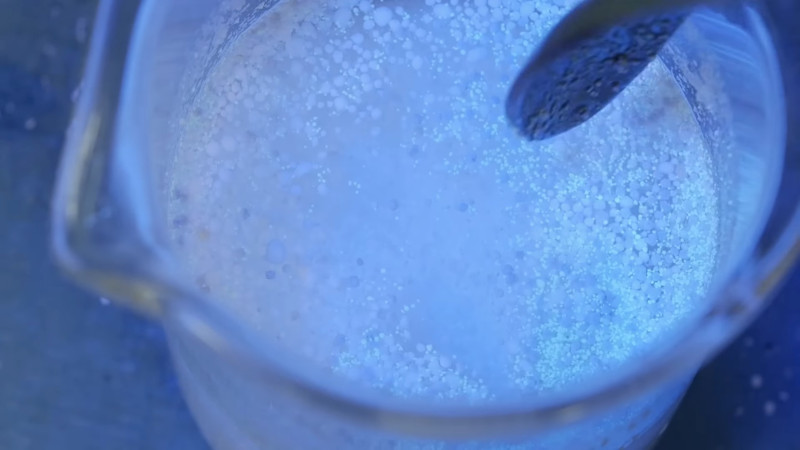
Optical brighteners, also called fluorescent whitening agents or fluorescent brighteners, are dyes that manipulate how humans perceive white. They absorb ultraviolet radiation that our eyes cannot see and re-emit part of that energy as visible blue or blue-violet light. The emitted blue light counters the natural yellow cast of paper, cotton, detergents, plastics, and many coatings.
This is fluorescence: a molecule absorbs a higher-energy photon, reaches an excited state, loses a small amount of energy through molecular motion, and releases a lower-energy photon at a longer wavelength. The wavelength difference between absorption and emission is commonly associated with the Stokes shift. The practical result is wonderfully cheeky chemistry. A material can appear to reflect more visible blue light because it has converted incoming UV energy into visible light.
Whitening Is Not the Same as Bleaching
Chemical bleach removes or destroys colored compounds. An optical brightener usually leaves the underlying yellowish material in place and changes its visual appearance by adding fluorescence. Bleach cleans the stage; a brightener adjusts the lighting.
That distinction explains why a brilliantly white shirt can look slightly duller under an indoor lamp with little ultraviolet output. In sunlight or beneath a UV-rich source, the brightener has more energy to absorb and more blue light to emit. Under some modern LED lights, which may produce very little UV, the same fabric can appear warmer or less dazzling.
Why Blue Makes Yellow Look Whiter
White materials are rarely perfectly neutral. Cellulose, natural fibers, polymer aging, residual lignin, and ordinary wear can contribute yellow tones. Blue counteracts yellow in human color perception, so a small blue contribution reduces the visual impression of yellowness.
Manufacturers use this effect because consumers tend to associate a cool, bluish white with cleanliness, freshness, and quality. Apparently, even laundry has branding psychology.
Why the Laser-Written Line Looks Dark
The mark is not necessarily dark because the base paper became significantly darker. It can look dark because the treated region temporarily stops contributing as much blue fluorescence as the surrounding surface. The untouched paper continues to glow subtly under UV-containing illumination, while the written line contributes less. Human vision interprets the difference as a gray or dark stroke.
This is an important distinction from permanent photobleaching. In fluorescence science, photobleaching commonly means the irreversible loss of emission after prolonged or intense illumination damages a fluorophore. The paper effect recovered, which indicates that a reversible process dominated the visible change, at least during the short observation period. Repeated or excessive exposure could still cause permanent damage to the brightener, coating, or cellulose.
The pulse structure also matters. Nanosecond laser pulses can produce enormous peak intensity even when average power seems modest. That concentration of energy can drive molecular reactions that a weak blacklight cannot. A grocery-store UV flashlight may reveal fluorescence, but it will not recreate the same transient writing effectand that is a feature, not a disappointing bug.
Where Fluorescent Whitening Agents Hide
The experiment is memorable because the chemistry is not rare. Optical brighteners are present in a broad range of commercial materials, often without attracting attention until a UV lamp enters the room.
Paper and Printed Products
Copy paper, premium stationery, coated magazine stock, packaging board, and some photographic or art papers may contain optical brightening agents. Papermakers use them to raise apparent whiteness and improve contrast between the sheet and printed ink.
Paper-measurement standards account for fluorescence because the reported brightness or whiteness can change with the ultraviolet content of an instrument’s light source. On some whiteness scales, highly fluorescent papers can even produce values above 100. The number is not evidence that the laws of physics have resigned; it reflects the conversion of previously unmeasured UV energy into visible light.
Conservators and document specialists use UV examination for the opposite reason: fluorescence can reveal modern paper, later repairs, coatings, adhesives, or replaced sections that are difficult to distinguish under normal illumination. A uniformly cream-colored document may become a patchwork of different glows under UV.
Laundry Detergents and Textiles
Many laundry formulations include brighteners that deposit on fibers during washing. Cotton and other fabrics then emit extra blue light when exposed to ultraviolet radiation. The shirt is not necessarily cleaner in a chemical sense; it simply looks less yellow and more radiant.
That visual boost becomes especially useful after repeated laundering, when natural whites may begin drifting toward the color of old piano keys. Brighteners help preserve the cool-white appearance consumers associate with freshly washed clothing.
Because detergent brighteners can pass into household wastewater, researchers and field investigators have also used fluorescence as a screening clue for sewage contamination, faulty septic systems, or leaking wastewater infrastructure. It is not a universal or perfectly specific test, but it demonstrates how a cosmetic laundry additive can become an environmental tracer.
Plastics, Coatings, and Synthetic Materials
Fluorescent brighteners are also used in plastics, synthetic fibers, paints, inks, adhesives, and surface coatings. Different chemical families suit different substrates. Stilbene derivatives are common in paper, textiles, and detergents, while benzoxazole-type brighteners are frequently associated with polymers and plastics.
Under a blacklight, molded plastic parts that look identical in daylight may fluoresce at dramatically different levels. That contrast can reveal variations in resin, recycled content, additives, aging, or manufacturing batches. UV inspection is therefore useful in quality control, material sorting, forensic comparison, and authentication.
What the Experiment Teaches About Everyday Color
The disappearing UV laser writing experiment is a compact lesson in how engineered modern appearance really is. “White” is not merely a surface reflecting all visible wavelengths evenly. It can be a carefully tuned optical performance involving pigments, dyes, fluorescent additives, lighting spectra, and the quirks of human vision.
It also explains why color matching can fail between a showroom, an office, and daylight. Two materials may look equally white under one lamp but separate into warm and cool tones under another. When one contains a strong optical brightener and the other does not, changing the UV component changes the comparison.
Useful Applications Beyond a Clever Demonstration
Temporary laser-induced contrast is scientifically interesting because it points toward reversible optical patterning, material identification, and rapid screening of fluorescent additives. The paper effect is not yet a practical printer: the laser system is specialized, the contrast is subtle, and the message vanishes quickly.
Still, the concept belongs to a wider family of technologies involving photochromic materials, rewritable media, fluorescent security marks, optical data storage, and light-controlled molecular switches.
For museums and archives, fluorescence helps characterize materials without cutting out a sample. For manufacturers, it can expose uneven coatings or additive distribution. For environmental work, it can help trace detergent-bearing water. For forensic examiners, it can reveal fibers, altered documents, or material differences. The humble brightener has an impressive résumé for a molecule hired mainly to make socks look enthusiastic.
Common Misunderstandings About the Disappearing Marks
“The Laser Is Writing With Invisible Ink”
No ink is applied. The beam changes the optical behavior of molecules already present in the paper. That makes the effect closer to temporary photochemical patterning than conventional writing.
“The Paper Heals After Being Burned”
The recovery does not mean charred cellulose repairs itself. The visible contrast fades because fluorescence returns toward its previous level. Permanent thermal or photochemical damage would not simply vanish.
“Every White Product Will Behave the Same Way”
Products differ in brightener chemistry, concentration, coating structure, additives, moisture, oxygen access, and substrate. Some fluoresce intensely; others barely respond. A product can also look white because of pigments such as titanium dioxide rather than fluorescent whitening agents.
“A Powerful UV Laser Is Just a Stronger Blacklight”
Not remotely. A research laser can deliver concentrated, coherent energy capable of causing immediate injury, material damage, and hazardous reflections. Observing fluorescence with a properly rated enclosed UV source is one thing; attempting high-peak-power laser exposure is another category entirely.
Experience Notes: Exploring the Hidden Fluorescence of Ordinary Objects
The most striking part of this topic is not the disappearing word itself. It is the moment a collection of boring white objects stops looking uniform. Under normal room lighting, printer paper, a cotton T-shirt, a detergent box, a plastic cable tie, and an old envelope may all appear to belong to the same plain-white family. Under controlled UVA illumination, they suddenly develop personalities.
A fresh sheet of bright copy paper often gives off a cool blue glow, while an older book page may remain muted or slightly violet. Place two envelopes side by side and one may shine as though it has been auditioning for a science-fiction movie, while the other barely changes. That contrast offers an immediate lesson: visible color under ordinary light does not reveal the full optical composition of a material.
Textiles can be even more dramatic. A white garment washed repeatedly with a brightener-containing detergent may fluoresce strongly, especially in seams or areas where residues accumulate. Untreated cotton, cream fabric, or older cloth may appear much darker. Lint becomes surprisingly obvious. So do detergent splashes, fibers, dust, and repairs. A supposedly spotless laundry room can begin to resemble a detective-show set, which is educational but not always emotionally convenient.
Paper comparisons are particularly useful because they connect the visual effect to manufacturing. Bright office paper often responds strongly, while recycled, archival, handmade, or naturally toned papers may show weaker fluorescence. This does not automatically make one sheet better than another. Optical brighteners improve visual whiteness, but archival buyers may prefer papers whose appearance depends less on fluorescent additives that can change with age and illumination.
The disappearing laser mark adds another layer. Watching a dark line slowly dissolve challenges the instinct that a visible mark must be material deposited on a surface. Here, the “ink” is reduced fluorescence. The surrounding page remains optically brighter, so the temporarily altered path becomes visible by contrast. As oxygen participates in recovery, the line fades. The result feels like a time-lapse chemical reaction compressed into a few minutes.
One practical takeaway is to document lighting conditions whenever comparing fluorescence. Camera auto-exposure can exaggerate differences, and two UV sources with different wavelengths may produce different results. Distance, angle, ambient light, optical filters, and the camera sensor all influence the image. A meaningful comparison uses the same lamp, geometry, exposure settings, and background for every sample.
Another takeaway is restraint. A low-power, properly labeled UVA inspection lamp used according to its safety instructions can reveal fluorescence without attempting to alter the material. There is no need to chase the high-energy laser effect at home. The original result depended on specialized equipment, and an invisible beam can damage vision before a person realizes anything is wrong.
Most of all, the experience changes how one sees “white.” A bright sheet of paper is no longer just bleached pulp. It is a designed optical system. A freshly washed shirt is not merely free of dirt; it may also be wearing a microscopic layer of fluorescent assistance. A plastic part can advertise its additives under UV without printing a label. Once that hidden blue glow has been noticed, the everyday world looks slightly less ordinaryand considerably more fluorescent.
Conclusion: A Vanishing Message With a Lasting Lesson
Disappearing writing created by a UV laser is more than a laboratory curiosity. It reveals the fluorescent whitening agents quietly embedded in paper and countless other products. By converting invisible ultraviolet energy into visible blue light, these additives make materials appear cleaner, cooler, and whiter. A sufficiently intense UV pulse can temporarily interrupt that performance, producing a dark path that fades as the chemistry recovers.
The experiment brings together photochemistry, color science, materials engineering, and a touch of theatrical mischief. It also reminds us that familiar appearances are often manufactured at the molecular level. The page looks plain. The chemistry underneath is anything but.













