
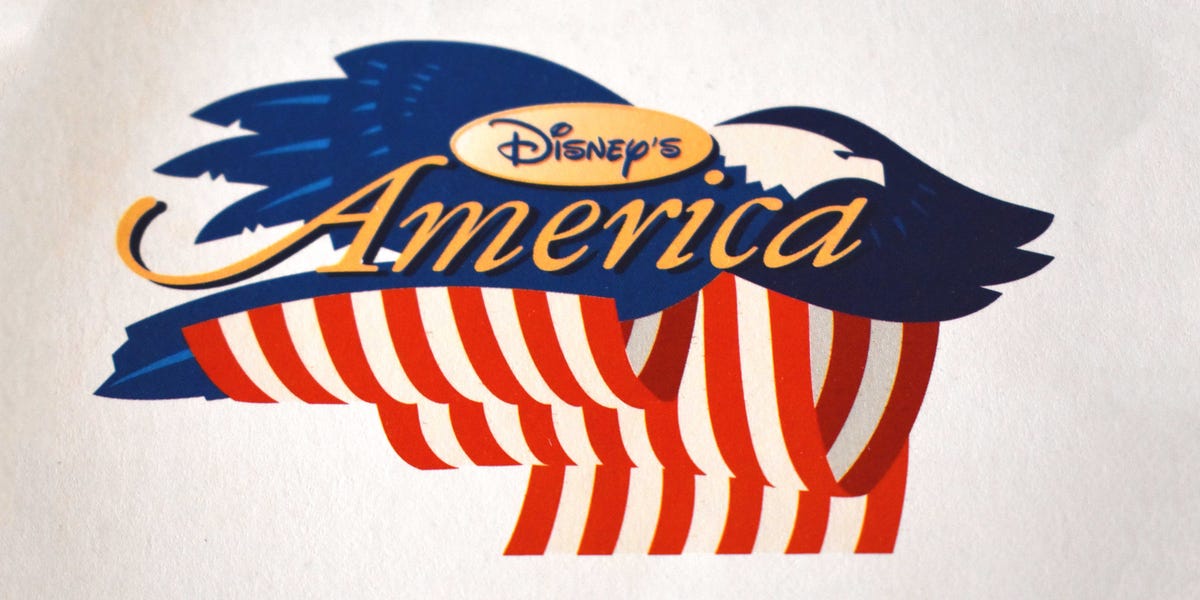
Once upon a time, Disney almost built a theme park where Mickey Mouse, Civil War memory, American immigration, industrial grit, patriotic pageantry, and Northern Virginia traffic were all supposed to hold hands and sing in harmony. Spoiler alert: they did not.
Disney’s America was one of the most ambitiousand controversialtheme park concepts The Walt Disney Company ever proposed. Announced in 1993, the project was planned for Haymarket, Virginia, near Washington, D.C., and not far from Manassas National Battlefield Park. Unlike Disneyland’s fantasy kingdoms or Walt Disney World’s vacation empire, this park would focus on American history. Guests would not simply ride through fairy tales; they would be invited to step into Revolutionary ideals, Civil War conflict, immigration stories, Native American culture, industrial progress, and the complicated question of what America means.
That last part turned out to be the dragon Disney could not slay. The idea sounded dazzling on paper: a history theme park that could make young visitors care about the past without requiring them to pretend a textbook was exciting bedtime reading. But the proposed location, the scale of development, and the challenge of turning painful history into family entertainment quickly sparked a national debate. Disney wanted to build a park about America. America, being America, immediately argued about it.
What Was Disney’s America?
Disney’s America was a proposed historical theme park intended to celebrate the diversity, struggle, innovation, and imagination of the United States. The original site was near Haymarket, Virginia, in Prince William County, roughly 35 to 40 miles west of Washington, D.C. Disney saw the location as strategically perfect: close to the nation’s capital, surrounded by historic destinations, and accessible to tourists already visiting monuments, museums, Mount Vernon, Monticello, and Civil War battlefields.
The project was announced in November 1993 under Disney chairman Michael Eisner. At the time, Disney was deep in an era of bold expansion. The company had revived its animation studio, grown its parks division, and was thinking bigsometimes big enough to make zoning boards reach for antacids. Disney’s America was planned as more than a theme park. The broader development included hotels, homes, retail space, recreation areas, and transportation improvements. Depending on the version of the plan, the theme park itself would occupy a portion of a much larger site that stretched across thousands of acres.
The official pitch was not simply “come ride a roller coaster shaped like a founding document,” although honestly, that would have been memorable. Disney framed the park as a one-day complement to a Washington, D.C. vacation. Visitors would experience the sweep of American history through immersive lands, theatrical attractions, exhibits, rides, and Disney’s famous talent for turning physical space into story.
The Big Idea: Turning American History Into a Theme Park
The core concept behind Disney’s America was both brilliant and risky. Disney had spent decades proving that themed environments could transport people into imaginary worlds. The question was whether the same storytelling machinery could responsibly handle real historyespecially history involving slavery, war, genocide, displacement, immigration hardship, and social conflict.
Disney’s proposed lands reportedly included areas such as Crossroads USA, President’s Square, Native America, Civil War Fort, We the People, Enterprise, State Fair, Family Farm, and Victory Field. These sections were designed to represent different eras and themes in the American story. Crossroads USA would evoke a 19th-century town. President’s Square would celebrate national leadership. Enterprise would highlight industrial innovation. Victory Field would focus on military history, especially the World War II era. State Fair would provide a more familiar amusement-park atmosphere, because even historical reflection needs snacks and something that spins until Uncle Bob regrets the funnel cake.
Some planned attractions sounded like classic Disney spectacle with a patriotic overlay. Concepts included a Lewis and Clark-style raft adventure, Civil War-related experiences, industrial-themed thrill rides, presidential presentations, and living-history environments. Disney promised that the park would not ignore difficult chapters of the past. That promise was meant to reassure critics, but it also raised the most explosive question of all: how exactly does a theme park present slavery, Indigenous dispossession, and battlefield death between lunch reservations and souvenir shopping?
Why Haymarket, Virginia?
Haymarket was attractive to Disney because it sat near a dense constellation of American history. Northern Virginia is layered with colonial sites, Civil War landscapes, presidential homes, and rural scenery that still carries historical atmosphere. The company believed guests visiting Washington, D.C. could extend their trip with a day at Disney’s America. In business terms, the location was a dream. In preservation terms, it was a lit match near dry grass.
The proposed site was close to Manassas National Battlefield Park, where the First and Second Battles of Manassasalso known as Bull Runwere fought during the Civil War. These battles were not minor footnotes. The First Battle of Bull Run in July 1861 shocked Americans who had imagined the Civil War would be short. The Second Battle of Manassas in August 1862 marked another major Confederate victory and deepened the war’s devastation.
For many historians and preservationists, the issue was not simply whether Disney could design a good attraction. It was whether massive development near such a landscape would damage the setting, increase sprawl, and change how future generations encountered the battlefield. A quiet field, a historic road, and a solemn interpretive trail communicate one kind of memory. A nearby entertainment district with hotels, traffic, fast food, and themed retail communicates another. Both may be American, but they do not whisper at the same volume.
The Promise: Jobs, Tourism, and Economic Magic
Supporters of Disney’s America saw opportunity. Disney projected major job creation, tourism growth, and tax revenue for Prince William County and Virginia. Local businesses imagined hotel guests, restaurant traffic, construction work, and a national spotlight. Some residents believed development was coming anyway, and Disney might be a more organized and attractive developer than a random parade of strip malls. In other words, if change was inevitable, why not change with fireworks?
Virginia political leaders initially welcomed the proposal. The project promised economic development at a scale few private companies could offer. Disney had a powerful brand, a track record of building destination resorts, and the ability to turn farmland into a global attraction. For officials seeking jobs and infrastructure investment, the Mouse looked less like a cartoon character and more like a very well-dressed economic engine.
Disney also argued that its park could make history accessible. Instead of leaving the past behind museum glass, Disney’s America would put guests inside reconstructed streets, dramatic scenes, and interactive experiences. For families whose children groaned at the phrase “educational vacation,” this was no small selling point. The park promised the impossible parental fantasy: learning disguised as fun.
The Backlash: Historians Enter the Chat
The opposition to Disney’s America grew quickly and loudly. Historians, writers, preservationists, environmental groups, and local residents questioned almost every part of the plan. A group called Protect Historic America emerged as a major voice against the Haymarket location. Prominent historians and public figures warned that the development could trivialize history, harm nearby historic landscapes, and accelerate sprawl in a region already under pressure.
The debate was not as simple as “serious historians hate fun.” Many critics understood that popular storytelling can spark interest in the past. Films, novels, reenactments, museums, and historic villages all interpret history for public audiences. The problem was trust. Disney was unmatched at creating emotional experiences, but American history is not a fairy tale with tidy villains, sparkling endings, and a gift shop arranged by moral clarity.
Critics asked hard questions. Would slavery be presented honestly or softened for family consumption? Would Native American history be treated as living history or decorative atmosphere? Would the Civil War become a thrilling adventure rather than a national catastrophe? Could a company built on entertainment resist the temptation to simplify, sentimentalize, or commercialize painful events?
Disney executives argued that opponents were judging the project before the creative work was finished. But in public history, the “script is not written yet” defense only goes so far. When the subject is national trauma, people want to know whether the chef understands the ingredients before the restaurant opens.
The Manassas Problem
The location near Manassas became the symbolic heart of the controversy. Manassas National Battlefield Park preserves the land where two major Civil War battles took place. For preservationists, nearby large-scale development threatened not only views and roads but also the emotional integrity of the place. A battlefield is not just acreage. It is a landscape of memory.
Opponents feared that Disney’s America would attract tens of thousands of visitors a day, requiring road expansions and commercial buildout. Traffic on Interstate 66 and surrounding roads was already a concern. Environmental groups worried about pollution, water use, and development pressure. Residents worried that rural communities would be transformed into an entertainment corridor. Historians worried that the authentic historical landscape would be overshadowed by a manufactured one.
This is where Disney’s greatest strength became a weakness. The company is very good at creating environments so polished that guests forget the outside world. But near Manassas, the outside world was the point. The landscape itself carried meaning. For critics, placing a Disney-made version of American history beside real Civil War ground felt like building a wax museum next to a family cemetery and insisting everyone admire the lighting.
What Disney Planned Inside the Park
Although Disney’s America never opened, concept descriptions and reporting give us a fascinating glimpse of what might have been. The park would likely have mixed rides, shows, exhibits, architecture, costumed interpretation, and Disney-style theatrical staging. It was not intended to be a conventional amusement park with history wallpaper. The ambition was deeper: to make guests feel the American story through place-based immersion.
Crossroads USA
Crossroads USA was imagined as an entry area resembling a mid-19th-century American town. Like Main Street, U.S.A. at Disneyland, it would create a nostalgic first impression. Guests would step into a carefully designed environment of storefronts, streets, and civic life. The danger, of course, was nostalgia’s habit of wearing soft-focus glasses and forgetting who was excluded from the postcard.
Native America
Native America was intended to represent Indigenous cultures. This was one of the most sensitive proposed areas because American popular culture has a long history of reducing Native people to stereotypes, props, or romantic symbols. A responsible version would have required deep collaboration with Native communities, specific tribal histories, and a commitment to living cultures rather than museum-piece generalizations.
Civil War Fort
A Civil War-themed section was perhaps the most controversial idea, especially given the location. Disney reportedly considered immersive battle-related experiences, including concepts involving virtual reality or participation-style storytelling. Critics feared such attractions could turn war into play. To be fair, battlefield reenactments and military museums also use performance and simulation, but Disney’s brand of entertainment raised concerns about tone. There is a thin line between “engaging the public” and “press X to experience national tragedy.”
Enterprise and Industrial America
The Enterprise area would have focused on American industry and innovation. One discussed concept involved an Industrial Revolution-themed thrill ride. This kind of attraction fits Disney’s strengths: motion, machinery, danger, spectacle, and a story about progress. Yet even industrial history has complicationslabor conflict, dangerous working conditions, child labor, immigration, inequality, and environmental cost. The steam whistle sounds different when you remember who was feeding the furnace.
Victory Field
Victory Field would have explored America’s military role, especially around the World War II era. This area may have included aircraft, military displays, and patriotic storytelling. It might have been visually impressive, but again the challenge would have been balance. Military history can inspire pride and gratitude, but it also involves death, trauma, and moral ambiguity. Disney would have had to land the plane carefullypreferably not into a fireworks finale called “Freedom Boom.”
Why Disney’s America Failed
Disney’s America failed for several overlapping reasons. The most visible reason was public opposition. The historian-led critique gained national attention and turned the project into a symbolic fight over who gets to tell American history. Local concerns about traffic, infrastructure, and land use added practical force to the philosophical objections. Environmental and preservation issues made the project harder to defend.
There were also business pressures. The early 1990s were not a frictionless moment for Disney’s parks division. Euro Disney, later Disneyland Paris, had opened in 1992 and struggled financially in its early years. Large destination projects suddenly looked riskier. Disney’s America would have required major investment, political stamina, and confidence that attendance and revenue could justify the fight. The project also faced seasonal limitations in Virginia, unlike parks in Southern California and Florida that could rely on milder year-round weather.
By September 1994, Disney announced it would abandon the Haymarket site. The company said it still believed in the concept and would look for another location, but the original version of Disney’s America was effectively over. Like many ambitious Disney ideas, pieces of its DNA later appeared elsewhere. Some observers see echoes of Disney’s America in Disney California Adventure, which opened in 2001 with lands celebrating California history, industry, aviation, agriculture, and popular culture.
The Bigger Lesson: History Is Not Just Content
The story of Disney’s America remains relevant because it exposes a tension that has only grown sharper: people want history to be engaging, but they do not want it flattened into content. Museums now use immersive design. Historic sites use apps, audio tours, augmented reality, and cinematic storytelling. Streaming documentaries use dramatic editing and celebrity narrators. Everyone is competing for attention. The past has to speak in a noisy room.
Disney understood attention better than almost anyone. That is why Disney’s America was not a silly idea. In fact, the basic premise was powerful. A well-designed historical park could have introduced millions of visitors to complex stories. It could have connected families to the American Revolution, immigration, labor history, Indigenous sovereignty, the Civil War, civil rights, and democratic ideals. It could have been a gateway to deeper learning.
But the project also showed that history is not merely a theme. It is contested memory. It belongs to descendants, communities, scholars, local residents, and the public. It includes pride and shame, achievement and violence, invention and exploitation. You cannot simply purchase land, build façades, add music, and declare the national story solved.
Could Disney’s America Work Today?
A version of Disney’s America could theoretically work today, but only under very different conditions. It would need transparent collaboration with historians, tribal nations, descendant communities, educators, preservationists, and local residents from the beginning. It would need to avoid sacred or sensitive landscapes where development itself becomes the controversy. It would need fewer grand claims and more humility. And it would need the courage to let guests feel discomfort without rushing them toward a churro-shaped resolution.
Modern audiences are more familiar with immersive history than they were in the 1990s. Attractions such as the National Museum of African American History and Culture, the Museum of the American Revolution, the National September 11 Memorial & Museum, and many battlefield visitor centers show that powerful storytelling can be emotional, accessible, and responsible. The difference is mission. A museum can be entertaining, but entertainment is not usually its core obligation. A theme park must always answer to guest satisfaction, crowd flow, merchandise, food service, and the sacred American ritual of asking, “How long is the line?”
If Disney ever returned to the concept, the smartest version might not be a traditional theme park. It could be a smaller educational resort, a rotating exhibition campus, a partnership with museums, or an immersive storytelling center located away from fragile historic landscapes. The best Disney’s America would not compete with real historic sites. It would send people to them.
Experiences Related to Disney’s America: Visiting the Story That Never Opened
Experiencing Disney’s America today is strange because there is no entrance gate, no map, no opening-day plaque, and no animatronic statesman politely malfunctioning in the corner. The park exists as a ghost attractionpart concept art, part political battle, part preservation lesson. Yet in some ways, that makes it more interesting than many parks that actually opened. Disney’s America is a place you visit with imagination, research, and a good pair of historical walking shoes.
A meaningful Disney’s America experience can begin in Northern Virginia, especially around Haymarket, Gainesville, and Manassas. Driving through the region helps explain why the debate became so emotional. The area is no longer frozen in 1993; Northern Virginia has grown dramatically, and modern development has already changed much of the landscape. That reality adds irony to the old argument. Disney did not build its park, but growth came anyway, wearing business-casual clothes instead of mouse ears.
From there, Manassas National Battlefield Park offers the most powerful context. Walking the battlefield trails makes the controversy easier to understand. The open fields, markers, cannons, historic structures, and quiet interpretive stops create a mood no theme park can duplicate. You begin to understand why historians objected to large-scale development nearby. A battlefield asks visitors to slow down. A theme park asks them to keep moving. Those are very different forms of attention.
Another worthwhile experience is comparing Disney’s America with Colonial Williamsburg, Mount Vernon, and Washington, D.C.’s museums. These places also stage history. They use architecture, performance, objects, and storytelling. The difference lies in tone and purpose. Colonial Williamsburg can be theatrical, yes, but it is anchored in a real place with a long interpretive mission. Mount Vernon has the gravity of Washington’s actual home, along with the responsibility of discussing enslaved labor. The Smithsonian museums combine scholarship with public access. Looking at these examples makes Disney’s challenge clearer: the company was not wrong to believe history could be immersive; it underestimated how much accountability immersion requires.
Fans of theme park design can also explore Disney’s America through concept art, archived articles, books, podcasts, and documentaries. This is where the project becomes a fascinating “what if.” Imagine a Disney park where the castle is replaced by a civic square, the lands are historical eras, and the emotional climax is not fantasy fulfilled but democracy questioned. It could have been inspiring. It could have been disastrous. It probably would have been both, sometimes before lunch.
The best personal takeaway from the Disney’s America story is that places matter. Stories do not float in the air; they land somewhere. Build a historical attraction in the wrong place, and the location becomes louder than the message. Build it without trust, and even good intentions look like branding. But when history is handled with patience, humility, and real partnership, it can become unforgettable. Disney’s America never opened, but the debate it created still feels alive because Americans are still arguing over memory, identity, and who gets to narrate the national story. In that sense, the park failed as a business project but succeeded as an accidental civics lesson. Not bad for a theme park nobody got to ride.
Conclusion: The Theme Park That Became a Warning Sign
Disney’s America remains one of the most fascinating unbuilt projects in theme park history. It was bold, imaginative, commercially tempting, and loaded with cultural dynamite. Disney wanted to make American history vivid for mass audiences, and that goal had real merit. But the company chose a location too close to sensitive historic ground and entered a public-history debate that could not be solved with concept art and economic forecasts.
The project’s collapse shows that history is not just a backdrop for entertainment. It is memory, identity, grief, pride, argument, and responsibility. Disney’s America might have become a groundbreaking historical experience. It also might have become the world’s most expensive lesson in why some stories resist being turned into attractions. Either way, its legacy endures because the questions it raised are still with us: How should America tell its story? Who gets to shape that story? And can entertainment honor the past without sanding off its sharp edges?
Disney’s America never opened its gates, but it left behind something surprisingly durable: a reminder that the past is not an IP franchise. It does not always want a mascot. Sometimes it wants silence, context, honesty, and enough room for visitors to think.













