
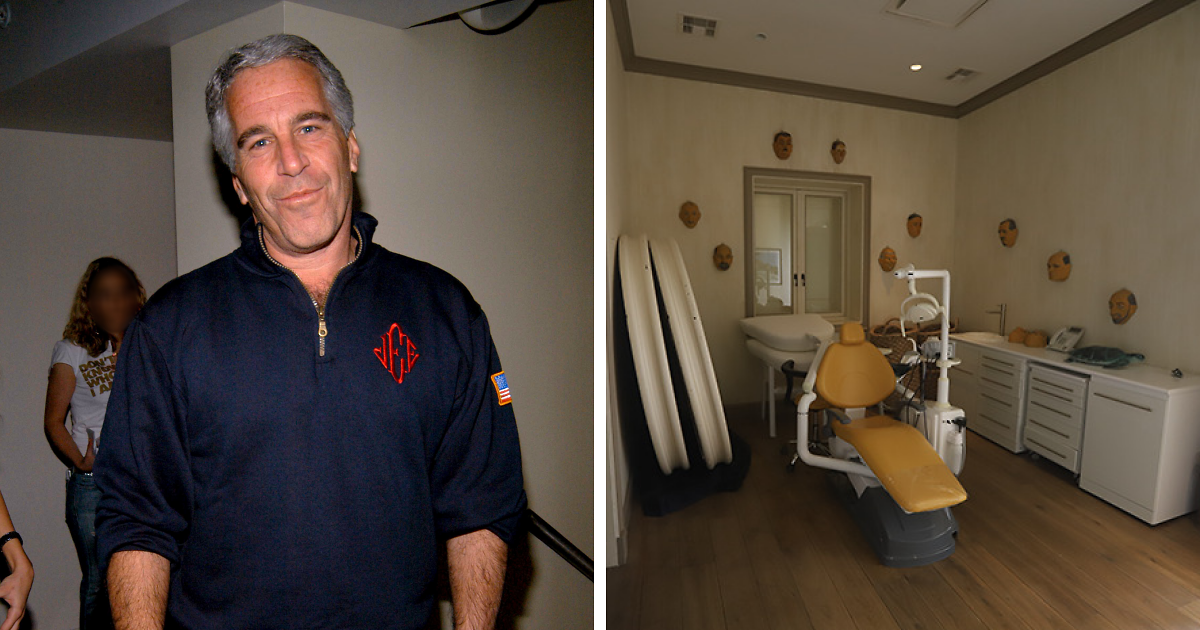
For years, Little Saint James existed in the public imagination as a place half luxury compound, half urban legend. The island’s reputation was so infamous that even people who knew almost nothing about Jeffrey Epstein still knew the nickname. But the latest release of images from the property does something rumor never could: it replaces blurry imagination with unsettling detail.
And here is the strange part. What the images reveal is not some over-the-top movie villain lair with lightning bolts and trapdoors. It is, in many ways, worse. The rooms look polished. Lived in. Organized. Curated. There are bedrooms with white bedding, tidy bathrooms, a study-like room with bookshelves and a chalkboard, telephones, courtyards, and a bizarre room featuring what appears to be a dentist-style chair surrounded by masks. It looks less like a haunted house and more like a carefully controlled private world designed to feel normal from the inside and impossible to question from the outside.
That contrast is what gives the new images their power. The island still looks tropical, expensive, and almost absurdly beautiful. But now the public can see more clearly how luxury, privacy, and isolation may have worked together in a place long tied to allegations and criminal conduct. In other words, the images do not merely show what was inside the home. They show the atmosphere of control that seemed to define it.
Why These New Images Matter
The new release matters because Little Saint James was never just another wealthy man’s getaway. It was one of the properties most closely associated with Epstein’s abuse and trafficking operation. Public discussion of the island has long swung between hard reporting and wild speculation, which is usually what happens when a place is both famous and difficult to access. Fresh visual evidence changes that dynamic.
Instead of relying on distant drone footage, old real estate descriptions, or internet folklore that grows three extra heads every time it gets reposted, these images give the public a more direct look at the interiors and grounds. That matters in stories like this. Space tells a story. Layout tells a story. Privacy tells a story. And on a private island off St. Thomas, privacy was not just a lifestyle perk. It was part of the architecture.
The newly public view of the estate also sharpens an uncomfortable truth: places tied to exploitation do not always look monstrous. Sometimes they look curated, calm, and expensive. Sometimes they look like a resort brochure that took a morally catastrophic detour.
What the Images Actually Show Inside
Bedrooms and living spaces
One of the most striking details in the new images is how ordinary some of the rooms appear at first glance. The bedrooms are airy and neatly staged, with white linens, lamps, simple furniture, and large open layouts. The bathrooms look upscale and serene. There is none of the theatrical decay people tend to expect from notorious properties. Instead, the vibe is controlled elegance.
That visual normalcy is exactly what makes the material so eerie. These are not chaotic rooms. They are deliberate rooms. They suggest comfort, routine, and permanence. They look like spaces arranged for guests, for business, for private conversation, and for life behind closed doors.
An office or library with a chalkboard
Another image shows a room that reads like part office, part library, part salon. There are chairs arranged for conversation, shelves lining the walls, and a chalkboard carrying words and notes. This detail has attracted attention because it pushes back against the idea that everything on the island was visually extravagant. Some of the most unsettling spaces are the ones that feel almost intellectual. They look like places where people talked, planned, and rationalized.
That matters because power in Epstein’s world was not just social. It was cultural. Financial. Psychological. Rooms like this suggest a setting where influence could be exercised in quiet ways, with polished surfaces doing the work of camouflage.
The room with the dentist-style chair
The most talked-about image is easily the room featuring what appears to be a dentist-style chair, with masks hanging nearby. It is the kind of picture that instantly triggers public fascination, partly because it feels so out of place and partly because it is not fully explained by the image alone. It is strange, sterile, and deeply uncomfortable to look at.
And yet the real lesson here is not to sprint into conspiracy country at Olympic speed. The point is not that one mysterious room explains everything. The point is that the room underscores how curated and compartmentalized the island appears to have been. Some spaces were soft and resort-like. Others look clinical, performative, or intentionally difficult to read. That inconsistency is part of what gives the estate its chilling character.
Phones, signs, and small details
The smaller details may be the creepiest of all. A desk phone. A “no trespassing” sign. Ordered courtyards. Quiet hallways. The images are full of objects that belong to ordinary private life, but here they read differently. In a normal home, a phone is a phone. On a property associated with secrecy, power, and isolation, a phone becomes a symbol of access and control. A sign becomes more than a sign. It becomes a boundary marker in a place designed to keep outsiders out and insiders contained.
This is why the new imagery feels so unnerving. It shows an environment built not around chaos, but around management.
Luxury Was Never the Story. Isolation Was.
Plenty of coverage over the years has described the island’s visual features: guest villas, pools, docks, landscaped paths, and the blue-and-white structures that inspired endless speculation. But the most important design feature may have been the island itself. Water is beautiful, sure. It is also a barrier. Distance is relaxing on vacation. It is something else entirely when the person controlling the space also controls transportation, access, staffing, and secrecy.
That is why Little Saint James continues to loom so large in public memory. The island functioned as more than a backdrop. It was a system. A private island offers exactly the kind of separation that makes oversight weaker and dependency stronger. If you wanted to design a place where a rich and connected man could feel untouchable, you would not need gothic theatrics. You would need beauty, distance, and control. Little Saint James appears to have offered all three.
The newer images sharpen that point. They reveal not merely an estate, but a closed ecosystem: sleeping quarters, gathering spaces, private communications, leisure areas, and strange hybrid rooms that do not fit cleanly into ordinary domestic categories. It was a world arranged to feel self-contained.
What the Pictures Do Not Prove
It is worth saying plainly that images alone do not answer every open question about what happened on the island, who knew what, or how every space was used. A photograph can show a room, but not the full context of every moment inside it. That is why good reporting matters more than social media theatrics.
The release also highlights the difference between verified reporting and internet mythmaking. Little Saint James has attracted years of rumor because its reputation was already horrific and the location itself encouraged fantasy. But unsupported claims do not help survivors, and they do not strengthen public understanding. What these images give us is not a permission slip to invent. They give us a clearer factual frame.
And the facts are already grim enough. A convicted sex offender owned this island, the property became central to public reporting and legal scrutiny, the FBI searched it after his death, and the estate later entered a major settlement with the U.S. Virgin Islands. No made-for-the-algorithm ghost story is required.
The Island After Epstein
The afterlife of Little Saint James is nearly as strange as its notoriety. In 2022, the islands were listed for sale with the expectation that the proceeds would help resolve estate obligations and lawsuits. In 2023, Little Saint James and Great Saint James were sold for $60 million to billionaire investor Stephen Deckoff, who announced plans for a high-end resort project.
That plan immediately raised a difficult question: can a place so strongly associated with abuse ever be rebranded as luxury real estate? On paper, the answer from developers is usually yes. On the moral ledger of public memory, it is far less clear.
Properties linked to notorious crimes often carry a long shadow. But Little Saint James is not just another infamous address. It is a whole island, physically detached and symbolically overloaded. Turning it into a resort may prove financially possible. Turning it into a blank slate is another matter entirely.
The new images make that even clearer. They reinforce that the island is not famous because of architecture alone. It is famous because of what the architecture sheltered.
The Real Horror Is How Normal It All Looks
If there is one takeaway from the newly released images, it is this: the scariest part is not that the island looks bizarre. It is that so much of it looks polished, tasteful, and almost dull. Evil rarely arrives wearing a cape and monologuing on a balcony. More often it hides inside expensive rooms, under soft lighting, behind staff, systems, and locked gates.
That is why the public reaction has been so intense. The pictures do not simply satisfy curiosity. They puncture a myth. They show that the island’s power may have come not from spectacle, but from normal-looking spaces arranged inside an abnormal structure of wealth and impunity.
In that sense, the images reveal more than furniture, floorplans, or tropical landscaping. They reveal a private environment that seems to have been designed to make power feel natural. And once you see that, the place becomes much harder to look at as just another scandalous address in the sun.
The Strange Experience of Seeing a Place Once Hidden
There is also a human experience attached to these images that is hard to ignore. For years, Little Saint James was one of those places people talked about in fragments. A boat captain had seen this. A drone image showed that. A journalist heard one thing. A court filing suggested another. The island became a kind of modern symbol: part crime scene, part gossip magnet, part monument to the way wealth can bend distance and privacy into tools. Looking at new images from a place like that feels less like scrolling through a gallery and more like stepping into a room everyone has been talking about for years but no one could properly enter.
That experience is disorienting because the island still looks beautiful. The water is gorgeous. The courtyards are polished. The rooms are airy. The furniture is not especially dramatic. Nothing announces itself with a flashing neon sign reading, “Here is the answer to everything.” The result is a kind of emotional whiplash. Viewers expect something cinematic. Instead, they get something calmer and more realistic. And realism is often harder to process.
For journalists, observers, and members of the public, the experience of seeing these interiors is unsettling in a very specific way. The pictures force a collision between aesthetics and knowledge. You are not looking at an abstract headline anymore. You are looking at the physical setting of a story that has already been established as horrifying. The rooms therefore become loaded in a way that ordinary rooms never are. A bed is not just a bed. A phone is not just a phone. A chair in a private room is not just furniture. Every object arrives carrying the weight of context.
There is also a broader public experience at work here: frustration. People have spent years wondering how a man so publicly disgraced still managed to move through elite spaces, maintain influence, and operate with so little interruption for so long. The island became a shorthand for that frustration. Seeing inside it now does not magically solve the unanswered questions, but it does make the imbalance feel more tangible. You can see the scale of privacy. You can see the comfort. You can see how far removed this world was from ordinary scrutiny.
And then there is the survivor-centered experience that should not be lost in the spectacle. For many people, the point of these images is not architecture or celebrity-adjacent fascination. It is accountability. Every new visual record matters because it helps document a world that was once closed, protected, and insulated by money. That does not erase harm, and it does not provide instant closure. But it does chip away at the secrecy that made harm easier to hide.
So yes, the images are eerie. But not because they reveal some fantastical underworld. They are eerie because they show how abuse can exist within spaces that look organized, expensive, and controlled. They are eerie because they make visible the quiet mechanics of isolation. Most of all, they are eerie because they remind us that some of the darkest stories in public life unfolded not in obvious chaos, but in rooms that were designed to look perfectly fine.
Conclusion
The newly released images from Little Saint James do not just satisfy curiosity about what was inside Epstein’s private island home. They deepen the public understanding of what the island represented: a sealed world of comfort, secrecy, and control. The interiors are not frightening because they are theatrical. They are frightening because they look composed, intentional, and disturbingly normal.
That is the lasting image of Little Saint James. Not a cartoon villain’s hideout. Not an internet fever dream. A private luxury compound whose polished surfaces now read as part of a much darker story. And once you see that, the island stops looking like a mystery and starts looking like what it always was: a place where privacy became power, and power was abused.














