
Note: This article is written in original wording and synthesized from publicly available information about Hanna Dovhan, Manooni, needle felting, and contemporary felted wool sculpture.
Some artists work in marble. Some work in bronze. Hanna Dovhan works in wool, tiny smiles, and the kind of visual sweetness that makes a person look at a felted egg and think, “Yes, that yolk deserves a healthy relationship.” Her charming felted wool sculpture Egg Love became a beloved example of how handmade fiber art can turn everyday food into tiny characters with surprising emotional power.
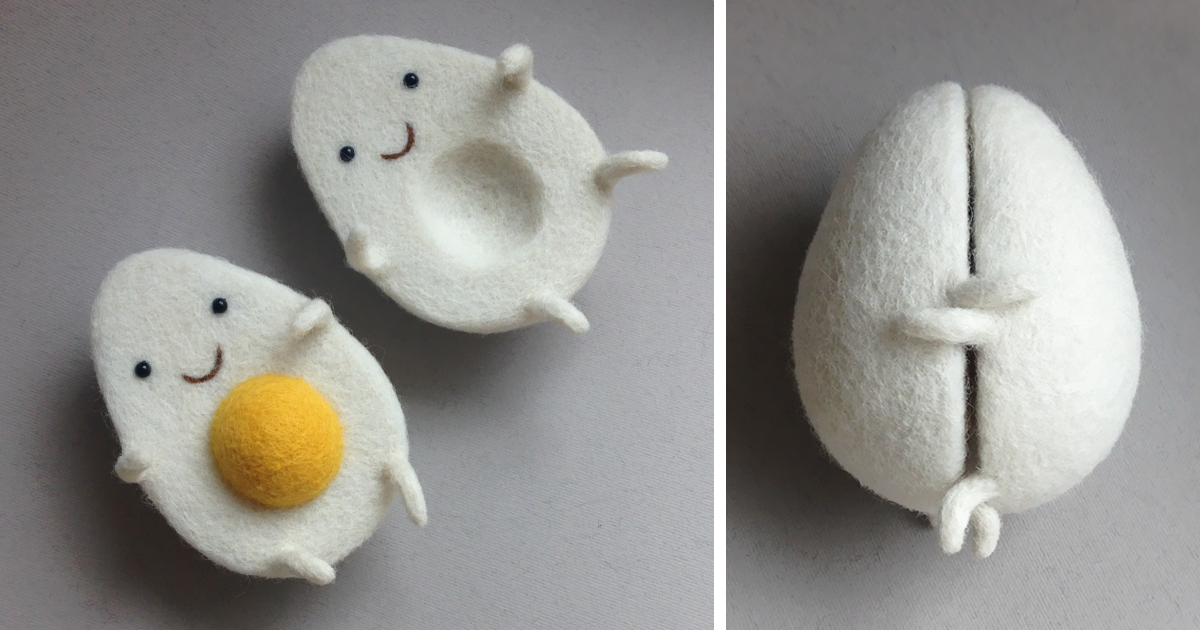
At first glance, Egg Love looks simple: two halves of an egg, soft and rounded, designed to sit apart or fit together in a warm little hug. But the appeal is not just cuteness for cuteness’ sake. Dovhan’s work taps into something universal: the desire to see companionship, humor, and tenderness in ordinary objects. A breakfast staple becomes a love story. A pear becomes a personality. A cloud becomes a friend. Somewhere, a baguette is probably having a very sincere emotional breakthrough.
Who Is Hanna Dovhan?
Hanna Dovhan is a Ukrainian artist and designer known for creating handmade needle-felted wool sculptures. Her work is often associated with Manooni, a creative studio and shop connected with Hanna and her sister Olha Dovhan. Together, they have built a recognizable world of soft sculptures featuring food, animals, plants, weather, mountains, and other cheerful subjects.
What makes Dovhan’s art instantly recognizable is her ability to reduce a subject to its most lovable visual essence. Her pieces are rarely overloaded with detail. Instead, they rely on clean shapes, bright color, rounded silhouettes, tiny eyes, and small smiles. The result feels modern, playful, and emotionally direct. Her characters look like they know a secret, and the secret is probably “life is better when you are made of wool.”
Why “Egg Love” Became So Memorable
Egg Love captured attention because it is built on an idea that is both funny and deeply sweet. The sculpture presents two egg halves as a pair. They can be displayed separately, but when placed together, they appear to embrace. It is a tiny scene of reunion, affection, and balance, all expressed through felted wool.
The humor is obvious: eggs do not usually have romantic arcs. They do not exchange meaningful glances over coffee. They do not text, “Did you get home safe?” Yet Dovhan gives these egg halves enough personality that the viewer immediately understands the emotional joke. The piece works because it is absurd and sincere at the same time.
That balance is the heart of Dovhan’s artistic language. She does not simply make a realistic egg. She makes an egg with a social life. She does not simply recreate food in wool. She turns food into characters that feel like they belong in a tiny, wholesome sitcom where the drama is low and the hugs are excellent.
The Art of Needle Felting: Softness With Structure
Dovhan’s sculptures are made through needle felting, a fiber art technique that uses barbed needles to repeatedly poke wool fibers until they lock together. This process gradually transforms loose wool into a dense, shaped form. It sounds simple, but anyone who has tried needle felting knows the truth: it is part sculpture, part patience test, and part negotiation with fluff.
Needle felting allows artists to build three-dimensional forms without sewing in the traditional sense. Wool can be layered, compacted, shaped, and refined. The artist can create smooth surfaces, add color blocks, attach limbs, shape faces, and build tiny details. A round fruit, a soft animal, or a smiling mountain can emerge from what began as a cloud of fibers.
In Dovhan’s hands, the technique becomes especially expressive. Her work avoids unnecessary realism and instead focuses on character. The firmness of the felt gives each sculpture structure, while the wool surface keeps everything warm and approachable. This is why her pieces feel both crafted and alive. They are soft, but they have presence.
From Avocado Love to Woolen Food Families
Before Egg Love became widely shared, Dovhan’s Avocado Love had already introduced many viewers to her talent for turning sliced food into emotional duos. Like the egg sculpture, the avocado halves fit together as a pair, transforming a familiar ingredient into a symbol of affection.
Her felted food sculptures have also included cherries, bananas, pears, mushrooms, carrots, baguettes, croissants, chili peppers, and other edible characters. These are not just “cute food toys.” They are miniature studies in pairing, belonging, and personality. A pear can look bashful. A mushroom can look wise. A baguette can look like it has opinions about the quality of butter in modern society.
Dovhan’s food figures also benefit from their simplicity. By keeping the faces minimal and the shapes bold, she allows viewers to project emotion onto the sculptures. The small smile does not explain everything. It invites interpretation. Are the eggs in love? Are the cherries siblings? Is the avocado couple doing better than most people on dating apps? The answer is yes, probably.
Beyond Food: Animals, Clouds, Mountains, and Tiny Worlds
Although food remains one of Dovhan’s most recognizable subjects, her creative world has expanded far beyond the kitchen. Manooni’s felted wool sculptures have included animals, plants, suns, moons, clouds, mountains, acorns, flowers, birds, and other nature-inspired characters. The same design language runs through them all: rounded shapes, gentle expressions, and a feeling of quiet joy.
This expansion matters because it shows that Dovhan’s work is not limited to novelty. The deeper theme is connection. Food pairs connect. Animal families connect. A sun and cloud connect. A mountain and moon connect. Her sculptures often present the world as a place of relationships, where even objects that normally sit silently in the background can become companions.
That is why the work resonates with collectors and casual viewers alike. It offers a small emotional reset. In a noisy online world, Dovhan’s felted sculptures feel like a soft pause button. They do not shout for attention. They smile quietly until you give in.
The Visual Style: Minimalism With a Heartbeat
One of the reasons Hanna Dovhan’s felted wool sculptures are so effective is their minimalist style. She does not crowd each figure with complicated features. Instead, she relies on a few strong elements: shape, color, proportion, and expression.
Simple Shapes
Most of the sculptures are based on rounded, geometric forms. Eggs are oval. Pears are plump. Clouds are puffy. Mountains are compact and friendly. These simple forms help the viewer identify the subject instantly.
Expressive Faces
The tiny faces are essential. Wide-set eyes and small smiles give the sculptures personality without turning them into cartoons that feel too busy. The expressions are gentle, never exaggerated. They suggest kindness, curiosity, and a little bit of mischief.
Soft Color
Dovhan’s use of color is bright but not chaotic. Food sculptures use recognizable tones, while nature-inspired pieces often lean into cheerful, decorative palettes. The colors help make each sculpture feel collectible and display-friendly.
Why Handmade Felted Wool Art Feels So Personal
In a world full of mass-produced décor, handmade felted wool art has a different emotional weight. Each piece carries evidence of time and touch. Needle felting is slow work. Every curve, face, and detail is built through repeated motion. There is no instant button for charm. The artist has to earn it, one careful poke at a time.
This handmade quality gives Dovhan’s sculptures their warmth. They feel like objects made with attention, not factory-perfect items stamped out by the thousands. Small variations are not flaws; they are part of the personality. A slightly different smile or curve can make one pear look shy and another look like it just heard a great joke.
For collectors, this is part of the appeal. A Manooni sculpture is not merely decoration. It is a small character. People place these pieces on shelves, desks, mantels, and bedside tables because they create a friendly atmosphere. They make a room feel inhabited by tiny optimistic roommates who never leave dishes in the sink.
Ukrainian Creativity and the Role of Joy
Dovhan’s work also carries significance because it comes from Ukrainian artists working through challenging times. Reports about Manooni have noted the sisters’ connection to Ukraine and their efforts to support people affected by war. In that context, the cheerful nature of the sculptures becomes even more meaningful.
Joy can be serious. Softness can be strong. A smiling wool cloud may look playful, but handmade art can also become a form of resilience. Creating gentle, humorous objects during difficult periods is not escapism in the shallow sense. It can be a way to preserve humanity, beauty, and emotional connection.
This is one reason Dovhan’s art has found international appreciation. The sculptures are easy to love visually, but they also carry the quiet power of care. They remind viewers that small acts of making still matter. A felted egg may not solve the world’s problems, but it can make someone feel a little more tender toward the world. That is not nothing.
Why “Egg Love” Works So Well for SEO and Web Readers
From a content perspective, Egg Love and Other Felted Wool Sculptures By Ukrainian Artist Hanna Dovhan is a strong topic because it combines several search-friendly themes: handmade art, Ukrainian artists, needle felting, wool sculpture, cute food art, and collectible fiber art. Readers searching for creative inspiration, craft ideas, artist profiles, or adorable handmade décor can all find something useful here.
The title also has a built-in hook. “Egg Love” is unusual enough to make people curious, while “felted wool sculptures” clearly explains the medium. The combination of specificity and charm is ideal for search visibility. It tells both human readers and search engines exactly what the article is about without sounding like a robot wearing a cardigan.
What Artists Can Learn From Hanna Dovhan’s Sculptures
Artists, crafters, and designers can learn several lessons from Dovhan’s work. First, a simple idea can be powerful when executed with clarity. Egg Love is not complex in concept, but it is memorable because the concept is clean and emotionally readable.
Second, style matters. Dovhan’s consistent visual language makes her work recognizable. Whether she is making eggs, pears, mountains, or animals, the viewer can sense the same creative hand behind the piece.
Third, emotional design can transform ordinary subjects. A banana is just a banana until it has a tiny face and a companion. Then suddenly it becomes a story. That is the magic of character-based craft: it turns objects into relationships.
The Experience of Seeing Felted Wool Sculptures Like “Egg Love”
There is a special kind of reaction people have when they first encounter Hanna Dovhan’s felted wool sculptures. It usually starts with a smile. Not the polite museum smile, where someone nods seriously at a blank canvas and pretends to understand the existential importance of beige. This is a real smile, the kind that arrives before you can stop it.
Seeing Egg Love feels like discovering a tiny joke that somehow also has a heart. The two egg halves are funny because they are eggs, but the pose is familiar because people understand closeness. The viewer recognizes the gesture immediately. That is the cleverness of the piece: it uses the simplest possible form to suggest something emotionally complete.
For people who enjoy handmade objects, the experience is even richer. You can imagine the artist shaping the wool, adjusting the curve, adding the face, refining the surface, and making sure the two halves work together visually. Needle felting has a tactile honesty to it. Even in photographs, the viewer can sense the softness and density of the material.
These sculptures also change the way people look at everyday objects. After seeing Dovhan’s work, an avocado may seem less like lunch and more like a potential character. A pear on the counter suddenly looks like it has emotional depth. A fried egg may appear to be waiting for its dramatic entrance. This is one of the quiet gifts of playful art: it teaches the eye to notice personality where we usually see routine.
Collectors often describe handmade art in terms of atmosphere, and that applies perfectly here. A felted wool sculpture does not dominate a room. It does not need a spotlight or a velvet rope. Instead, it creates a small pocket of warmth. Placed on a desk, it can make work feel less mechanical. On a bookshelf, it can soften the seriousness of hardcovers and tax documents. On a nightstand, it can act like a tiny guardian of good moods.
The experience is also nostalgic without being old-fashioned. Felted wool has a handmade, traditional quality, but Dovhan’s designs feel contemporary. The clean shapes and humorous concepts fit modern visual culture, especially the internet’s love of charming, shareable images. Her sculptures belong equally in a craft studio, a design blog, an Etsy collection, and a group chat where someone writes, “I need this egg couple immediately.”
For beginner crafters, Dovhan’s work can be inspiring because it proves that emotional impact does not always require huge scale or expensive materials. Wool, a needle, time, and imagination can create something memorable. Of course, making it look this effortless is not actually effortless. The simplicity is the result of skill. But that is part of the motivation: it shows what is possible when technique and personality meet.
Ultimately, the experience of Egg Love and Dovhan’s other felted wool sculptures is one of gentle delight. They invite viewers to slow down, laugh softly, and appreciate the handmade world. In an age of scrolling, speed, and digital noise, a tiny wool egg hug feels almost rebellious. It says: here is softness, here is humor, here is love, and yes, breakfast can be emotionally available.
Conclusion
Egg Love remains one of Hanna Dovhan’s most memorable felted wool sculptures because it combines humor, craft, and emotional storytelling in one tiny handmade object. Alongside her avocados, cherries, pears, animals, clouds, mountains, and other woolen characters, it shows how ordinary things can become extraordinary when filtered through imagination and skilled needle felting.
Dovhan’s art is cute, yes, but it is not empty cuteness. It is thoughtful, consistent, and emotionally intelligent. Her sculptures remind us that handmade objects can carry warmth, that simple forms can tell big stories, and that even an egg can find its perfect match. Honestly, that is more romantic than half the movies released this year.













